Two or three horses

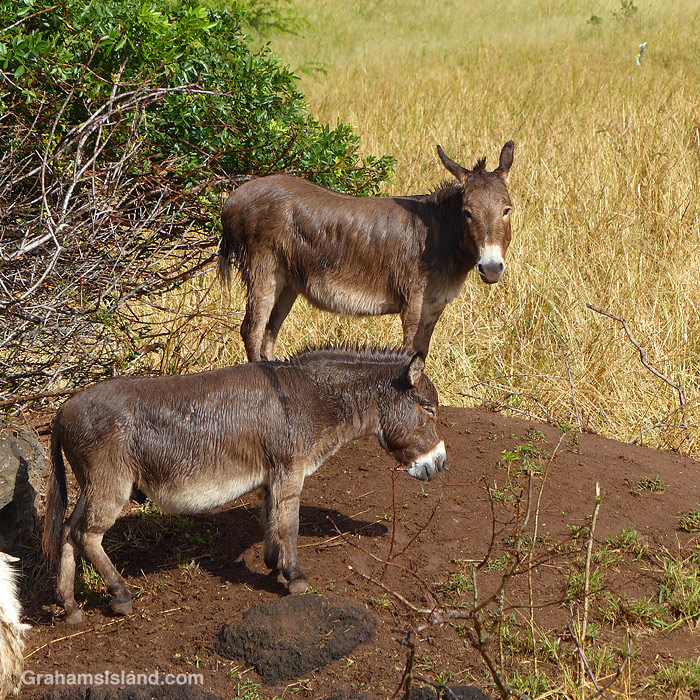
I saw these two horses in Waimea, near the Parker Ranch headquarters. Nothing remarkable about them, but I’m pretty sure that brown lump in the grass is a third horse. I mention this because one of the early things I learned about horses is that they sleep standing up. They can do this because they have something called the stay apparatus, which locks the knees so they don’t fall over. The benefit of sleeping while standing is that they can respond quicker to a predator attack from that position.

While I learned this bit about horses, it didn’t register in the same way that horses will also lie down to sleep. As a result, every single time I see a horse lying stretched out in the grass the way they do, I think it’s dead or dying. Despite knowing better, this response seems to so ingrained in me that I doubt it will ever go away.

Day octopus squabble

A couple of days ago, I saw an octopus while snorkeling. It was on a vertical face of rock and when I showed up it slipped around the corner out of sight. I followed and could see it had gone into a recess there. I saw a tentacle moving and then, moments later, a round white thing appeared, a tentacle clasped around it.

I was mystified. I thought it might be the remains of an urchin or something. The white globe disappeared back into the depths. Moments later it appeared out of the side of the recess and it quickly became clear that the round white balloon was the head of another, completely white octopus. This white coloration is adopted when an octopus is feeling aggressive or threatened.

After a brief flurry of tentacles the white octopus disengaged, shot away a short distance, and changed color again as it landed on a rock. The octopus I’d first seen appeared again at the entrance of the recess. There was a little more to and fro before the evicted octopus gave up and moved away and the first octopus slipped back into the depths of the recess. My take on this was that the octopus I saw first wasn’t happy to find the other octopus in its lair and turfed it out.

The top photo shows the evicted octopus gathering itself after being run off. The second photo shows it on the move, still with the white coloration. The third photo shows the victor in the dispute, looking a little smug if I may say so.

Inside and out

I was sitting on the couch when a large, dark shape appeared on the window screen. The bottom photo shows this first view I had of what was clearly a black witch moth. I took my camera outside and shot a few more photos.

Sometimes these moths can look very battered indeed, but this one looked in good shape, if a little faded. It remained in this spot for several hours until an ambitious gecko saw it as a potential banquet. When the gecko got too close, the moth took off.

I’ve seen a gecko go after one of these moths before (here), but I’ve yet to see one succeed in its quest.

Hapuna Beach

This week’s Sunday Stills challenge theme is ‘Winter Wonderland.’ See more responses here.

We do get snow here on the Big Island, on the summits of Mauna Kea and Mauna Loa, but there’s none up there right now. However, for those knee deep in snow, shrouded in freezing fog, or sliding on icy sidewalks, I thought these photos might seem like something of a winter wonderland.

Hapuna beach (officially Hapuna Beach State Recreation Area) regularly features on lists of the world’s best beaches. It’s a long stretch of golden sand across the head of a wide bay with fairly protected waters. Swimming is good, but when waves do roll in, surfers take over.

The top two photos show the view from the south end of the beach. In the second photo, the line of greenery jutting into the beach represents the edge of the State Recreation Area. North of there is Hapuna Resort, which is private, but the beach is still open to the public. The bottom photo shows the view from the north, looking south. The tracks in the sand are from vehicles used in beach maintenance or by the lifeguards who patrol the beach.

Kilauea Iki Trail weather

When I visited Hawaii Volcanoes National Park in the summer I hiked the Kilauea Iki Trail again. On that occasion, I descended into the crater on the western end and came back up on the eastern end. Shortly after I got up to the crater rim I took the top photo.

The trail continues around the northern rim of the crater and I continued walking. Three minutes after I took the first photo, I came to another overlook into the crater and the bottom photo shows the view I got there, an illustration of how quickly the weather can change in this area.

For more information about Hawaii Volcanoes National Park, go to nps.gov/havo/.