
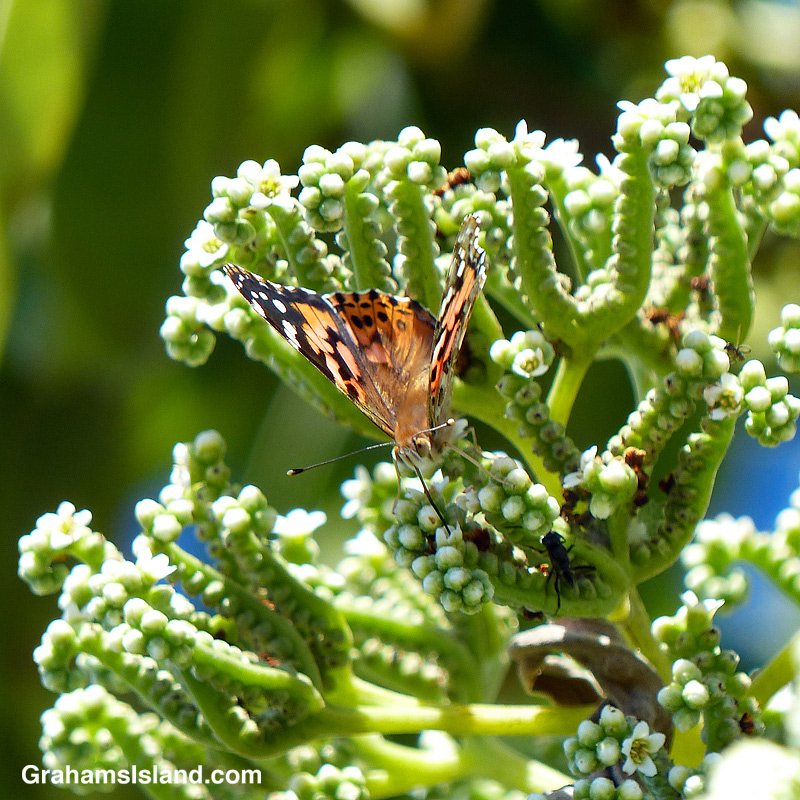
A painted lady butterfly feeds on the small blooms of a tree heliotrope. This particular tree heliotrope stand by itself on a small beach on the North Kohala coast. It’s a popular destination for a variety of butterflies and bugs.

A painted lady butterfly feeds on the small blooms of a tree heliotrope. This particular tree heliotrope stand by itself on a small beach on the North Kohala coast. It’s a popular destination for a variety of butterflies and bugs.

A female pearl wrasse catching a bit of sun, which really makes her colors shine.
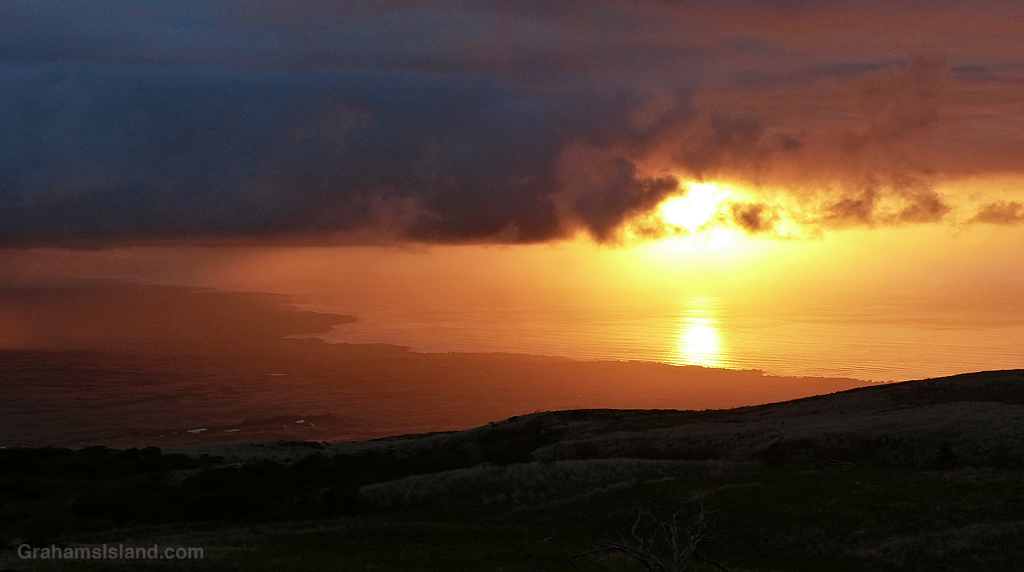
Looking down towards the South Kohala coast as the sun drops below a band of clouds, shortly before sunset.


This week’s Sunday Stills challenge theme is ‘Straight.’ See more offerings here.
Last week, I revisited the Powerline Trail off of Saddle Road. This trail, when combined with the Pu’u O’o Trail, makes a good long loop hike. I like hiking the Pu’u O’o Trail because it passes through several kipukas (patches of old forest that have been spared by lava flows) and those kipukas have lots of birds living in them.
The Powerline Trail is a bit less interesting. There are fewer kipukas and it’s a long, exposed hike in a straight line across the lava. The reason for this can be found in the name. It follows an old 4-wheel drive road that serviced a power line that ran across the lava fields. The line is gone, but the sawn-off stumps of power poles can be seen alongside the trail (to the right of the trail in the top photo, to the left in the bottom photo).
One advantage the Powerline Trail has over the Pu’u O’o Trail can be seen in the bottom photo. This was near the end of my hike in the mid-afternoon as clouds closed in. It’s not unusual for this part of the saddle to be shrouded in thick fog and, if you happen to be out hiking in those conditions, the straight and clear Powerline Trail is much easier to follow than the Pu’u O’o Trail which, crossing the lava fields, can be hard to follow when you can’t see the cairns that mark its route.
The trail, of course, isn’t perfectly straight (though I suspect the power line was). It bumps around lava upwellings and collapsed tubes. But most of the time, one just needs to look up to see, straight ahead in the distance, the faint pale thread of the trail topping a hill or emerging from a dip in the landscape.


This goat looks like it’s thinking about climbing aboard the helicopter. Probably a good thing it didn’t since that likely wouldn’t end well.

Pu’uanahulu is a small community midway between Kailua Kona and Waimea, on the upper road between those two communities. I don’t drive that highway much, except when I go to hike up Pu’u Wa’awa’a. Last time I did this, driving through Pu’uanahulu, I noticed that the jacaranda trees were in bloom alongside the road. What I hadn’t realized is just how many jacaranda trees there are in this area.
These photos are taken from the northern slopes of Pu’u Wa’awa’a. The bottom photo shows the general area with the purple jacaranda flowers of Pu’uanahulu clearly visible. The top photo shows a closer view of part of the community and the abundance of flowering jacaranda trees.

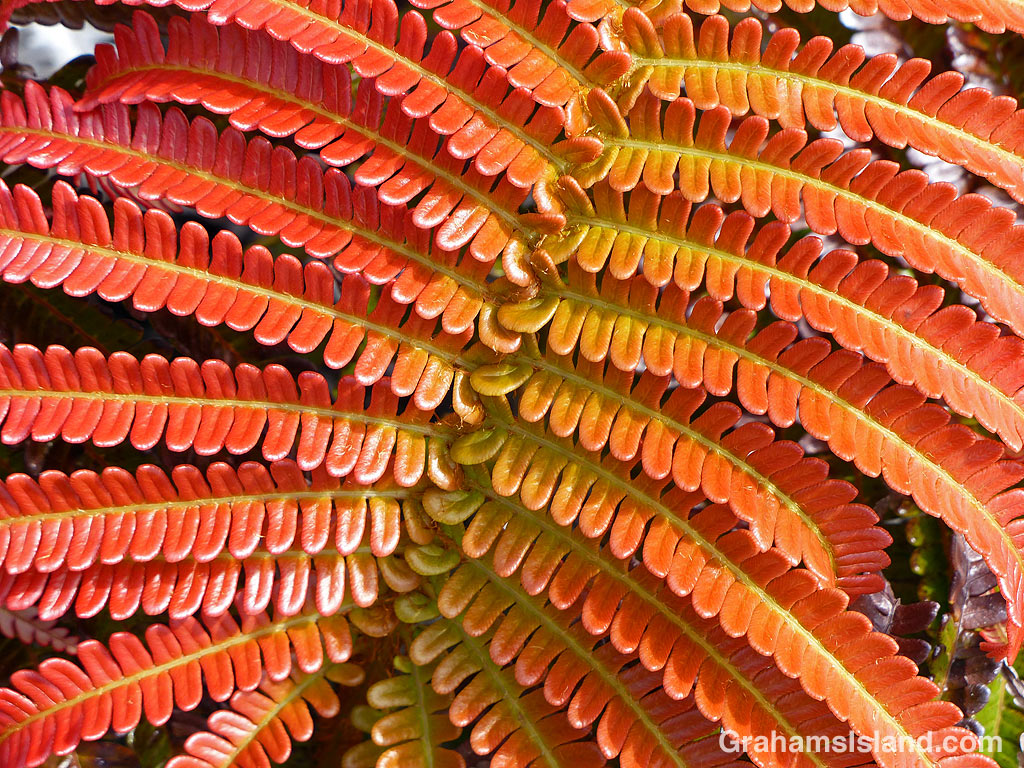
A close up of a new frond of an endemic amaumau fern (Sadleria cyatheoides).

A bee on a passion flower as another bee approaches. What I like about this photo is the one bee’s leg up in the air. A friendly wave? Get away from me? Only the bees know for sure.

