Laupahoehoe is a small community on the Hamakua Coast, 24 miles northwest of Hilo. The name means ‘leaf of lava’ and refers to the low, wedge-shaped cape of pahoehoe lava which juts into the ocean there. That cape is now the site of Laupahoehoe Point Beach Park, but in its early days, this low point of land was the thriving center of the community, with houses, shops, and a school.
On April 1, 1946, all that changed. In the early hours of the morning, there was an earthquake in the Aelutian Islands of Alaska. I’ve seen various reports of the size of that earthquake from 7.1 to 8.6. Some of these variances are due to differing scales in use. The higher numbers refer to the scale in use today, which is moment magnitude, and which more accurately reflects the energy of large earthquakes.
Regardless of the scale, the earthquake generated a huge tsunami, which roared across the Pacific at speeds up to 500 mph. The tsunami reached the east coast of the Big Island around 5 hours later and came ashore as a sequence of three giant waves. In Hilo, the receding water before the third wave, drained Hilo Bay. Then the largest, 55-foot-high wave, thundered ashore. It destroyed much of the town and killed more than a hundred people.
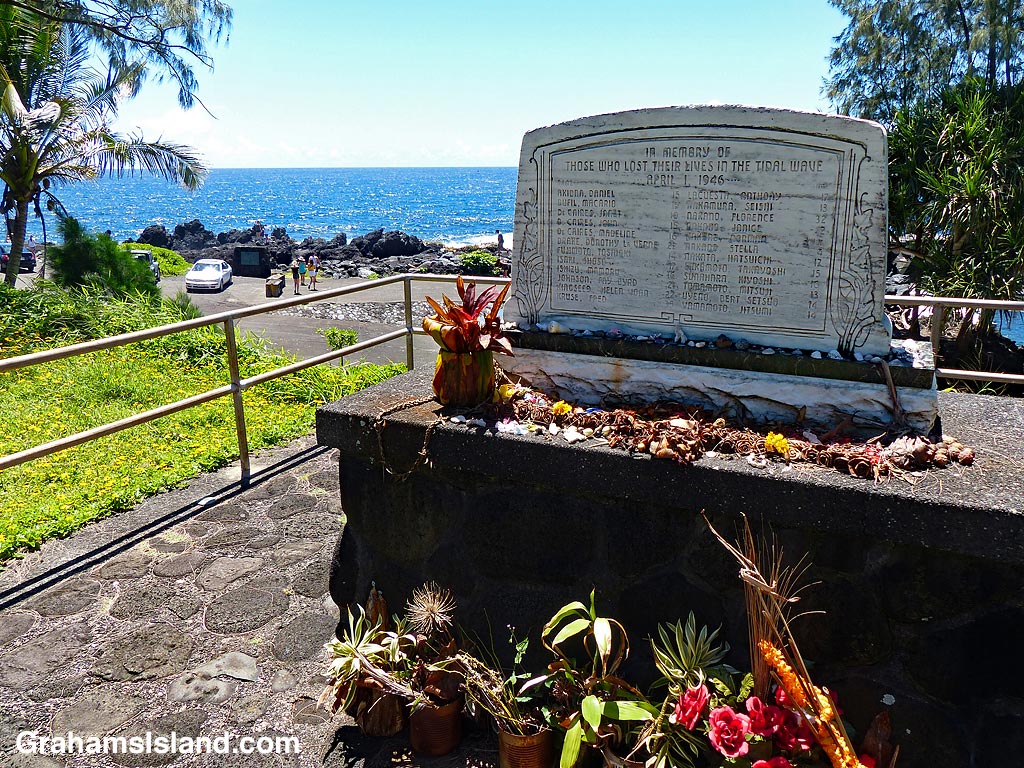
In Laupahoehoe, the same set of three waves occurred. The first two, somewhat smaller waves drenched people and threw fish out of the water. Students from the school were collecting these fish when the third wave struck. 21 students and three teachers were killed and the top photo shows the memorial plaque bearing their names. Only one of the bodies was recovered. Three students survived after being washed out to sea and drifting along the coast for more than a day. An account of their ordeal can be found here.
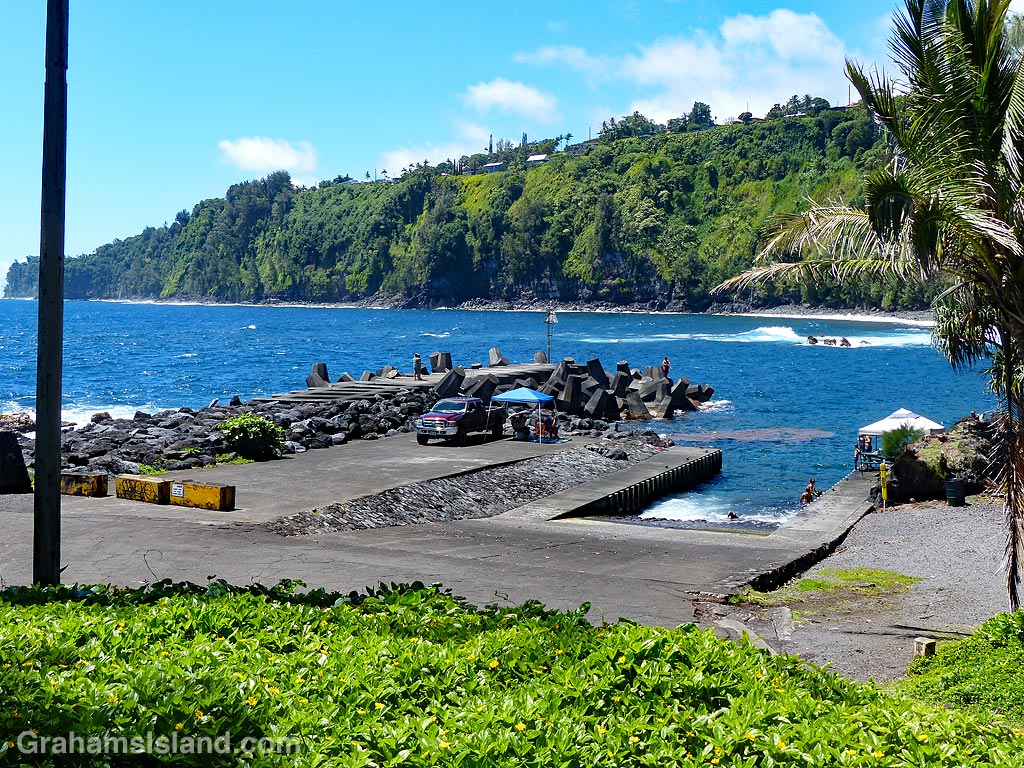
After the tsunami, the community was rebuilt up on the cliffs, which can be seen overlooking the park’s boat ramp and breakwater in the bottom photo. The park is now a peaceful spot with palm trees dotting the shoreline and an expanse of grass where kids can run. But if the tsunami siren sounds, this community has learned that there’s only one way to run, and that’s uphill.