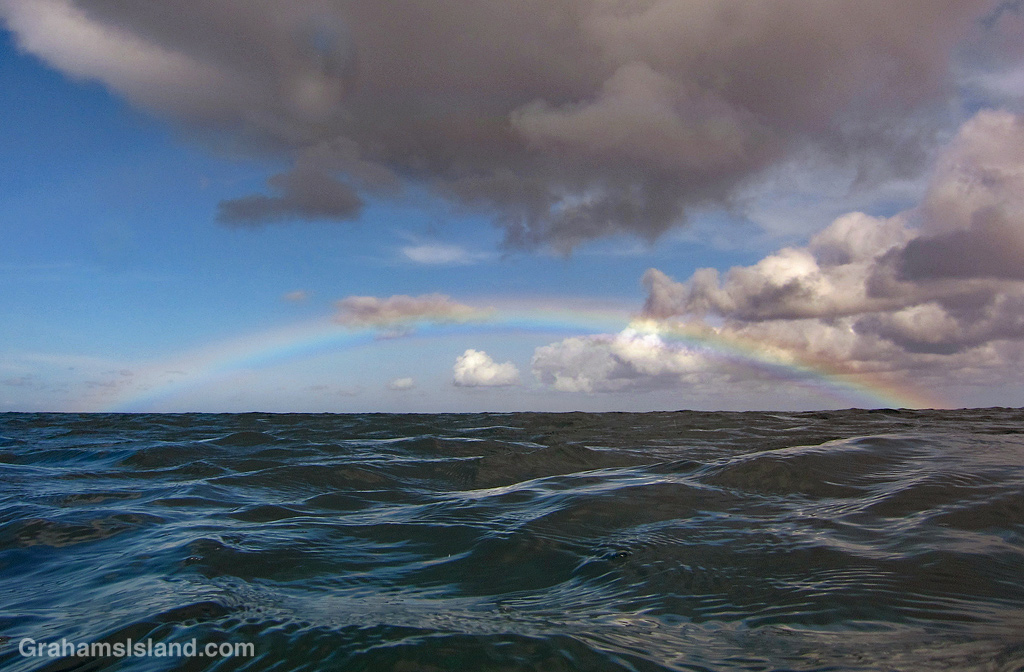
Today marks the start of this blog’s fifth year and to mark the occasion I’m posting a rainbow photo, as I did for the first blog post and for last year’s anniversary.
This rainbow occurred while I was snorkeling in somewhat lumpy water with clumps of clouds above.
On a recent snorkeling expedition I was lucky to notice this eagle ray sliding by below in some hazy water. It’s the smallest eagle ray I’ve seen, with a wingspan of about a foot-and-a-half. Adults can have a wingspan of up to ten feet though the ones I see are mostly in the five to six feet range.
One nice thing to see was that this little ray was in perfect condition with nary a mark on it. Some of the bigger ones look like they have been in the wars.
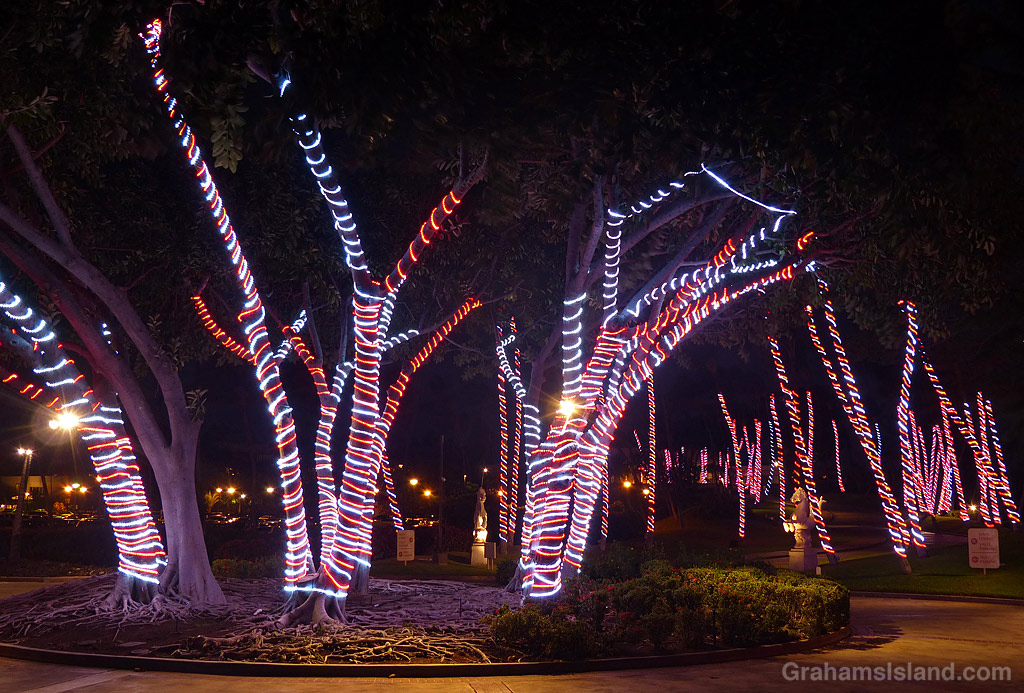
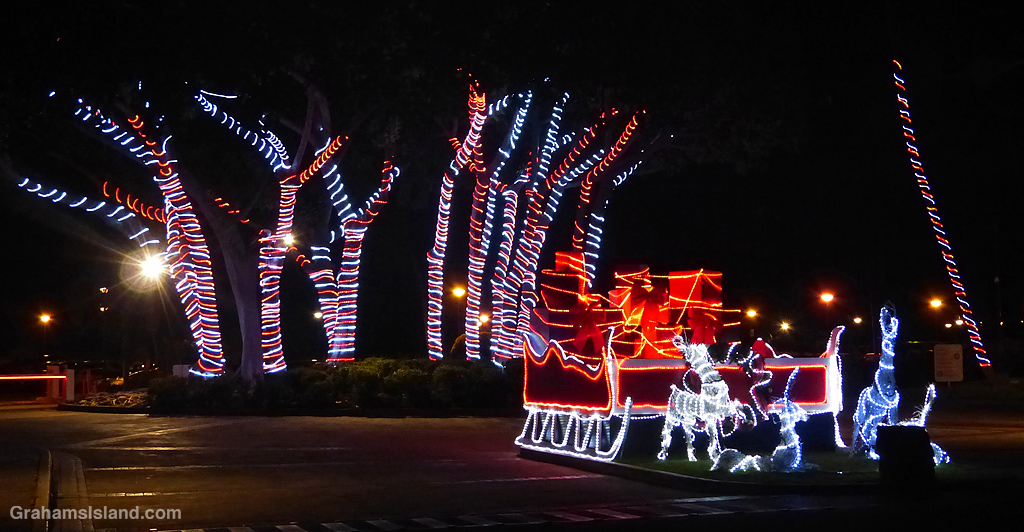
Seasons greetings to all. I’ve swung by the Hilton at Waikoloa a couple of times in the early morning to see the collection of lights creating a festive display. Fronting the display is a large sleigh being pulled by a quartet of little deer (they’re not gonna make it down the block let alone around the world). But what makes it stand out is that the trees on the roundabout behind the sleigh, and all the way up the drive to the hotel, are wrapped with lights. It looks like a candy cane forest.
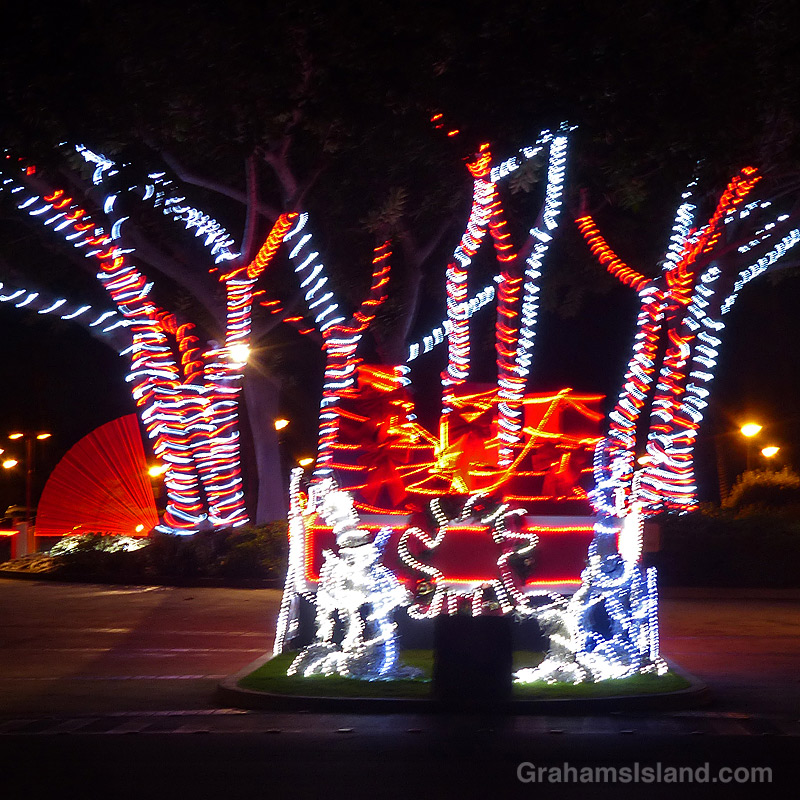
I used a tripod for the top and bottom shots, but for some the camera was handheld. Most of the shots were shaky, but I liked the one in the middle, in part because it caught a barrier rising making it look like a large red fan.
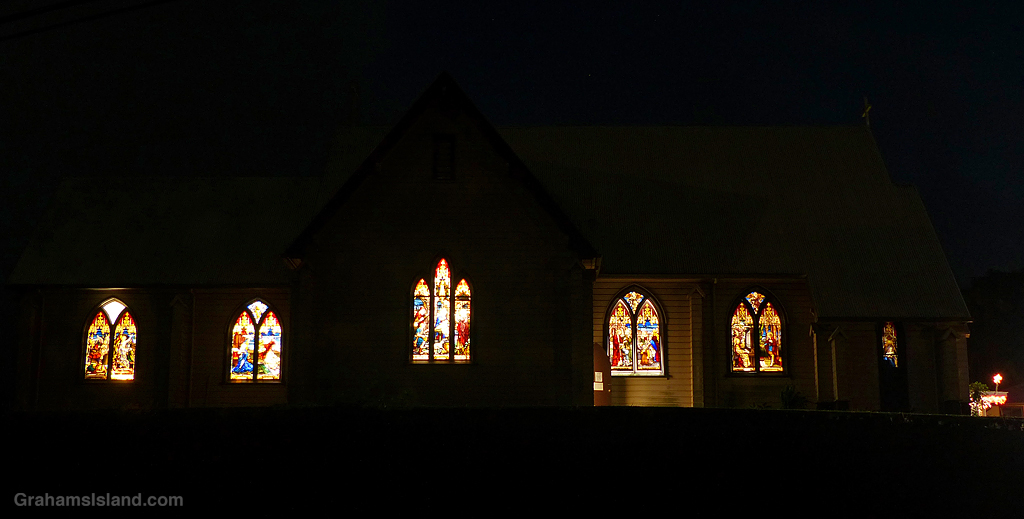
It’s Christmas Eve, so what better time for a post about Hawi’s Sacred Heart Catholic Church. These photos were taken on a Wednesday evening and I’m not sure what the activity was inside the church. My goal was to take photos of the exterior without disturbing anyone.
When I got there, I was a bit surprised to see someone sitting on the steps outside the church, but they were absorbed in their phone and didn’t see me. I’d taken a few photos, when I realized that the figure on the steps had got up and was walking up the path to the church. That’s the person in clerical robes standing in the doorway in the lower photo. Shortly afterwards, he entered the church and I didn’t see him again.
While I’m not religious, I always enjoyed visiting churches in my native England and elsewhere. The interiors are usually cool and calm and conducive to reflection, and each church invariably has some feature of note. In this case, I liked the stained glass windows illuminated by the lights within.
Abandoned vehicles are something of a problem in Hawaii. The root of the problem is that it’s expensive to responsibly get rid of an old car. So people leave them by the side of the road or on undeveloped property by the highway. I’ve posted before about one such vehicle here.
This latest one was sitting alongside the road just north of Kawaihae. At first, it looked like an older car that had perhaps broken down and was awaiting a tow or for the owner to return and fix it. But after a few days, it was clear that wasn’t happening.
If a vehicle sits unattended for a few days, people move in. Wheels are often the first to go. Then the hood goes up and anything useful in the engine compartment gets removed. There’s also a good chance that someone will tag the vehicle with graffiti.
What else can they do? Why not set it on fire. That’s what happened to this one. When I took these photos, the car had been sitting there two or three weeks.
About a week later I saw a police car parked behind it. The policeman wrote out a notice warning that the car will be towed at the owner’s expense if it was still there the next day. It should not come as a surprise that no one reacted to this notice, but neither was the car removed.
Another week passed and some traffic cones were placed around the burned-out hulk. There was good reason for this. The car was low to the ground and, with all the color burned off, it blended into the road. Someone could easily not have seen it, especially at night, and run into it.
Another week passed and then, one day, the car was gone. Only the traffic cones remained surrounding a small mound of ashes. Another week later, the cones and ash mounds area still there, but one day those too will disappear and that stretch of road will be ready to accommodate the next abandoned vehicle.
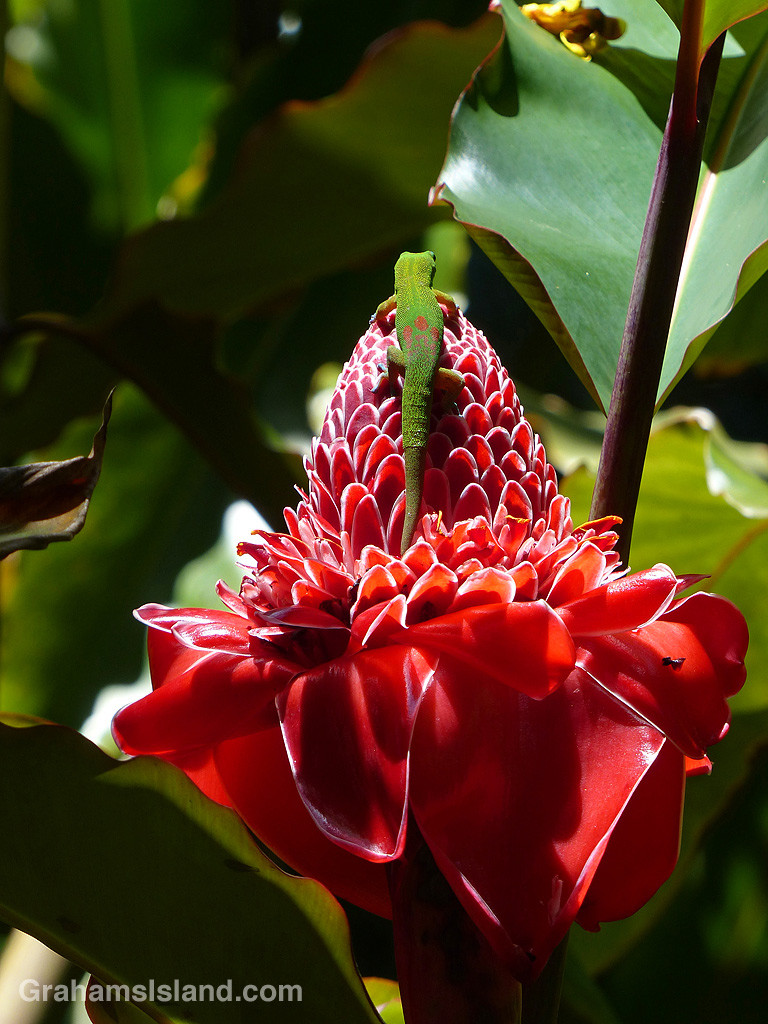
There is no Sunday Stills challenge this week (or next), but the theme was going to be ‘Something Red or Green or Both!’ so I thought I’d go with the photo I had picked out for that anyway.
So here’s a very green (with red markings) gold dust day gecko resting atop a very red torch ginger surrounded by green foliage. It looks like the gecko has been in the wars judging from the rings around its tail, which suggest it has lost it a few times. The most recent regrowth is the lower brown part, which will ultimately take on a matching green color once it’s fully grown.
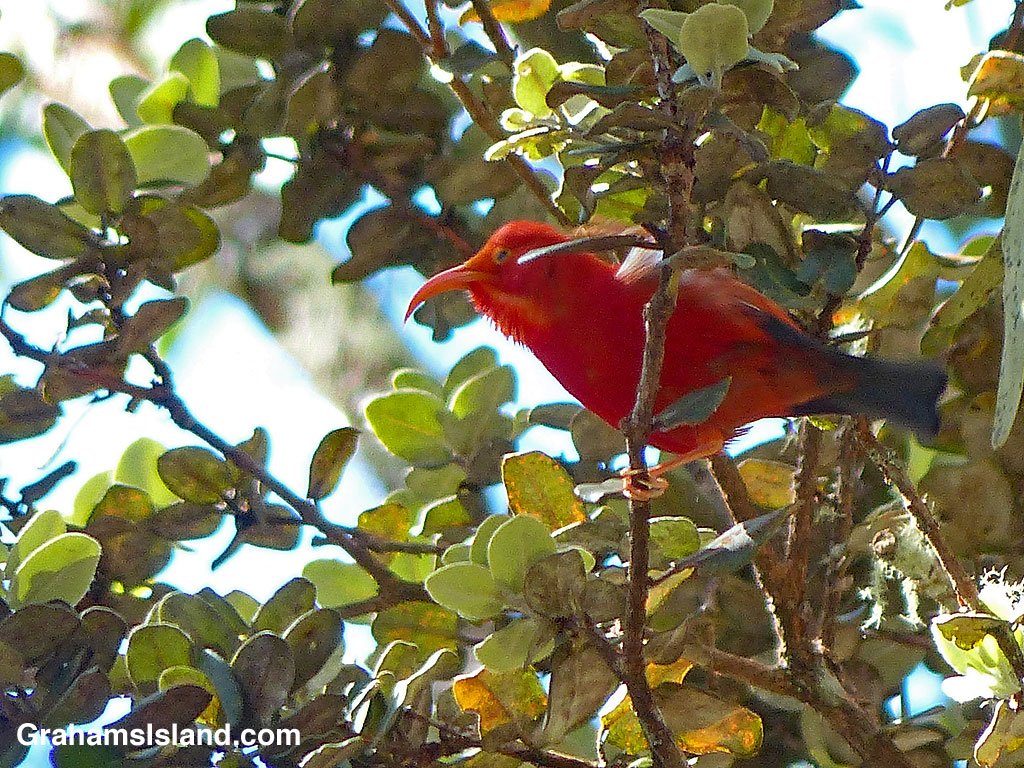
I saw this I’iwi (Drepanis coccinea) on a trail off of Saddle Road, between Mauna Kea and Mauna Loa. These bright red birds are native Hawaiian honeycreepers and in the old days, the feathers of the birds were collected to make cloaks for Hawaiian royalty.
The curved bill is suited for feeding on native lobelias, but a decline in those plants has seen the I’iwi adapt to feeding on other native plants including ʻōhiʻa lehua, māmane, and ohelo.
While the numbers of I’iwi are still fairly good, particularly on the Big Island and Maui, they have suffered, like other birds, from loss of habitat. In addition, They are susceptible to avian malaria, spread by mosquitoes. Consequently, I’iwi are doing better at higher elevations, such as where this photo was taken at around 6,000 feet.
On a recent foray into Hawi to get photos for last week’s Sunday Stills challenge (here), I took these photos of the Kohala Welcome Center. This is the place to get information about North Kohala for visitors en route to Kapaau and Pololu, which marks the end of the highway.
On this particular evening, the welcome center was illuminated by its Christmas display and a full moon, which also highlighted the palm trees that tower over that location.






 Graham's Island