These lights are on most of the time in the house, but I liked how they reflected in the overlapping kitchen windows.
Posted in response to this week’s Sunday Stills challenge on the theme of ‘Reflect.’ See more offerings on this theme here.

These lights are on most of the time in the house, but I liked how they reflected in the overlapping kitchen windows.
Posted in response to this week’s Sunday Stills challenge on the theme of ‘Reflect.’ See more offerings on this theme here.

There are many varieties of phalaenopsis orchids on show at Hawaii Tropical Botanical Garden. This one is Phalaenopsis (ChianXen Queen x Diamond Beauty).
There are so many orchid hybrids, with subtle variations, that it can be difficult to identify them. However, at the garden, I’ve found that if I root around at the base of the plant I often find a name tag sticking out of the dirt, and when it comes to identification I’ll take all the help I can get.
For more information about Hawaii Tropical Botanical Garden, go to htbg.com.

Costus curvibracteatus is also known as orange tulip ginger and hails from Costa Rica and Panama. In these photos, the overlapping red parts are the bracts and the longer orange tubular forms, emerging from between the bracts, are the flowers. However the bracts can also be orange, and the flowers a similar length as the bracts.
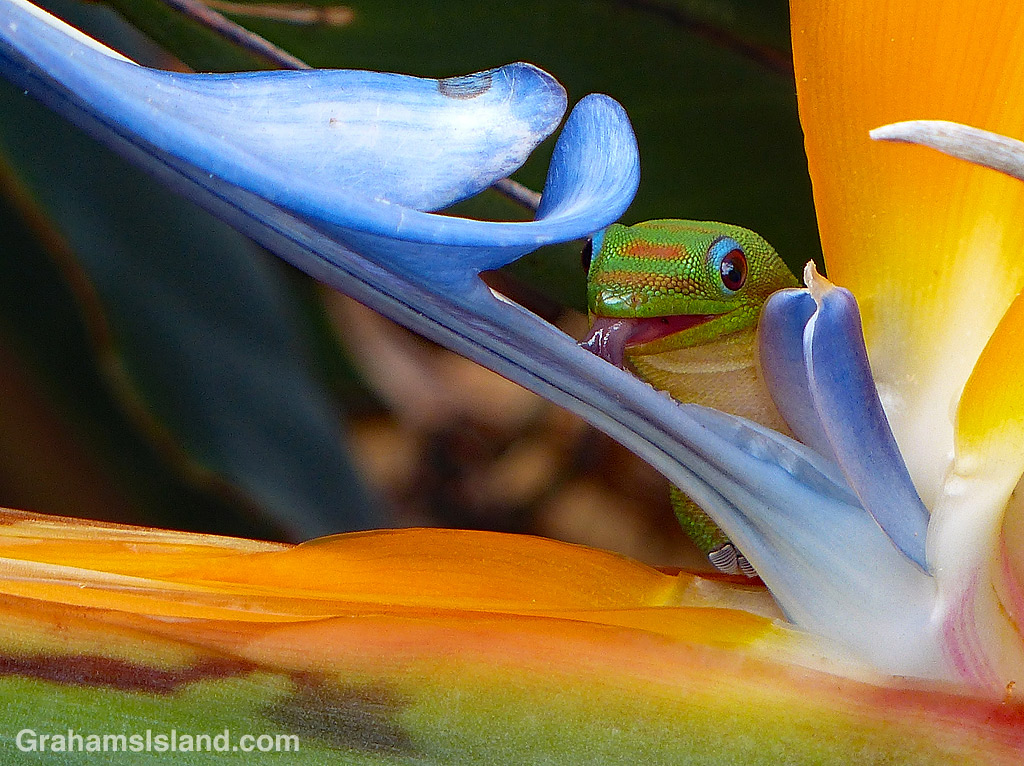
The plant was being explored by a gold dust day gecko, which was likely searching for something sweet or possibly seeking water trapped in the bracts.
This one was at Hawaii Tropical Botanical Garden. For more information about Hawaii Tropical Botanical Garden, go to htbg.com.


Toward the end of a hike along the coast, I came across this turtle feeding in a shallow tidal area. There was good grazing to be had, but the problem was that the ledge was continually swept by incoming waves.
The turtle would swim in and access the ledge from the shore side (on the right in the top photo). Then he lumped forward to where the good grazing was and buried his head in it.
Waves would surge in and sluice over him (below). Sometimes, the receding wave had enough oomph that it would wash the turtle over the front edge of the ledge. Then he’d swim around and start over again.


This Hawaii ‘amakihi, one of Hawaii’s native honeycreepers, was feeding on mamane flowers near the top of Pu’u Wa’awa’a.


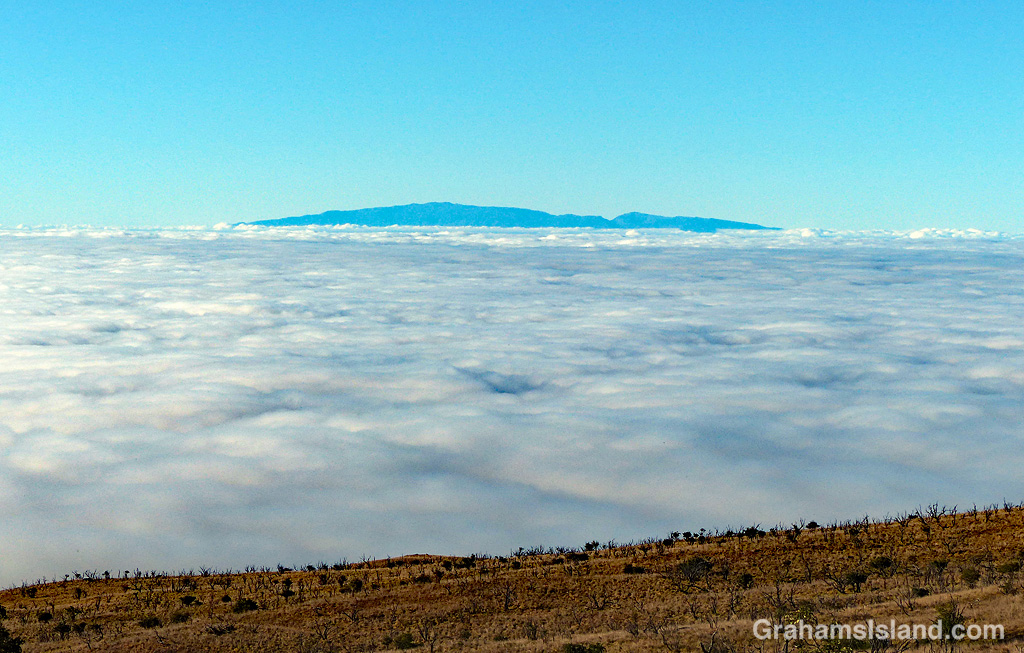
What’s this grader got to do with a happy new year? Well, it’s sitting near the edge of a newly-graded house pad at Hapuna Resort. Soon, a house will be built here and when it’s done it will have a fabulous view toward Maui (above) and out over the ocean (below). So it’s kind of a new beginning with a wonderful outlook. I hope your new year has a similarly great prospects.


A small fishing boat works the blue waters off the Kohala coast.

Crab spiders tend to proliferate in the fall and dwindle in the spring. That means winter is prime time for encountering lots of them, usually in the form of blundering into their webs. This is easy to do for two reasons.
One is that the webs can be large. While the circular centers aren’t that big, the anchoring strands often span 10 feet or more, and are hard to spot. The second reason is that crab spiders build connected webs, meaning there are often a dozen or more covering a large area.
Crab spiders will bite, usually after they’ve got caught in someone’s clothing. This is why, when I run into a web or webs, my first response is to locate the spider. If I find it on a remnant of its web, I don’t worry too much. If I don’t see it, then I usually do my flailing crab spider dance, which serves no useful purpose other than to likely irritate the spider if it is on my person.
On the plus side, crab spider webs, like most webs, are quite beautiful when they catch the sunlight.