
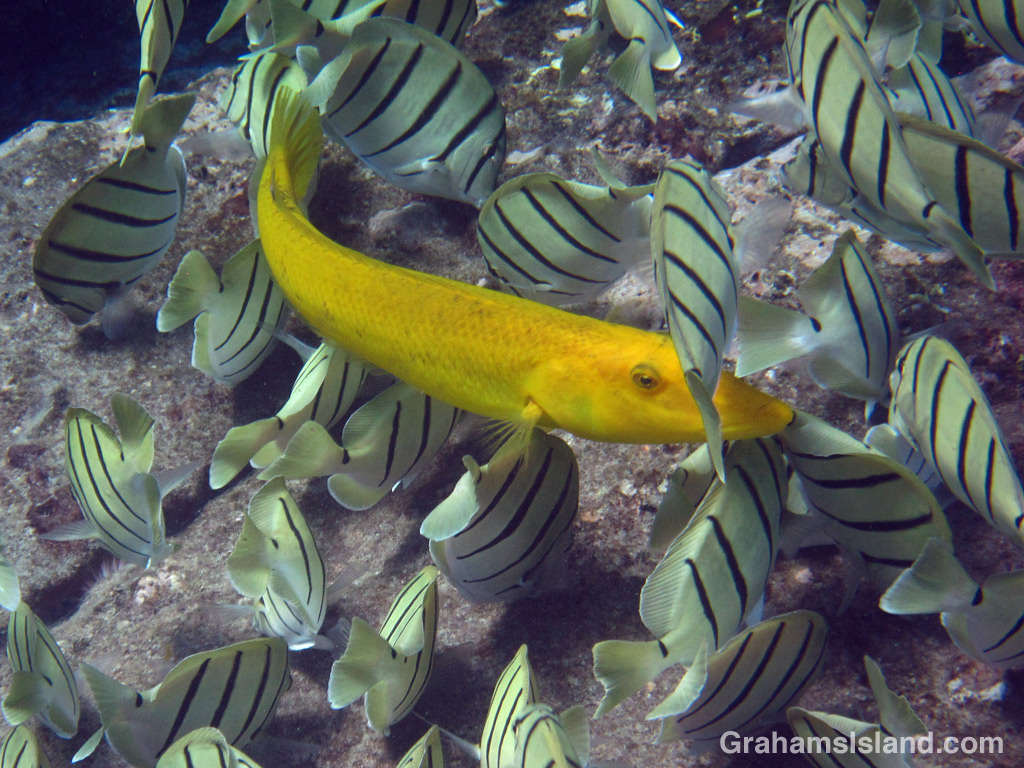
Shoals of convict tang are common in the near-shore waters of the Big Island and it’s equally common to see a bright yellow female cigar wrasse among them. The theory is that the cigar wrasse uses the cover of the harmless shoal to surprise its prey, a variety of marine invertebrates. Seems like the cigar wrasse’s prey does not have real good eyesight.
Abstracts: Green anole on wire
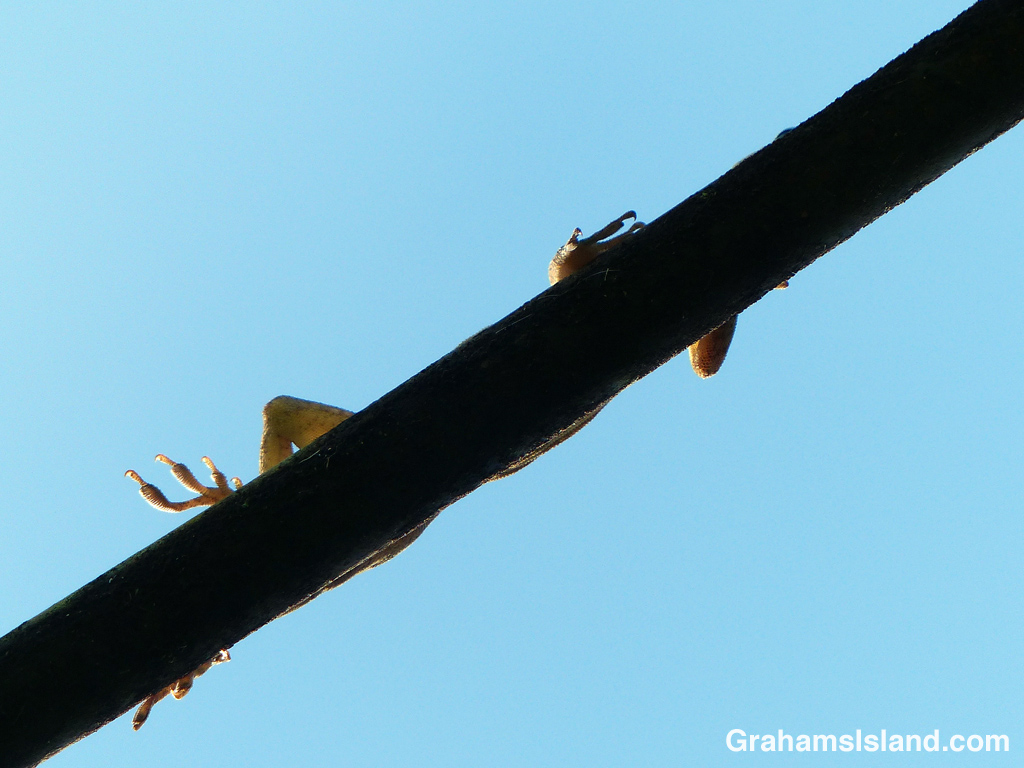
I posted once before here about how green anoles head back and forth from the house on the cable and power lines. This is a photo of one of them as seen from below.
Sunset and palms
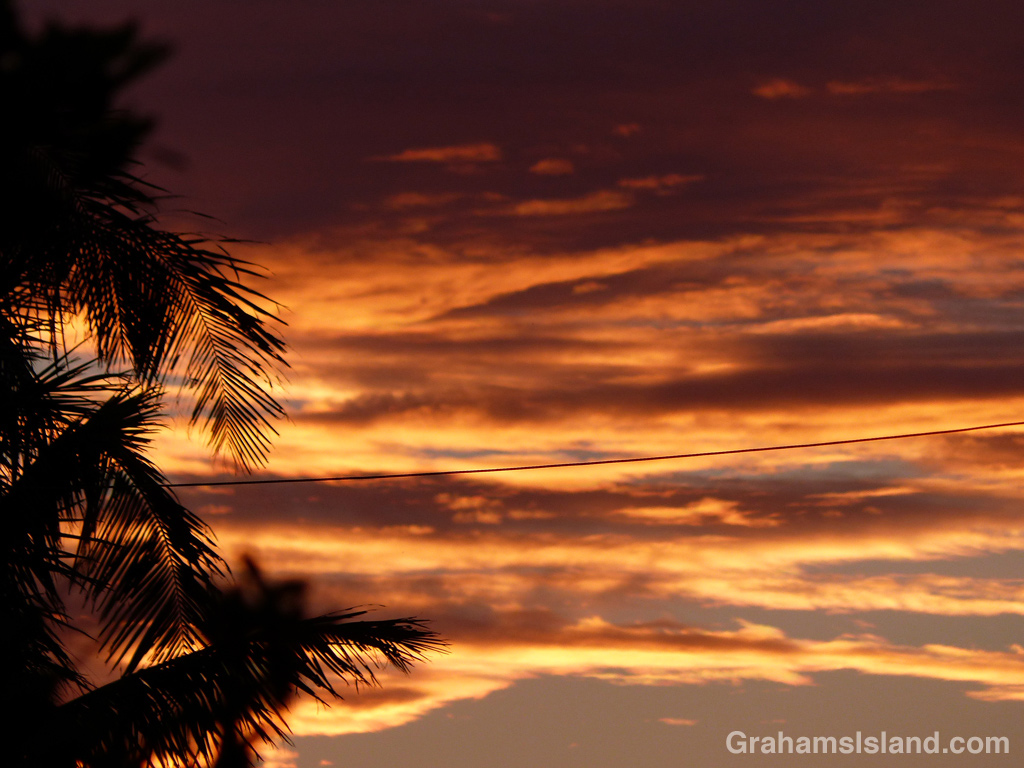
Palm trees silhouetted against a Kohala sunset.
Unwise mourning gecko
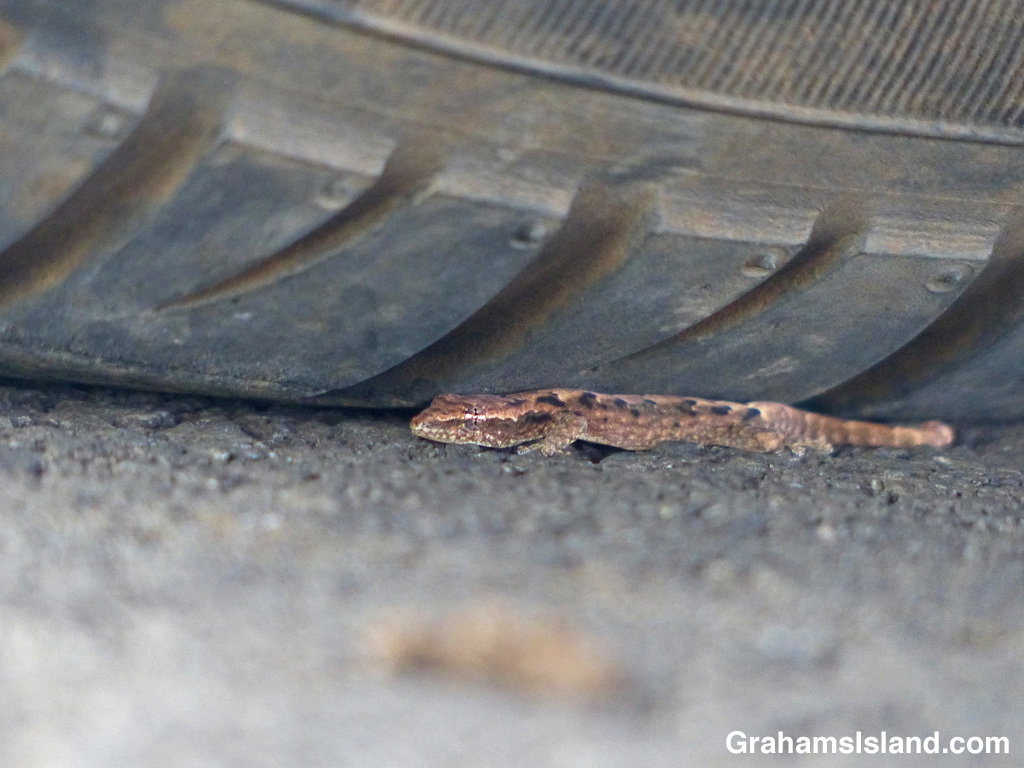

Returning to my truck after a walk, I happened to notice this little gecko scuttling into the shadows. I got down on hands and knees to see where it had gone and it moved farther under the truck. I went around the truck, back on hands and knees, and saw it shoot off in the opposite direction. Then I went to the front of the truck, hands and knees again, and wondered where it had gone.
It took me a while to discover it’s hiding place. As the top photo shows, the gecko hadn’t picked a great spot. I waggled my hand at it, but it didn’t budge. So I got up, found a stick, and, back on hands and knees again, reached in and tapped the ground behind it until it shot out and around the other side of the tire. I got up, walked around to usher it away and it promptly scurried back to the inside of the tire.
We repeated this little dance two or three times. I wasn’t getting anywhere and the young mourning gecko clearly believed it had found a really safe hideout. My knees were sore and I figured this kind of activity was probably what Darwin was thinking of. So I got in the truck, fired it up, waited a minute or two, and slowly reversed. Then I pulled forward, stopped and got out.
The little guy had survived so I thought I’d take a photo. Right about then a young woman approached with two boisterous dogs and asked if I could suggest a good place to exercise them. The dogs were getting plenty of exercise right there, barking continuously, and jumping up and down. I cast concerned looks at where they were landing as I gave her a few tips.
When she headed out of the parking lot with her charges, I bent down and saw that the little gecko had survived the canine cacophony and was still anchored in the same spot. I took the second photo and then the gecko headed off toward the low concrete tire stop and eventually disappeared underneath.
A flowery flounder vanishes

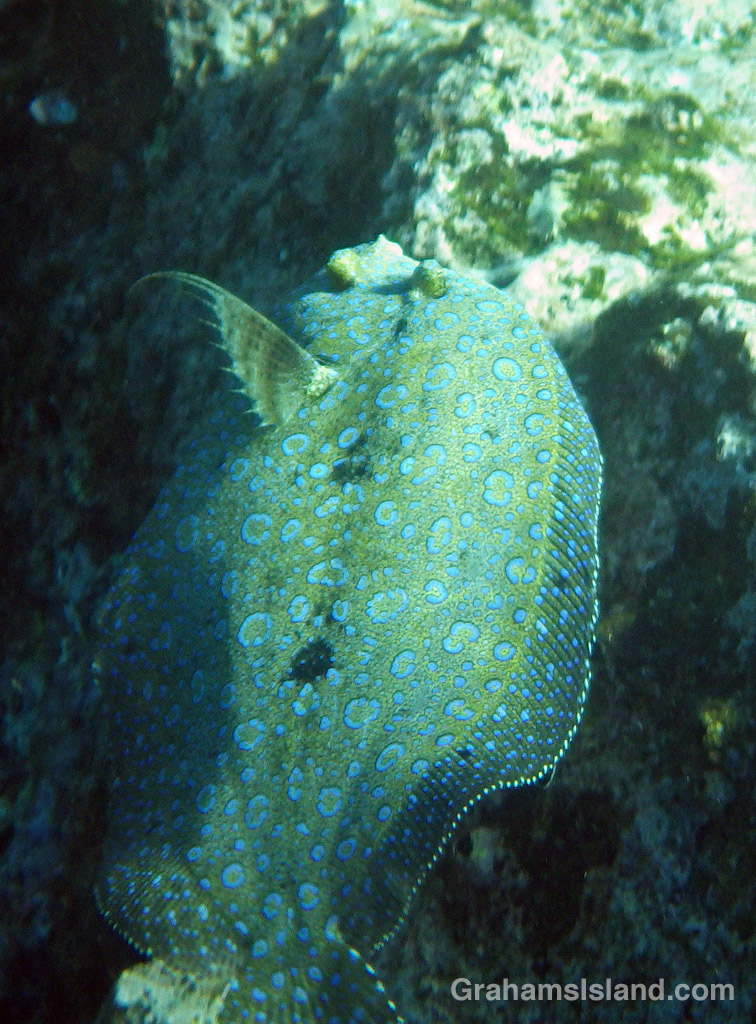
Camouflage is a creature making a good match with its surroundings. This serves to conceal it from both predators and prey. In the water, there are many exponents of this approach, from octopuses to scorpionfish.
Flatfish are masters of camouflage. It’s a fluke to see a stationary flatfish. It’s almost always necessary to see one on the move and to track it to where it settles down. Once it’s set though, it will usually stay put, making it one of the easier fish to observe and photograph.
I saw this flowery flounder on the move but once it plopped onto a rock (above) I would never have noticed it had I not known it was there.
Plumeria rubra
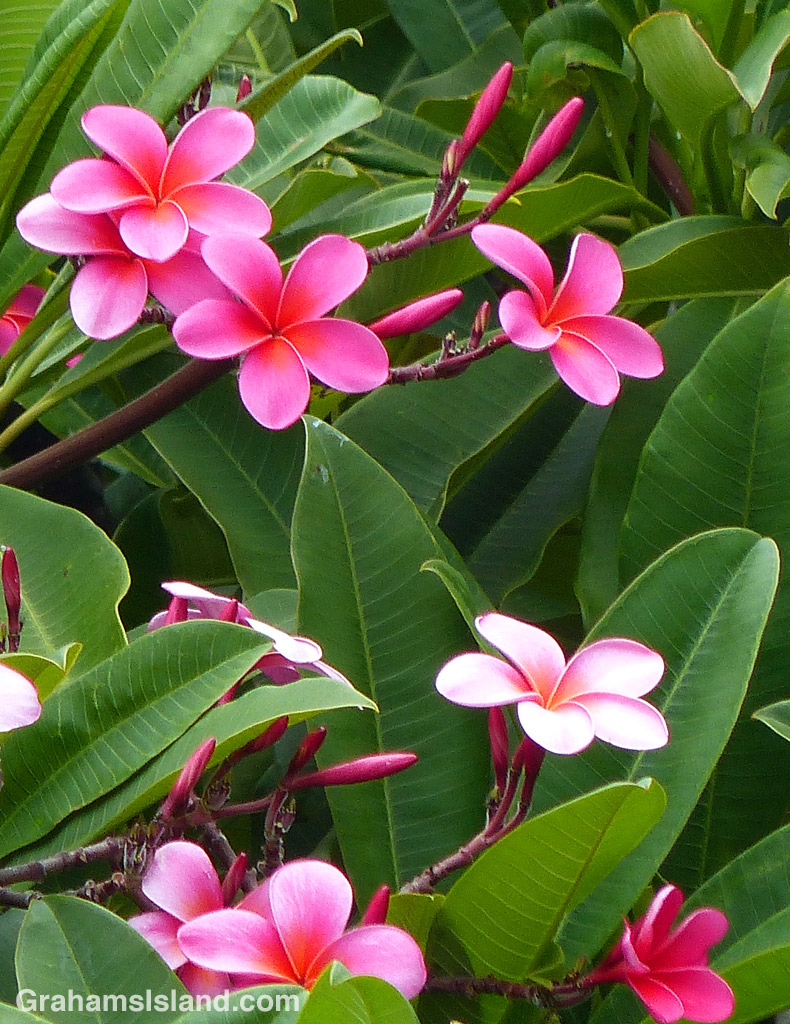
This Plumeria rubra has dark pink flowers, but others might sport, red, orange, yellow, or white flowers.
For more information about this and other Hawaiian flowers, go to wildlifeofhawaii.com/flowers/.
V-22 Ospreys

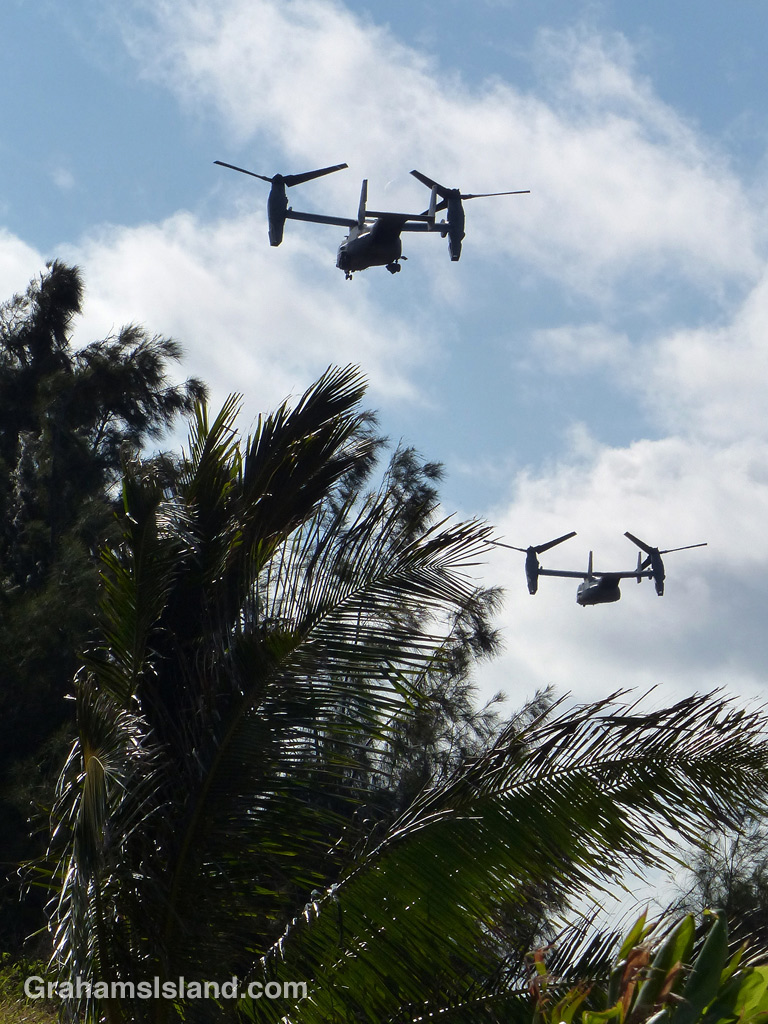
I’m not a bird watcher per se, but I’ve increasingly enjoyed the wide variety of bird life that I see when I’m out and about. Recently, I’ve been seeing a couple of pairs of nene, the Hawaiian goose. There’s a family of zebra doves that huddle up together on the mock orange outside the kitchen window. On a daily basis I encounter pairs of mynah birds, saffron finches, northern cardinals and several more.
What does that have to do with these photos? Well, for some reason, my first thought on seeing these two V-22 Ospreys thundering toward Upolu Airport was, ‘I wonder if they’re a breeding pair?’ All things considered, I suspect they are.
Nutmeg mannikin

Nutmeg mannikins are often seen in flocks and are flighty birds. By this, I mean they’re the kind of bird that constantly flits around and gets farther away in the process. They feed on grass seeds, climbing up the stems and stripping the seeds off the ends.
In Hawaii, when cane grass (Pennisetum purpureum) goes to seed it’s a popular feast for a variety of birds. Here, one of a small group of nutmeg mannikins, busily plucks seeds off this stem before moving on for more.

