
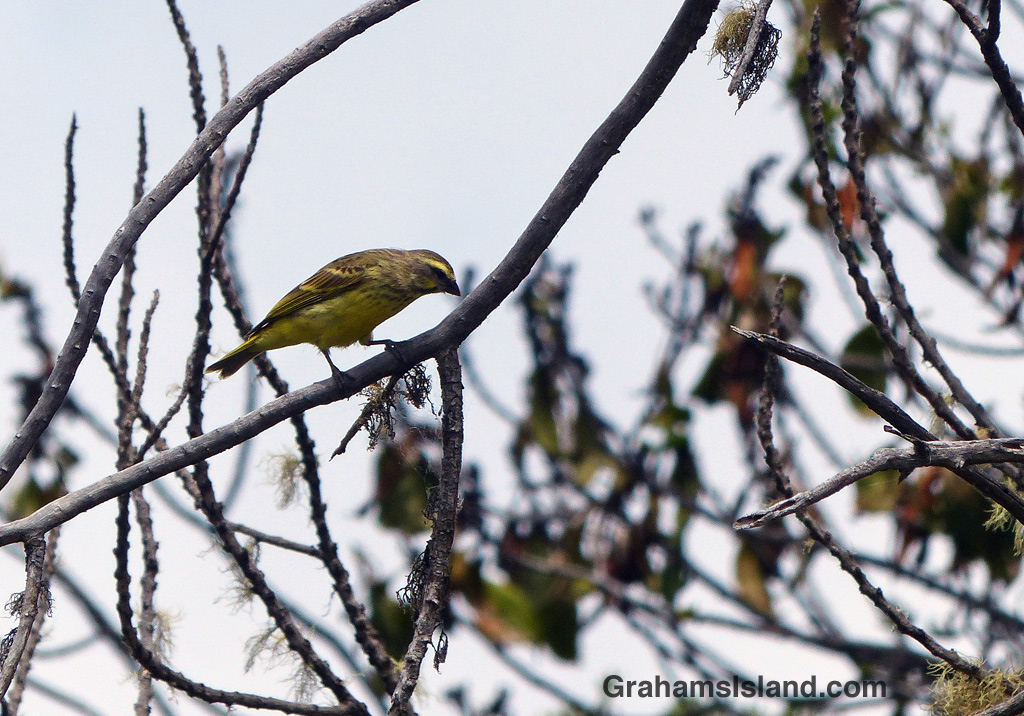
A yellow-fronted canary surveys the scene at the Palila Forest Discovery Trail on the lower slopes of Mauna Kea.
Gold dust day gecko drinks from a ti plant
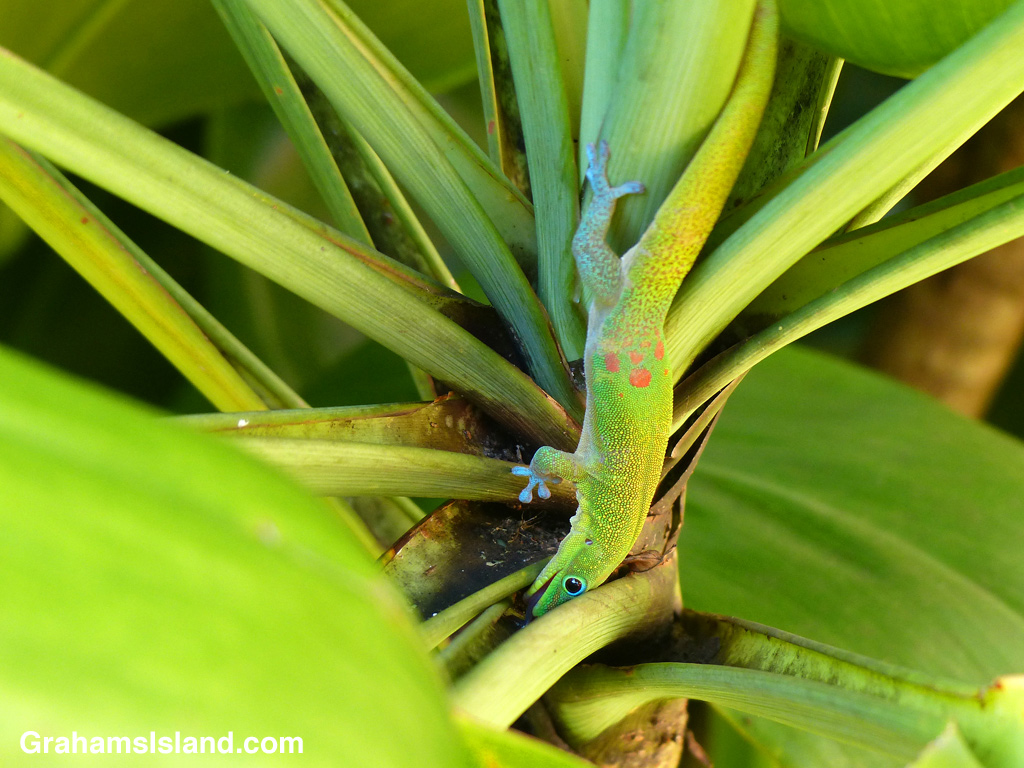
In the morning, it’s common to see geckos taking a drink of water. Sometimes it’s from morning dew or leftover drops from overnight rain. Here, a gold dust day gecko drinks from water collected where a ti leaf joins the main stem.
For more information about geckos, go to geckoweb.org.
Sun dips below the horizon
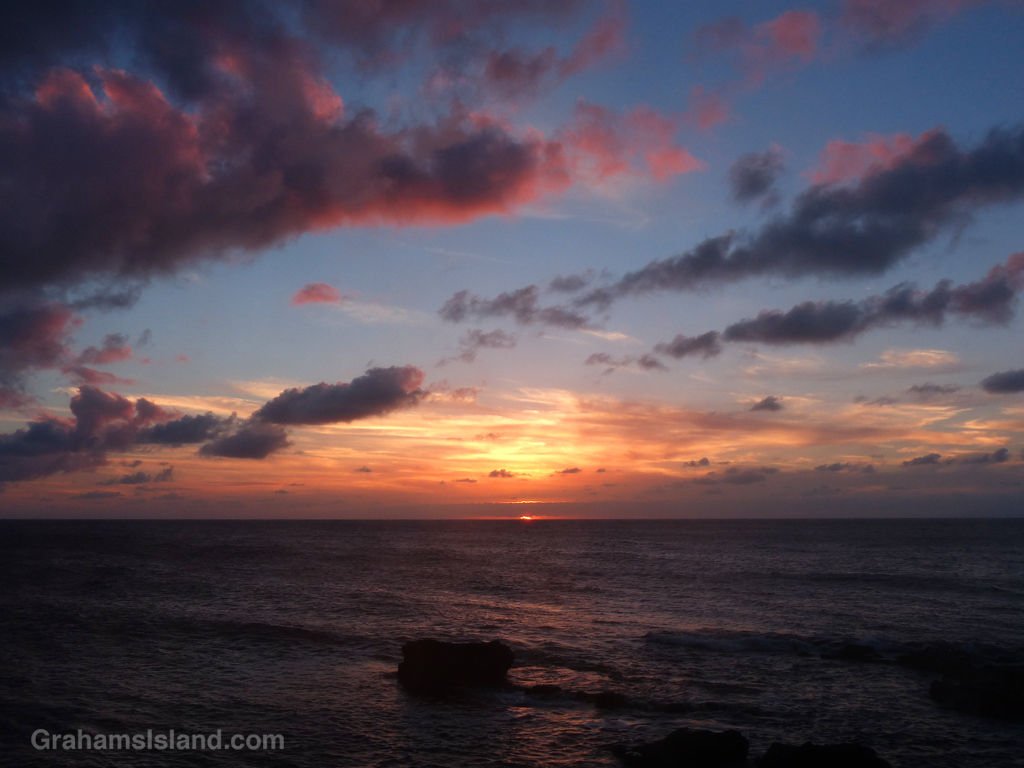
A last glimpse of the sun as it continues on its journey around the Earth, the flat Earth that is. Just trying to get hired as a presidential advisor.
Memorial on the coast
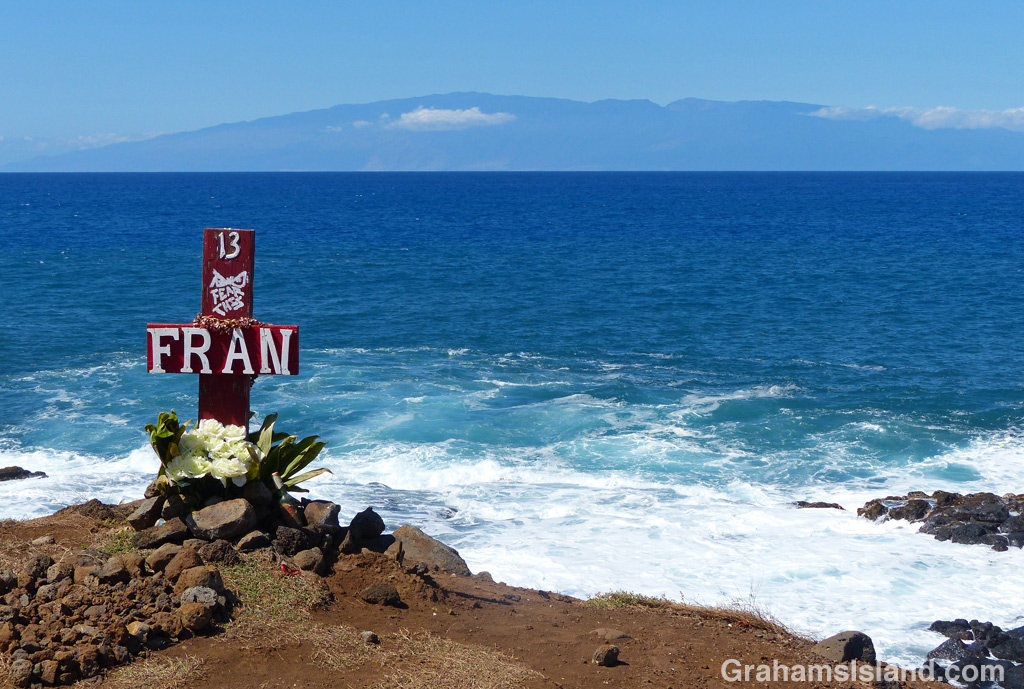
As is the case in many places, the Big Island is home to a variety of memorials, put in place and maintained by loved ones. Many can be seen by the side of highways, marking the spot where a life ended.
I don’t know the story behind this one, but it’s a beautiful, peaceful spot with its view across the ʻAlenuihāhā Channel to Maui.
Katydid
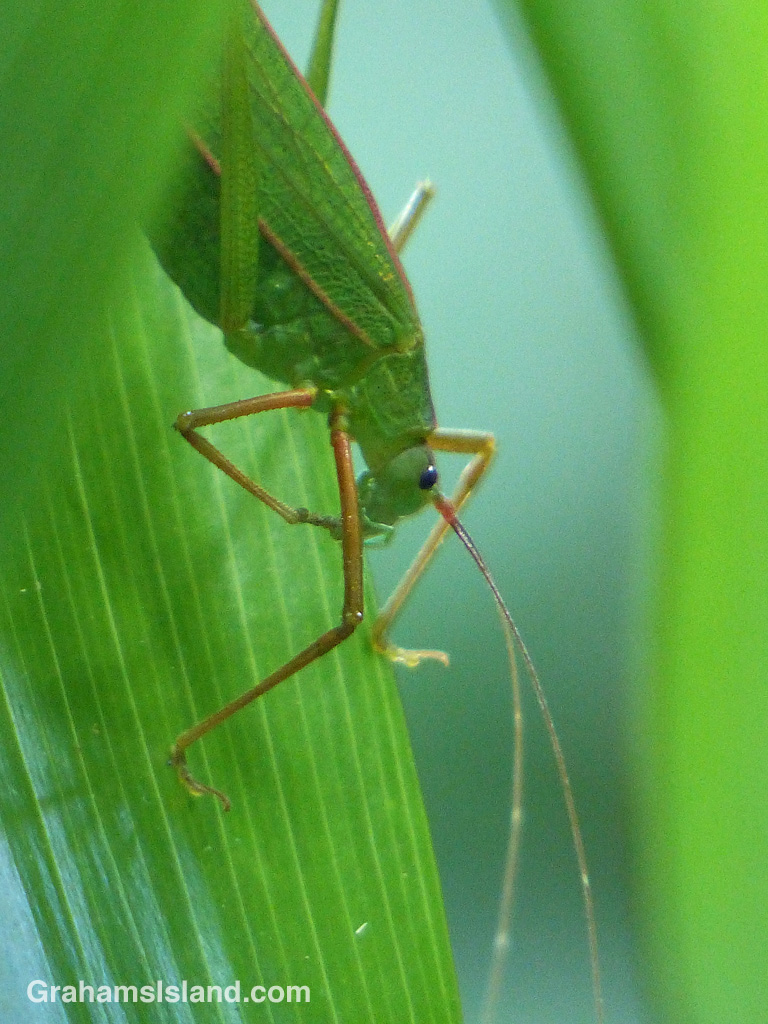
A katydid, probably heading toward one of the basil plants. I think this one might be one of the bush katydids, but there are an awful lot of them.
Spotted eagle ray
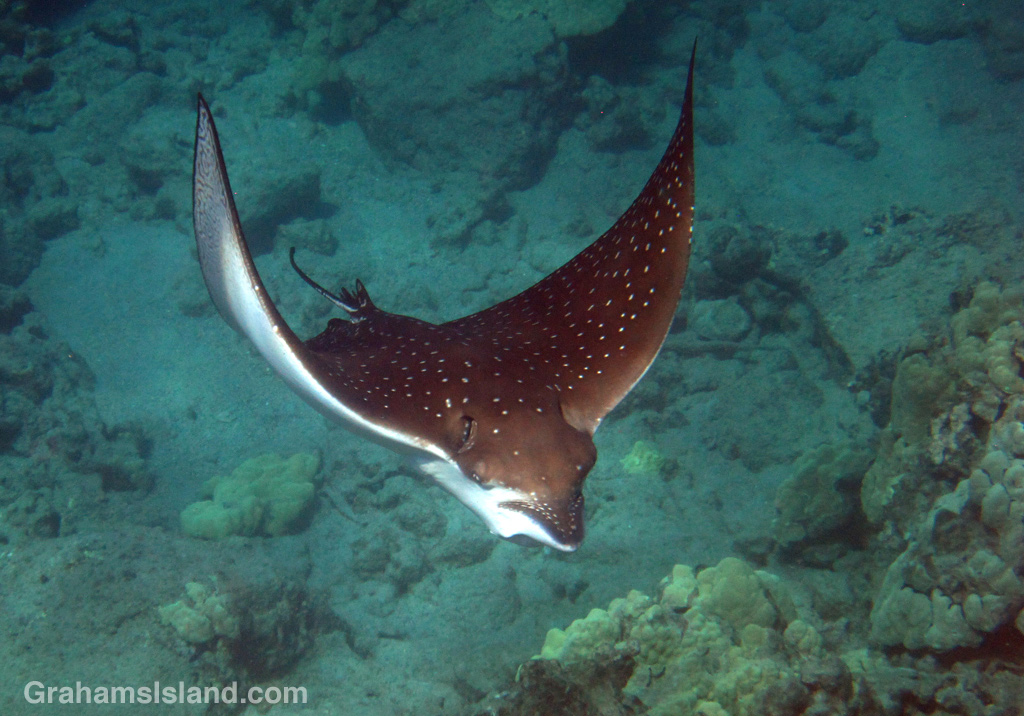

During the summer months, the west coast of the Big Island sees more southwest or westerly swells. These tend to roil the waters and reduce visibility. So it was a pleasant surprise recently, to dip into the water and find good visibility for the first time in a while.
The good visibility wasn’t matched by the appearance of rarely seen, exotic fish. Only the ‘usual suspects’ were to be found, which is no bad thing. I enjoy watching even the most common of fish. However, I confess I was feeling a tad disappointed at having my camera and good conditions, but not seeing anything that especially fired my enthusiasm.
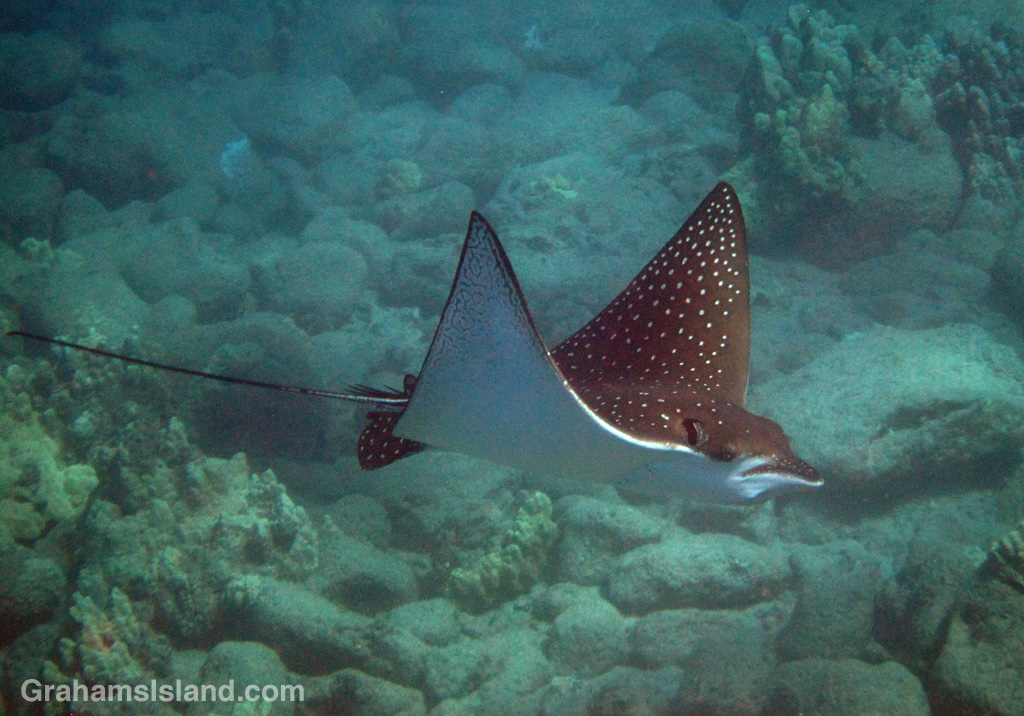
As if on cue, I looked up to see three spotted eagle rays coming toward me. One quickly slipped away and a second came and went. The third (second photo) cruised back and forth nearby, keeping an eye on me as I kept an eye on it. It had clearly lost its tail at some point. I’m not sure if a new one will grow back. In the bottom photo, the venomous spines at the base of the tail can be seen, though the venom is not nearly as toxic as that of some ocean dwellers.
After a while, the two remaining rays headed out toward deeper water and disappeared taking with them any disappointment I’d been feeling.
For more information about eagle rays, go to bioweb.uwlax.edu/bio203/s2014/hayward_paig/index.htm
Degarmoara Winter Wonderland ‘White Fairy’
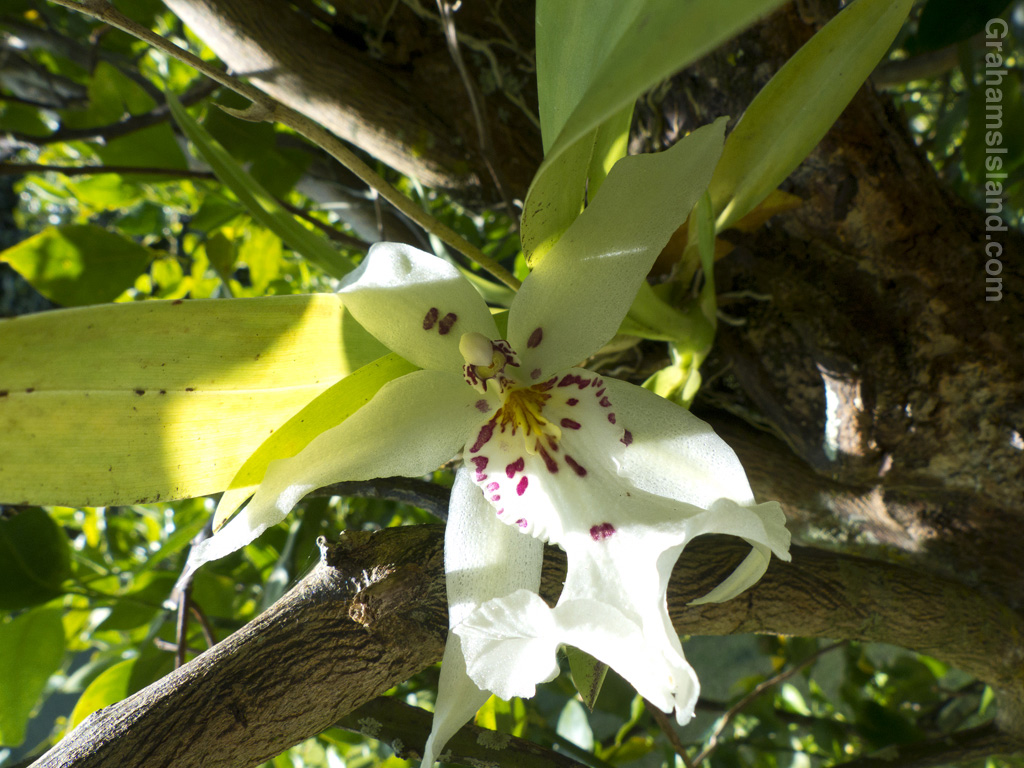
Apparently, there are around 8 billion different kinds of orchid. That, of course, doesn’t include hybrids. In my efforts to identify this flower, I tried all kinds of descriptions in my online search engine – ‘white orchid, purple spots,’ ‘epiphyte orchid, white with purple,’ ‘white and purple epiphyte.”
No matter what I tried I didn’t see anything that matched. I rifled through books at the library without success. Finally, I found a book, The Illustrated Encyclopedia of Orchids edited by Alec Pridgeon, that also failed to solve my problem. But the photos in the book did seem to indicate that this flower might be an oncidium orchid.
So I searched for ‘oncidium orchid, white with purple spots’ and voila, there it was. Of course, this being orchids, some photos were identified as ‘White Wonderland.’ Others referred to it as ‘Aliceara Winter Wonderland “White Fairy.”’ I plumped for ‘Degarmoara Winter Wonderland “White Fairy”’ because that appeared to be the more numerous choice. In the world of orchids, there seem to be varying opinions as to which plant fits in which species.
Now the only question is, how did this orchid come to be growing deep in the branches of a tangerine tree?
Abstracts: The pitter-patter of tiny feet
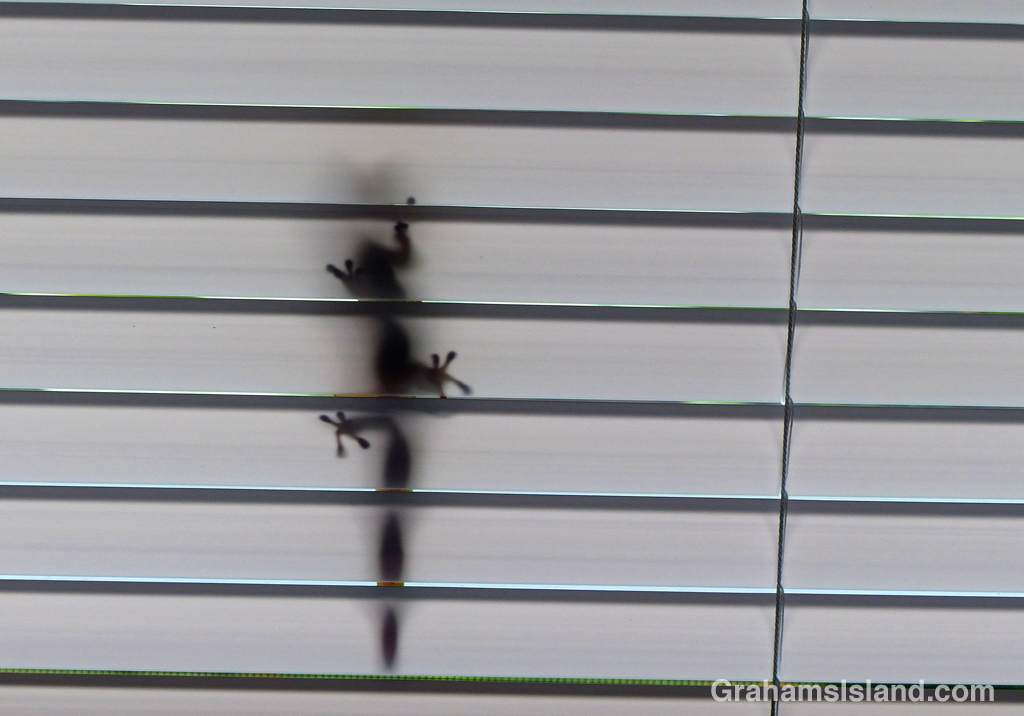
The telltale foot pads of a gecko making its way up the outside of a window blind.

