
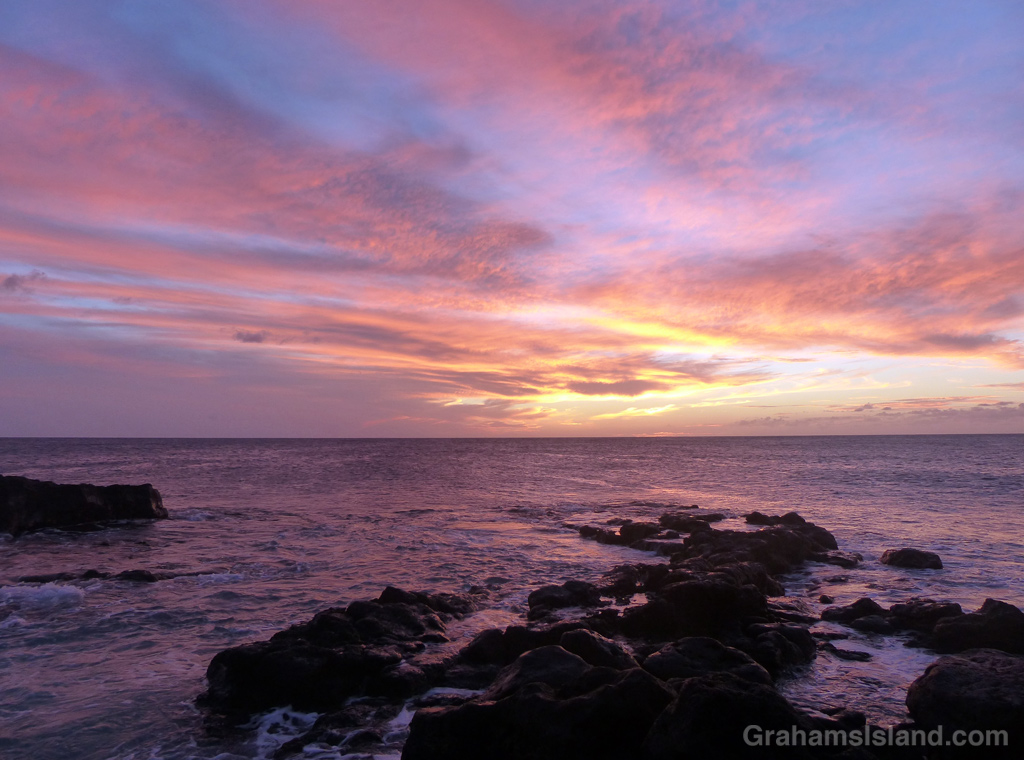
At sunset, the sky and water display a slowly-changing palette of pastels.
Better Days: Waipi’o boat
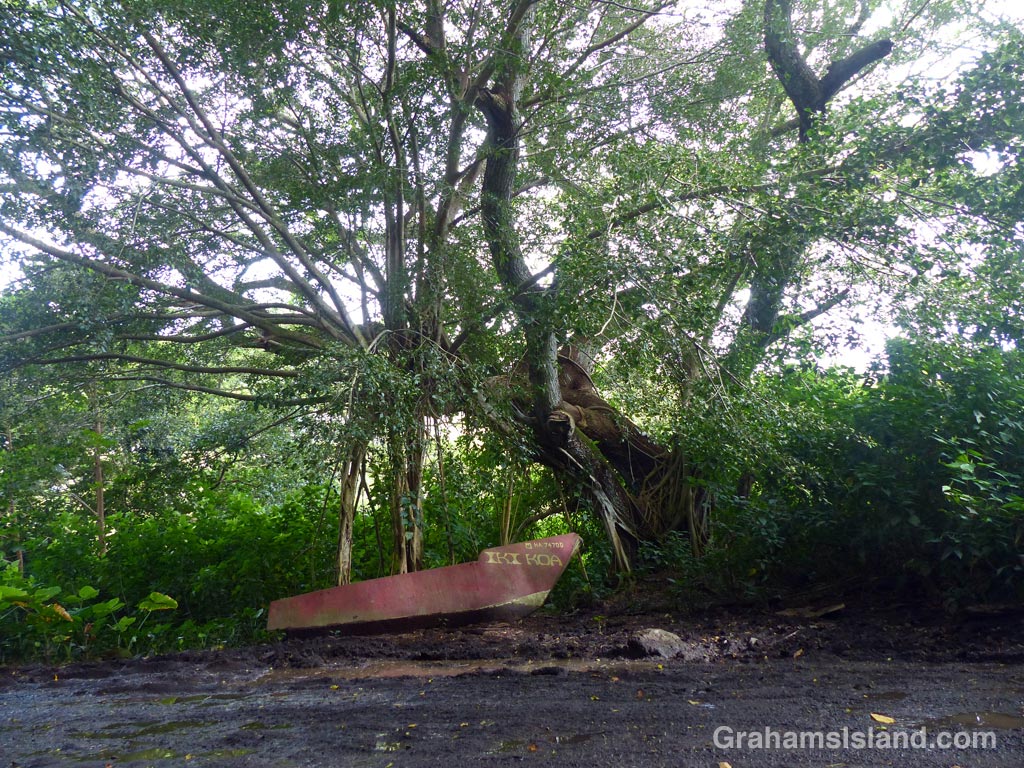
This old boat hull lies peacefully below the spreading limbs of what I think is a banyan tree on the road to Waipi’o beach.
Kilauea lava reaches the ocean – part 2

The lava flow lights up the pre-dawn sky.

Apparently, you can never be too close to get a good photo of the action.

The bottom of the flow, where the lava meets the sea. To the right is the beginning of a new black sand beach created by the activity.
Yesterday, I posted about the background to the trip my wife and I made to see lava entering the ocean from Kilauea Volcano’s Pu’u O’o vent. Today, I have a few more photos from the trip.
The Lava Ocean boat was a good-sized double-hulled aluminum boat and we were on the water around 4:30 a.m.. The trip out, in the dark, was uneventful and we arrived at the flow in dim, pre-dawn light. The bright lava glow cut through the darkness. Tiny figures materialized on the cliff top near the flow.
Once at the flow, the boat slowed and made passes back and forth. A couple of smaller boats were also around. Ashore, figures could be seen perched dangerously close to both the flow and the cliff edge. Several had gathered, with their cameras, on a raised knob of lava to one side of the flow. I hoped those photographers knew the risks they were taking. From their standpoint, they’d know they were near the edge, but from our vantage we could see that the knob they stood on was sharply undercut, a prime candidate to crash down at any time.
Our boat moved about, sharing time near the flow with the other boats, and providing views from different angles. It edged in close to shore, then away again. We could feel the heat from the lava. As daylight filled in, the drama of the glow ebbed, but more detail emerged – clumps of glowing lava tumbling down the slope, waves rushing ashore to explode into steam, and a steady river of lava flowing down the slope to the sea.
A helicopter from the United States Geological Survey (USGS) joined the scene, making close passes over the area. The USGS surveys Kilauea’s activity regularly and posts daily updates of the situation at the website below.
We were there an hour or so before heading back. The experience was everything we’d hoped, well worth the cost of the excursion. We were lucky that conditions had been good – not too windy and a quiet sea for that area. To top off the trip, on the way back we were joined, for a while, by a pod of spinner dolphins.
Today, the flow has widened and is putting on an even better show, but I’m happy to have seen what we saw, knowing I could check the situation tomorrow or the next day and find out that the flow has stalled, never to resume.
For more information about Kilauea Volcano and it current eruption, go to hvo.wr.usgs.gov/activity/kilaueastatus.php.
For more information about boat trips to see the lava, go to lavaocean.com.

The top of the flow with lava running over the edge. A couple more steps and the man on the right will be one with the flow. Ouch!

A couple of smaller boats were at the scene while we were there.
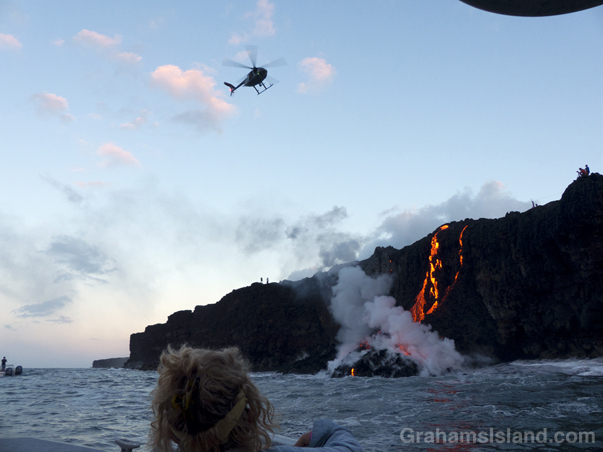
A USGS helicopter joined the scene for a while to monitor the state of the activity.
Kilauea lava reaches the ocean – part 1

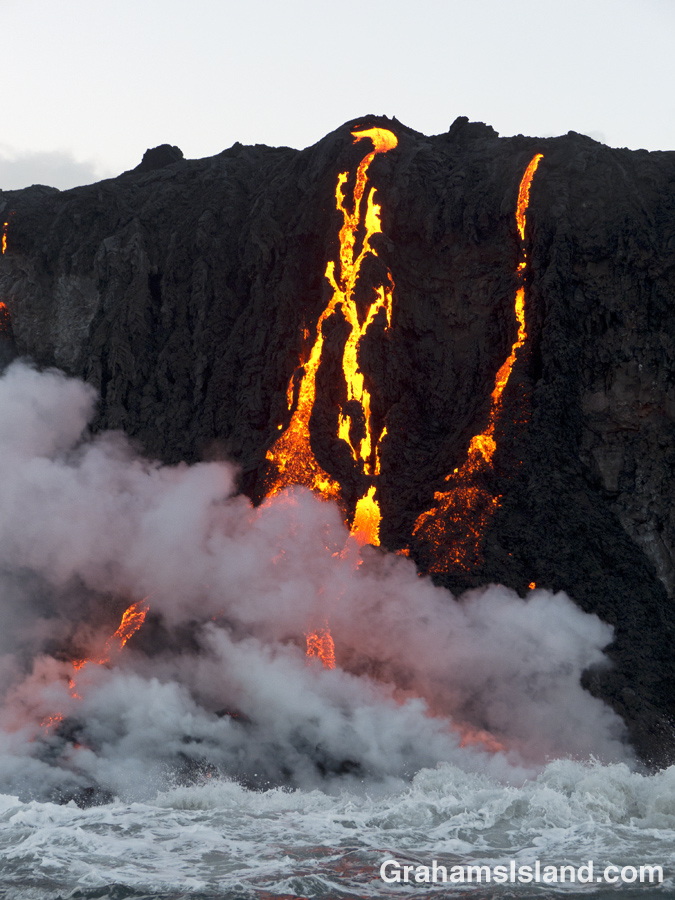
On July 9, I posted about a visit to see the latest lava flow (exotically named the 61g flow) from Kilauea Volcano’s Pu’u O’o vent. At that time the lava was less than three-quarters of a mile from the ocean and I figured I’d go back when it got closer to the emergency road (about a tenth of a mile inland) and the water.
That, of course, was the cue for forward progress to cease. The flow was still active, but mostly in breakouts to the side. Day after day the lava was noted as being about half a mile short of the water. I checked again on Sunday, still no change. Monday, I forgot to look. So naturally, Tuesday’s lava report, not seen until the late afternoon, reported that the lava had reached the ocean at 1:15 that morning. Scratch the idea of being present when that happened.
However, my wife and I really wanted to see the lava’s ocean entry from the water and it sounded as though at least one boat tour company, Lava Ocean Guided Tours, was already running trips. A phone call later, we were booked on the sunrise trip the next morning. Check-in time was 4 a.m.. Current time was 5:30 p.m.. Drive time to the launch place is three hours – it’s the far corner of the island. That left seven and a half hours for getting organized and, oh yes, sleep.
Today’s photos show we made it. At the top is the view from the sea, and people ashore perilously close to the flow. Second photo is a frontal view. Below, the morning scene looking toward the sunrise. Tomorrow I’ll post more photos and details, but first, a good night’s sleep is in order.
For more information about Kilauea Volcano and it current eruption, go to hvo.wr.usgs.gov/activity/kilaueastatus.php.
For more information about boat trips to see the lava, go to lavaocean.com.

Bird wrasse
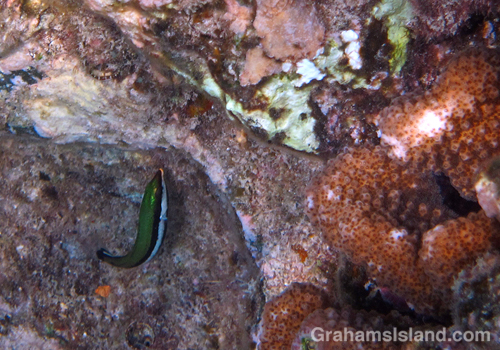
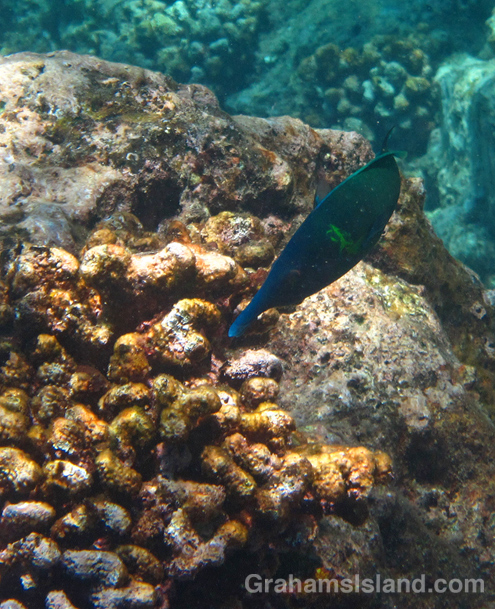
This bird wrasse is another of those fish that will grow up to look completely different than it did as a youngster. The juvenile above will not only change color, but will also end up with a much longer snout, like the fish on the right, a supermale.
In my attempts to identify what I see in the water, I use John P. Hoover’s book The Ultimate Guide to Hawaiian Reef Fishes, Sea Turtles, Dolphins, Whales, and Seals. His website is hawaiisfishes.com.
Tree tobacco

Tree Tobacco (Nicotiana glauca) heralds from South America, but in Hawaii, it’s an invasive species. The chances of eradicating it are slight. Controlling its spread is a more realistic possibility. But tree tobacco is one invasive species in Hawaii that does have something going for it.
Enter Blackburn’s sphinx moth (Manduca blackburni), a large, endemic moth, once thought extinct, and a long-time resident on the endangered species list. Among its problems is that its host species, ‘aiea, (Nothocestrum spp.) has been on the decline for a while. ‘Aiea belongs to the nightshade family (Solanaceae) as does tree tobacco.
It seems that the moth, in the interests of survival, decided tree tobacco is not so bad. So we have an endangered species becoming reliant on an invasive species. Hmm. As I said, control is the most likely approach with tree tobacco and that will undoubtedly involve checking to see whether Blackburn’s sphinx moth is present before removing areas of tree tobacco.
That’s good news for the plant in this photo. I found it at Pu’u Wa’awa’a, a State Forest Reserve on the northern slope of Hualalai. Pu’u Wa’awa’a is home to a variety of endangered plants and animals including Blackburn’s sphinx moth.
For more information about tree tobacco, go to cabi.org/isc/datasheet/36324.
For more information about Blackburn’s sphinx moth, go to fws.gov/pacificislands/fauna/bsmoth.html.
For more information about Pu’u Wa’a Wa’a, go to puuwaawaa.org.
Abstracts: Moth wing

I like these colors and patterns on the wing of a black witch moth.
Great frigatebirds meet Tropical Storm Darby
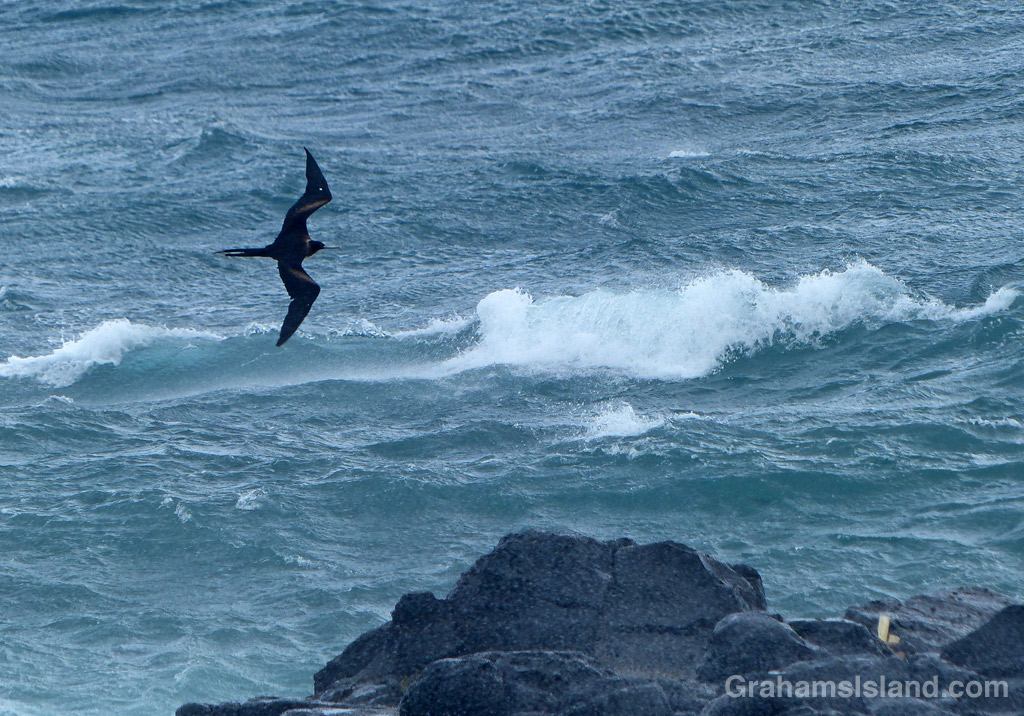
Tropical Storm Darby reached the Big Island yesterday. It was due to pass over this corner of the island during the night. The predicted track followed the north coast and since it was packing 60 knot winds on its approach, storm warnings were issued.
The power went out here Friday, getting the jump on the storm, but luckily it was just for an hour or so. Saturday dawned dark and windy with sudden, intense downpours, but in the early afternoon the weather broke for a short while and I went down to the coast to see how things looked. In truth, while it was very windy, it didn’t look that much worse than it often does around here.
On the way back from a short walk, some movement caught my eye. A large bird angling along the coast. Then another. In all, three great frigatebirds headed east, into the teeth of the storm. They made slow progress, sliding toward the coast, then away. Even though it was slow going, their progress looked effortless. They glided on the air currents, beating their wings only occasionally. The nice thing about their slow progress was that they remained in view for some time.
Returning home, the power was out again, but as the afternoon progressed the winds died to nothing (the storm had tracked farther south than anticipated). The early evening was tranquil enough that when I stepped outside, mosquitoes quickly buzzed around me. Mosquitoes do not do tropical storms.
Around 8:30 in the evening a decision needed to be made. Power had been out for seven hours or so and the contents of the refrigerator weren’t likely to last the night. It was time to pack the essentials into a cooler while trying not to lose whatever cold air survived in the fridge.
A smooth, military-style operation was worked out. Doors opened, items whisked from shelf to cooler, ice blocks rearranged. The operation was a success. I snapped the lid down on the cooler and the exact instant I did so, the microwave beeped and the power returned.

