Breakfast strikes back

Breakfast strikes backAt first, this green anole had the bug in its mouth, but then events took a turn for the worse. At first I thought the bug was a larder beetle, but now I believe it’s a Chinese rose beetle, though I wouldn’t bet the farm on that. In the end, it got away. The anole did not look pleased to have these events witnessed.

For more information about green anoles, go to en.wikipedia.org/wiki/Carolina_anole.

Anthurium

Purple anthuriumI believe these striking plants are purple anthuriums, which I saw at the Hawaiian Tropical Botanical Garden on the Hilo side of the island.

For more information about Hawaiian flowers, go to wildlifeofhawaii.com/flowers/. For more information about Hawaii Tropical Botanical Garden, go to htbg.com.

Oriental stink bug

An oriental stink bug on a basil leaf.

When I first saw this bug, I thought it was a Japanese beetle. Later, I realized I was wrong and it was a stink bug. They get their name because they can emit a foul-smelling substance when disturbed. Luckily, I didn’t disturb it enough to provoke that response, though there was no way I was going to leave it be on the basil plant where I found it. Most mornings see the plant with new holes or bite marks. Seems to be a favorite of just about every bug around.

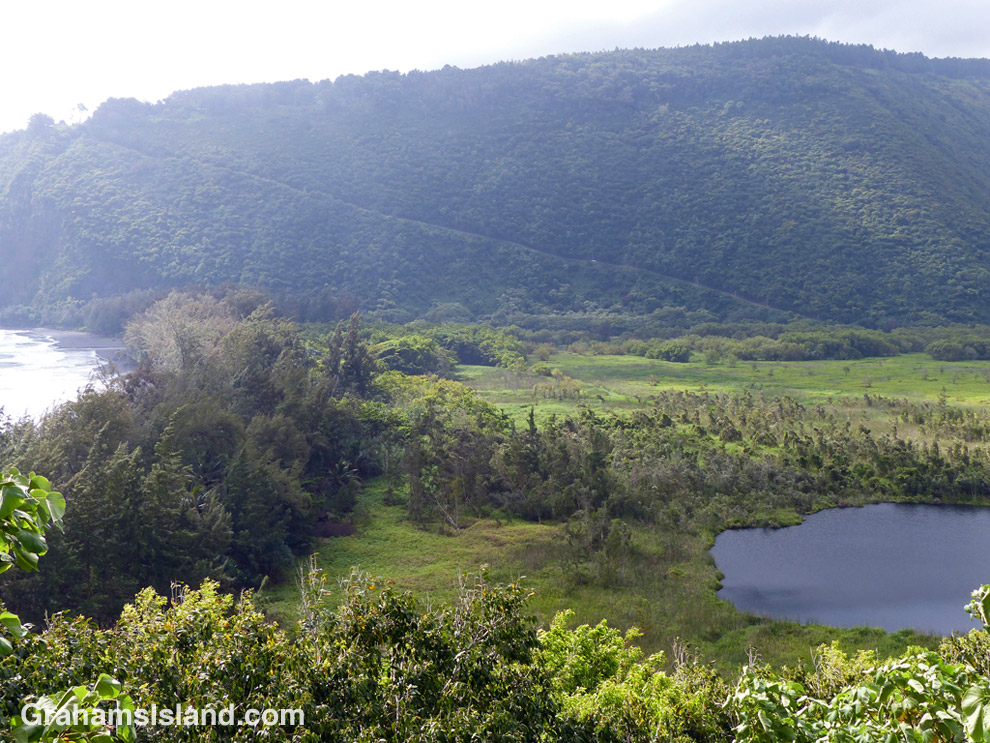
How green is my valley?

Lush foliage on the east side of the Big Island, Hawaii.
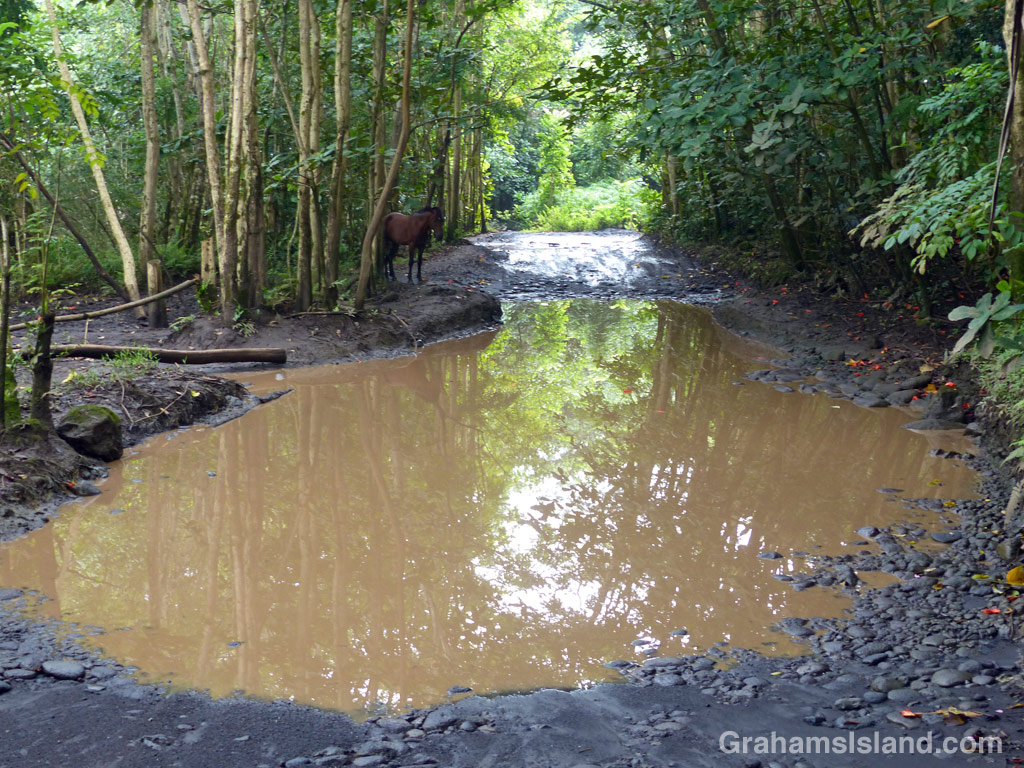
The north and east sides of the Big Island get more rain than the west – a lot more rain. Much of that area gets 100 inches and up. A good chunk of it gets more than 200 inches. By contrast, there are areas on the west coast that get less than 10 inches of rain a year. Two of the driest parts of the island are the summits of Mauna Kea and Mauna Loa, which also get less than 10 inches. That’s because they’re mostly up above the clouds.

The east side’s rain tends to be of the tropical variety – intense downpours that don’t necessarily last long. Several inches can fall in the space of half an hour. Flash floods are a threat all over the island. Those heavy rains falling up on the hills can channel down west side gullies.

Another result of all that rain is that the foliage is luxuriantly tropical: towering trees and shrubs, extravagantly large leaves, and vines with everything. This scene is on the coast near the Hawaiian Tropical Botanical Garden north of Hilo.

For more information about Hawaii Tropical Botanical Garden, go to htbg.com.

Great frigatebird

Great frigatebirds on the wing

A great frigatebird on the wingUsually I see this bird in ones or twos, but on this occasion, I saw a flock of 15 or more cruising along near the coast.

It’s known in Hawaii as the ’Iwa, which means ‘thief.’ It gets this name because it sometimes harasses other birds into dropping their catch, which it then swoops down to retrieve. Mostly though, it feeds on squid and flyingfish. Since it can’t take off from water, it scoops prey out with its hooked beak while on the wing.

The single bird pictured is a female, distinguished by the white breast and neck.

For more information about great frigatebirds, go to fws.gov/refuge/hawaiian_islands/wildlife_and_habitat/great_frigatebird.html.

Sea Monster?

Sea MonsterSeemed like a good day to run a photo I took a year or so ago, but what kind of terrible sea monster is it, rising from the ocean, jaws agape?

Truth is, it’s a humpback whale about to splash back into the water. The ‘lower jaw’ is really a pectoral fin. The ‘spiky teeth,’ are tubercles, knobby bumps on the fin’s leading edge. The ‘upper jaw’ is the lower jaw seen from below. And the ‘eye’? Well, that’s an eye, no fooling.

For more information about humpback whales, I recommend Jim Darling’s book, Humpbacks: Unveiling the Mysteries or go to whaletrust.org or hawaiihumpbackwhale.noaa.gov/welcome.html.