Signs: What’s for breakfast then?

What's for breakfast then?A favorite sign of mine at a local state park. Among the usual warnings is the draconian limit on drinking hours. I mean, what’s a person supposed to do for breakfast? It will come as no surprise to know that the rule is routinely ignored and I doubt it’s ever been enforced.

Gold dust day gecko

A gecko sparkles in the sunlightThis gecko is probably the most commonly seen here, given that it’s diurnal, numerous, and not shy. It doesn’t hurt either that it’s so brightly colored. Its brilliant green and gold body has red markings on the head and back. A striking blue above the eyes and matching blue feet complete the ensemble.

The intensity of the colors can dull to a dowdy hue at certain times but when they’re at their brightest, they really are like little jewels.

For more information about geckos, go to geckoweb.org.

Reef fish

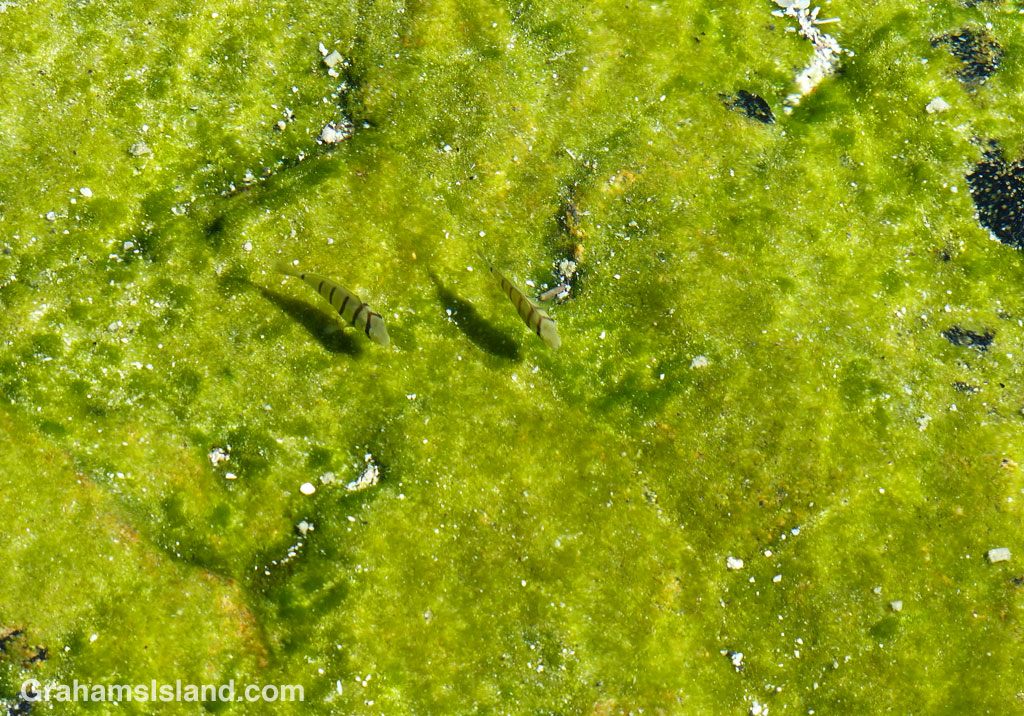
Many fish make the reef homeA great variety of fish make their home among the rocks and coral on the coast. From the bottom these are: two indo-pacific sergeants, a scrawled filefish, two or three whitebar surgeonfish, and in the background, a number of black triggerfish.

One of the pleasures of snorkeling here is that there’s always something to see and every day is different.

In my attempts to identify what I see in the water, I use John P. Hoover’s book The Ultimate Guide to Hawaiian Reef Fishes, Sea Turtles, Dolphins, Whales, and Seals. His website is hawaiisfishes.com.

Yellow-billed cardinal

Yellow-billed Cardinal
030916-951-Yellow-billed-Cardinal-HWA South American bird, the yellow-billed cardinal was introduced to Hawaii and is quite common on the Big Island. I saw these two birds flitting through a stand of kiawes. The bird in the top photo was working hard on the bit of foliage in its beak. I assumed this was something for a nest, but didn’t see where the bird went. The second bird just hung out in the trees, possibly keeping watch.

Anoles on wire

Anoles on Wire
Anole on WireThere’s something of a daily ritual here involving the green anoles who live under the roof. Each morning two or three small anoles will head out on the cable wire and jump off into the cane grass. I call it the anole commute.

On this particular morning, a large green anole was out on the wire first. When one of the smaller ones approached, the big anole got agitated as anoles are wont to do. He began his ritual of head bobbing and puffing out his dewlap. The little fellow came on, sliding to the side of the wire. Suddenly it jumped onto the nearby telephone wire, scooted past, and leapt into the cane grass. The big anole spun around, but too late. He continued to extend his dewlap for a while to let any watchers, including me, know that this was his territory and he was not to be messed with. Point taken.

For more information about green anoles, go to en.wikipedia.org/wiki/Carolina_anole.