

 This week’s Friendly Friday challenge theme is ‘Comfort Zone.’ (See more responses here.) In my youth, swimming in the sea wasn’t something I enjoyed. This wasn’t because I was afraid, but rather that I was so skinny, I was instantly cold when I got in. Here in Hawaii, that’s no longer a problem. I’ve added a few pounds and the water’s warmer, so when I go snorkeling, I feel at home. There can be strong currents, big waves, and sharks with more sharp teeth than seems necessary, but I don’t worry about any of this. I try not to do stupid things in the water, but instead enjoy putting along and watching the fish.
Lately, I haven’t been able to get in as much and, because of a series of large swells, when I have, the water quality hasn’t been great. A couple of days ago I popped down hoping to cash in on some calm waters before a new swell filled in. Alas, the swell was bigger than the previous day, with some large sets rushing in and crashing ashore.
I thought the day was doomed, but got in anyway and immediately couldn’t see a thing. The water was all stirred-up sand. But visibility is often better farther from shore so I swam out. It did improve and by the time I got to one of the areas I usually visit, the visibility was OK, if not exactly great. By way of compensation, lots of fish were active, milling around near the surface and in deeper waters.
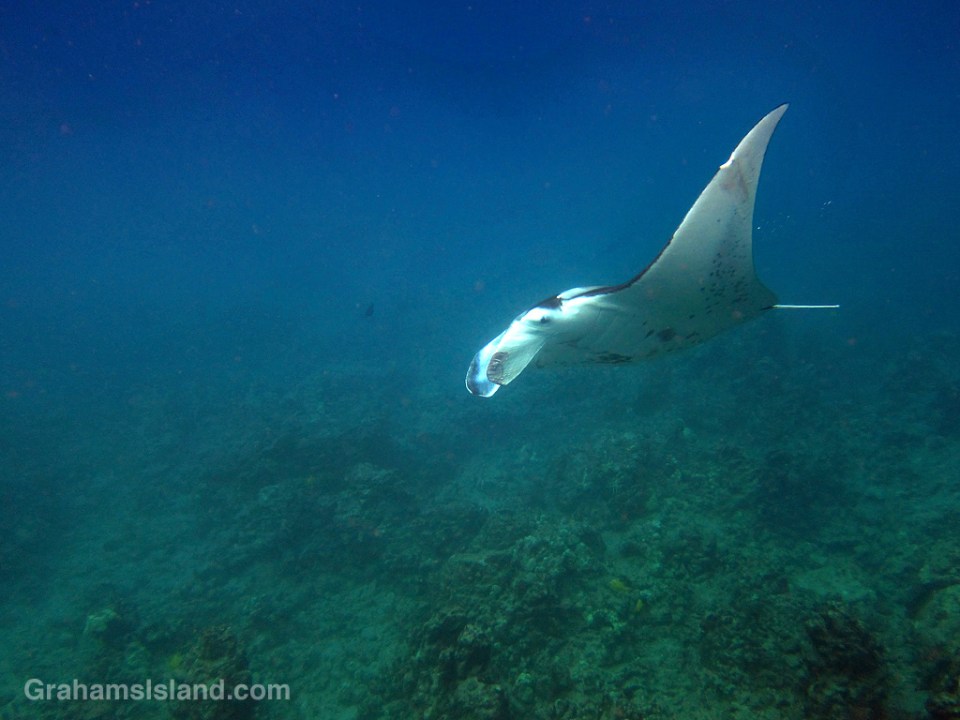
I was checking out these fish when I glanced to one side and saw this manta ray coming my way, not 20 feet away. It was a big one, with a wingspan of 8 to 10 feet. I hadn’t seen it before, but it was traveling fast enough that I wasn’t surprised by that. I snapped a couple of quick photos (including the one below) and then it was past and heading into the murk. I turned to follow.
One thing I’ve learned is that it’s mostly a futile activity chasing fish of any kind. In the water, I’m a model T Ford in a world of turbocharged Ferraris. The manta was swimming with little effort but easily outpacing me. But I noticed that it was heading into the bay and I thought that if I cut straight across the bay, I might see it again as it swung out.
Sadly, the visibility got worse the farther I went and I resigned myself to not seeing it again, right about the time the manta emerged from the gloom heading toward me. It cut across in front of me and I took the middle photo. It says something about how close the manta was that I was able to get a decent photo in such murky water.
Once again the manta disappeared with languid ease, heading south. I followed for a bit before I gave up and started looking around to see what else was in the water. Moments later the manta reappeared, again heading my way. Again it slipped by in front of me (top photo). Again, I followed, lost it, and then saw it coming toward me. The manta ray was clearly curious, checking me out, wondering this thing what in the water was that apparently could barely swim.
After it disappeared again, I waited a while but didn’t see it again and headed back to shore. When I got out, I saw another swimmer about to get in. “Did you see it?” he asked. I told him what had happened. “It’s still there,” he said, and then got in to see if he could find it.
Sure enough, the manta was visible from shore, its back showing through disturbed water, and its wingtips occasionally breaking the surface. As I watched, the manta ray swam back and forth, staying in the center of the bay, not that far from shore. I’d been in the water with it for about half an hour, and watched from the shore for another 20 minutes. When I left, it was still there.
I’ve been on a manta ray tour and there are others that take snorkelers to swim with the dolphins or to watch whales, but there is nothing quite so exhilarating or rewarding as a chance encounter. I headed out with low expectations and little enthusiasm, and returned energized. It’s moments like this that make living in Hawaii, indeed just living, worthwhile.

 It’s been a while since I was last at Pohoiki, also known as Isaac Hale Beach Park. One reason for this is that it’s about as far away from where I live as is possible on the island. But back in July 2016, I went down there at an ungodly hour to board a boat and go see lava flowing into the ocean. I wrote about that trip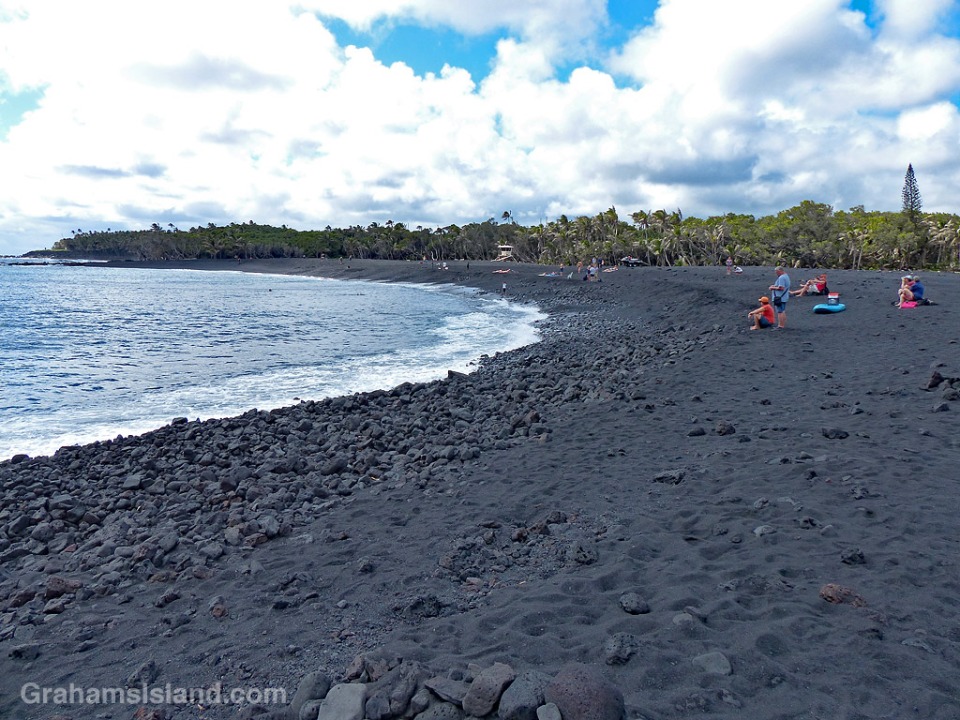


 The recent lunar eclipse occurred last Sunday evening here in Hawaii. When the moon rose at 6:02 p.m. (five minutes before sunset) the eclipse was already well underway. Where I was watching, the sky was hazy so the moon wasn’t very clear. It then disappeared into a bank of clouds and I considered heading for home. But the cloud bank wasn’t huge and was drifting away from the area I was watching.
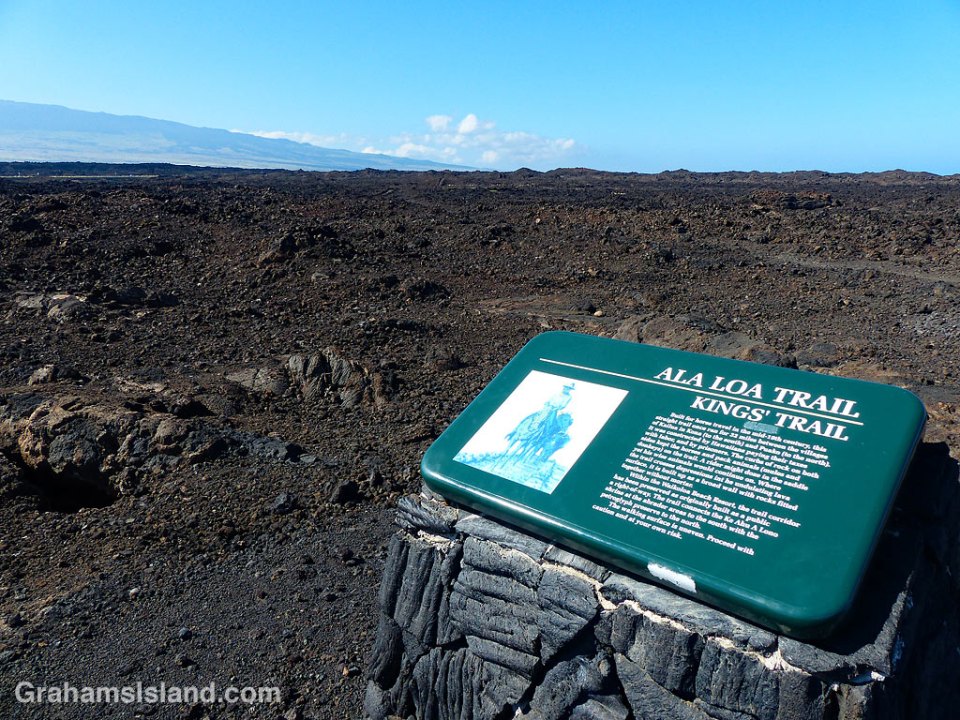
 The Kings’ Trail, is more properly known as the Ala Kahakai Trail (shoreline trail) or the Ala Loa Trail (long trail). The trail was created in the 1800s and stretched 175 miles from Upolu, at the northern tip of the island, down the west coast and up the south coast, to Kalapana in the southeast corner.
 Graham's Island