
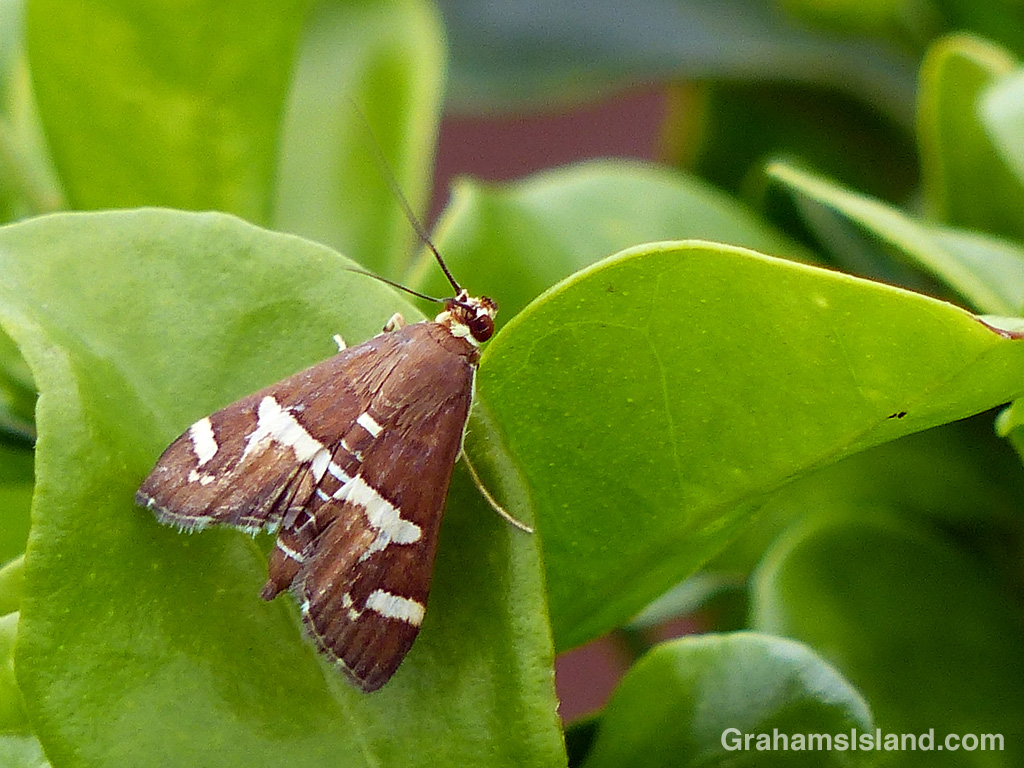
While Hawaiian beet webworm moth (spoladea recurvalis) sounds quite local, this moth is actually widespread in warm regions of the U.S. and other parts of the world. Also widespread is the damage its larvae does to chard, spinach, weeds in genera Chenopodium and Amaranthus, and of course beets.
Tag Archives: Macro
A jumping spider snags a meal
I was watching some butterflies recently when my eye was caught by something tiny (we’re talking a quarter-inch long here) bouncing across the dirt in front of me. I peered down and snapped a couple of photos before it disappeared. I’d seen enough to recognize it as a spider and the photos, while not great, were good enough to enable me to identify it as a striped lynx spider, a kind of jumping spider.
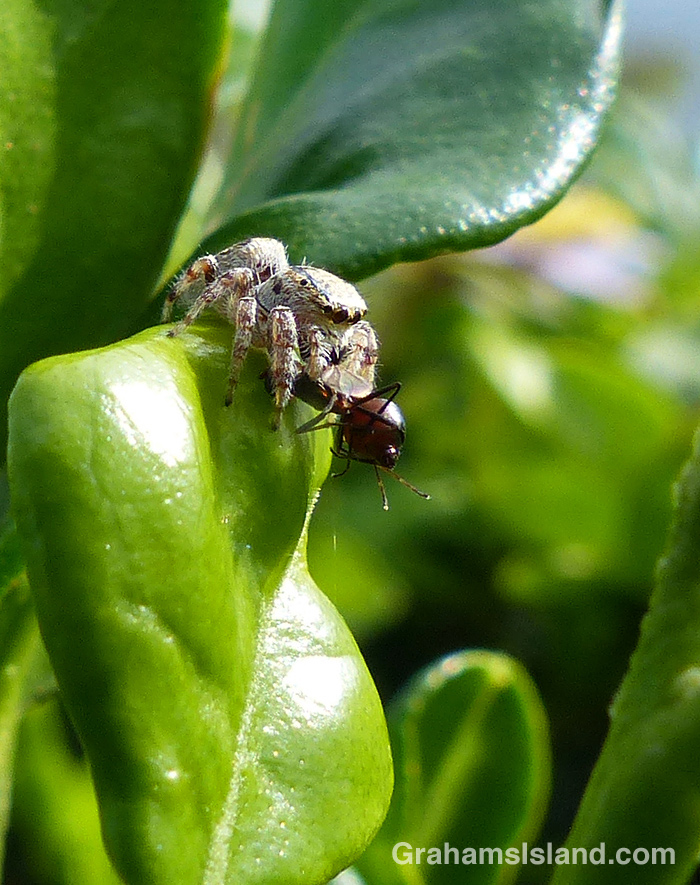
Not long after that, I was again watching butterflies and other bugs inhabiting a mock orange hedge, when I saw this little creature. Again, no more than a quarter inch long, it’s movement caught my eye against the glossy green of the mock orange leaves. A different kind of jumping spider, it hung around, enabling me to get this photo, because it had latched on to what I think is a parasitic wasp. Jumping spider don’t make webs, they pounce on their prey.
Jumping spiders are in the family Salticidae, but there are numerous species within the family and I haven’t yet been able to identify which this is. A characteristic of these jumping spiders is the pair of large eyes in front. This gives them very good eyesight, useful in identifying prey.
Another thing I’ve found out is that they’re everywhere around here. Now that I’m aware of them, and looking out for them, I see them often where I had never noticed them before. Mine eyes have been opened to the glories of the jumping spider – or something like that.
Fiery skipper butterfly
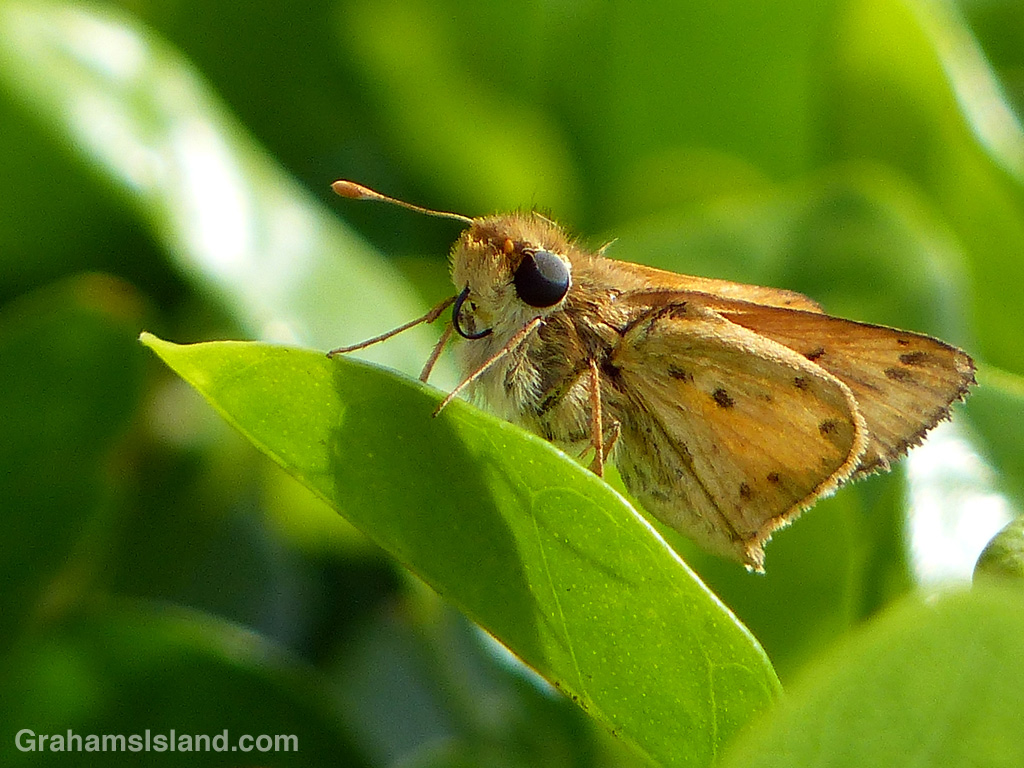
A male fiery skipper butterfly sits on a leaf pondering its next move.
A passion vine butterfly lays her eggs

I watched this passion vine butterfly flitting around on a hedge, laying eggs atop the leaves of, you guessed it, a passion vine growing in the hedge. Typically, she deposits a single egg on each leaf, but this butterfly laid two on this one.
The butterfly is selective about which leaves to use. She chooses ones that have no eggs on them yet, since this will reduce the competition for her offspring. On the leaf she’s using in the photo are some yellow spots. I thought these might be where eggs had been laid previously, but some passion vines produce these colored bumps to make it look like eggs are already there and thus discourage the butterfly.
Not that laying eggs on unoccupied leaves guarantees survival. I saw a number of small parasitic wasps checking out the yellow bumps on several leaves. I have no doubt they do the same with the real eggs. I also saw a very small passion vine butterfly caterpillar snacking on what looked suspiciously like a newly-laid egg. And there’s always the possibility that someone will come along and trim the hedge. Not sure what the vine or the butterfly can do about that.
Black stink bug

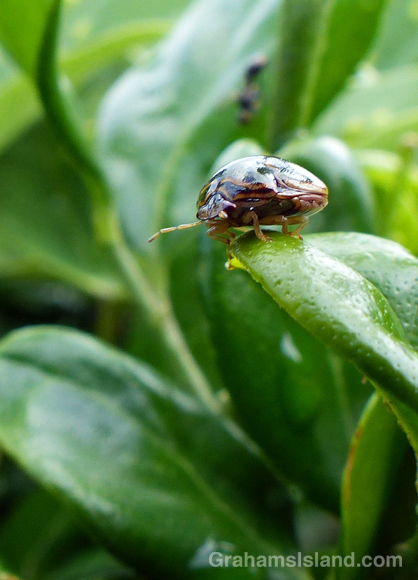
I thought this was a lady bug when I first saw it, but a bit of research revealed that it’s actually a black stink bug (Coptosoma xanthogramma). Black stink bugs were first found in Hawaii in 1965 on Oahu and can be problematic for some legumes and vines here.
Young katydid

This very small katydid gave me a wary look as I descended the front steps. It had good reason to since katydids have been one of the main munchers of the basil plants. But since those plants are now safe under netting, I tiptoed past without so much as a nasty glare.
Better Days: Hawaiian garden spider
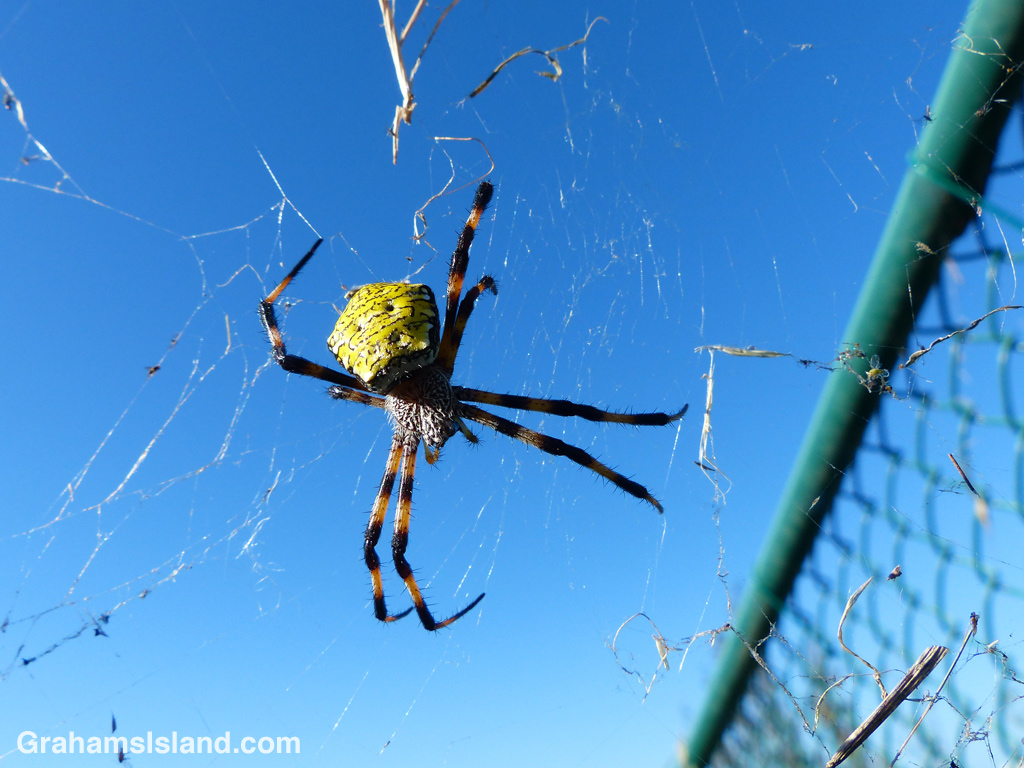
I came across this brightly-colored Hawaiian garden spider, the female of the species, in the late afternoon of a windy day. Her web shows debris that’s been blown in and likely encounters with bugs large and small. The web looks like it’s on its last legs and indeed it is because, at the end of the day, this spider will eat her web (or what remains of it) and start afresh in the morning.
Grasshopper shadow

A grasshopper casts a shadow on a glass windshield.

