Tag Archives: Mauna Kea

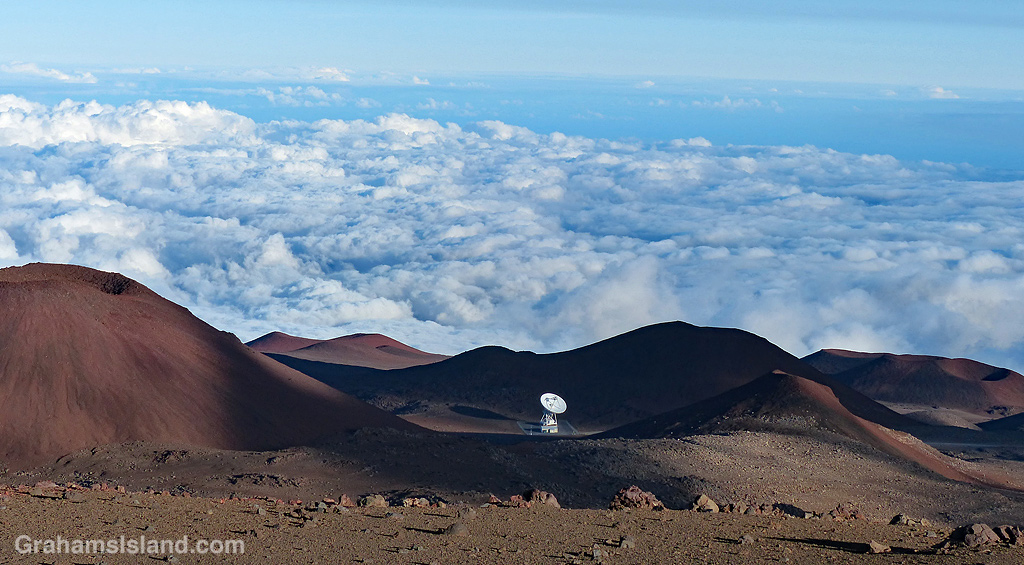
Very Long Baseline Array on Mauna Kea

The very long baseline array on Mauna Kea is one of the ten radio telescopes that make up the Very Long Baseline Array (VLBA)Most of the telescopes on Mauna Kea are clustered together near the summit, but about halfway between the Mauna Kea Visitor Center and the summit is this lonely telescope. It’s one of the ten radio telescopes that make up the Very Long Baseline Array (VLBA), which began operating in 1993. Eight of the other telescopes are scattered around the U.S. mainland with the tenth at St. Croix in the Virgin Islands.

The Mauna Kea telescope, like the others, consists of a dish antenna 82 feet in diameter, and an unmanned control building. These ten telescopes are remotely operated from the Domenici Science Operations Center in Socorro, New Mexico.

For more information about the Very Long Baseline Array, go to https://public.lbo.us/.

Abstracts: James Clerk Maxwell Telescope mirror framework

Framing supports the mirror on the James Clerk Maxwell Telescope.

Last year, when I went on the Kama‘āina Observatory Experience, I visited a couple of telescopes. One of them was the James Clerk Maxwell Telescope, a single-dish telescope dedicated to detecting submillimetre radiation.

One of the things I liked about that telescope was the structure of the supporting framework. It reminded me of something found at Ikea, but on a giant scale. If I’d been involved in putting it together, at the end of the day, when congratulations were being bandied about, I’d have been the one saying, “Er, I’ve got a rod and three little hexagonal nuts left over. Where do they go?”

Mauna Kea shadow

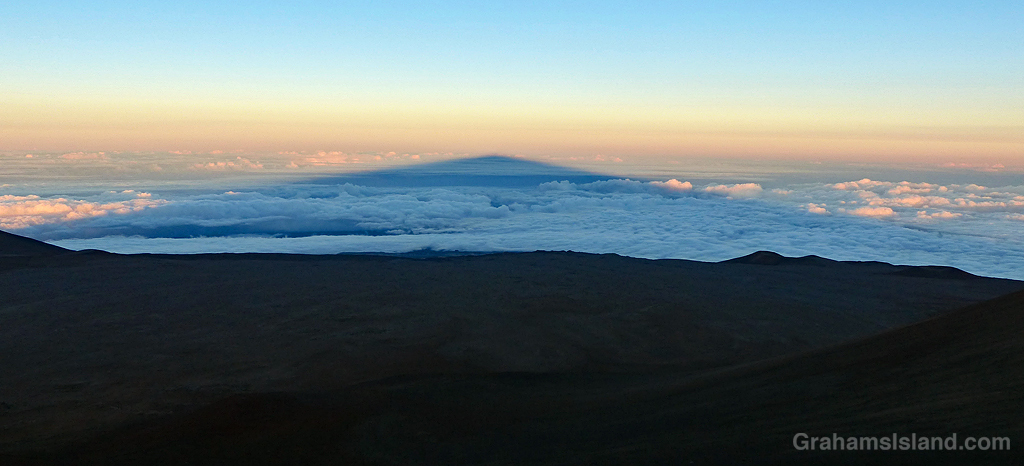
The shadow of Mauna Kea stretches out above the clouds.

Seen from the top of Mauna Kea, what is this shape we’re looking at, stretched out over the clouds, with that crisp corner at the top? It is, of course, the shadow of the volcano itself.

I like this image a lot, I think because it’s something I never thought about until I saw it. Then, I was immediately struck by how it illustrates the size of Mauna Kea and what a classic volcano it is.

Mauna Kea telescopes

Mauna Kea telescopes as sunset nears.

Waiting for sunset at the top of Mauna Kea, there are many distractions – shiny telescopes, other sunset watchers, pillowed clouds, and plummeting temperatures. By the time I returned to the car I was ready to turn up the heat, a rare opportunity in Hawaii.

The telescopes are from left: Suburu Telescope, The two telescopes of the W. M. Keck Observatory, and NASA Infrared Telescope Facility.

Mauna Kea rain

Cloud and rain on Mauna Kea

Mauna Kea is a mecca for astronomers because it boasts clear skies more than 300 days a year. That doesn’t mean Mauna Kea doesn’t get rain, just that it falls more on the lower slopes.

This photo shows the access road, a little way below the summit, socked in with clouds and steady rain. It was a little better at the top, but still very cloudy and not a day for seeing stars.

Mauna Kea snow

Snow covers the summit of Mauna Kea

This week’s posts are in response to the WordPress photo challenge on the theme of ‘transient.’

Despite the tropical latitude of the Big Island, Mauna Kea can get snow at any time of year. It’s always fun to see the mountain with a white coating. In the winter it sometimes sticks around for a while. At other times of the year it’s usually here today, gone tomorrow.


Hawai‘i ‘amakihi

A Hawaii Amakihi about to feed on mamane flowers.A Hawaii Amakihi about to feed on mamane flowers.

‘Amakihi are endemic honeycreepers and the different islands have slightly different versions of the bird. The Hawai‘i ‘amakihi is very similar to the Maui ‘amakihi, but the O‘ahu and Kaua‘i birds have more noticeable differences. They’re one native bird that has adapted relatively well to changing habitat and introduced diseases including avian malaria.

This one was feeding from bright yellow māmane flowers at the Palila Forest Discovery Trail on the southwest slope of Mauna Kea.