Tag Archives: Mauna Kea

Māmane

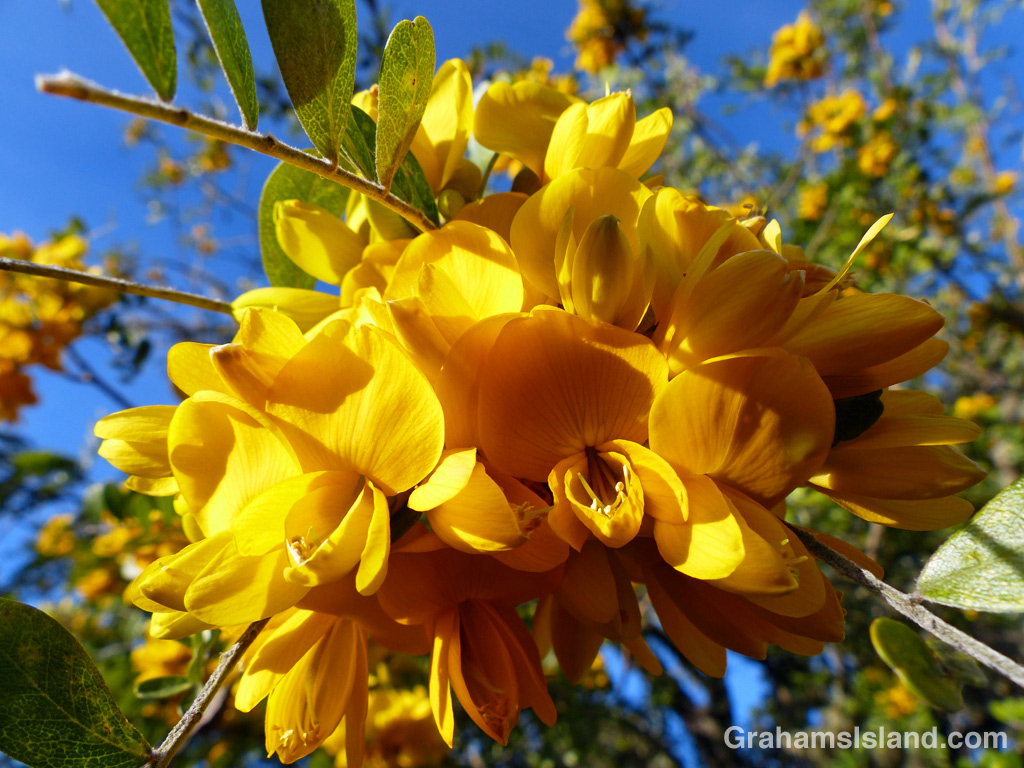
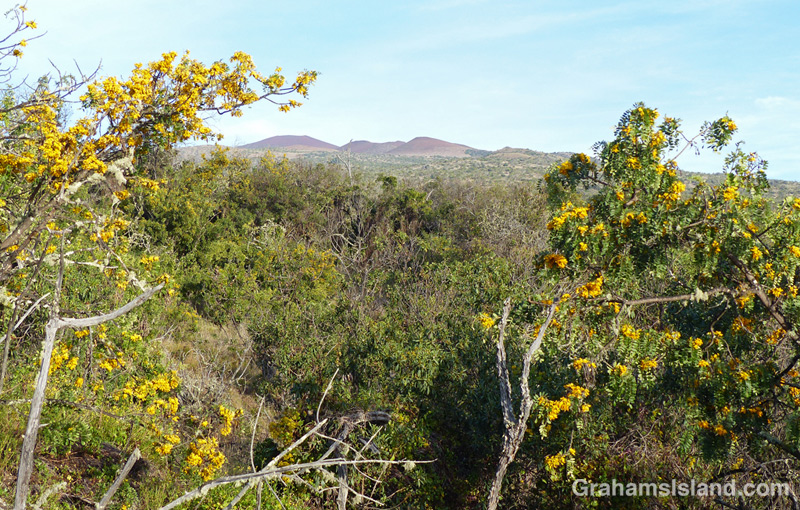
The flowers of the mamane tree in Hawaii.Mamane trees on the slopes of Mauna Kea.
Māmane (Sophora chrysophylla) is an endemic Hawaiian tree which grows in the dry forest on the sides of Mauna Kea. These māmane are in the recently-opened Palila Forest Discovery Trail at an elevation of around 7,000 feet.

Māmane is an important plant for several endemic Hawaiian birds including the endangered palila, which is found only in this area. Palila depend on māmane trees for 90% of their food, the most important item being immature māmane seeds. These seeds are poisonous to other wildlife, but not palila.

Palila Forest Discovery Trail is part of an ongoing effort to reestablish the high-elevation dry forest on Mauna Kea, which has been greatly impacted by non-native goats, sheep, and cattle.

For more information about Palila Forest Discovery Trail, go to dlnr.hawaii.gov/restoremaunakea/palila-forest-discovery-trail/.

Mauna Kea’s winter wonderland
Snow on Mauna Kea
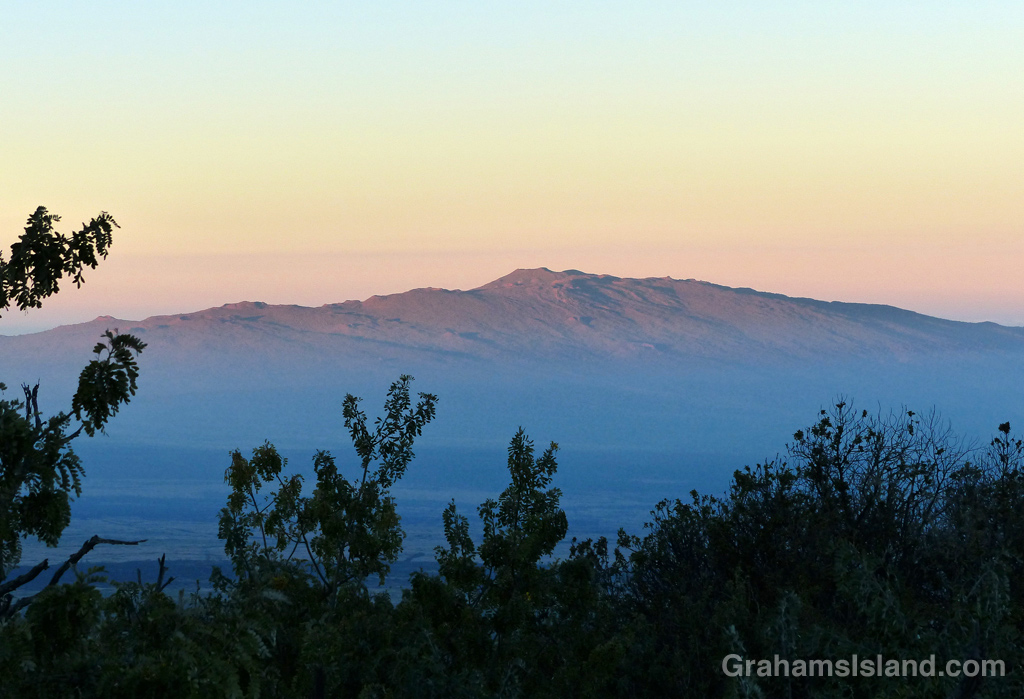
The past few weeks have been very wet on the Big Island with moisture-laden systems sweeping through from the south as well as the usual northeast. As a result, both Mauna Kea and Mauna Loa have received generous amounts of snow. This view is taken from the relative warmth of the Kohala coast.

Mauna Kea telescopes

The CalTech Submillimeter Telescope is one of 13 currently operating on Mauna Kea.
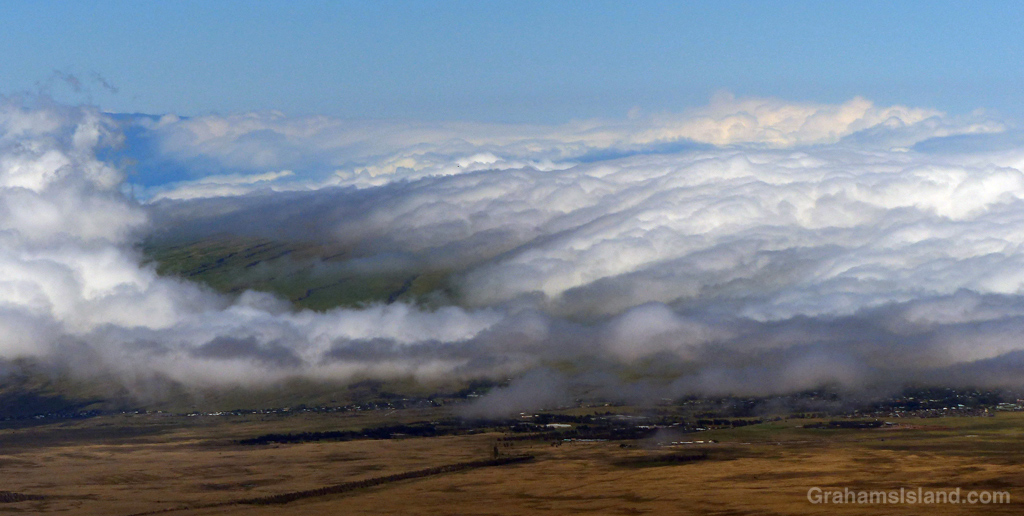
One of the reasons Mauna Kea is a prime spot for telescopes is that it boasts clear skies for more than 300 days a year. It’s common to see clouds below the summit, but less so to see them passing above the summit like this.

In the foreground is the CalTech Submillimeter Telescope, one of 13 currently operating on the mountain.

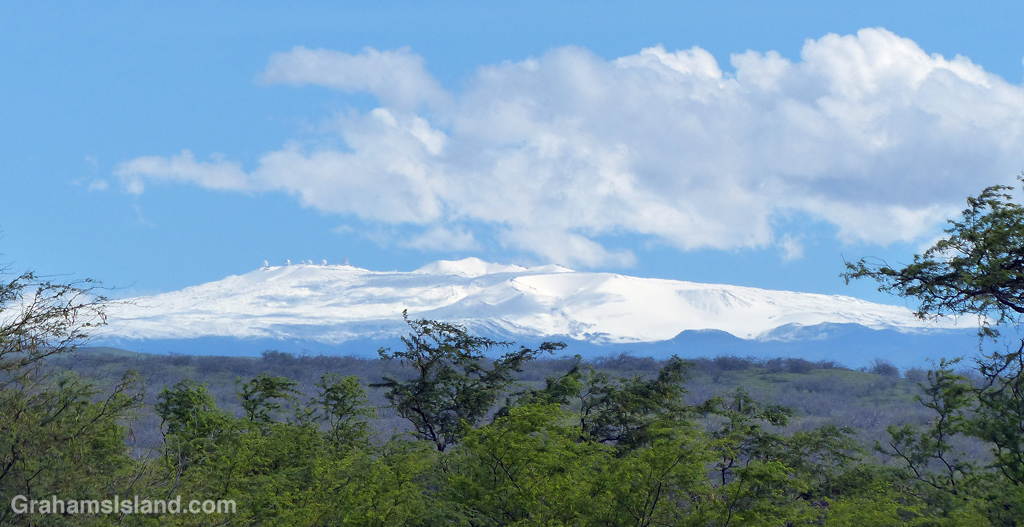
Snow on Mauna Kea

Snow on Mauna Kea seen from Waimea.

Ah Hawaii, a place of golden sandy beaches, warm tropical waters, luxuriant foliage and snow-capped peaks. Wait a minute! Snow? In Hawaii?

It’s true. Here on the Big Island, Mauna Loa and Mauna Kea are high enough to see snowfall most years. People go up there to ski and tube. There’s a local tradition of driving up the mountain, loading a pickup truck with snow, and then driving back to lower elevations for a snowball fight.

This winter’s first snow fell yesterday. Last year, there was a snowfall in July! This photo is from last winter, taken from Waimea, which as the foreground suggests, is paniolo (cowboy) country.

This is one image where I photoshopped something out, in this case a distracting wire trailing above the building’s roofline.

James Clerk Maxwell Telescope

The JCMT from the outside with its huge Gore-Tex tarp curving up and in. The tarp protects the dish from wind and blown sand. It also reflects visible and near-infrared radiation which allows for daytime observations.
The dish of the James Clerk Maxwell Telescope on Mauna Kea.
The dish of the telescope. The shinier areas are where telescope staff experimented with cleaning the dish using Swiffer Sweepers. A little dirt on the dish doesn’t affect readings at the wavelengths where the JCMT operates.
The framework supporting the dish of the James Clerk Maxwell Telescope on Mauna Kea.
The framework which supports the telescope’s dish.

I posted here about a visit to the Canada-France-Hawaii-Telescope on Mauna Kea as part of the Kama‘āina Observatory Experience being offered by the island’s observatories. The other observatory visited during that tour was the James Clerk Maxwell Telescope (JCMT).

The JCMT began operation in 1987 and was funded by the United Kingdom, Canada and the Netherlands. However, the United Kingdom decided to improve how it handled its scientific funding and, as a result, early in 2015, the JCMT’s funding efficiently disappeared into deep space and was never seen again. Subesequently, as one of the guides on the tour said, they basically put the telescope on Craigslist and the East Asian Observatory (EAO) picked up the operation.

The telescope is the largest single-dish telescope in the world dedicated to detecting submillimetre radiation. Other telescopes on Mauna Kea operate at different wavelengths so they are complimentary each other rather than in direct competition. And where other telescopes on Mauna Kea are there because of the 300+ nights of clear skies, the JCMT is there for the lack of moisture in the air, which is critical to its operations.

Inside the James Clerk Maxwell Telescope on Mauna Kea.
The exterior of the structure rotates on wheels enclosed in yellow housings. Inside, the dish rotates independently.

As well as information about the telescope’s operations, the tour included a story about how the steel for telescope’s enclosure had to be sent from England on a small ship after the original freighter broke down. The steel was piled high on deck and was supposed to be headed direct to Hawaii. But the ship’s captain stopped first in Holland to take on a cargo of high explosives! Besides the delay this involved, it also presented problems when the ship arrived at the Panama Canal, for obvious reasons. More delays ensued before the ship disappeared to some port on the Pacific coast to offload the explosives. By the time it arrived in Hawaii, it was so far behind schedule that the penalties accrued for late delivery practically equaled the fee for delivery. However, the ship’s captain, in an apparently canny tactic, waited outside territorial waters and demanded full payment, threatening to dump the steel into the sea if he didn’t get it. This proved to be a bad move! The telescope’s operators took him to court and nailed him for piracy on the high seas. The U.S. Coastguard moved in, took over the ship, and guided it into port of Hilo.

Another story from the telescope’s beginnings concerned the opening ceremony. Several VIPs from the nations operating the telescope turned up, including Prince Philip. When the lever was pulled to start the telescope’s operation, nothing happened. Turned out one of the VIP’s was leaning against an emergency stop button.

For more information on the James Clerk Maxwell Telescope, go to eaobservatory.org/jcmt/about-jcmt/
For more information on the Kama’āina Observatory Experience, go to kamaainaobservatoryexperience.org/

Star formation images from the constellation of Orion from the James Clerk Maxwell Telescope on Mauna Kea.
Star formation images from the constellation of Orion.
The small mirror in the Cassegrain cabin of the James Clerk Maxwell Telescope on Mauna Kea.
The small mirror in the Cassegrain cabin, which directs incoming information to the appropriate instruments.