The Queen Ka’ahumanu Highway was built in the 1970s to connect Kailua Kona to Kawaihae and Waimea along a coastal route. This also opened up the south Kohala coast for resort development that had been led by the Mauna Kea Resort, which opened in the late 1960s. Mauna Kea Resort is in the foreground of this image.
Spencer Beach Park is a place I visit fairly often. Recently, I had the opportunity to fly to Maui and, while I was in the air, took the usual plethora of photos. Some of these were of the park.
The top photo shows the park with its sandy beach, surrounding trees, and calm blue waters offshore. It also shows how close the recent brush fires came to the park. The building on the left side of the photo is the visitor center for Pu’ukohola Heiau National Historic Site, which adjoins the site.
In the bottom photo, Spencer is at the lower left. To the right is Mauna Kea resort, which did suffer some damage in the fires. Mauna Kea Volcano provides the backdrop.
I was driving home yesterday and I was struck by a contrasting view. The top photo shows the Keanuiomano Stream running down towards the Queen Ka’ahumanu Highway, the main road along the coast from Kailua Kona to the north.
I posted (here) about the river running high a few weeks ago, following the passage of Tropical Storm Calvin. Since then, there’s been a gradual decline in volume, but there’s still a trickle of water and the stream bed is full of pools. This area is popular with the goats, because it’s a good source of water and fodder after rainfall.
Crossing the road, the view is starkly different. The passage of Hurricane Dora triggered strong, dry trade winds. When fires broke out, they spread quickly (here). This view shows the aftermath of one of the relatively small fires, which burned about 500 acres next door to Mauna Kea Resort. The palm trees and houses on the left of the bottom image are part of the resort.
Ironically, when I took river running high photos, I checked out the other side of the highway for possible photos. I didn’t bother taking any, as I couldn’t see much because of the thick vegetation. Now it’s wide open down to the ocean.
Keanuiomano Stream has been bone dry for weeks, but yesterday’s passage of Tropical Storm Calvin transformed it into a roaring river. There was a lot of rain up in the Kohala Mountain area, which is the source of the stream. It was interesting, though, that the gullies that carry water off the leeward side of that mountain were still dry, so all that rain must have fallen mostly on the windward side and the east end of the mountain.
I saw this endemic Hawaii Amakihi on the slopes of Mauna Kea, feeding at Mamane flowers. The Hawaii in the name refers, not to the state, but to the island of Hawaii, otherwise known as the Big Island. There are different species on Oahu, Maui, and Kauai.
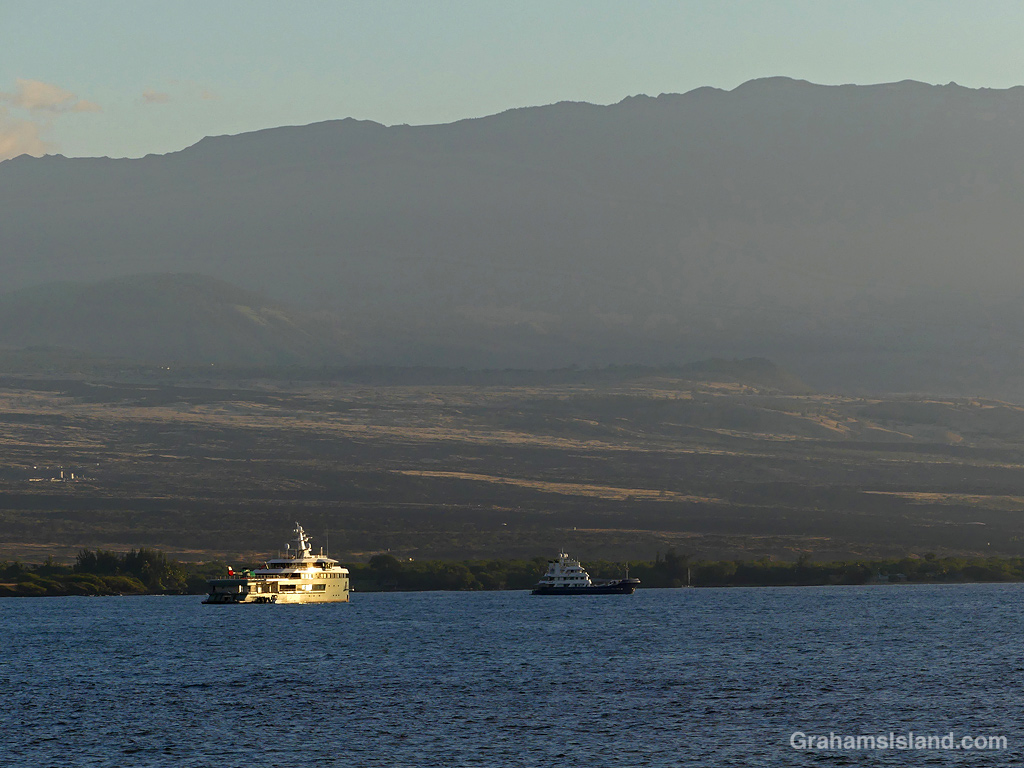
This rather splendid sailing vessel was anchored recently, for a few days, in front of Mauna Kea Resort. It’s the Robert C. Seamans, a 134-foot steel-hulled brigantine that, despite its classic appearance, was built in 2001. The vessel is a Sailing School Vessel (SSV) operated by the Sea Education Association, which conducts sail training and research.
For more information about the Robert C. Seamans and Sea Education Association, go to https://sea.edu/.
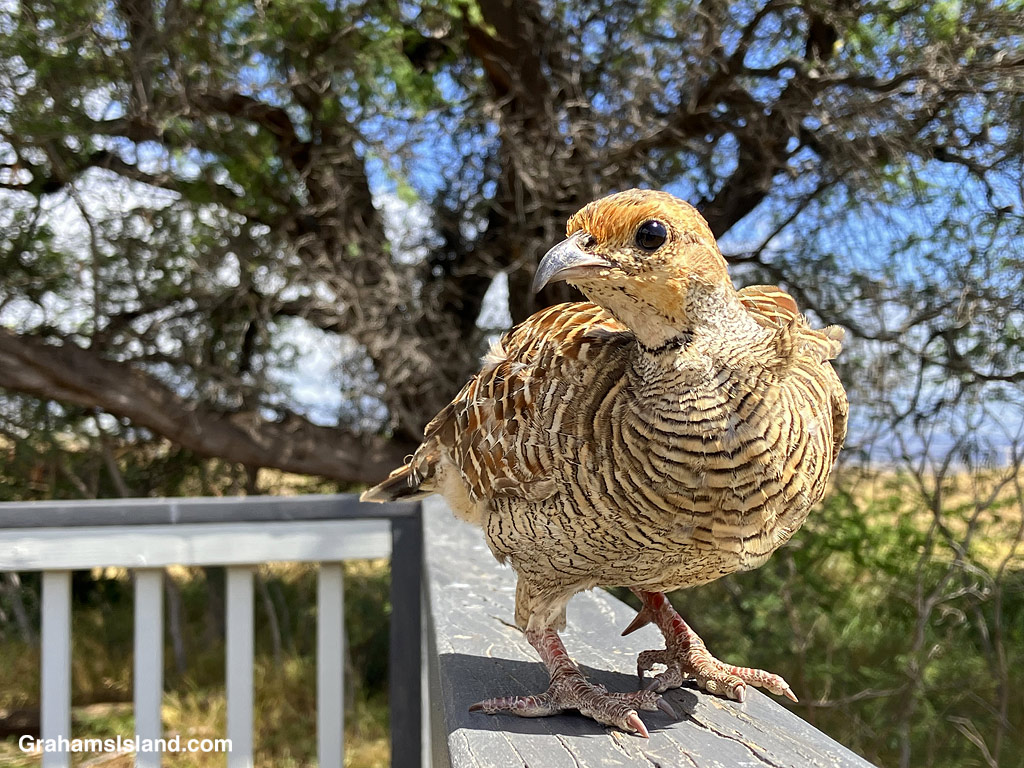
I saw this Erckel’s Francolin walking up an angled tree trunk on the side of Mauna Kea. It got to the spot in the top photo, had a look around, and then walked back down again. Francolins prefer to walk everywhere because, being game birds, they know that when they take wing, people try and shoot them.
There’s still a bit of snow on top of both Mauna Loa and Mauna Kea. Every time it looks like it’s going to disappear, a new dusting bolsters the coverage.
This view is from Kohala Mountain Road. The dark strip snaking through the center of the photo is housing alongside Kawaihae Road, which goes down to the coast. These houses are part of the town of Waimea, which sits in the saddle between Mauna Kea and Kohala Mountain. This part of Waimea is known as the dryside because it receives significantly less rainfall than areas on the east side of the saddle, which is known, correctly, as the wetside.