Tag Archives: Saddle Road

Emesine lava tube

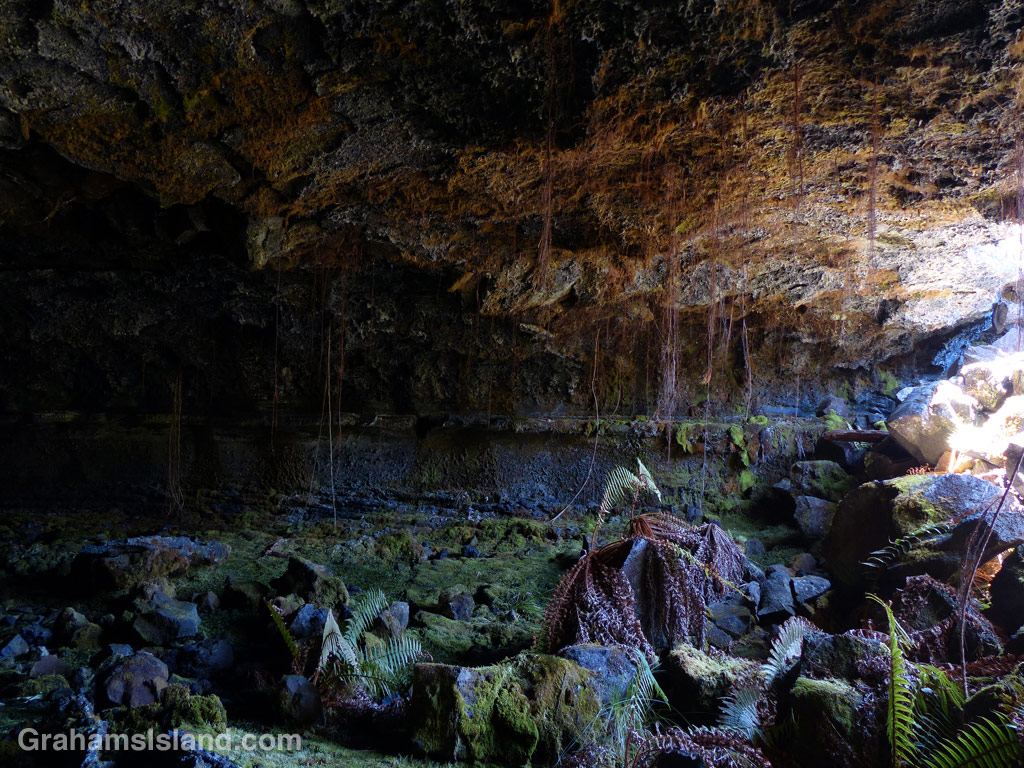
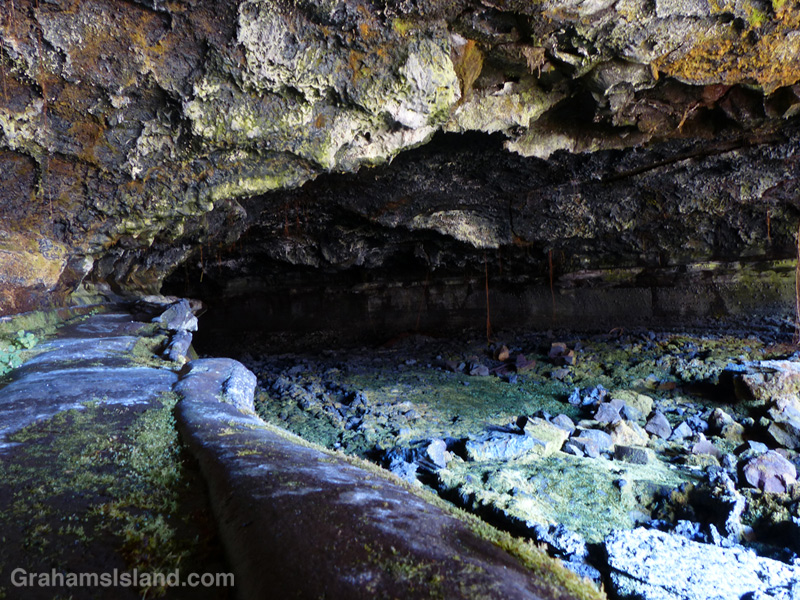
The entrance to Emesine Lava Tube on the Powerline Trail off Saddle Road.The entrance to Emesine Lava Tube on the Powerline Trail off Saddle Road.

One of the things to look out for on the Powerline Trail, off of Saddle Road, is Emesine lava tube. There’s a sign right next to the trail, though it could be missed if you happened to be looking the other way while walking that stretch. Bear in mind that if you want to explore the lave tube, the sign indicates that you should first get a permit from the State Department of Land and Natural Resources (Division of Forestry and Wildlife).

These photos are from the entrance of the eastern part of the tube, which is the most accessible. The ceiling here is about 4 feet so it’s not for the claustrophobic. Not sure whether it opens up further along, but be sure to take plenty of good lights.

For more information about Emesine lava tube, go to darkerview.com/wordpress/?p=3781.
For more information about the Powerline Trail, go to bigislandhikes.com/puu-oo-trail/.

 

Powerline trail

The very straight Powerline Trail heads south off of Saddle Road on the Big Island of Hawaii
The Powerline Trail heads south off of Saddle Road around the 22 mile marker. This trail used to be, as the name suggests, where power lines ran, but only the stumps of poles remain. It’s a very straight trail, which used to run all the way to Kilauea until lava flows disrupted it.

This trail is about 3.5 miles long to the point where it meets the Pu’u O’o trail. The southern part of the trail is dotted with kipukas and is shady and alive with birds. However, the northern two miles or so are exposed as the photo shows. The main feature of interest in this stretch is the Emesine Lava Tube about which, more tomorrow.

For more information about this, and other hikes on the Big Island, go to bigislandhikes.com.

I’iwi

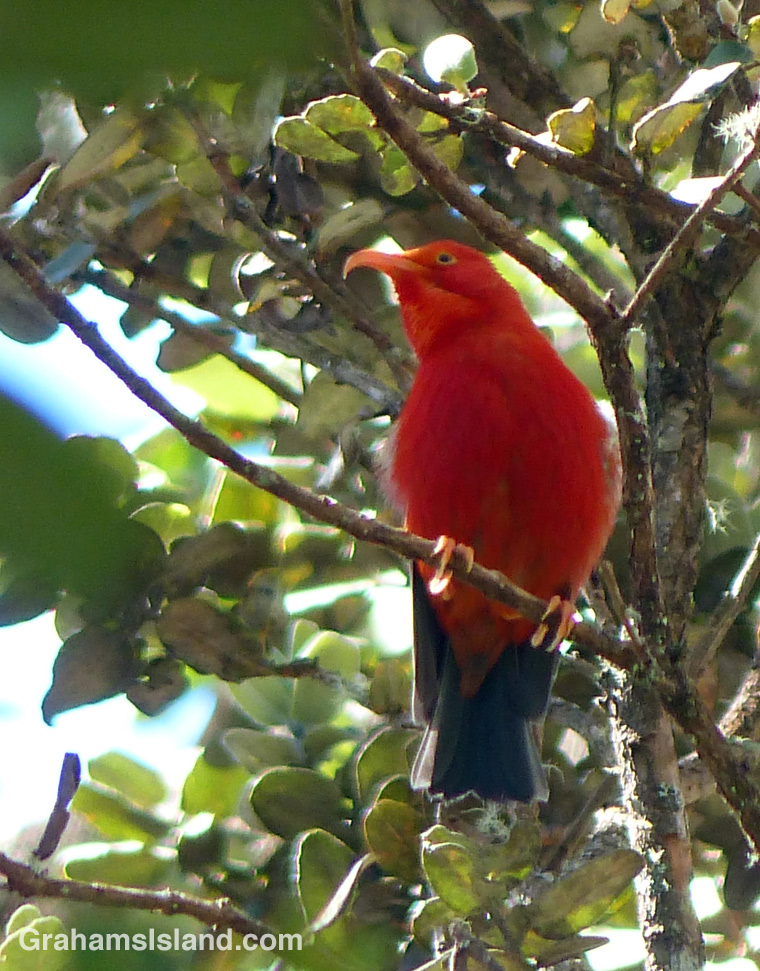
The I’iwi (vestiaria coccinea) is a native Hawaiian honeycreeper
The I’iwi (vestiaria coccinea) is a native Hawaiian honeycreeper, which is still quite common on the Big Island, as well as on Kaua’i and Maui. I saw several while hiking the Pu’u O’o Trail, off of Saddle Road. The fact that they’re bright red and they have a quite distinctive call makes spotting them a bit easier for a non-birder like me.

For more information about the Pu’u O’o Trail, go to bigislandhikes.com/puu-oo-trail/.

Pu’u O’o trail

A kipuka on the Pu'u O'o trail off Saddle Road on the Big Island of Hawaii.
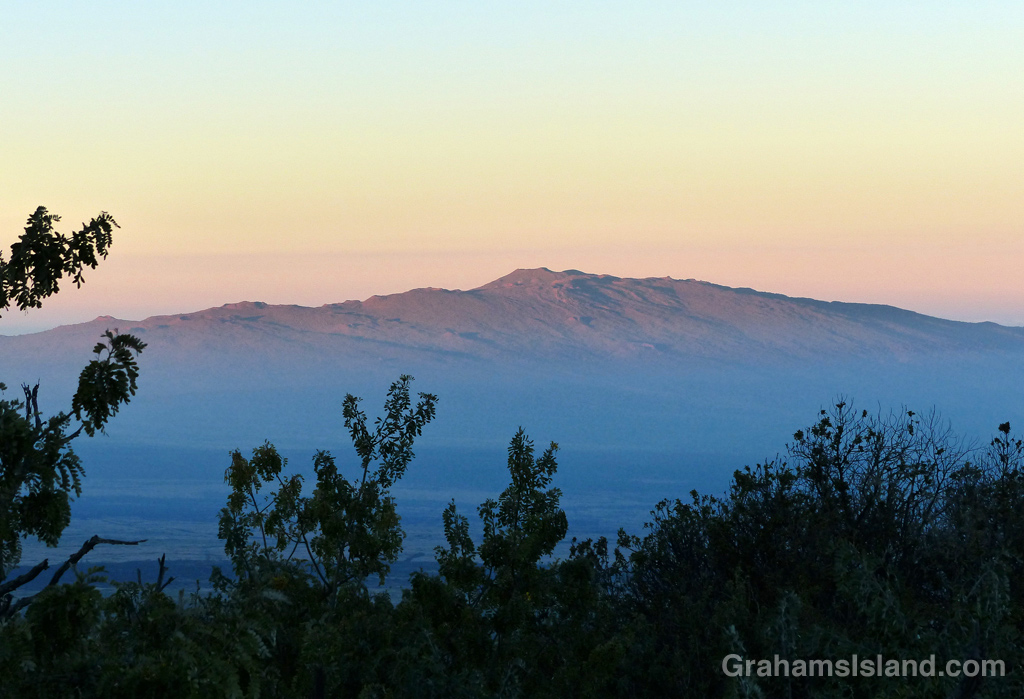
More recent lava flows have yet to be reclaimed by vegetation. The greenery is a kipuka on the trail with Mauna Kea in the background.
A kipuka on the Pu'u O'o trail off Saddle Road on the Big Island of Hawaii.
When the trail passes though a kipuka it offers shade and abundant bird calls.
A kipuka on the Pu'u O'o trail off Saddle Road on the Big Island of Hawaii.
An older lava flow has been softened by vegetation.

It took me a while to discover the various trails off Saddle Road. That’s because, from the road, they look like they’re mostly lava with some scrubby vegetation, but this is misleading. The kipukas (areas of land where lava has flowed around leaving it relatively untouched) are full of plants and a haven for wildlife including many endemic species. The whole area is an example of the cycle of destruction and regeneration that shapes this island and, indeed, the Earth.

The Pu’u O’o Trail, off of Saddle Road, has nothing to do with Kilauea’s Pu’u O’o vent. It refers to the Pu’u O’o Ranch on Mauna Loa. The trail was used for moving cattle from one grazing area to another.

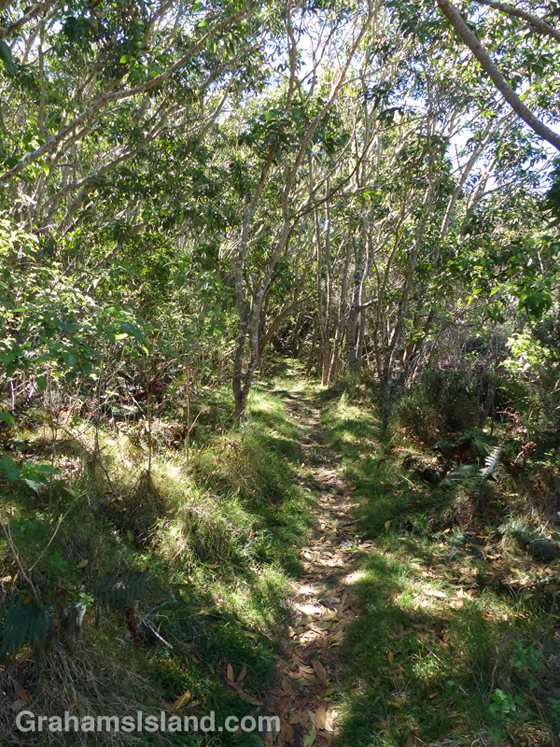
The trail alternates between crossing lava flows and passing through kipukas. Depending on the age of the flow, it might have a good deal of greenery on it, but more recent flows are stark lava fields. While the open lava flows offer great views of Mauna Loa and Mauna Kea (assuming it’s a clear day), the kipukas offer shade and are alive with bird calls, most of which I don’t recognize.

After about 4 miles the trail intersects with the Powerline trail and a loop can be made back to the start, or simply retrace your steps. Bear in mind that if the clouds roll in, which they do on a regular basis, the trail is a good deal harder to follow.

For more information about this, and other hikes on the Big Island, go to bigislandhikes.com.

Game bird guzzler

A game bird guzzler collects water for wild birds
On a recent hike, I came across this contraption. What I liked most about it was its name – Game Bird Guzzler. It’s basically a device for providing a source of water for game birds. The way it works is that when rain hits the roof of this structure, it’s collected in a gutter and piped into the back into the tank. This water is then fed, through the white pipe, into the small basin at the front. There’s a flap in the basin so that when a game bird such as a turkey takes a drink, its head will push the flap and release more water into the basin.

When I was there, I didn’t see any turkeys or other game birds, but my approach prompted great activity and squawking as a good number of assorted finches and African silverbills took to the surrounding trees. They sat there, refusing to return to the water but not leaving either. The area surrounding the guzzler was alive with bird calls in an area otherwise not noticeably populated.

Eventually I gave up waiting for a bird to take a drink and moved on. No doubt, within a few minutes the guzzler was again crowded with small birds.