Tag Archives: Sharks

Signs: Shark sighted

A sign on a beach at Kawaihae, Hawaii

This sign stands behind the little beach below Puʻukoholā Heiau at Kawaihae. Typically, When a shark is sighted, a temporary warning sign is put up, then removed after a few days. This sign is permanent. The reason for this is that beyond this beach is Pelekane Bay and that’s the site of an underwater heiau dedicated to sharks.

This heiau, called Hale o Kapuni, was built by a chief for whom sharks were considered carriers of the spirits of his ancestors. Human sacrifices were carried out on the beach and afterwards, the bodies were believed to have been placed at the heiau for the sharks. Those days are long gone, but the bay and surrounding area is still home to a large population of sharks, hence the sign.

For more information, go to https://www.nps.gov/puhe/index.htm
A whitetip reef shark cruising

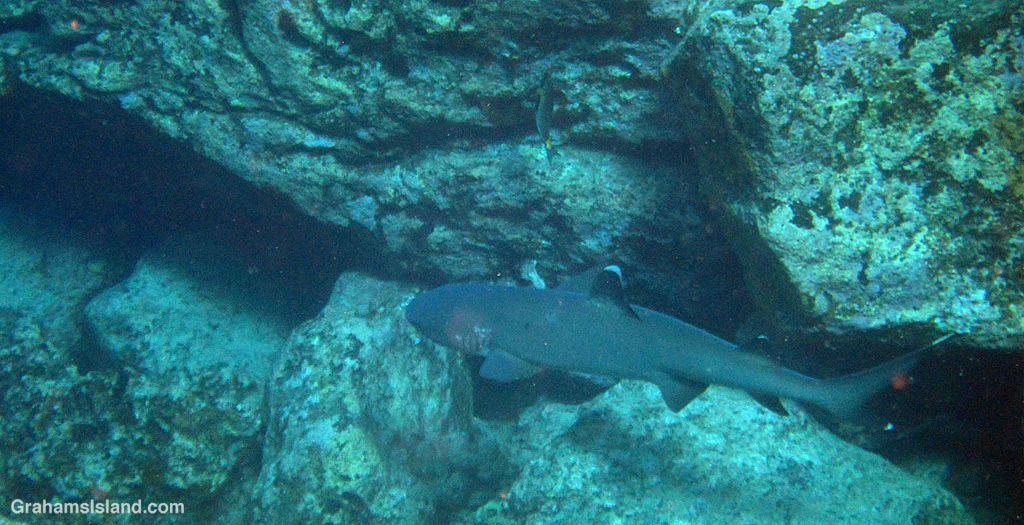
A whitetip reef shark cruises off the Big Island, Hawaii

It’s been a while since I last saw a shark (cue seeing one this morning!) so I thought I’d post a couple of photos to remind myself what they look like.

This whitetip reef shark was cruising back and forth at the foot of a rocky ledge, possibly looking for a recess where it could rest.

The morning dip

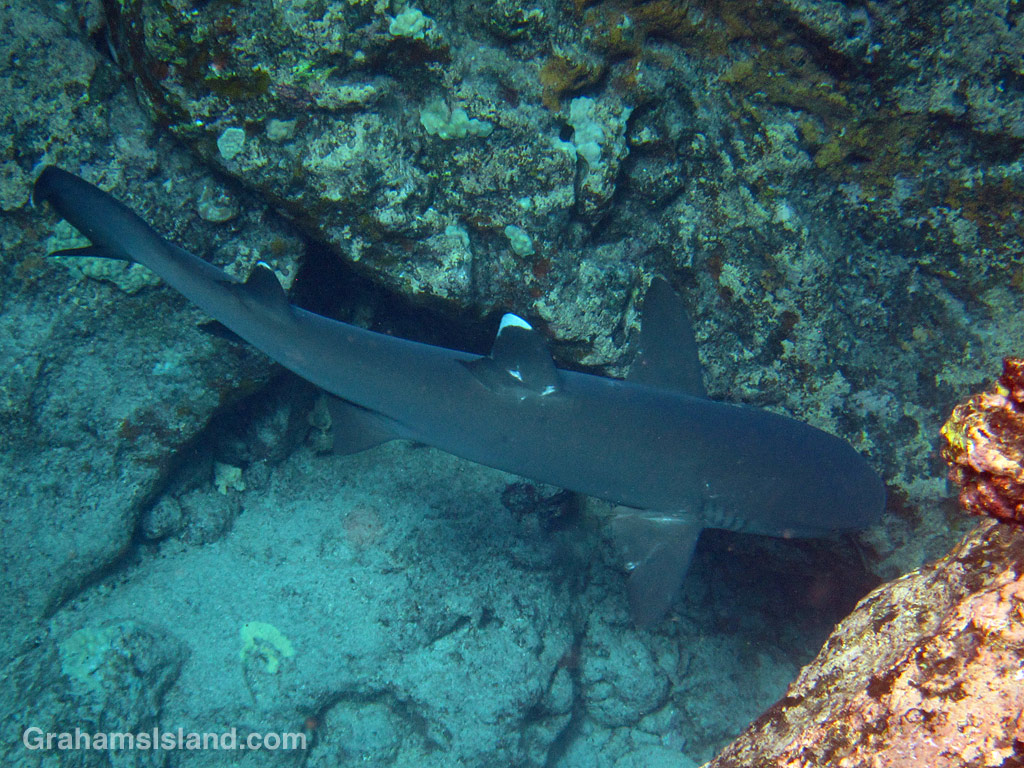
A whitetip reef shark passes below looking, I think, for a quiet place to get some rest.
A fourspot butterflyfish swims by a patch of cauliflower coral, some living, some dead. There are two spots on each side, but this fish was very small so the second spot was still filling in as space allowed.
A blue goatfish cruises by.
A green linckia sea star and lobster molt. Most green linckia have five arms but can have four or six. They’re able to reproduce by detaching an arm which will eventually develop into a new star.

This week’s Friendly Friday challenge theme is ‘Morning Rituals.’ See more responses here.

Most mornings, I try to get in the water, as conditions and schedules allow. Morning is the best time for snorkeling as the water is usually calmer before the wind picks up as the day wears on. Visibility can vary from day to day and it can help to check surf reports to see if there are any swells moving in. But calm water doesn’t guarantee good visibility just as swells don’t always mean bad visibility. There’s only one way to be sure and that’s to jump in.

My favorite thing about snorkeling is that every day is different and I never know what I’ll see. Going to the same spot means I become familiar with some of the regulars, but there are always transient creatures passing through including rays and dolphins. And while those big creatures are great to encounter, it’s equally interesting to watch the activities of smaller fish and marine invertebrates.

It’s a rare day indeed that I don’t emerge prattling on about something I saw while I was in the water. And on those rare days, well, I’ve still had a good swim to set me up for the day ahead.

It wasn’t until I processed this photo of a goldring surgeonfish that I noticed the stocky hawkfish resting motionless below it.

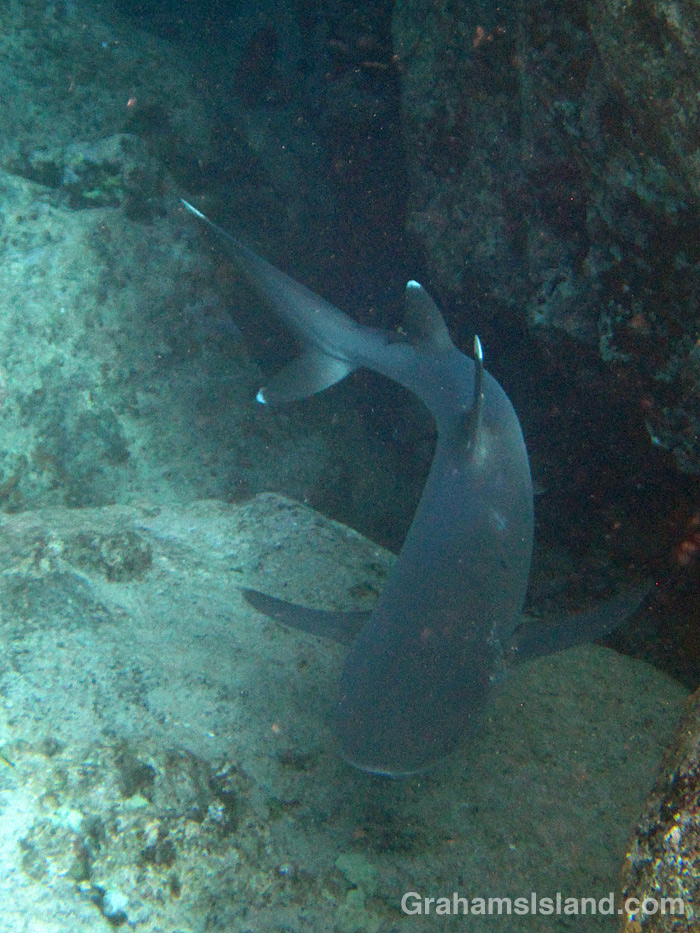
A whitetip reef shark passes by

I get the impression that, for most people, if they have to see a shark, they’d prefer it to be from this perspective – going away from them. Being something of a contrarian, I’m always looking for sharks coming toward me. The qualifier in this is what kind of shark it is.

This is a whitetip reef shark, the first I’ve seen in quite a while. Whitetip reef sharks tend to be curious and will cruise up and check me out. Once they determine that I’m really quite boring, they carry on in search of something more interesting.

Now if this had been a tiger shark, well, all bets are off.

Posted in response to Becky’s July Squares challenge theme of ‘Perspective.’ See more responses here.

Top of the food chain

I’ve seen sharks when I go snorkeling, but this was the only time I’ve seen a shark from shore. I couldn’t identify it from just the fin and tip of the tail, except to rule out whitetip and blacktip reef sharks. Likely candidates would include gray, tiger, hammerhead, and Galapagos sharks.

Posted in response to Becky’s April Squares challenge theme of ‘Top.’ See more responses here.

Whitetip reef shark

This week’s Sunday Stills challenge theme is ‘Something Scary.’ See more responses here.

Here’s a photo of a whitetip reef shark passing almost directly beneath me. In truth, these sharks aren’t especially scary since they’re more curious than dangerous, but the sinuous movement and serious chompers can send a shiver through anyone who encounters them in the water.

Commerson’s frogfish

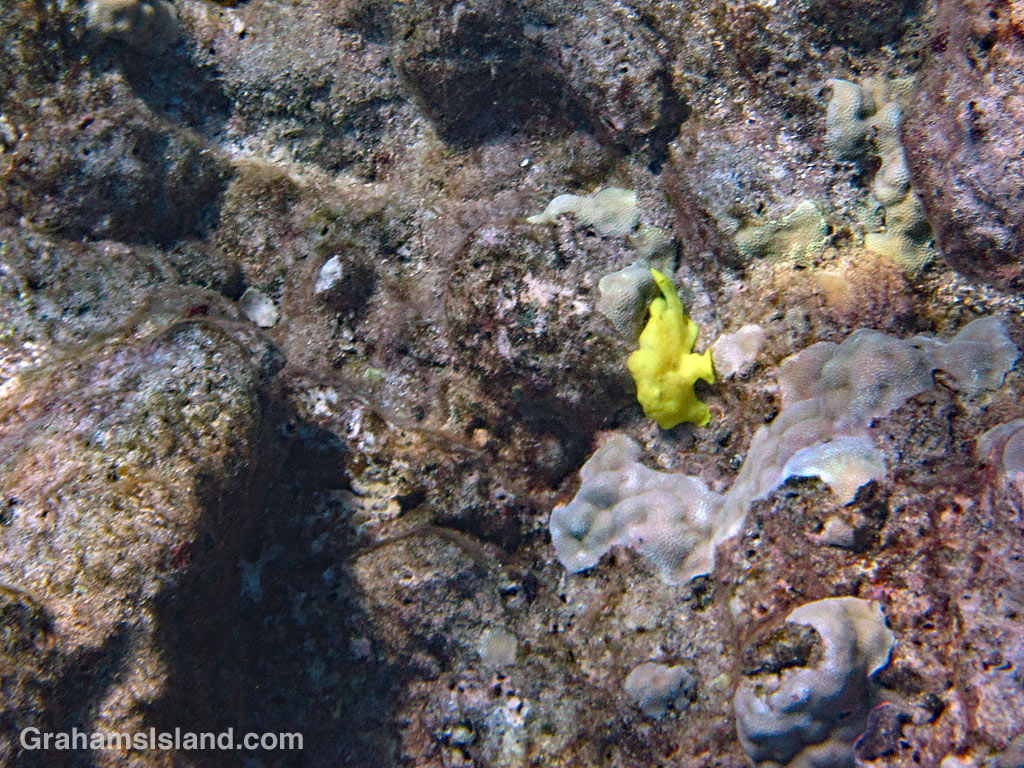
A juvenile Commerson’s frogfish in the waters off Hawaii

This little lemon-yellow beauty is a juvenile Commerson’s frogfish. Frogfish are rarely seen by snorkelers because they blend in so beautifully. Typically they look like bits of the reef but some, such as this one, mimic sponges and so are more easily seen.

Frogfish are anglers. They sit motionless on the bottom. When potential prey approaches, they flick their first dorsal fin forward. This is tipped with a fleshy lure that hangs over its mouth. If the prey takes the bait, the frogfish strikes. It can expand its mouth to swallow quite large fish and it strikes with such speed that other fish in the vicinity are generally unaware what’s happened, thus allowing the frogfish to remain in place and continue fishing.

In this photo, the frogfish’s eyes and mouth are visible, as are its pectoral fins that are adapted to help it hang on to the reef and to move about.

This frogfish was spotted by my wife and we watched it for a while before we were interrupted by three whales breaching. They were half-a-mile or more away, but this was the first time I’d seen whale activity from the water and it was pretty impressive, if almost impossible to photograph.

When the whales settled down, I dipped my head below the water to try and locate the frogfish again and the first thing I saw was a white-tipped reef shark cruising by. I suspect it had been attracted by my feeble attempts to dive and photograph the frogfish, probably thinking there was some easy prey to be had. It quickly disappeared again, but it made for a memorable few minutes.

Monk seal scars

Monk seal scars

Monk seal with scarsThese are older photos, but still interesting to me. I spotted this monk seal one day, not too far from a second seal that is a regular around the Big Island.

The top photo shows some lighter marking on the side of the seal, below and behind the two dark marks. This lighter marking is bleaching, which is applied to seals when possible, to help researchers monitor the population and keep track of their travels. The bleaching only lasts a year as seals molt annually. In addition to the bleaching, most seals have red tags placed in their rear flippers, to help identify them. It can be a hit and miss method as these photos show. This seal has tags in both flippers, but they were never visible to me.

The other interesting thing is those two dark circles on the seal’s back. They’re made by cookiecutter sharks. Cookiecutter sharks are small dogfish sharks, less than two feet in length. They feed by gouging round plugs, hence the name, out of larger creatures such as monk seals.

Cookiecutter sharks live in the deep ocean during the day, sometimes at depths over two miles. At dusk they rise up toward the surface, before descending to the depths again around daybreak. Another reason not to go swimming at night.