
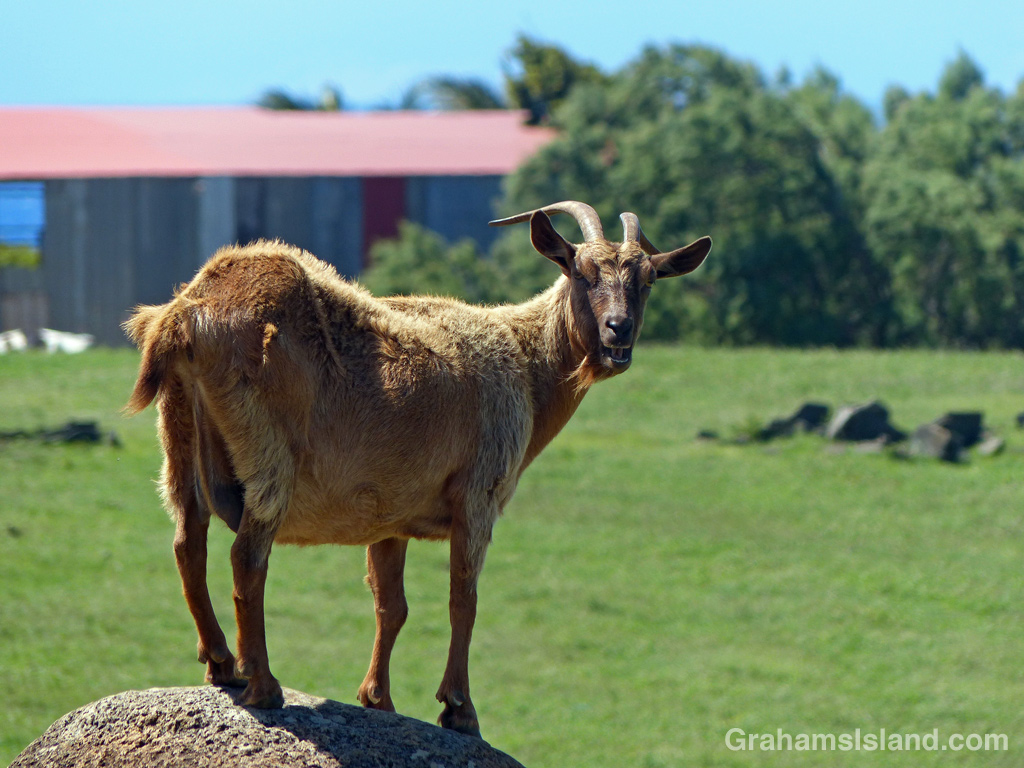
Following up on yesterday’s against-the-odds photo of a bright-eye damselfish, here’s one of a goat standing on a rock. What are the chances of seeing that?
Tag Archives: Wordpress Photo Challenge
Bright-eye damselfish
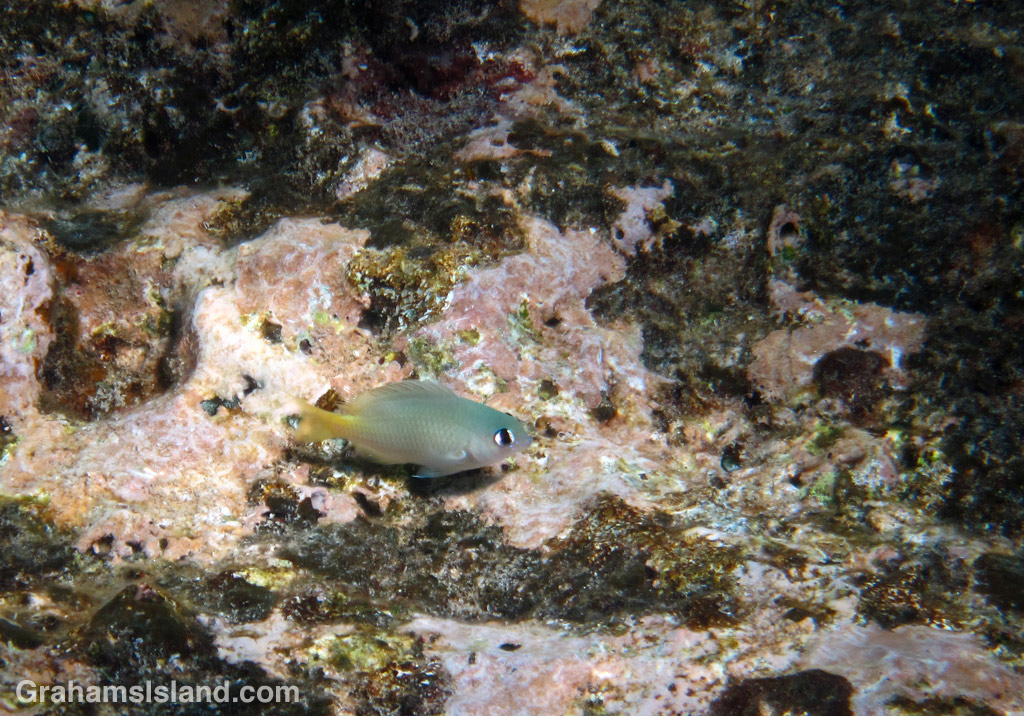
The aptly-named bright-eye damselfish is a tiny fish around 1 to 2 inches long. Despite its small size it aggressively defends its territory, usually a nook or hollow in the rock. It’s not unusual to see it come charging out at some much larger fish that has strayed too close.
Given that these fish spend all their time in one small area, often just hovering in the water, it would seem a simple matter to get a photo, but no. When they hover, they’re constantly moving, almost vibrating. And then they shoot off in one direction or another.
I’ve taken many of photos of bright-eye damselfish and the majority of them turn out to be pictures of bits of rock or coral. Locating the tiny fish on my screen is no easy matter, keeping it there, harder still. When I do manage that, often the fish is a blur or just a tail fin heading out of shot. Thus, this photo is something of an against-the-odds triumph – an entire bright-eye damselfish reasonably in focus.
Grasshopper shadow

A grasshopper casts a shadow on a glass windshield.
The bench overlooking Honokane Nui Valley
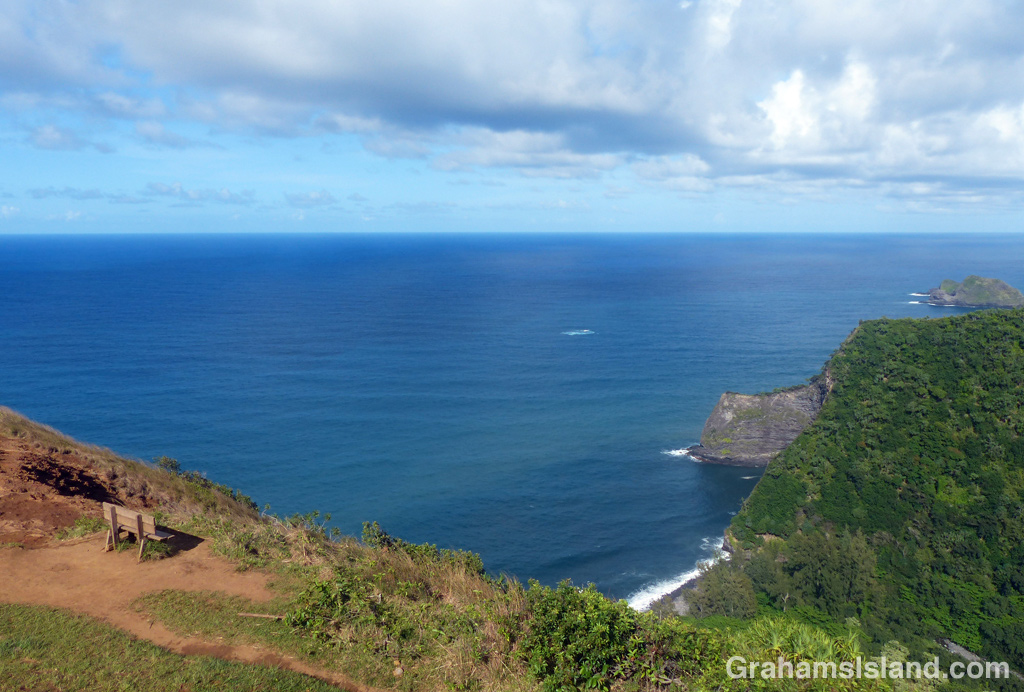
At the end of the highway in North Kohala is the Pololū Valley overlook. This is where most people park their cars (if they can find a space), snap a photo or three, and then climb back in and attempt to turn around and head back.
Quite a few people head down the steep, third-of-a-mile trail to the valley and beach below. Some walk the half-mile-long beach. Very few continue up the trail on the other side. There are good reasons for this. The trail is somewhat hidden. If it’s been raining, it can be even muddier and more treacherous than the trail down to the valley. If conditions are right, it can be alive with bugs. But for those that do press on for another a mile or so, this is the spot they will reach.
Overlooking Honokane Nui Valley, this bench is the perfect spot to experience some welcome solitude. Chances are it will be unoccupied. Chances are no one else will even pass by. I like to sit on the bench (rickety though it is currently) and enjoy the ocean stretching away on one side and the tropical jungle climbing the side of the Kohala Mountains on the other.
For more information about the trail go to bigislandhikes.com/pololu-valley/.
Black-crowned night heron in flight

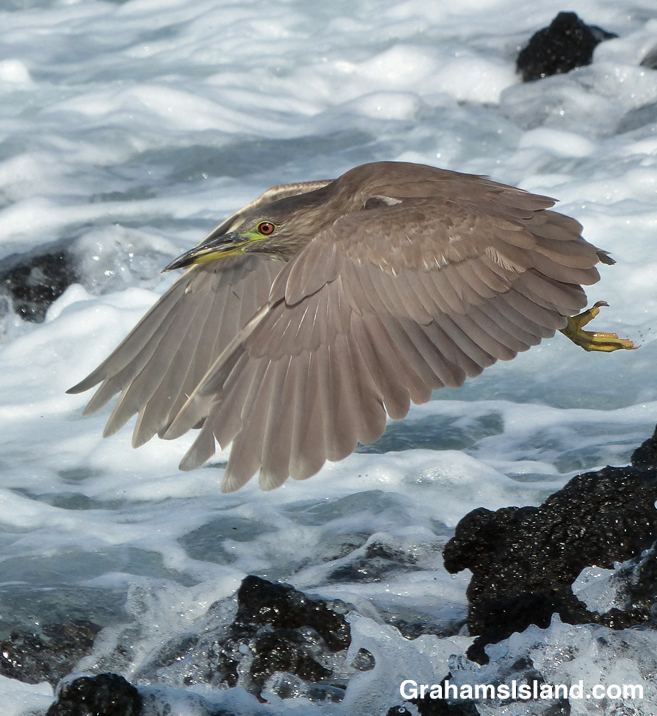
I find the flight of birds very graceful. This juvenile black-crowned night heron was mostly statuesque while fishing in the shallows, but every so often it took flight to relocate, gliding over turbulent waters.
The Painted Church at Honaunau


I’m not a religious person, but I’ve always enjoyed visiting churches. I grew up in England and the stone churches had a calm ambience with cool, quiet interiors. Usually, there was some feature of note, even in the smallest church – carvings on the pew ends, a font dating from Norman times, the tomb of some ancient notable under the floor.
The Painted Church at Honaunau, on the Big Island, is different from those churches, more fitting to its setting. A wooden structure, it dates back to 1899. Father John Velghe moved much of a previous structure to its present site and had it repaired and added to. A self-taught artist, he then painted the interior including several scenes from the bible on the walls.
What I like is how colorful the interior is, with a real tropical feel. But it too has that stillness that I associate with churches and an ambience all its own.
For more information about the Painted Church at Honaunau, go to thepaintedchurch.org.
King Kamehameha’s birthplace

At Kapakai Kokoiki Heiau in North Kohala, not far from Mo’okini Heiau (which can be seen on the hill in the background), stands this sign. Kamehameha Akāhi ‘Āina Hānau loosely translates as the birthplace of Kamehameha I. He was born here around 1736. The exact date isn’t known, with some accounts placing it as late as 1758. Known as Kamehameha the Great, he was the king who fulfilled Hawaiian prophecies and united the Hawaiian islands for the first time in 1810.
He was succeeded by four others in his family who took the name Kamehameha, so the name is in the forefront of Hawaiian history. In present day life it occurs in numerous ways. There’s Kamehameha Day, a state holiday, which celebrates his birth. Kamehameha Schools is an private school system with extensive land holdings on the Big Island and elsewhere. Hotels and other businesses sport the name. A fair number of them will be located on Kamehameha Street, Road, Highway, Avenue, or Boulevard.
In short, the name Kamehameha is still an integral and important part of everyday Hawaiian life.
Growth in the lava
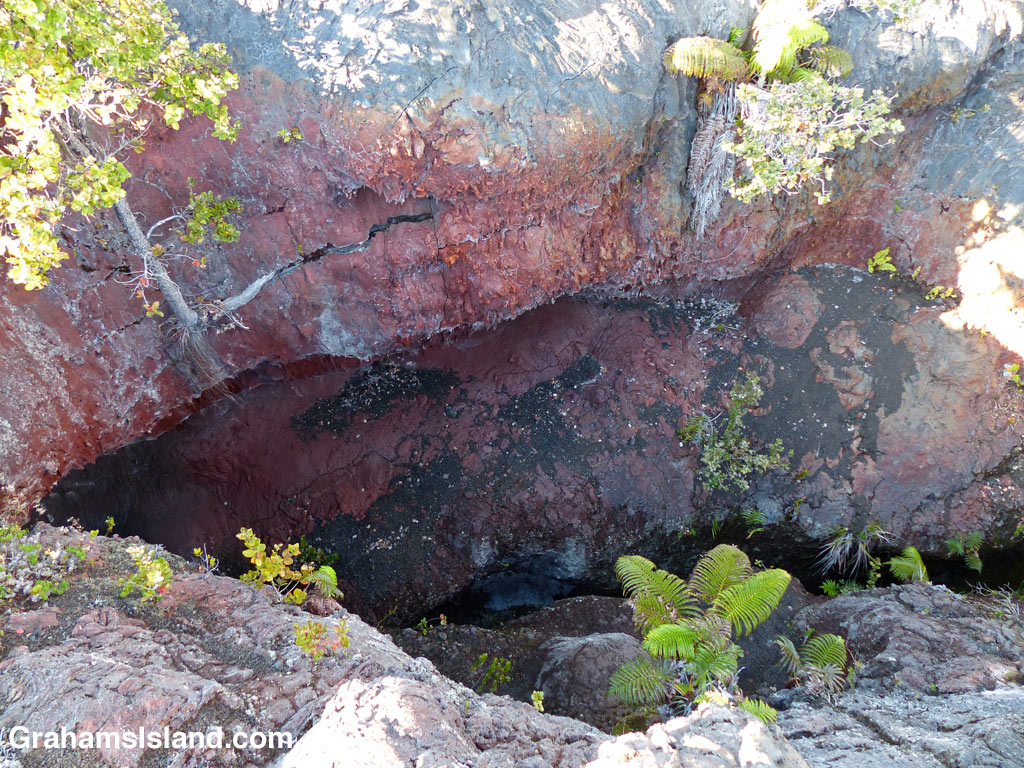
In May of 1969, a series of earthquakes opened a large fissure alongside Chain of Craters Road in Hawaii Volcanoes National Park. This was the beginning of what is known as the Mauna Ulu eruption. For five years, lava poured forth in a series of eruptions. Chain of Craters Road, completed only a few years earlier, was buried for several miles. Landmarks along the road were destroyed or irrevocably altered. A swathe of forest disappeared in flame.
When the eruptions finally ceased, life soon began to reappear on the barren lava landscape. In this photo, vegetation has reclaimed a section of the original 1969 fissure. Roots are anchored in cool, moist cracks in the lava. The tree on the left is particularly striking. Having started out in a crack on a vertical face, it has reached up to the light and is going strong. I like to think it shows how resilient nature can be.
For more information about Hawaii Volcanoes National Park, go to nps.gov/havo/. For more information about Kilauea Volcano and it’s eruptions, go to hvo.wr.usgs.gov/kilauea/history/main.html.
 Graham's Island