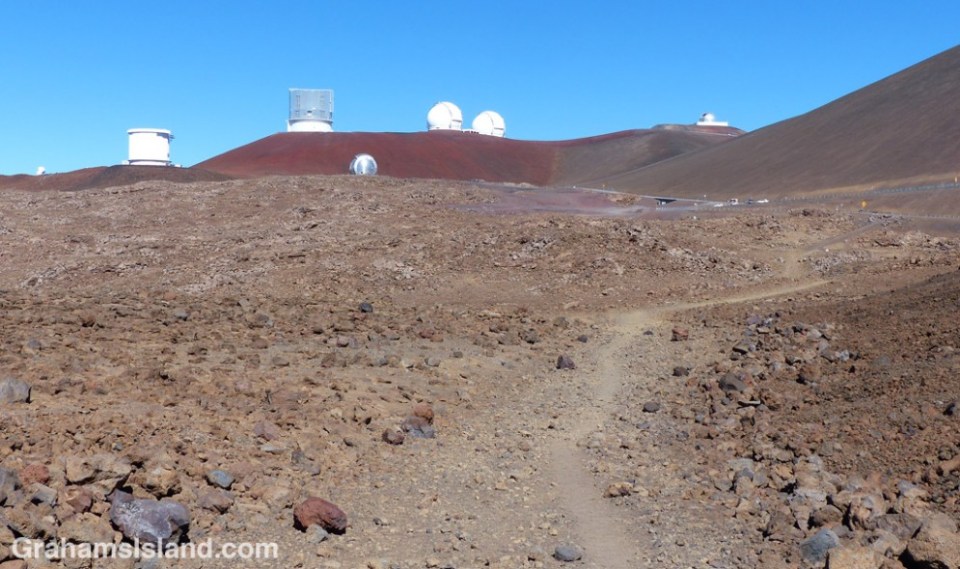
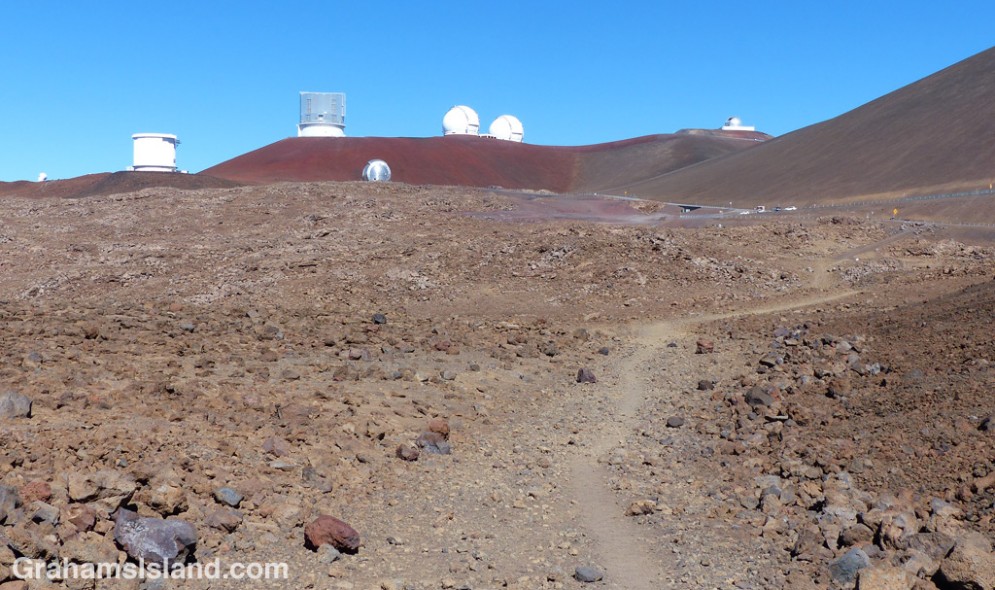
The trail starts just below the loop road that links the telescopes.
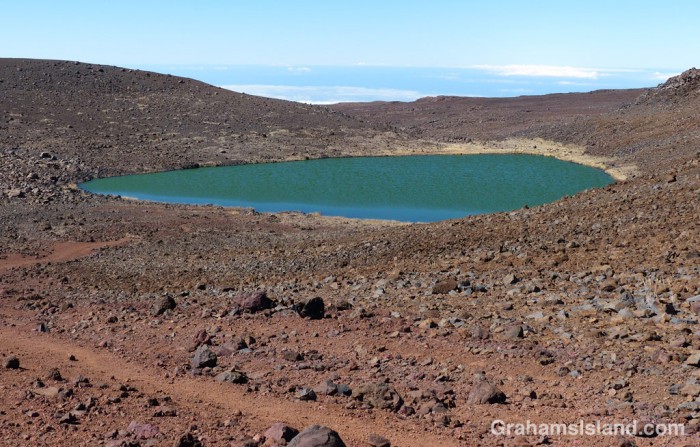
Lake Waiau.
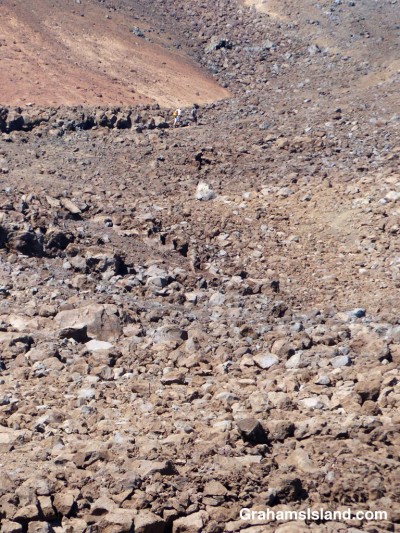
The trail passes through unforgiving landscape. Two hikers are just visible at the top center.
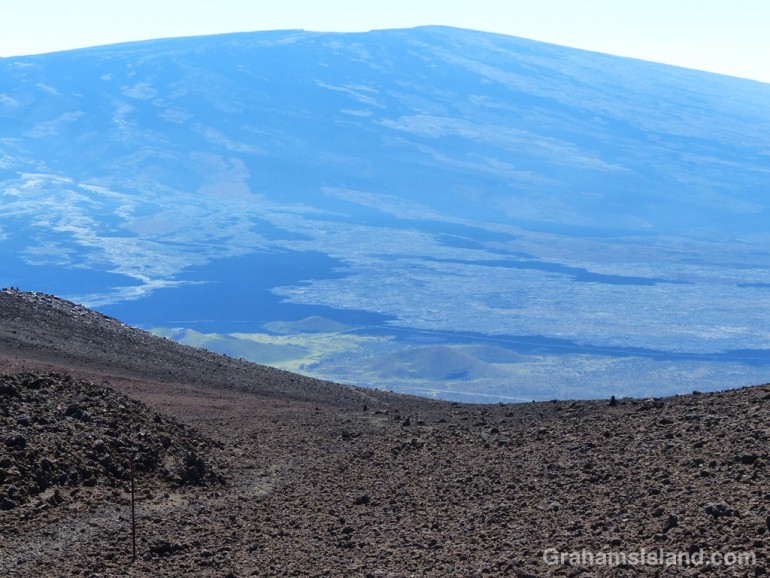
Looking across at Mauna Loa. The trail is visible at bottom left.
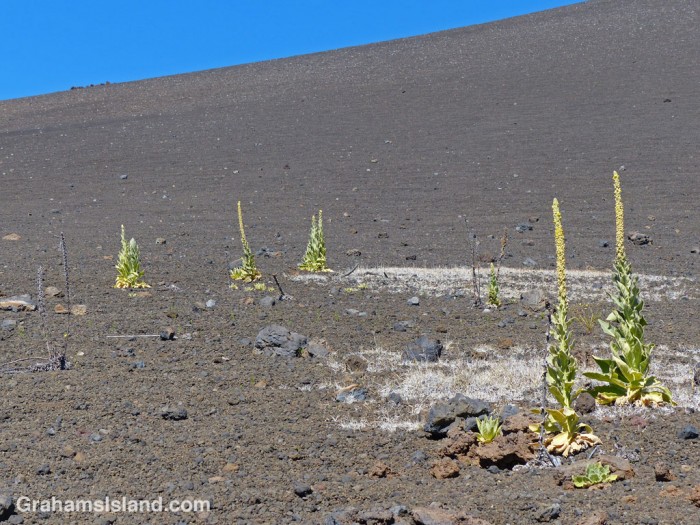
Mullein, Verbascum thapsus, grows in the otherwise barren cinder landscape.
I took a hike on Mauna Kea recently. I’ve been up the mountain before in the car and I’ve done a hike or two going around the volcano. This time I thought I’d tackle the Summit Trail. The trail starts at the Mauna Kea Visitor Center at about 9,250 feet and goes 6 miles to the summit at about 13,800 feet. That’s around 4,550 feet of elevation gain. It’s also high altitude, which means it’s not an easy trail.
My plan was to ‘try out’ the trail. I figured if I made a one-way trip it would give me a good insight about whether to try the round trip. My idea was to get a ride from the visitor center to the top, then hike down, because that has to be easier than going up, doesn’t it? Cue ominous music.
I got to the visitor center before opening time and spent an hour acclimating to the altitude. I chatted with one of the volunteers at the desk and she said she preferred the hike UP the mountain. She asked if I had walking sticks, which I didn’t. Tactfully, she didn’t follow up by asking about next of kin. At least the weather was good – sunny and dry, but cool.
By starting early I’d hoped I might snag a ride with a work vehicle heading up to the telescopes that dot the summit. They all passed me by, either fully loaded or, I suspect, forbidden from picking up hitchhikers. That gave me a problem. I’d just left the visitor center and knew there were no 4-wheel-drive vehicles there, which is what visitors going to the summit should be driving. I couldn’t expect a ride until one arrived and the occupants had acclimated as I had. Faced with the prospect of waiting an hour or more I headed off up the trail. I could hike the first ¾ mile, to where it passed close to the road again, and try and get a ride from there.
The trail started off up a rough dirt road that quickly transitioned to a trail. When I say up, I mean up. Mauna Kea is shaped like a classic volcano. It looks, and is, steep.
I huffed and puffed up the slope, feet slipping on the loose cinder underfoot. I began to understand what the woman at the visitor center meant; coming down would be treacherous. Going up was hard work too, but at least I felt I’d earned the frequent stops to recover and appreciate how much elevation had been gained.
I reached the road at around 10,200 feet and soon got a ride to the top. The actual summit of Mauna Kea is along a short trail across from one of the parking areas. I didn’t take it this time having been there before. Instead, I headed off on the road that loops around the top. It’s a surreal place, a barren, windswept, cinder landscape dotted with high-tech telescopes gathering information from the farthest reaches of the universe.
The trail down starts just below where the road begins its loop. It’s easy going at first, through a small valley, over a ridge and down a steeper bit to a saddle. This is where the main trail intersects another one heading to Lake Waiau. Lake Waiau is a small, somewhat perplexing lake. At 13,000 feet it sits on a volcano made up of highly permeable rock at an elevation where it gets very little in the way of rainfall. It’s not entirely clear why the lake exists at all though it undoubtedly does. The day I was there, it appeared quite full and green.
After the side trip to the lake, I started down again. Almost immediately I missed the trail down. I thought it intersected the Lake Waiau trail toward the road, but I soon realized that wasn’t true. So I angled across to the right one over loose lava, slipping often, but finally regaining the proper track.
Soon after, I met two other hikers who I’d seen in the parking lot earlier. They were hiking the round trip, up and down. We chatted a while before they continued. They were younger and fitter than I, though their conversation had left me with the impression that they weren’t looking forward to the return journey.
It’s a steady downhill slog, mostly with a loose surface underfoot (at one point I fell, my feet slipping out from under me, luckily leaving me with nothing worse than a couple of scrapes on one hand). I’d like to say the effort was worth it for the views, but the truth is, I can’t. Across the saddle, is Mauna Loa, which is a bigger volcano than Mauna Kea, but doesn’t look it. Mauna Loa (which means ‘long mountain’) has enormous mass, but not striking, steep sides. Otherwise, I was looking mostly at my feet or the same kind of landscape I was walking on.
This was one of those hikes where I kept thinking that the place where the trail passed close to the road where I’d got my ride, must be just over the next ridge. But one ridge followed another and there were several of them before that observation became true. Then I was back on territory I’d climbed up that morning. The woman at the visitor center was right: it was easier going up.
When I got back to my car, a visitor there asked me about the hike, whether it was worth it. “No,” I said. He was disappointed. He was keen on the hike; his partner, less so. But the truth is, it’s a slog up and down over a barren, cinder landscape. Yes, there are plusses. There’s a stark beauty in the place and the lake is worth it. But, to me, it’s more for the person who likes to be able to say ‘Yeah, I did that hike.’
For more information about the Mauna Kea Summit Trail and Lake Waiau, go to bigislandhikes.com/mauna-kea and ifa.hawaii.edu/info/vis/visiting-mauna-kea/hiking.

Nearly there. The visitor center and road is visible to the left of the red cinder cone.



 Graham's Island