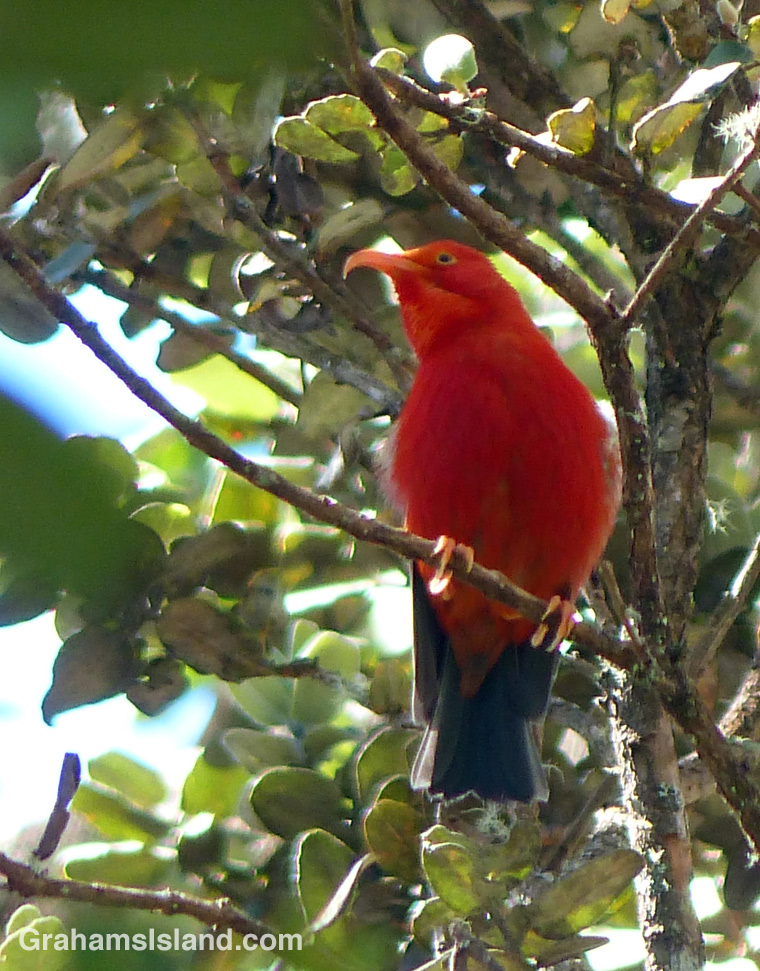
The I’iwi (vestiaria coccinea) is a native Hawaiian honeycreeper, which is still quite common on the Big Island, as well as on Kaua’i and Maui. I saw several while hiking the Pu’u O’o Trail, off of Saddle Road. The fact that they’re bright red and they have a quite distinctive call makes spotting them a bit easier for a non-birder like me.
More recent lava flows have yet to be reclaimed by vegetation. The greenery is a kipuka on the trail with Mauna Kea in the background.
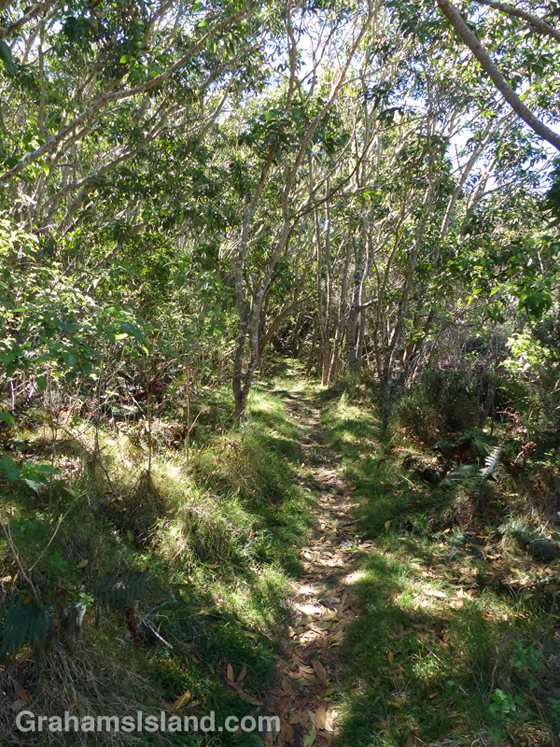
When the trail passes though a kipuka it offers shade and abundant bird calls.
An older lava flow has been softened by vegetation.
It took me a while to discover the various trails off Saddle Road. That’s because, from the road, they look like they’re mostly lava with some scrubby vegetation, but this is misleading. The kipukas (areas of land where lava has flowed around leaving it relatively untouched) are full of plants and a haven for wildlife including many endemic species. The whole area is an example of the cycle of destruction and regeneration that shapes this island and, indeed, the Earth.
The Pu’u O’o Trail, off of Saddle Road, has nothing to do with Kilauea’s Pu’u O’o vent. It refers to the Pu’u O’o Ranch on Mauna Loa. The trail was used for moving cattle from one grazing area to another.
The trail alternates between crossing lava flows and passing through kipukas. Depending on the age of the flow, it might have a good deal of greenery on it, but more recent flows are stark lava fields. While the open lava flows offer great views of Mauna Loa and Mauna Kea (assuming it’s a clear day), the kipukas offer shade and are alive with bird calls, most of which I don’t recognize.
After about 4 miles the trail intersects with the Powerline trail and a loop can be made back to the start, or simply retrace your steps. Bear in mind that if the clouds roll in, which they do on a regular basis, the trail is a good deal harder to follow.
For more information about this, and other hikes on the Big Island, go to bigislandhikes.com.
Maui and Kohala Mountain as seen from Pu’u Ahumoa on the lower slopes of Mauna Kea. The structure on the left is what remains of an old beacon for low-flying aircraft.
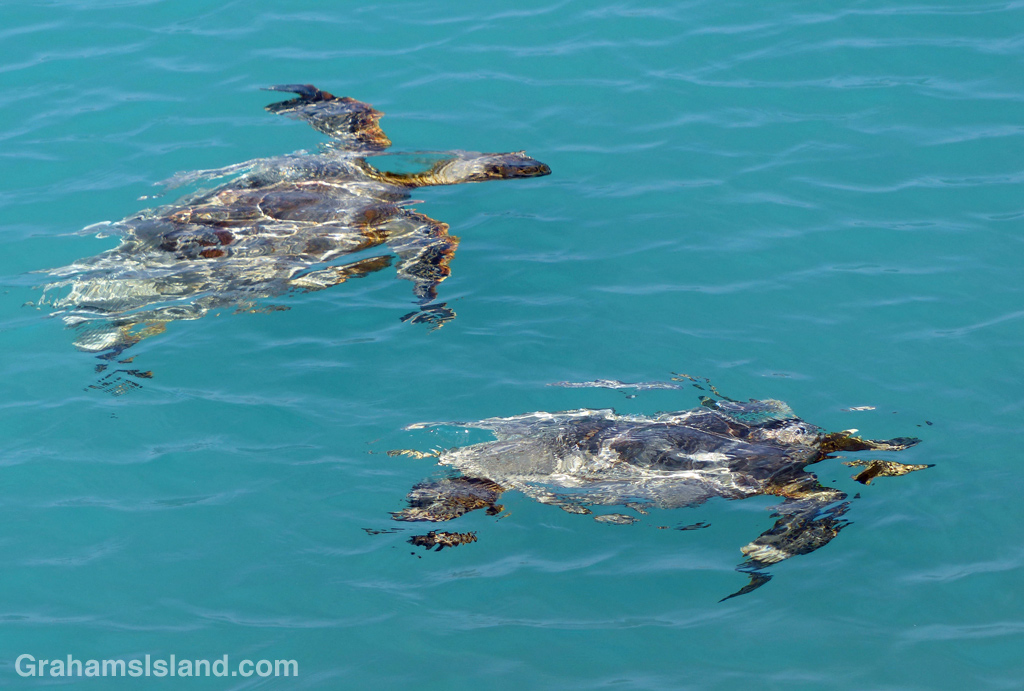
Kiholo Bay is a popular spot for Hawaiian green sea turtles. On a recent hike I saw several of them on land and in the water. A light breeze rippled the water and when the turtles swam just below the surface, their appearance was in constant flux. It was a nice surprise to find I’d captured this impressionistic effect.
Sometimes I get caught up taking a set of photos of certain things. Lately, I’ve been trying to capture waves breaking toward me. On this day the water looked promising, but mostly the waves refused to break.
However, it was a pleasant surprise to find that I’d managed to capture this image. The water has lumped into a pleasing mountain shape and the coral below looks like aspects of its rocky face.





 Graham's Island