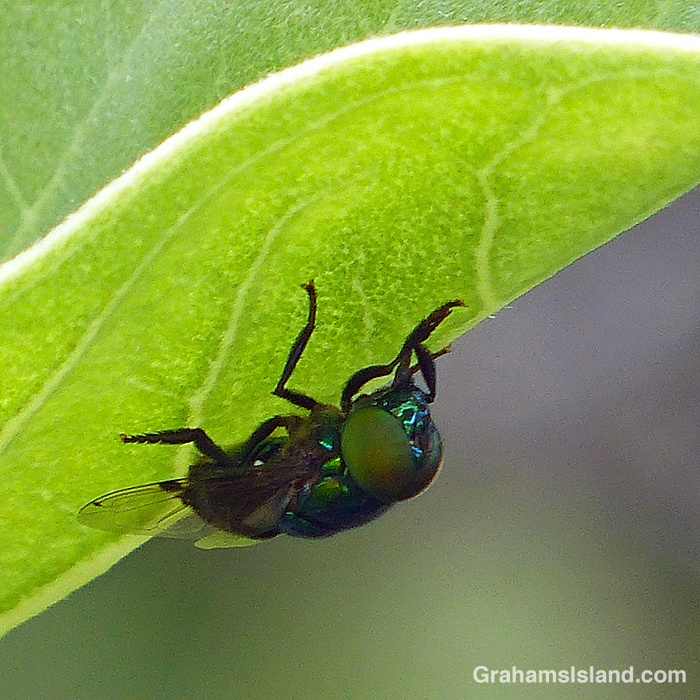
The reason I don’t like this photo is because, just a moment before, this green hover fly (Ornidia obesa) had been right side up in the sun, which illuminated its wonderful metallic-green body. Alas, by the time I got my camera out, it had relocated to this spot.
Still, it’s an interesting fly, which could just as easily be called the green wolf fly – ‘what big eyes you have.’
The engine, prop shaft, and propeller of the SS Kauai, an old wooden steamship, that sank in 1913. Now it’s home to a variety of fish and is a moderately popular dive site.
The latest eruption at Kilauea Volcano has recently been declared paused. It was never an especially dramatic eruption, but when I went down a few days after it began (here) the sky was illuminated by the activity. In recent weeks though, the lava lake formed by the eruption crusted over completely and lava from the active vent was also hidden from view.
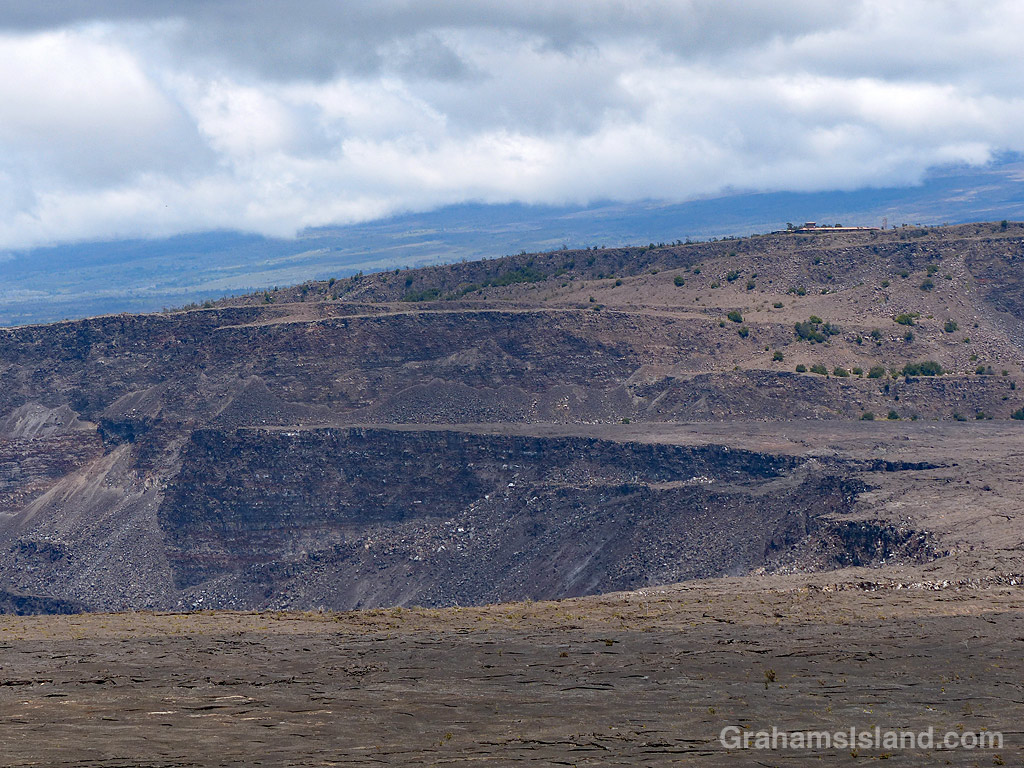
The photos are two views of Halemaumau Crater, taken before this latest eruption. In the top one, the collapsed floor of the crater is on the left. This is what the new lava lake was filling up. On the ridge, to the right side of the photo, is the low profile of the Jaggar Museum, which was closed after the 2018 eruption and likely won’t reopen.
The bottom photo shows the easternmost edge of Halemaumau Crater, which wasn’t greatly impacted by this eruption or the events of 2018. Consequently, the walls of the crater are quite green and the floor is dotted with plants. These plants are mostly ohia trees, which are among the first plants to grow in lava fields, in part because their roots will tap into lava tubes to find moisture and nutrients.
For more information about Hawaii Volcanoes National Park and Kilauea’s eruptions, go to nps.gov/havo/.
The truth is, I get to cheat on Bushboy’s Last on the Card photo challenge (more responses here). I generally see his post in the late afternoon here since he’s in Australia and many hours ahead of me in Hawaii. That was the case today and when I looked, I found that, for various reasons, I hadn’t taken any photos in more than a week.
So I poked my head outside and immediately thought of the tangerine trees in the yard. One is so heavily laden with fruit that a couple of branches are scraping the ground. Despite the trees looking to be in terrible condition, they fruit prolifically. An interesting fact is that the only flower I’ve ever seen on these trees was an orchid growing at the base of one of the branches. What’s that about?
Driving home from work I saw this scene in front of me on the hill leading towards Hawi. It was such a striking example of the weather around here that I was moved to pull over and take a couple of photos.
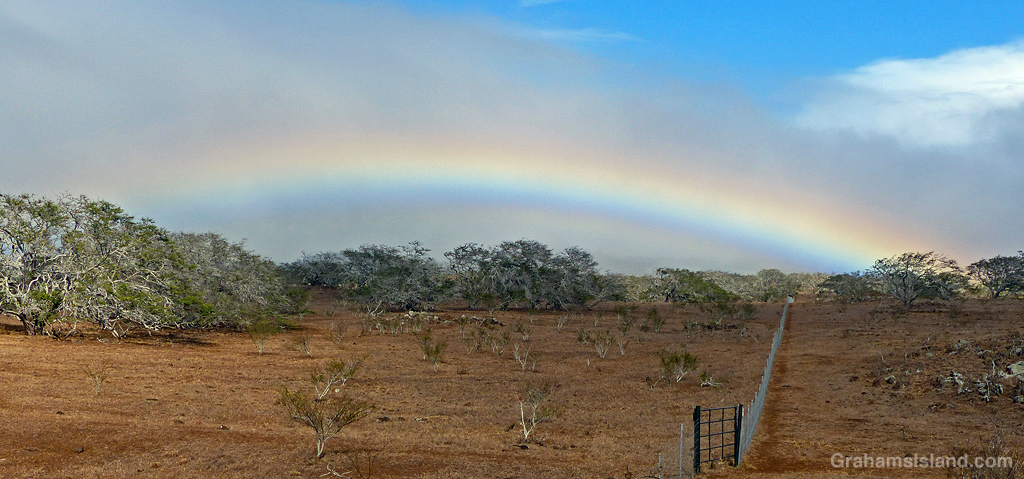
The top photo shows the blue skies and scattered white clouds I’d been working under all day, and was standing under to take the photo. The gray band is wind-driven, low cloud being blown from east to west along the northern coast of the island, and blotting out the sun in this area. Under this band it was raining and visibility was poor. The cloud is channeled in this way by the northern shoulder of Kohala Mountain. As the band moved out over the ocean it became less pronounced as it dissipated.
Turning to my right, I took the bottom photo, a rainbow formed by the sun at my back and moisture tumbling over the mountain’s shoulder.
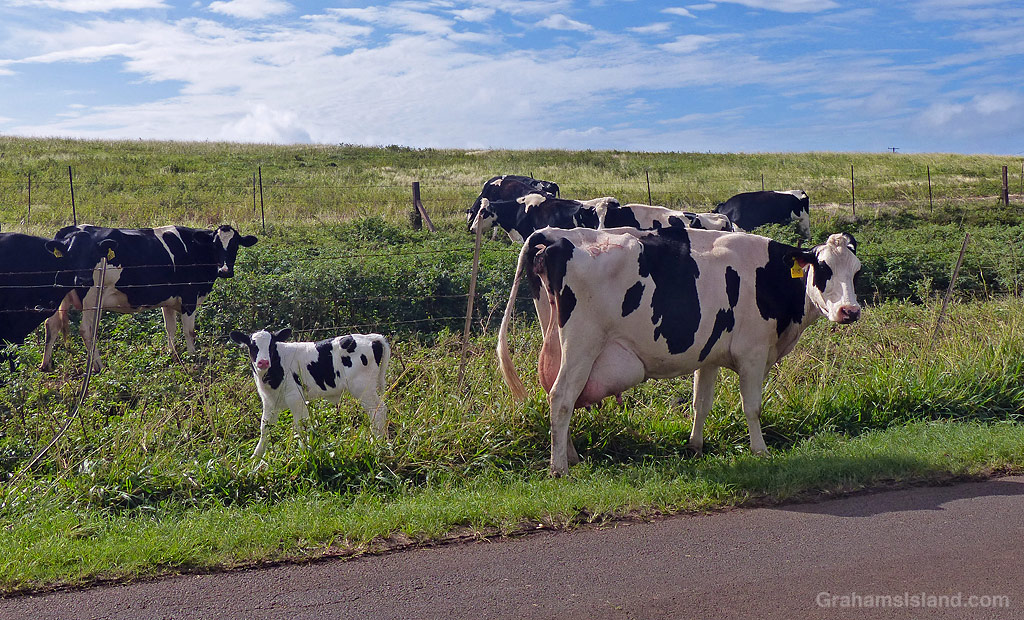
I passed this mother and calf on the road one day. The mother was enjoying the green grass by the roadside while the calf, only a day or two old, looked bemused by everything around it. At least it looked like it wouldn’t go hungry anytime soon.
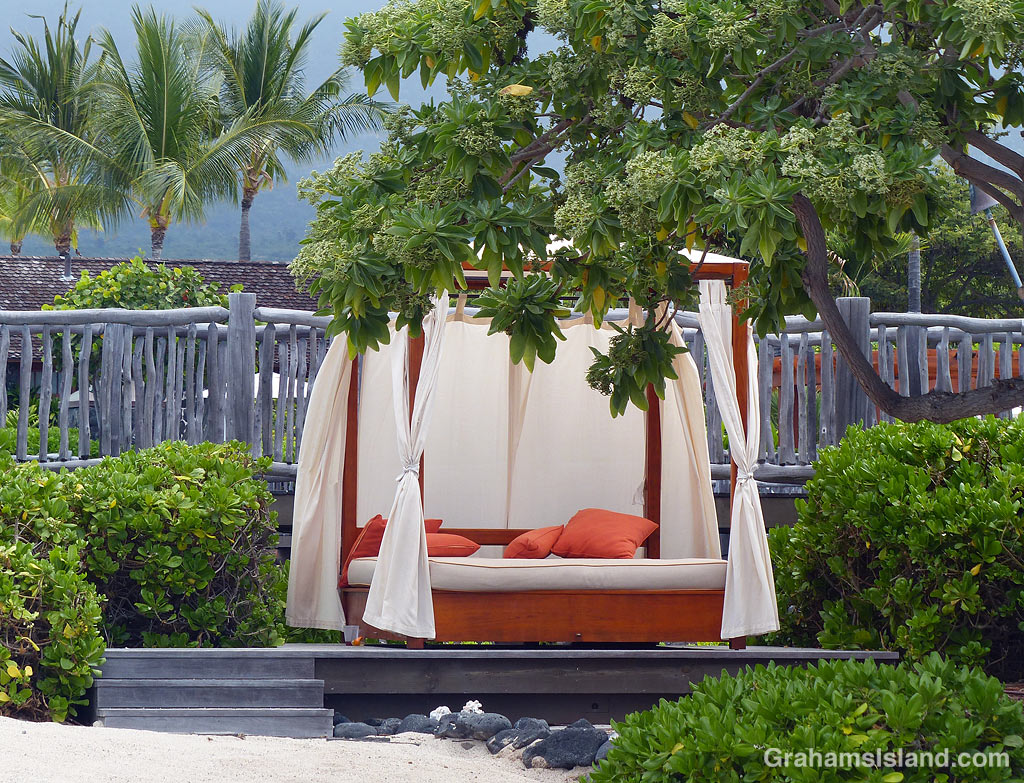
On a coastal walk, I saw this scene at the back of the beach fronting Kohanaiki Beach Club. The urge to rest was strong, but I suspect I wouldn’t have been peaceful for long.
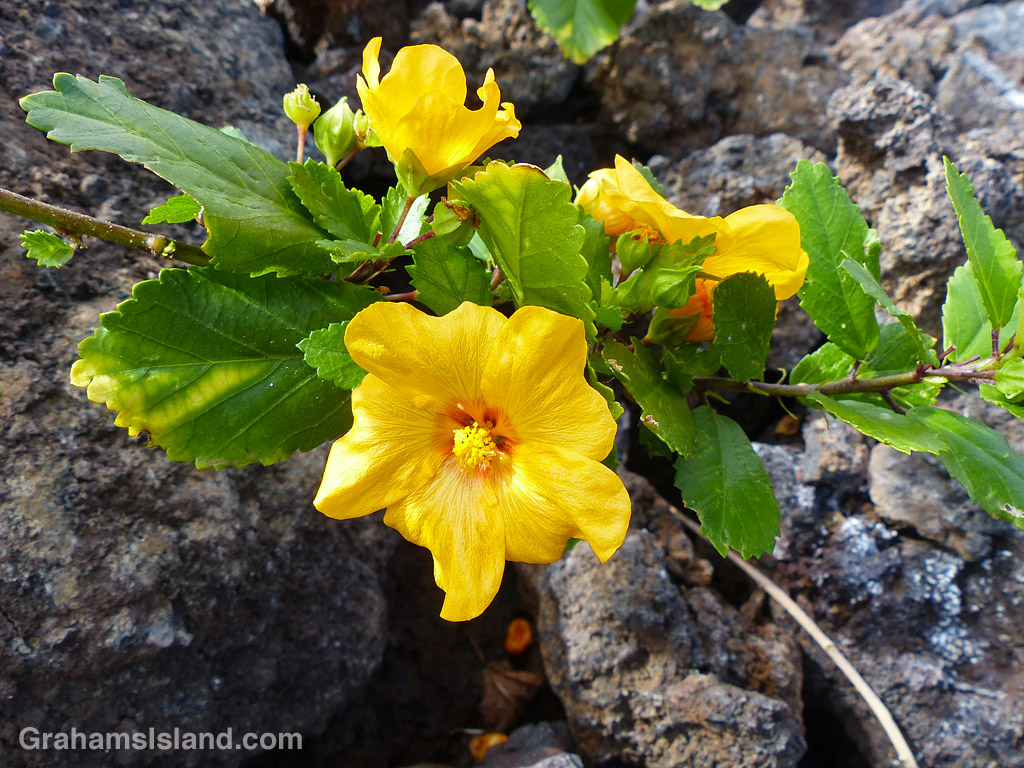
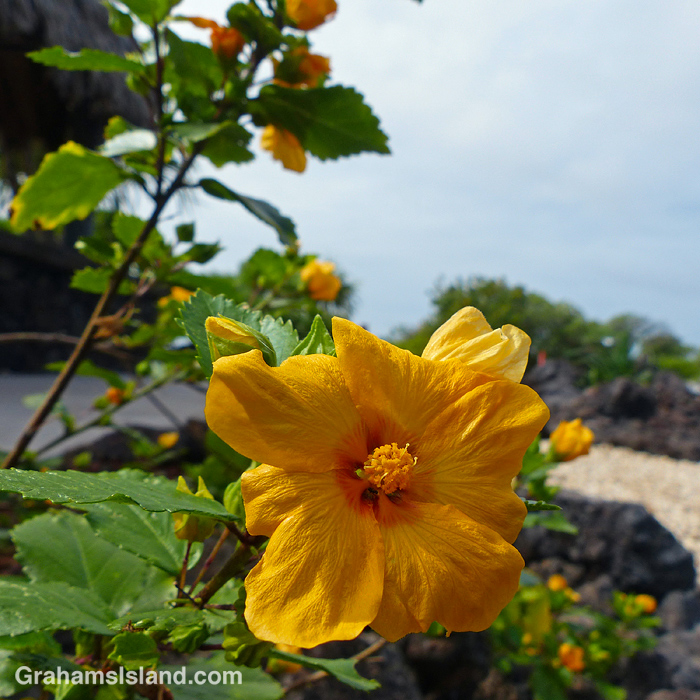
‘Ilima (Sida fallax) is an indigenous plant that has different forms. It can be a groundcover or a shrub and it can have different colored flowers. The top two photo show the shrub form, while the bottom two are of the groundcover.