Triton’s trumpets are snails and their shells are the second largest in the Indo-Pacific. They can attain a length of 20 inches. The colorful shells are also quite beautiful, especially when they catch the light filtering down from above.
These snails eat echinoderms including Crown-of-Thorns stars, which feed on corals.
This week’s Sunday Stills challenge theme is ‘Gray.’ See more offerings here.
This photo shows a pueo, the native Hawaiian short-eared owl, gliding over a gray road beneath a gray sky. This is a stretch of Old Saddle Road, which is one of the best places to see pueos as they hunt in the pastures on either side of the road or rest on fence posts alongside the road.
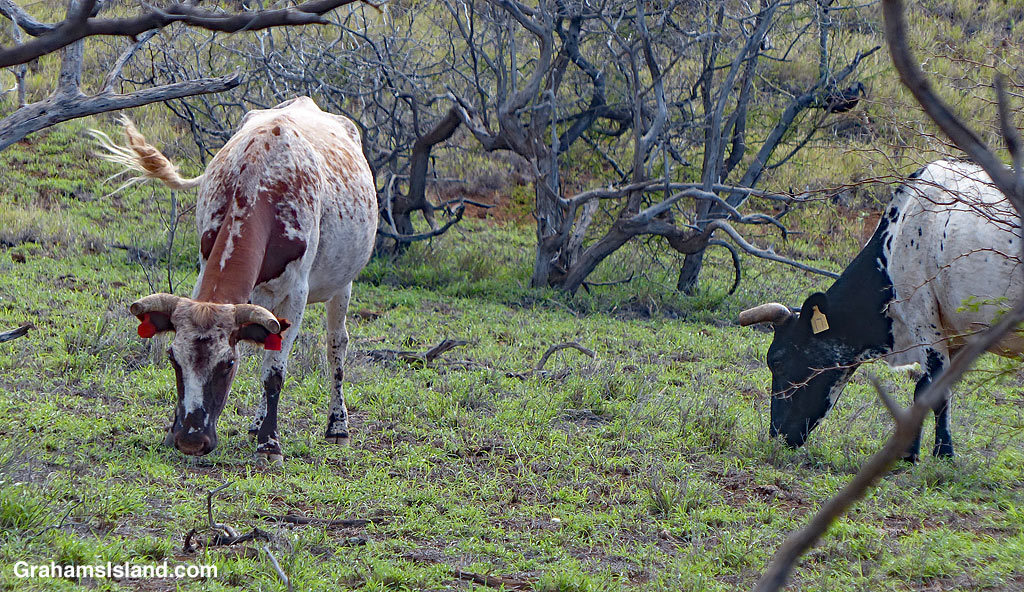
These are a couple of short-horned cattle, not shorthorn cattle which is an established breed of cattle. These two have had the ends of their horns removed. Unlike dehorning, when the entire horn is removed, removing only the tip is not supposed to be painful because that part of the horn is just keratin.
This kind of procedure is probably to reduce the risk to people handling the cattle, but I have seen these cattle in the company of others with a full set of horns, so I guess it’s a case of let the handlers beware.
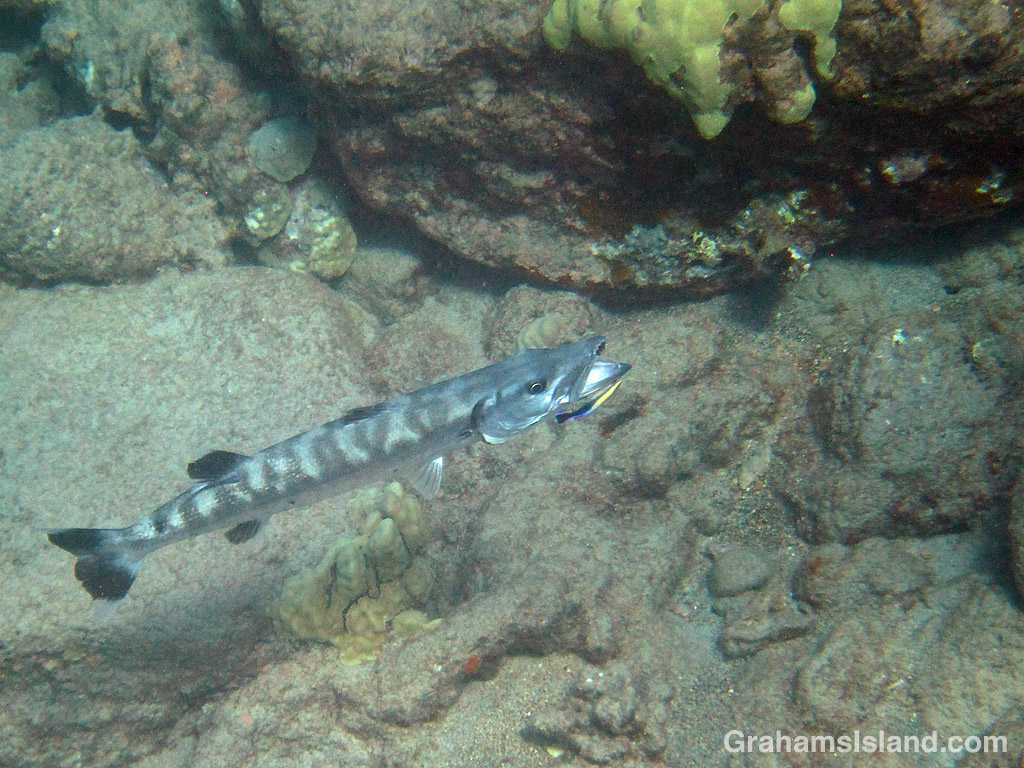
A small cleaner wrasse works at removing parasites, dead tissue and mucus from a great barracuda. The service they provide is recognized by larger potential predators, which don’t harm these little blue and yellow fish, even when they go inside the mouth to clean.
Great barracudas are generally mostly silver with black marks on the tail fins and second dorsal fins. However, some great barracudas, such as this one, have black marks on other fins and their silvery sides are mottled with darker markings.
Last week, I went down to Hualalai Resort while the 2020 Mitsubishi Electric Championship, the first event on this year’s PGA Tour Champions, was going on. I was going to spend time at the event but, on arrival, found that the PGA doesn’t allow cameras. Since I was mostly going to take photos I wasn’t sure how much time I wanted to spend watching golf without it.
Instead, I went for walk along the waterfront, which is public access. This path also happens to go by the 17th hole of the golf course, so I took some photos and returned later when the players reached that point.
The top photo shows the 17th green with Hualalai volcano in the background. The tee for this par 3 hole is on the slightly elevated area to the right of the photo. This was taken in the morning, before the tournament started. In the middle photo, staff rake the 17th hole bunker before the event. Below, Ken Tanigawa puts on the 17th green. He missed, though got close enough to make par. Technically, I wasn’t supposed to take this photo, so if this blog suddenly stops it’s probably because the PGA’s lawyers have bludgeoned me with five irons (the preferred club for that kind of activity) and buried me in a bunker on the 13th hole.
Earlier this month, I got up in the wee hours to view the Quadrantids meteor shower, with the idea of taking photos. My camera isn’t the greatest for this, but in the event, it didn’t matter. I caught a peripheral glimpse of one meteor and that was it.
Still, the effort wasn’t without its rewards. The sky was clear and starry, and I liked this scene of the illuminated building, the large kiawe tree, and the dark, starlit sky.
This is my third post on this week’s Sunday Stills challenge theme of ‘Yin-Yang.’ See more responses here.
Yesterday, I posted (here) a response to this week’s Sunday Stills challenge theme of ‘Yin-Yang.’ (See more responses here.)
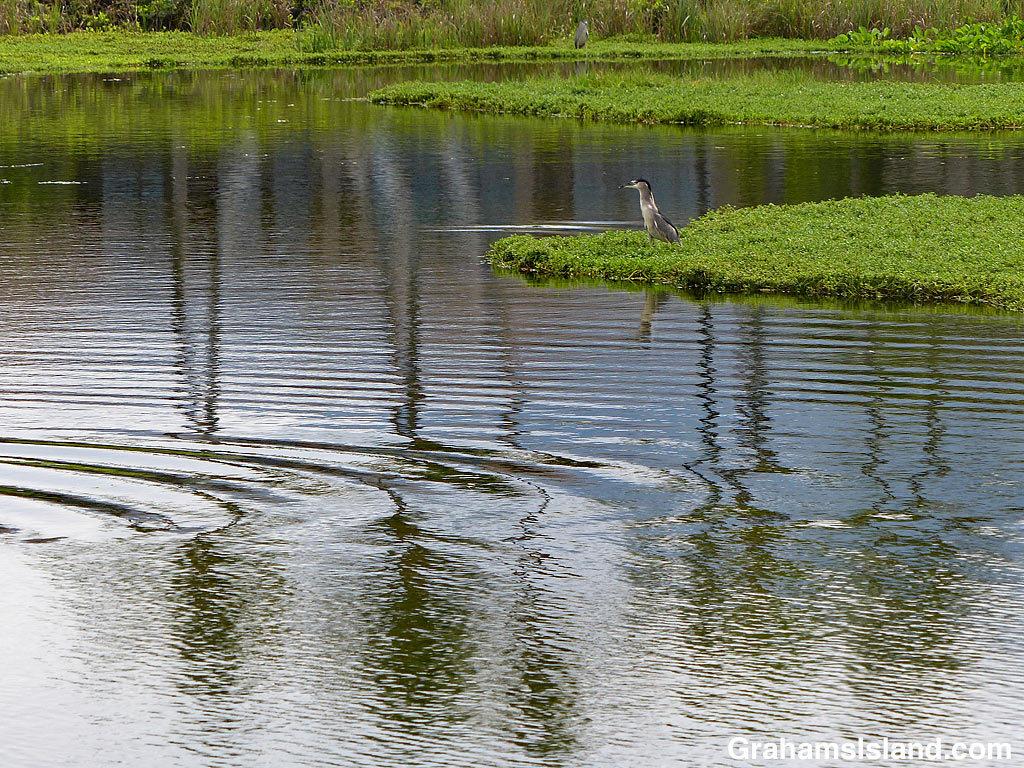
This is my second offering on the theme, which also features light and dark, but also stillness and movement – the stillness of the herons (there’s a second one in the background) and the movement of the rippling water. I like how the second set of ripples disturbs the first set and the reflections of the palm trees.