Author Archives: Graham

Unknown's avatar

About Graham

I take photos when I'm out and about, recording life on the Big Island of Hawaii.

Early morning brush fire

Recently, I was driving to work, enjoying a robust pink sunrise, when I came across the scene in the top photo – flashing lights and a line of traffic. I thought there had been an accident, but when I drove past, I could see most of the vehicles were fire trucks. The air was acrid with smoke and I saw flames here and there. The land there is scrubby and dry and while there isn’t a lot of vegetation, what there is burns easily. I drove on to work.

When I returned home late that afternoon, I thought I’d check out the scene of the fire. I was surprised to still see smoke rising in several places, and nobody around. Cars on the highway drove by, barely slowing down. I got out and had a wander along the roadside and then ventured into the ashy ground, all smoky and warm (middle photo). What I didn’t see was any firefighters.

I wondered if I should call 911. Perhaps the fire was thought to be extinguished and had rekindled in the wind. Before I made up my mind, a large yellow truck emerged from a cutting down the road and began spraying water onto the area beside the highway, which was where I was standing (bottom photo). I decided it was a good time to return to my truck.

When I drove on, I saw a clutch of firefighters gathered along a dirt road branching off from the cutting. They were there the next morning, and the next afternoon as well, when I still saw smoke rising from the area. It was three days before they left and the smell of burning hung in the air for a good while afterwards.

Leonotis leonurus

Leonotis leonurus is also known as lion’s tail or wild dagga. It’s native to South Africa and is known for its medicinal and mild psychoactive properties. It seems like I mostly see it after it has bloomed and the heads have dried to a brittle brown. This one, however, was still in flower, its bright orange flowers contrasting with the green of the rest of the plant.

Hawaiian coot diving

I saw this Hawaiian coot at Kaloko-Honokohau National Historical Park, north of Kailua Kona. It was puttering around in one of the inland lagoons, periodically diving for food, as it is in these photos.

For more information about Kaloko-Honokohau National Historical Park, go to https://www.nps.gov/kaho/index.htm or bigislandhikes.com/kaloko-honokohau-park/.

Curious spotted eagle ray

I have a tendency, when out snorkeling, to revisit places where I’ve seen something interesting. So if I’ve seen a frogfish, a shark, or gargantuan blenny in a particular place, I go back there to see if it’s still there. Bear in mind that these are creatures that extremely mobile and move around a good deal.

And yet, there’s method in this madness. Many fish are territorial and so do occupy a very limited area which they defend with great vigor. Others might be more transient, but tend to feed in certain areas.

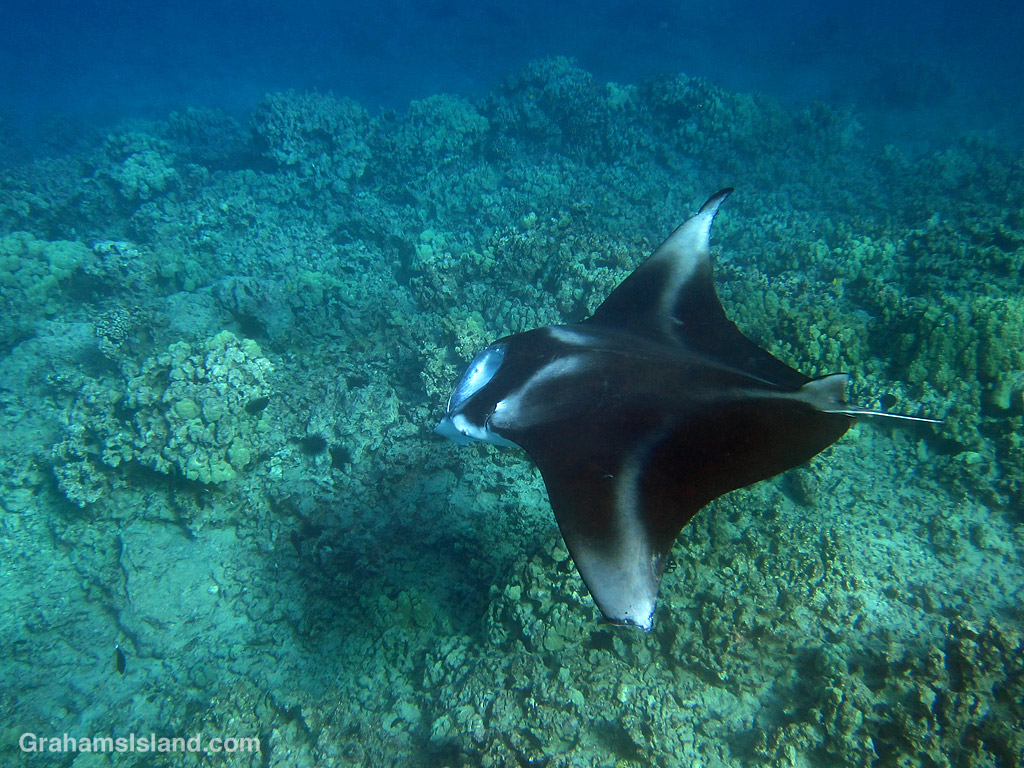
Spotted eagle rays fall into this latter category. They can cover large distances, but tend to feed on sandy bottoms, shoveling the sand with their bills to uncover the marine invertebrates that they feed on.

This eagle ray was dong just that, cruising low over the sand, pausing occasionally dig for potential prey. But after a long spell of this activity, it rose in the water, cruised around, and made a close pass, clearly checking me out. It did this a couple of times before heading back down and in toward the shore in search of food.

I don’t think there was any reason for this behavior other than a curiosity to see what this ungainly creature was that was following it. And it’s not alone in this behavior. Manta rays also do this along with dolphins, sharks, and a fair number of smaller fish. They’re curious about us; we’re curious about them. This is what makes getting in the water fun.

Cane toad

This week’s Sunday Stills challenge theme is ‘Zen.’ (See more offerings here.) This is a cane toad and, despite the exceedingly grumpy look, it found a moment of zen in the sanctuary of this sprinkler.

Cane toads were introduced to Hawaii to control pests, such as the cane beetle, in sugar cane fields. As with many such introductions, the results were mixed. The toads do eat an assortment of undesirable insects, but also breed prolifically so that they can become pests themselves.

They are the world’s largest toad and have poison glands that can release a toxic substance onto their skin, so they should be handled with care or not at all.

Mauna Kea telescopes at sunset

This week’s Friendly Friday challenge theme is ‘Remote.’ (See more responses here.)

I’m going for this photo for three reasons. First, Hawaii itself is remote at more than 2,200 miles from the nearest major landmass. The closest U.S. state is actually Alaska, though California is the closest state to the Big Island.

Secondly, Mauna Kea is one of the more remote spots on the island, particularly these days. Protests over building a new telescope on Mauna Kea have resulted in the road up the volcano being closed for some weeks now with no end to the dispute in sight. So if a person wants to go to the top, a long and arduous hike is the only way.

Thirdly, the telescopes on the summit are there to explore the farthest reaches of the universe, and you can’t get more remote than that.

Cow on the road

Upolu is home the last dairy on the Big Island. It has a large herd of cows, mostly black and white holsteins, but with a few other kinds mixed in. However, this cow is a little different. It’s the only one I’ve seen with a collar or horns.

I get the impression this is somewhat of the dairy’s pet, which is allowed to wander. And lately, it’s been wandering on the road. When I drive by it looks up and then continues munching grass, which grows well by the road.