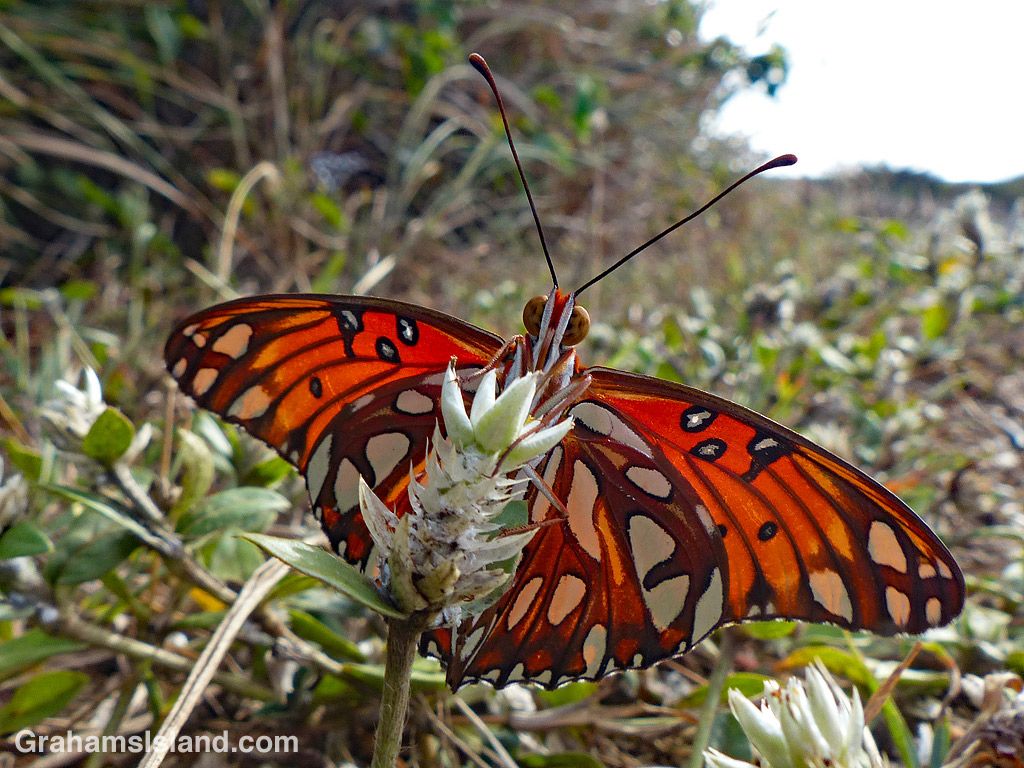
A lesser grass blue butterfly reveals the reason for its name, at least the blue part anyway.
Posted in response to this week’s Sunday Stills challenge on the theme of ‘Blue.’ See more responses here.

A lesser grass blue butterfly reveals the reason for its name, at least the blue part anyway.
Posted in response to this week’s Sunday Stills challenge on the theme of ‘Blue.’ See more responses here.

A lot of cargo for Hawaii is delivered by ship to Honolulu on Oahu. Cargo for the smaller (in population) islands is then distributed by inter-island barges. One of their ports of call is Kawaihae, on the west coast of the Big Island.
When the tug and barge arrives at the port, a second tug is sent out to hook a line onto the stern of the barge, so that it can help check the momentum of the barge. The tug at the front stops towing and assists in this braking process. Once the barge has pretty much come to a stop, the two tugs push the barge around until it’s alongside the jetty for unloading.
These photos show some of that process. Above: entering the port and slowing down. Below: both tugs begin to push the barge.
Posted in response to this week’s Friendly Friday challenge on the theme of ‘Between the Lines.’ See more responses here.


Bright yellow mamane flowers are not only a cheerful sight, but also very popular with bees. They were all over these mamane flowers on the upper slopes of Pu’u Wa’awa’a.


A green anole pauses on the mossy trunk of a ti plant.

Peacock groupers are easily identified by their iridescent blue spots and, in larger specimens, lighter vertical bars toward the tail. They tend to be skittish fish, diving for cover when anything approaches. But these two were in an area where fishing is prohibited and I’ve noticed that the fish in these areas have figured out they don’t have to worry about people in the water (probably a big mistake).
Another trait of peacock groupers is that they will often hunt with eels and octopuses. That’s what these two were doing on this day. On the right of the photo, the tail of the eel can be seen sticking out from whatever cranny the eel was disappearing into.
But the thing I like best about this photo is the fish just above the head of the top peacock grouper. Not much can be seen of it except for two white areas that look like a mischievous grin. I suspect that these white spots are the bill of a large parrotfish, but I was never able to get enough of a look to be sure.

I have a quest to get photos of breaking waves without getting myself smushed on the rocks. I like this one for the forms that the wave’s foam has taken – loops, tendrils and little blobs.

This rainbow appeared when I was snorkeling and conveniently arranged itself over a rock I was swimming by. Even a couple of water spots on the camera housing were artfully arranged on either side of the rock.

This week’s Sunday Stills challenge theme is ‘Great Outdoors.’ (See more responses here.) When I think of the great outdoors, I think of hiking, and one of my favorite hikes on the Big Island is up Pu’u Wa’awa’a. It’s an 8-mile round trip and tops out at just under 4,000 feet. On a good day, the hike offers great views, not only from the top, but also on the way up and down. And there are several benches where a person can rest and take in those views, including a couple on the summit.
The top photo shows the view north from around 3,500-feet elevation, with Tamaki Coral in the foreground and Kohala Mountain in the background. The bottom photo is a view from 100 feet or so below the summit looking east toward Mauna Kea.
The hike can also include many native trees and plants as well as a variety of wildlife. There are domestic sheep, cattle, and horses, as well as wild pigs and goats. When the trees are in bloom, they’re rich with insects and birds including several native varieties.
To top it off, most of the times I’ve visited, usually in the early morning, I’ve had the place to myself.
For more information about Pu’u Wa’awa’a and its trails, go to puuwaawaa.org.