Category Archives: Activities

Pu’us

Pu'us on Mauna Kea

In Hawaii, one meaning of the word ‘pu’u’ is ‘a protuberance of some kind.’ This can be anything from a pimple to a hill, but ‘hill’ is the most common usage I encounter, as a general reference or in place names.

Pu’u O’o is the cinder cone that is home to the vent on Kilauea Volcano that was active from 1983 until earlier this year. Pu’u Wa’awa’a is an old cinder cone that is now managed by the Division of Forestry & Wildlife. A common thread is that, in Hawaii, a hill is a cinder cone because all of Hawaii is volcanic and the landscape is liberally dotted with cinder cones.

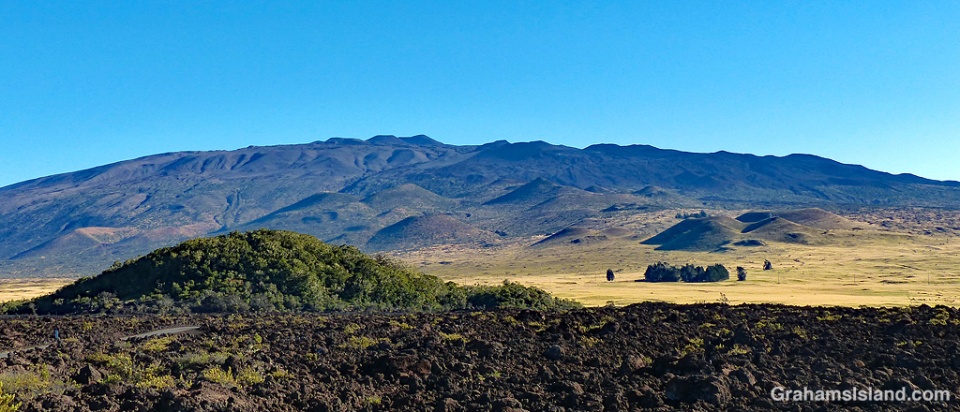
The top photo shows Mauna Kea and the large array of pu’us on its southern slopes. In the foreground is Pu’u Huluhulu, which means hairy hill. There’s a trail to the top of this pu’u which offers good views of Mauna Kea and Mauna Loa.

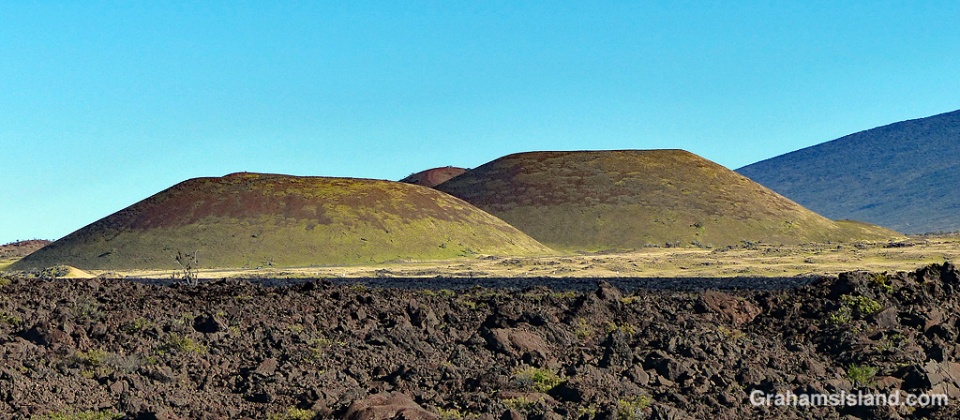
The bottom photo shows grassed over pu’us in Pōhakuloa Training Area, which is a military base located in the region between Mauna Loa, Mauna Kea and Hualālai volcanoes.

On the Big Island, several pu’us are accessible to hikers, usually with a trail curving up to the top and then around the rim of the pu’u. Even if the pu’u isn’t that high, it invariably stands out from its surroundings and offers good views.

Pu'us between Mauna Kea and Mauna Loa

Signs: Ironman advice

Signs-Ironman advice

During last month’s Ironman race, these cyclists had committed some sort of misdemeanor, probably following too close, on their way to Hawi, and had been pulled over to serve a 5-minute penalty. But what I liked about this scene was the sign in the background reading ‘Exertion plus perspiration equals inspiration.’ I suspect many of the Ironman participants might have thought the sign should have read ‘Exertion plus perspiration equals pain.’

Incidentally, that bright neon sign was a source of great community consternation when it went up. Some locals thought it was OK. Others thought it was a blight on the community and a sign of the impending apocalypse. It’s been in place a few months now and the hubbub seems to have subsided. I have to say though that the neon colors are still as garish as they ever were.

Kites

Kite with tail

KitesOn one of my recent walks, I saw half a dozen kites soaring in the air and I realized it might be the first time I’ve seen kites around here. This is somewhat surprising since North Kohala is notoriously windy and seems like it would be a mecca for kite flying.

Kites are no longer simple diamond shapes on a wooden cross and these were by no means the most exotic kites available these days. But I did like the pterodactyl below and the others were also striking, particularly when they caught the sunlight.

Kite

Orange

Dendrobium secundum flowers

Dendrobium secundum orchidThis week’s Sunday Stills theme is ‘Orange.’ (See more responses here.) Usually I pick one subject for these challenges, but I had two recent subjects that fit the bill and I couldn’t make up my mind, so I’m including both.

The flower photos are of a dendrobium secundum orchid, which is also known as a toothbrush orchid. The flower color can vary from pale pink to purple with an orange labellum at the tip. These flowers were soft and delicate looking, yet so lush.

The bottom photo is from the recent Ironman race on the island. I liked the pop of this cyclist’s outfit and how his water bottle matched his orange helmet.

Ironman cyclist and old shed

Ironman 2018

Ironman winner Patrick Lange
Ironman cyclist leaving Hawi
Ironman cyclists
Ironman cyclist in blue

Saturday saw the running of the 40th edition of the Ironman World Championships in Kailua Kona. This is the event featuring a swim of 2.4 miles, a bike ride of 112 miles, and a run of 26.2 miles. As in previous years, I participated in this event by walking out to the main road and taking photos, whenever possible from a nice shady spot.

Actually, this year’s race was run in prime conditions for the athletes. It was overcast with occasional light rain and only a gentle breeze from time to time. Consequently many records were set, including new course records for both men and women.

The top photo shows men’s winner and defending champion, Patrick Lange of Germany, zipping by on his way back towards Kona. Second photo, Great Britain’s Susie Cheetham heads out of Hawi. Third photo, Dan Plews of NewZealand (1685) leads Robin Schneider of Germany (2310), and Neil Eddy of Great Britain (2070). These three finished the bike leg in fairly close proximity, but after the marathon run, Plews finished 21 minutes ahead of Eddy and 45 minutes ahead of Schneider. Fourth photo, Jodie Robertson of the U.S.A demonstrates the importance of color coordination while cycling. Bottom, a large group of riders roll into Hawi, the turnaround point of the bike leg.

For more information about Ironman, go to Ironman.com.

Ironman group

Signs: No Lay Net

Signs-No Lay Net

Lay nets are also known as gill nets. They can be hundreds of feet long and many feet deep with floats on the top edge and weights on the bottom. The problem with them is that, rather than targeting specific food fish, they can catch anything swimming by including turtles and monk seals. Because of this, they’re banned in certain areas, though not everywhere in Hawaii.

To me, this photo represents how the ban works. This section of the Kona coast is one of those areas where lay nets are banned. Someone has gone so far as to erect a sign in the lava near the coast. But that’s about it. In due course, the sign will fall down. It probably won’t be replaced. In the meantime, enforcement of the ban is spotty at best. Even when a violation is called in, chances are no one will be out to check on the situation until long after the net has been hauled and the netters gone home.

Bench overlooking Honokane Nui Valley

Bench overlooking Honokane Nui Valley

I’ve posted a photo of this bench and view before, but when I took this walk beyond Pololu a few months ago the bench was in bad shape. One of the legs had rotted out and if I wanted to sit, it had to be on one end and with care.

So last time I hiked up that way I took a tape measure, planning to assess the damage and work out what was needed to fix the bench. However, when I got there I found someone had beaten me to it. And unlike my repair idea, they had wisely decided to discard the previous bench frame and replace it with a plastic one.

While it might be somewhat less aesthetically pleasing, the plastic frame should last a lot longer than its predecessor. It’s also securely anchored with metal rods so the bench should be around for a good long time. Something to look forward to next time I make the hike.