Category Archives: Activities

Signs: Kiholo campsite

One of the ocean-side campsites at Kiholo Bay on the Big Island of Hawaii
The campground at Kiholo is located at the end of a gravel road and is only open Friday through Sunday nights. It has eight sites that must be reserved in advance. There are portable toilets, but no other facilities, and no water. So what’s the attraction? Well, let’s see if the photo offers any clues. (Sorry, but the yacht doesn’t come with the reservation.)

For more information about camping at Kiholo, go to camping.ehawaii.gov/camping/all,details,57781.html

For more information about Kiholo Bay, go to bigislandhikes.com/kiholo-bay/

I’iwi

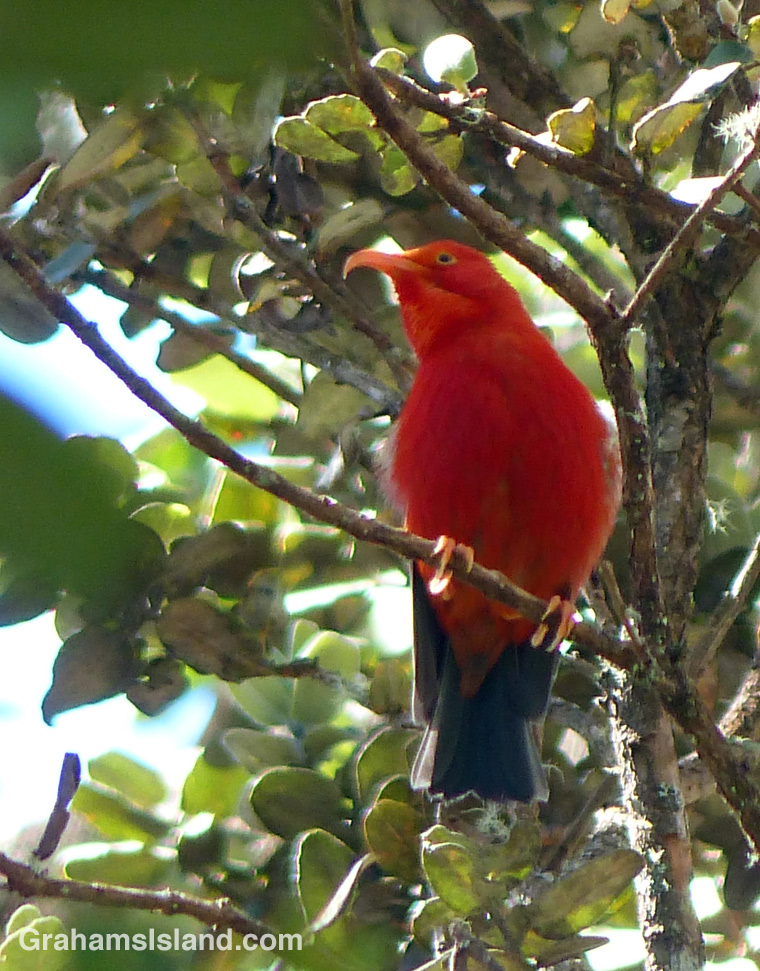
The I’iwi (vestiaria coccinea) is a native Hawaiian honeycreeper
The I’iwi (vestiaria coccinea) is a native Hawaiian honeycreeper, which is still quite common on the Big Island, as well as on Kaua’i and Maui. I saw several while hiking the Pu’u O’o Trail, off of Saddle Road. The fact that they’re bright red and they have a quite distinctive call makes spotting them a bit easier for a non-birder like me.

For more information about the Pu’u O’o Trail, go to bigislandhikes.com/puu-oo-trail/.

Pu’u O’o trail

A kipuka on the Pu'u O'o trail off Saddle Road on the Big Island of Hawaii.
More recent lava flows have yet to be reclaimed by vegetation. The greenery is a kipuka on the trail with Mauna Kea in the background.
A kipuka on the Pu'u O'o trail off Saddle Road on the Big Island of Hawaii.
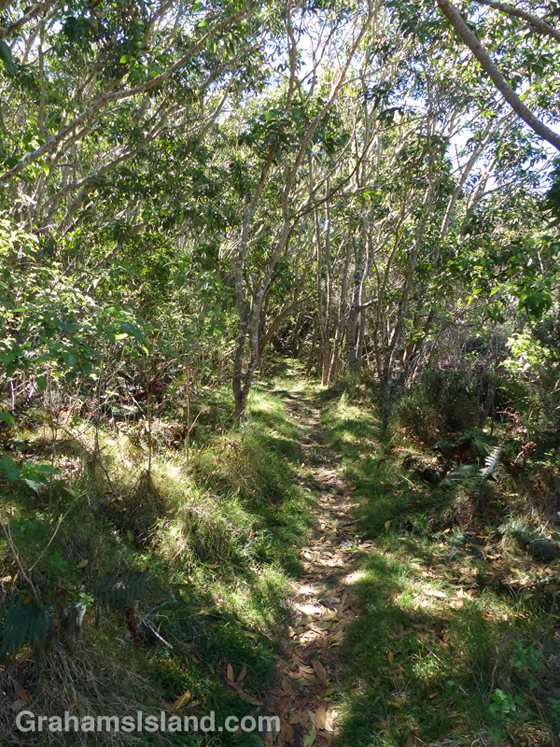
When the trail passes though a kipuka it offers shade and abundant bird calls.
A kipuka on the Pu'u O'o trail off Saddle Road on the Big Island of Hawaii.
An older lava flow has been softened by vegetation.

It took me a while to discover the various trails off Saddle Road. That’s because, from the road, they look like they’re mostly lava with some scrubby vegetation, but this is misleading. The kipukas (areas of land where lava has flowed around leaving it relatively untouched) are full of plants and a haven for wildlife including many endemic species. The whole area is an example of the cycle of destruction and regeneration that shapes this island and, indeed, the Earth.

The Pu’u O’o Trail, off of Saddle Road, has nothing to do with Kilauea’s Pu’u O’o vent. It refers to the Pu’u O’o Ranch on Mauna Loa. The trail was used for moving cattle from one grazing area to another.

The trail alternates between crossing lava flows and passing through kipukas. Depending on the age of the flow, it might have a good deal of greenery on it, but more recent flows are stark lava fields. While the open lava flows offer great views of Mauna Loa and Mauna Kea (assuming it’s a clear day), the kipukas offer shade and are alive with bird calls, most of which I don’t recognize.

After about 4 miles the trail intersects with the Powerline trail and a loop can be made back to the start, or simply retrace your steps. Bear in mind that if the clouds roll in, which they do on a regular basis, the trail is a good deal harder to follow.

For more information about this, and other hikes on the Big Island, go to bigislandhikes.com.

Moon landing

These skydivers appear head for the moon.These skydivers appear to have just missed the moon.

When I saw these skydivers I thought of Kurt Vonnegut’s satirical essay “Excelsior! We’re Going to the Moon! Excelsior!” The connection was really nothing more than the title.

In this case, I imagined the captions as “Coming in for landing,” “Whoa, just missed,” and “Let’s go round again.” I bet this is along the lines of how the moon landings were faked!

The reality is these were part of Upolu Airport’s newest/only economic enterprise, B.I.G Skydiving. On this outing, a couple of solo skydivers had already landed. These two were on a tandem skydive, where a paying customer has the much-needed security of being attached to an experienced skydiver.

For more information about B. I. G. Skydiving go to skydivebig.com.

These skydivers appear to be leaving the moon.

Game bird guzzler

A game bird guzzler collects water for wild birds
On a recent hike, I came across this contraption. What I liked most about it was its name – Game Bird Guzzler. It’s basically a device for providing a source of water for game birds. The way it works is that when rain hits the roof of this structure, it’s collected in a gutter and piped into the back into the tank. This water is then fed, through the white pipe, into the small basin at the front. There’s a flap in the basin so that when a game bird such as a turkey takes a drink, its head will push the flap and release more water into the basin.

When I was there, I didn’t see any turkeys or other game birds, but my approach prompted great activity and squawking as a good number of assorted finches and African silverbills took to the surrounding trees. They sat there, refusing to return to the water but not leaving either. The area surrounding the guzzler was alive with bird calls in an area otherwise not noticeably populated.

Eventually I gave up waiting for a bird to take a drink and moved on. No doubt, within a few minutes the guzzler was again crowded with small birds.

Truck stuck

A truck stuck in a muddy puddle on the Big Island of Hawaii
While I always prefer to take smaller, winding roads, such roads taken are not without pitfalls.

The last mile of the journey to Mo’okini Heiau in North Kohala is an uneven dirt road studded with rocks. When the road is dry it can be navigated by almost all vehicles (I saw a smart car there once!). However, care is needed, particularly regarding clearance. Almost every time I walk the road, I see fresh scrapes on the rocks. With rainy weather, the road becomes the territory of 4-wheel drives and jacked-up suspensions.

On this day, the puddles that often form on the road had become lakes. This truck had passed me earlier and when I saw it returning I ducked behind a bank to do a little whale watching and avoid the wave of spray that would surely accompany anything driving through the lake. A few minutes passed. I realized I hadn’t registered the truck passing. It had gone very quiet. So I wandered out to the road again and saw the truck marooned. They’d made it through on the way out, but weren’t so lucky on the way back.

The truck was a 4×4 but not with extra clearance. I think their problem was that the lake was deeper at the far end (in the photo). On the way out, they’d no doubt barreled into the water and their momentum had carried them to shallower waters and out. On the way back, the same approach would have propelled them toward the deep end. I suspect a bow wave built up, slowed them, and allowed water to penetrate parts of the truck that responded unfavorably.

The two young local men seemed quite cheerful. They waded through the muddy water, tried to coax life into the truck. One was on the phone (a miracle to have service there). After they insisted they had everything under control, I walked past on the high bank alongside the road, then turned and took this photo. When I returned a half hour or more later, the truck and its occupants were gone.

Going to the flow

Cyclists head to the Kilauea lava flow where it enters the sea.
I posted here about the current flow from Kilauea Volcano entering the sea, in a dramatic, firehose-like outpouring. In that post, I mentioned that the day after my visit, a cliff collapse caused the firehose to disappear from view. Things have settled down again and the firehose is once more visible, though another large crack not far back from the cliff is expected to cause another collapse soon.

From the Kalapana side, it’s about four miles to the viewing area and a thriving trade in bike rentals has sprung up. When I was down that way last July there were a few bikes available for rent. Now there are maybe 200 or 300 available from a large number of vendors in the parking lot. At the viewing area, bikes were piled alongside the road, and locked in clumps.

I preferred to walk, seeing the towering column of smoke and steam getting gradually larger on the way out, and enjoying a star-studded night sky on my return.

For more information about Kilauea Volcano and it current eruption, go to hvo.wr.usgs.gov/activity/kilaueastatus.php.

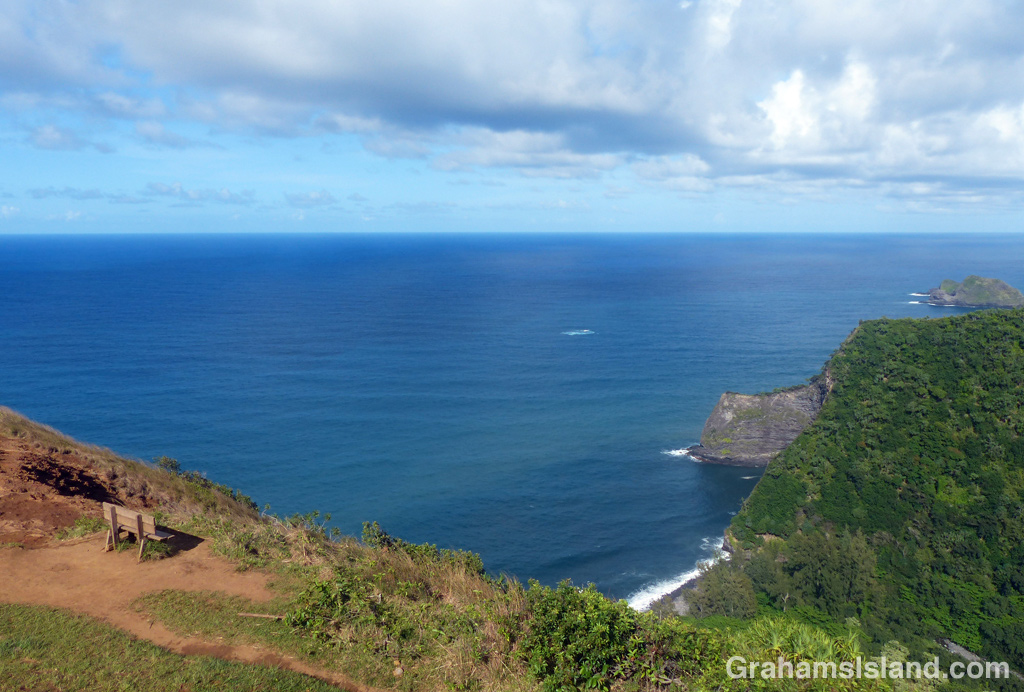
The bench overlooking Honokane Nui Valley

The bench overlooking Honokane Nui Valley on the Big Island.
At the end of the highway in North Kohala is the Pololū Valley overlook. This is where most people park their cars (if they can find a space), snap a photo or three, and then climb back in and attempt to turn around and head back.

Quite a few people head down the steep, third-of-a-mile trail to the valley and beach below. Some walk the half-mile-long beach. Very few continue up the trail on the other side. There are good reasons for this. The trail is somewhat hidden. If it’s been raining, it can be even muddier and more treacherous than the trail down to the valley. If conditions are right, it can be alive with bugs. But for those that do press on for another a mile or so, this is the spot they will reach.

Overlooking Honokane Nui Valley, this bench is the perfect spot to experience some welcome solitude. Chances are it will be unoccupied. Chances are no one else will even pass by. I like to sit on the bench (rickety though it is currently) and enjoy the ocean stretching away on one side and the tropical jungle climbing the side of the Kohala Mountains on the other.

For more information about the trail go to bigislandhikes.com/pololu-valley/.