This week’s Sunday Stills challenge theme is ‘Yin-Yang.’ (See more offerings here.) I had no idea what I’d post for this, but ended up with a couple of posts.
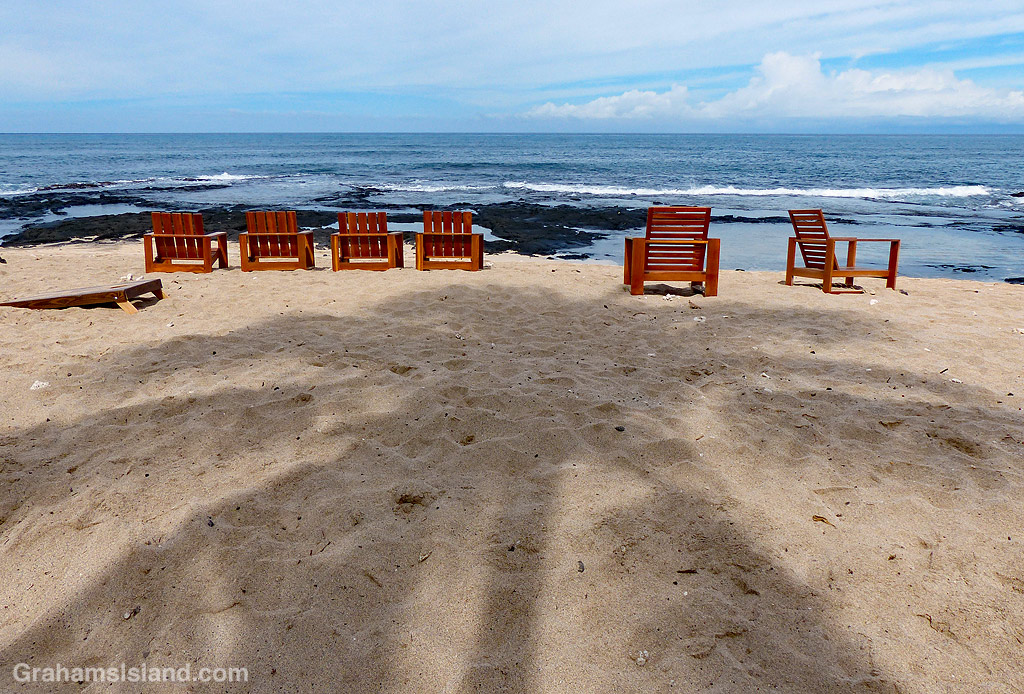
The first is a simple take on light and dark, or light and shadow. On a recent walk along the shoreline, the shadow of a palm tree imposed on a sunny beach, deserted except for empty chairs.
This week’s Sunday Stills challenge theme is ‘Old.’ See more offerings here.
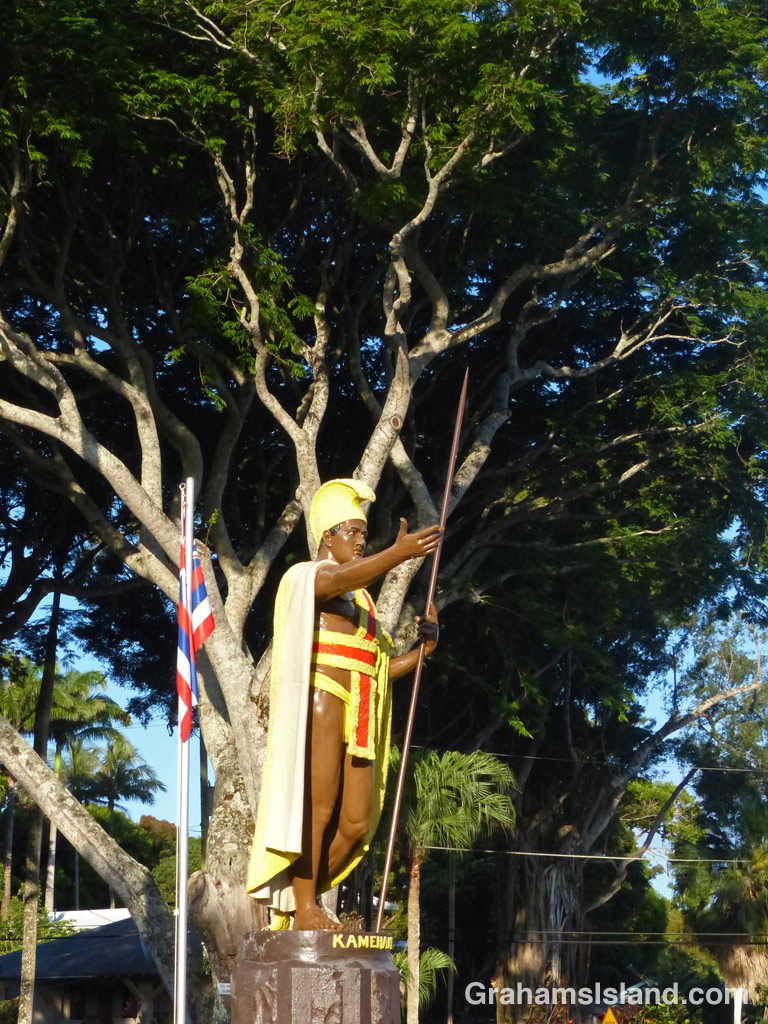
This is the original statue of Kamehameha 1, the king who first united the Hawaiian Islands. The statue was commissioned in 1878, but was lost off the Falkland Islands. A new statue was made, but in the meantime, the original one was salvaged. The new statue was put up in Honolulu and the original shipped to Kapaau.
Not long after I took this photo, the trees in the background were badly damaged during a windstorm and had to be cut down, so this scene looks quite different today.
Kohanaiki Beach Park, north of Kailua Kona, is a favorite spot for surfers. But at the south end of the park, the focus switches to history.
There’s a hālau, Ka Hale Waʽa, which is used for teaching Hawaiian crafts and culture. There’s a garden which grows the same kind of plants brought over by the first Polynesian settlers. And there’s a Hawaiian star compass, a 17-foot diameter recreation showing how the Polynesians used to navigate the vast open spaces of the Pacific Ocean.
The top photo show shows the compass. The middle photo shows a plaque, which explains the basics of how it works, using the points of the compass, the sun, nighttime celestial bodies and the ocean swells. I won’t go into detail here, but more information can be found here, here, and here. Below, the setting of the compass, with a Pacific golden plover walking on it. I like this shot because the plover is said to be the reason Polynesians discovered Hawaii. Each year, plovers summer in Alaska and then fly south as far as New Zealand. It is said that the Polynesians noted this small bird’s annual journey back and forth and figured there must be land somewhere to the north, so they set out in their canoes to find it.
Posted in response to this week’s Sunday Stills challenge on the theme of ‘Round.’ See more offerings here.
There is no Sunday Stills challenge this week (or next), but the theme was going to be ‘Something Red or Green or Both!’ so I thought I’d go with the photo I had picked out for that anyway.
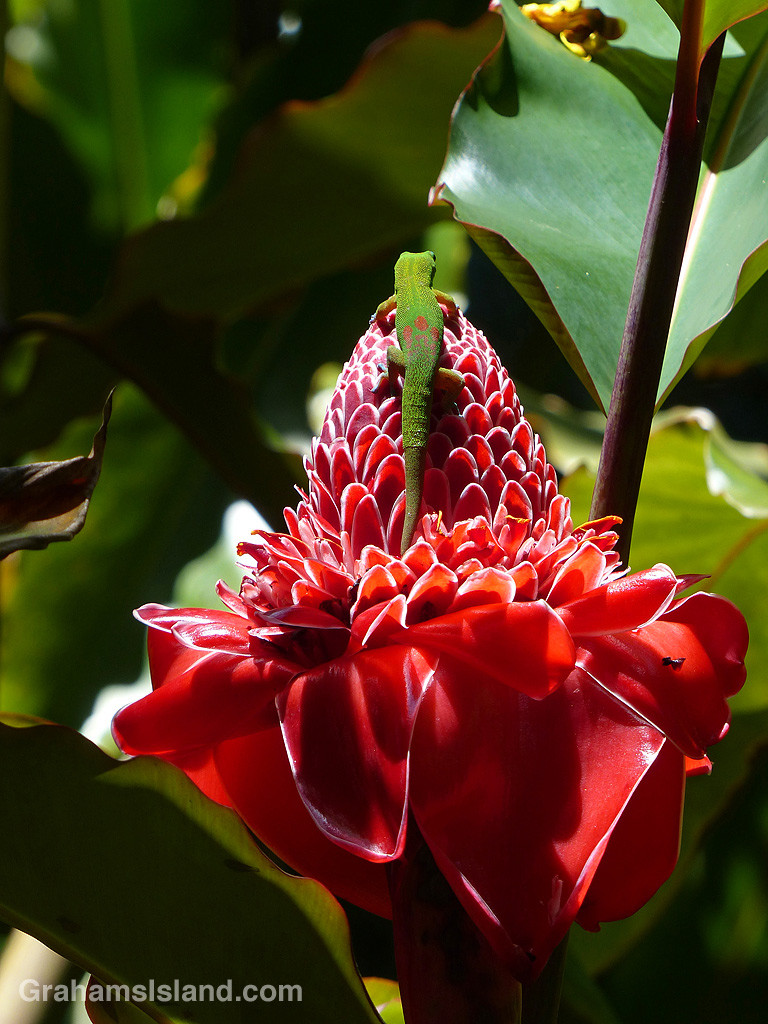
So here’s a very green (with red markings) gold dust day gecko resting atop a very red torch ginger surrounded by green foliage. It looks like the gecko has been in the wars judging from the rings around its tail, which suggest it has lost it a few times. The most recent regrowth is the lower brown part, which will ultimately take on a matching green color once it’s fully grown.
This week’s Sunday Stills challenge theme is ‘Holiday Decor.’ See more offerings here.
This theme forced me outside after dark, something of a rarity these days. As usual, when I walked into Hawi, I thought, ‘I should do this more often.’
Here are a couple of the downtown buildings illuminated for the season. In truth, this was pretty much it for holiday trappings, but it’s still a good deal more than at my house!
Also posted, belatedly, in response to the last Friendly Friday challenge theme of 2019, ‘Christmas Preparations.’ See more responses here.
This week’s Sunday Stills challenge theme is ‘Peace.’ See more offerings here.
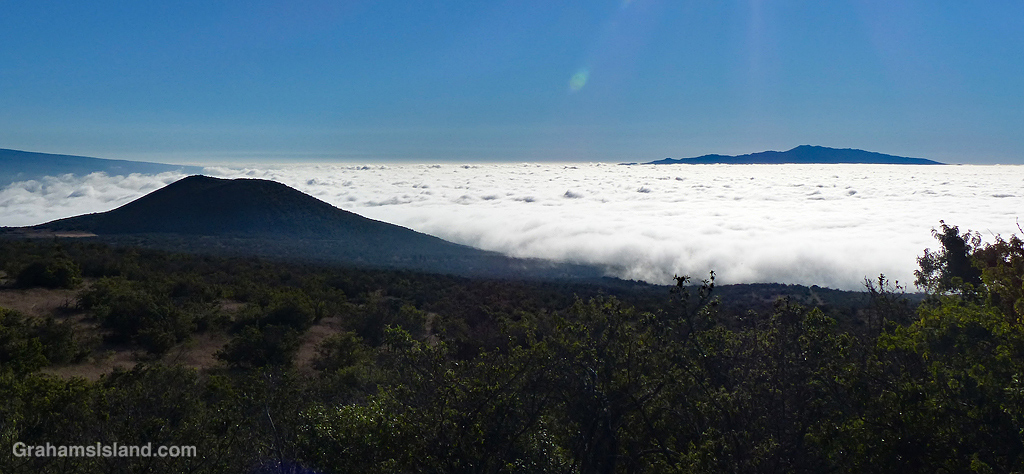
I’ve always found looking down on clouds gives me a peaceful feeling. Those fluffy balls of cotton wool look like they would make a comfy resting place. The irony is that those clouds may actually conceal roiling, turbulent air currents that are anything but peaceful, but let’s not allow reality to spoil the image.
This cloud layer blanketed the saddle between Mauna Kea and Mauna Loa. The two peaks poking above the clouds are, in the foreground, Pu’u Ahumoa, and in the background, Hualalai.
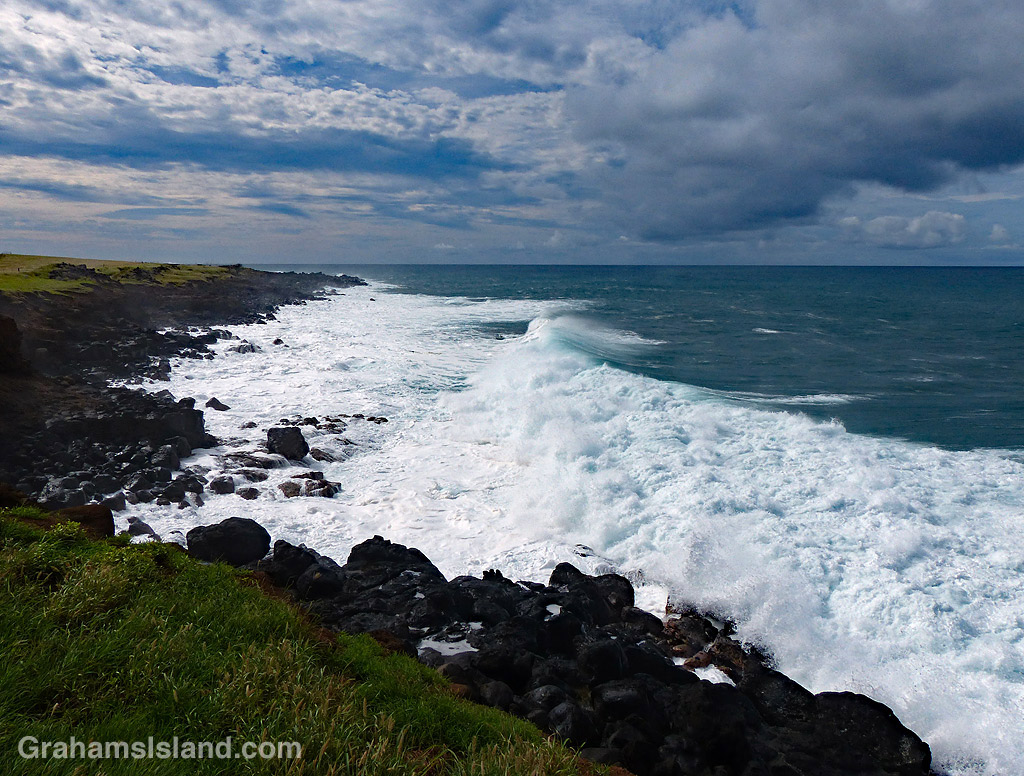
This week’s Sunday Stills challenge theme is ‘December Chill.’ (See more offerings here.)
Since I haven’t been to the chilly areas of the island recently, up on Mauna Kea or Mauna Loa, I’ve gone for a scene that at least looks chilly. Low, scudding clouds and high surf, driven by brisk trade winds make for a chilly scene, though the truth is I was almost certainly wearing shorts and a t-shirt when I took the photo.
This week’s Friendly Friday challenge theme is ‘Future.’ (See more responses here.) Since this is Snow’s last time hosting the Friendly Friday challenge I thought I’d offer a personal interpretation of the theme.
Here is one of the beaches at Kekaha Kai Park. What does this have to do with ‘future?’ Well I hope such blue-green water, white sand, palm trees and sun are somewhere in your none-too-distant future, Snow. Thanks for hosting the challenge.