This week’s Friendly Friday challenge theme is ‘Twins.’ (See more responses here.)
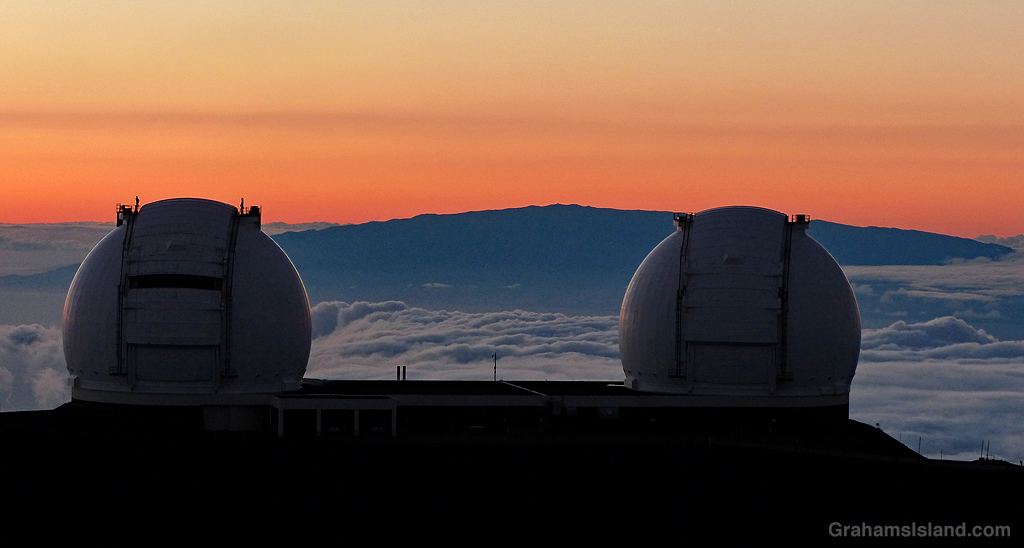
These are the two telescopes of the W. M. Keck Observatory on Mauna Kea. Keck 1 began operation in November, 1990, while Keck 2 made its first observations in October 1996. Each telescope’s 10-meter primary mirror is made up of 36 segments, hexagonal in shape. Not that these segments are small themselves. Each one is 1.8 meters wide and weighs half a ton.
The telescopes can accommodate a wide variety of instruments, such as cameras and spectrometers, and are considered to be the most scientifically productive in the world.
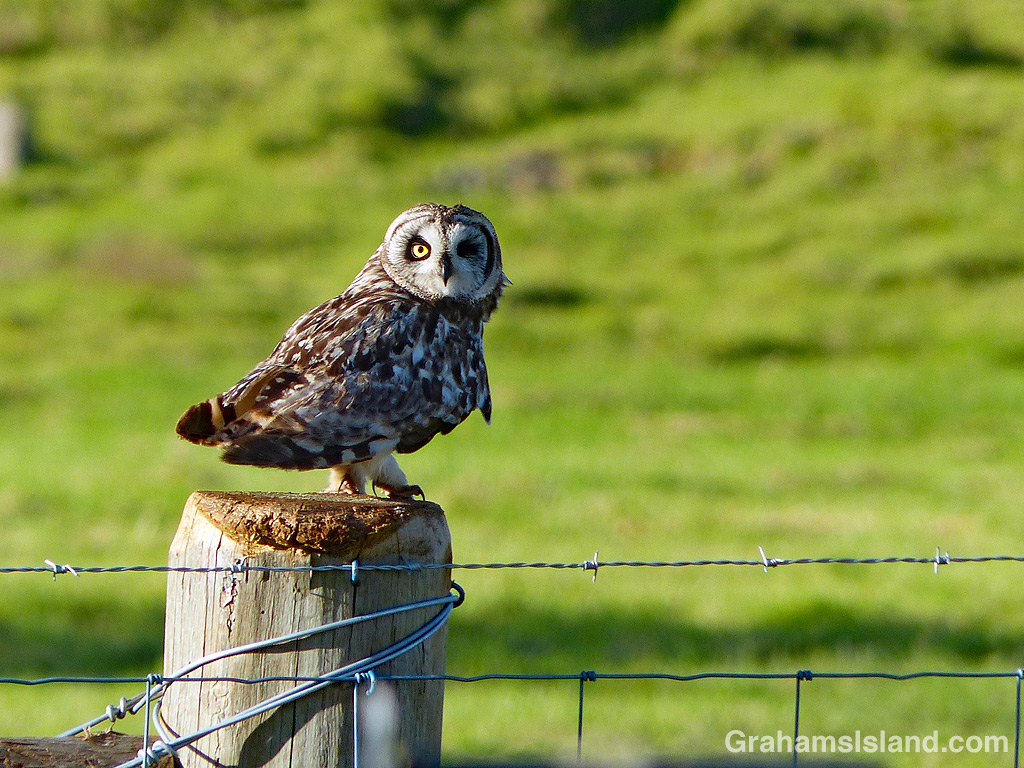
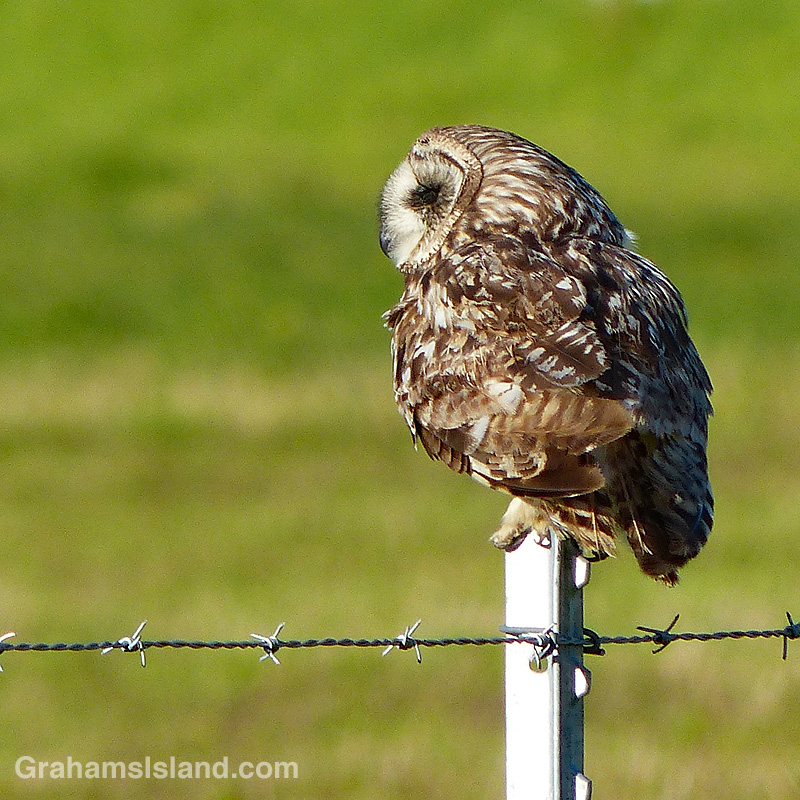
I saw this pueo (Hawaiian short-eared owl) near Waimea and pulled over to take photos. I watched and photographed it for 15 minutes or so and, at the time, I thought there was something unusual about it. Something didn’t seem quite right. But it wasn’t until I got home and looked at the photos that I realized what was up.
The pueo was missing its left eye. The eye socket seemed healed and the pueo didn’t appear to be in pain. Nor did it seem affected in its flying or behavior. In some ways this makes sense. Owls have great eyesight, but it’s their hearing that is truly extraordinary. They can pinpoint prey just by listening. However, in Hawaii, pueos are active during the day so one would think eyesight might be a more important sense than for nocturnal owls.
Either way, I felt a bit sad for the pueo, but I’m also keenly aware that nature isn’t all warm and fuzzy. And I’ve seen several creatures that have been significantly damaged in one way or another that seem to be doing fine despite their handicaps. Perhaps, from a Darwinian point of view, they’re not successful when it comes to finding a mate and breeding, so their genes are not passed on. I don’t know whether this is the case, but it’s certainly possible.
Regardless, I hope for the best for this pueo. Life for them is tough enough as it is without added challenges.
Posted in response to this week’s Sunday Stills challenge on the theme of ‘Unusual.’ (See more offerings here.)
This week’s Friendly Friday challenge theme is ‘Shadows.’ See more responses here.
This view was taken near the summit of Mauna Kea. Pu’us – little volcanic cinder cones – dot the landscape here, giving the area an otherworldly look. As the sun sets, the pu’us cast shadows on one another accentuating the slopes and craters.
This week’s Sunday Stills challenge theme is ‘Edge.’ (See more offerings here.) My first thought was this image, but I hadn’t actually ever taken such a photo. So I took my camera outside and wandered around. It wasn’t long before I found an obliging gecko keeping a beady eye on my movements.
The reason I was confident of getting this photo is because this is a typical pose for geckos. They’re constantly peeking over the edge of roofs, around corners, and around the edge of the leaves they occupy. They’re constantly on the lookout for prey – and predators.
In this case, the gecko was on my side of the leaf when I approached, but zipped to the other side, before checking out what I was up to.
This week’s Friendly Friday challenge theme is ‘Design.’ (See more responses here.) For this, I’m posting photos of the Hawaii State Capitol building in Honolulu. Opened in 1969, it’s a relatively recent structure. Some of the design features of the building are striking because they represent elements of the state.
In the middle photo, the reflecting pool, surrounding the building, represents the Pacific Ocean. The columns resemble royal palm trees, and the conical structure, the base of one of the legislative chambers, is the shape of the volcanoes that formed the island chain.
The bottom photo shows how the building is open to the elements, and reflects life in Hawaii where many activities happen outside. On the right is one of four kukui nut trees, the state tree, which represent the four main counties.
The top photo is a view of a segment of the open roof and the walkway that encircles the upper level of the building. I like the strong lines and colors of this view.
This week’s Sunday Stills challenge theme is ‘Danger.’ (See more offerings here.) It seemed a suitable opportunity to post some photos reviewing on Kilauea Volcano’s last eruption, which began in May of last year.
The bottom photo, taken from the Jaggar Museum overlook, shows the scene on the morning of April 25, 2018. Lava in the active vent in Halema’uma’u Crater, at Kilauea’s summit, was just below the crater floor and had been overflowing into the crater in previous days. The overflow is the large dark area to the right of the glowing lava.
By early May, the lava level in the vent had dropped around 1,000 feet. This drop occurred at the same time that lava disappeared from Pu’u O’o vent. Not long afterwards, cracks opened in the ground at Leilani Estates, a housing subdivision in the southeastern part of the island. By the end of May, 24 fissures had opened in the area. The most prolific lava flow emanated from Fissure 8, which flowed to the ocean and created more than 800 acres of new land. However, more than 700 homes were destroyed by this eruption.
Meanwhile, back at the summit, the absence of lava in the vent in Halema’uma’u Crater resulted in a series of collapses of the crater floor. Each collapse triggered earthquakes and shot clouds of ash and toxic gas thousands of feet into the air.
The top photo shows Halema’uma’u Crater as it looks today. The crater is twice the size it was the year before and the floor, which was mostly flat, is now a huge cascading pit. In the upper left of the photo, the Jaggar Museum, where I stood to take the bottom photo, can just be seen. It was heavily damaged by the earthquakes, as were the parking lot and access road. It’s also much closer to the crater edge than it was. (Technically the crater edge is closer to it, since the museum hasn’t moved!)
The museum, along with the rest of the park, closed in May 2018, because of the eruption. While much of the rest of the park reopened in September, Jaggar Museum did not. There’s a good possibility it never will and that its fate will be the same as the portion of Crater Rim Drive in the middle photo. A significant length of that road, which used to encircle the whole summit caldera, was destroyed, including the section in the photo which slid, intact, into the crater.
Things have settled down since September 2018 and there has been no volcanic activity anywhere on the island since then. But Kilauea remains an active volcano and will undoubtedly erupt again. It’s just that no one knows exactly when or where that will happen.
This week’s Friendly Friday challenge theme is ‘Illumination.’ (See more responses here.) I plumped for this image for the early morning light and for the two house lights, nicely positioned above the illumination of the passing car’s lights, as though they are somehow all connected.
I don’t know who Christa is or was, but there were a couple of things that struck me about this image.
The sign and the swing’s rope and seat were in excellent condition in stark contrast to the tree, which was dying and deliberately so. The channel around the trunk, below the sign, is intended to kill the tree, probably a silk oak, which can take over and crowd out native trees.
And then there’s the location, not far from the old quarry near the foot of Pu’u Wa’a Wa’a. It’s more than a mile down the hill to the nearest habitation, a ranch that runs livestock in this area. So, an isolated spot for Christa’s playground, but a wonderful location too, with views to the Pacific and surrounded by birds and animals, both domestic and wild.
Posted in response to this week’s Sunday Stills challenge on the theme of ‘Playground.’ See more responses here.