This week’s Friendly Friday challenge theme is ‘Sunrise.’ (See more responses here.)
I saw this pink and purple pastel sunrise over Kohala Mountain on my way to work, which says something about my commute.

This week’s Friendly Friday challenge theme is ‘Sunrise.’ (See more responses here.)
I saw this pink and purple pastel sunrise over Kohala Mountain on my way to work, which says something about my commute.

A small catamaran cruises through the waters off the Kona coast, its triangular sails harnessing the wind to keep it moving on course and away from rocks inshore.
Posted in response to this week’s Sunday Stills challenge on the theme of ‘Triangles.’ See more responses here.

This week’s Sunday Stills challenge theme is ‘Taste.’ See more responses here.
In Hawaii, cooking outdoors is an everyday affair. Some houses have their kitchens outside. Others, with kitchens inside, have a secondary setup on the lanai (deck) for outdoor cooking. And of course when we’re talking outdoor cooking, we’re talking barbecue. Most days, when I’m out and about, I’ll catch a scent on the air and think, ‘Oh, someone’s cooking something good.’
This photo was from a simple lunchtime barbecue and, yes, it did taste good.

I came across this little scene on an early morning walk around Kiholo Bay. I looked around. There was no one in the water, no one visible on land. The gear appeared to be abandoned. But all I could think of was a Tom Waits song, The Ocean Doesn’t Want Me, and in particular the line in it, ‘All they will find is my beer and my shirt.’ The shirt is there, and this is Hawaii – no one’s leaving their beer behind.
Posted in response to this week’s Friendly Friday challenge on the theme of ‘Abandoned.’ See more responses here.

These two gold dust day geckos share the same expression as they gaze up at the interloper looking down at them. It’s not unusual for plants to harbor several geckos. Sometimes this results in turf wars, but mostly they seem to tolerate each other, once the pecking order has been established.
Posted in response to this week’s Sunday Stills challenge on the theme of ‘Creatures and Critters.’ See more responses here.

This week’s Friendly Friday challenge theme is ‘Day Trip.’ (See more responses here.)
Any trip on the Big Island could qualify as a day trip, as everything can be reached and returned from in a day. But a common day trip in Hawaii is a visit to one of the other islands. This might be for work, for medical reasons, for some other kind of appointment, or simply for pleasure.
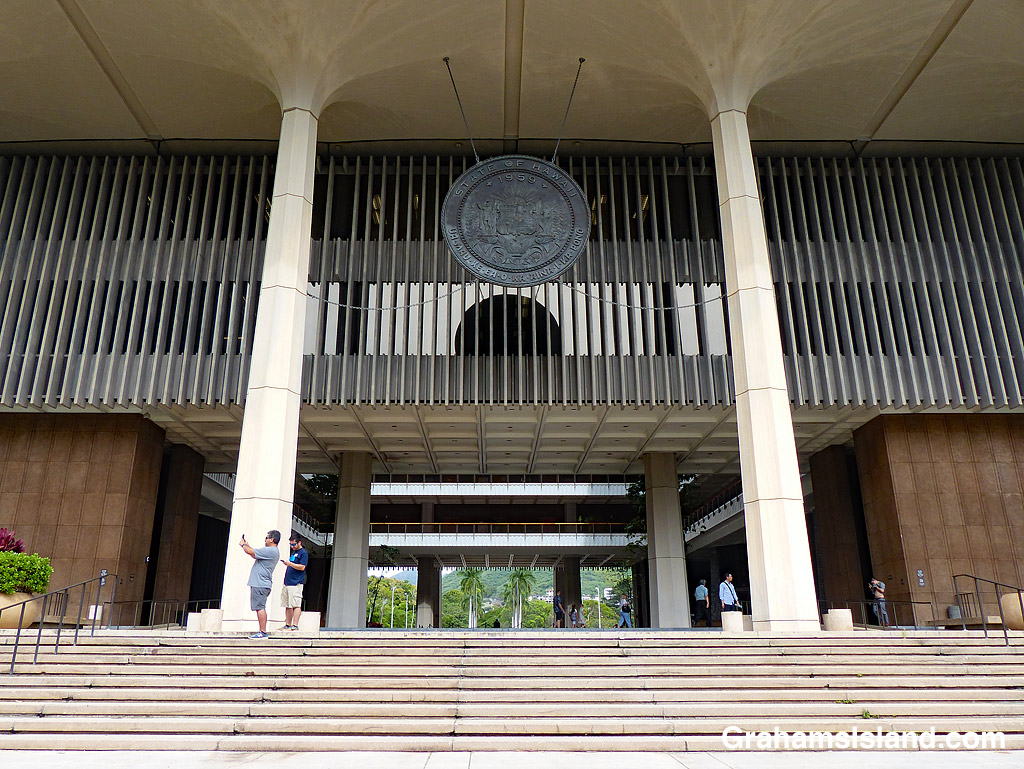
These photos are from my last trip to Honolulu. An early flight from Kona Airport and a late afternoon return gave me plenty of time to conduct my business and have a wander around downtown.
The top photo shows the entrance to the Hawaii State Capitol building. In the middle is Kawaiaha’o Church, constructed between 1836 and 1842, and considered the main Protestant church in Hawaii. Below is one of Honolulu’s large office buildings, somewhat screened by a generous amount of palms and other trees.

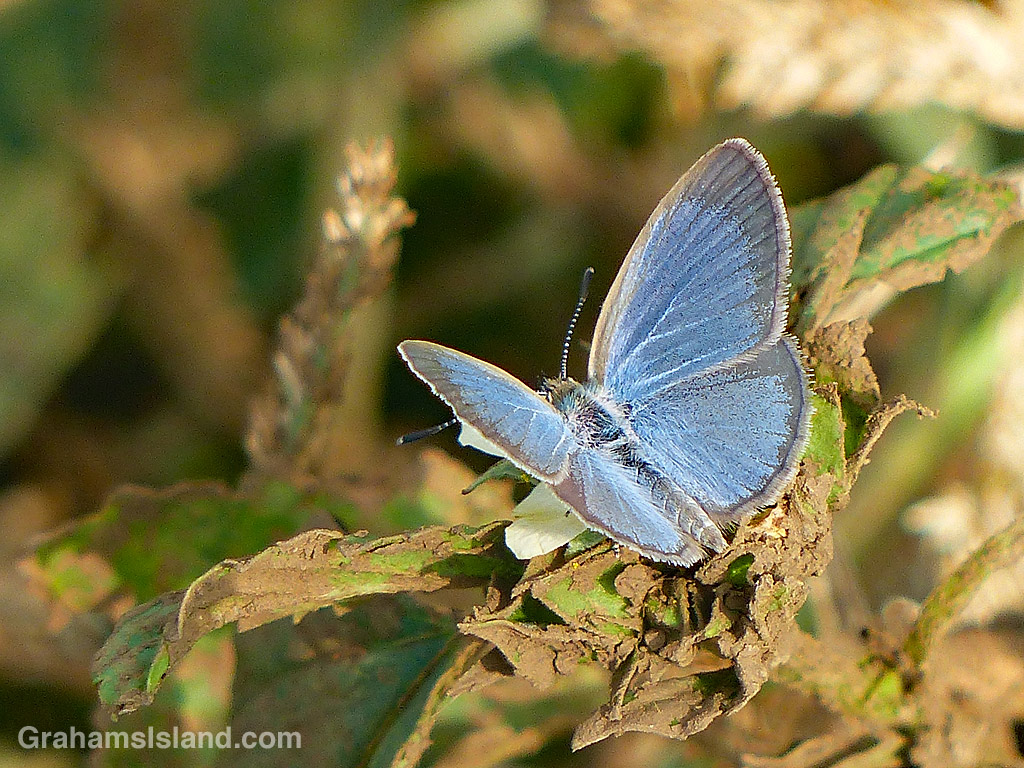
A lesser grass blue butterfly reveals the reason for its name, at least the blue part anyway.
Posted in response to this week’s Sunday Stills challenge on the theme of ‘Blue.’ See more responses here.
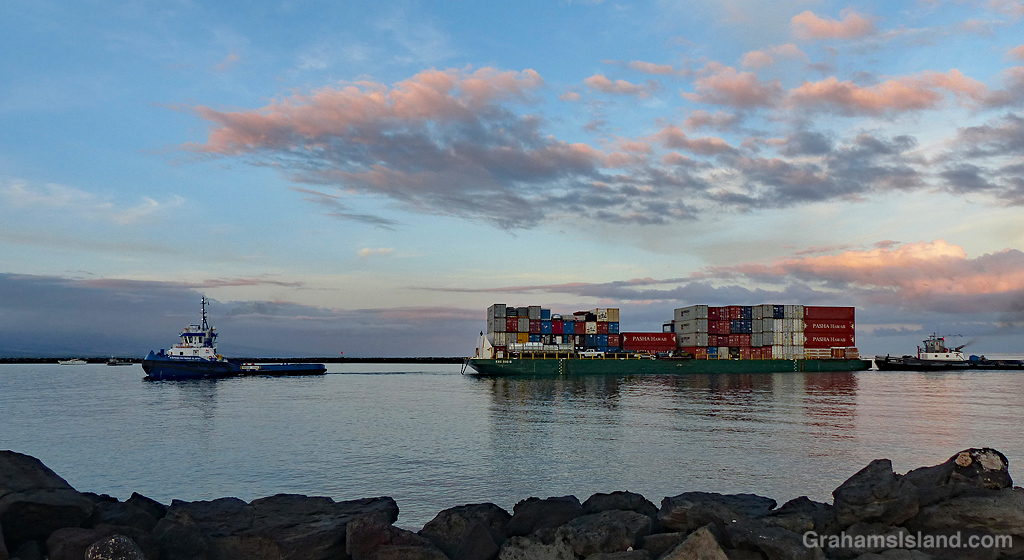
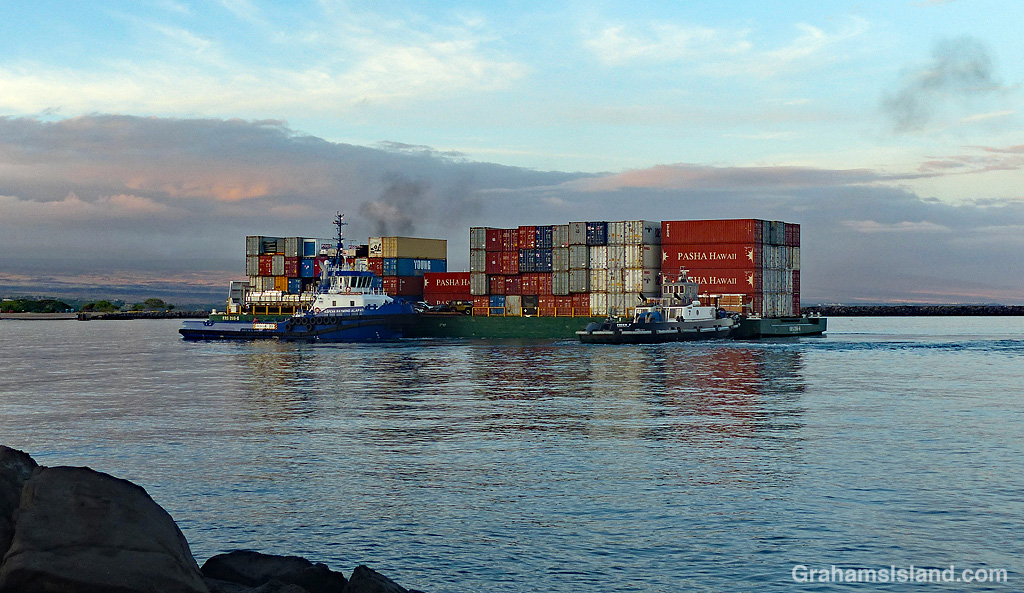
A lot of cargo for Hawaii is delivered by ship to Honolulu on Oahu. Cargo for the smaller (in population) islands is then distributed by inter-island barges. One of their ports of call is Kawaihae, on the west coast of the Big Island.
When the tug and barge arrives at the port, a second tug is sent out to hook a line onto the stern of the barge, so that it can help check the momentum of the barge. The tug at the front stops towing and assists in this braking process. Once the barge has pretty much come to a stop, the two tugs push the barge around until it’s alongside the jetty for unloading.
These photos show some of that process. Above: entering the port and slowing down. Below: both tugs begin to push the barge.
Posted in response to this week’s Friendly Friday challenge on the theme of ‘Between the Lines.’ See more responses here.