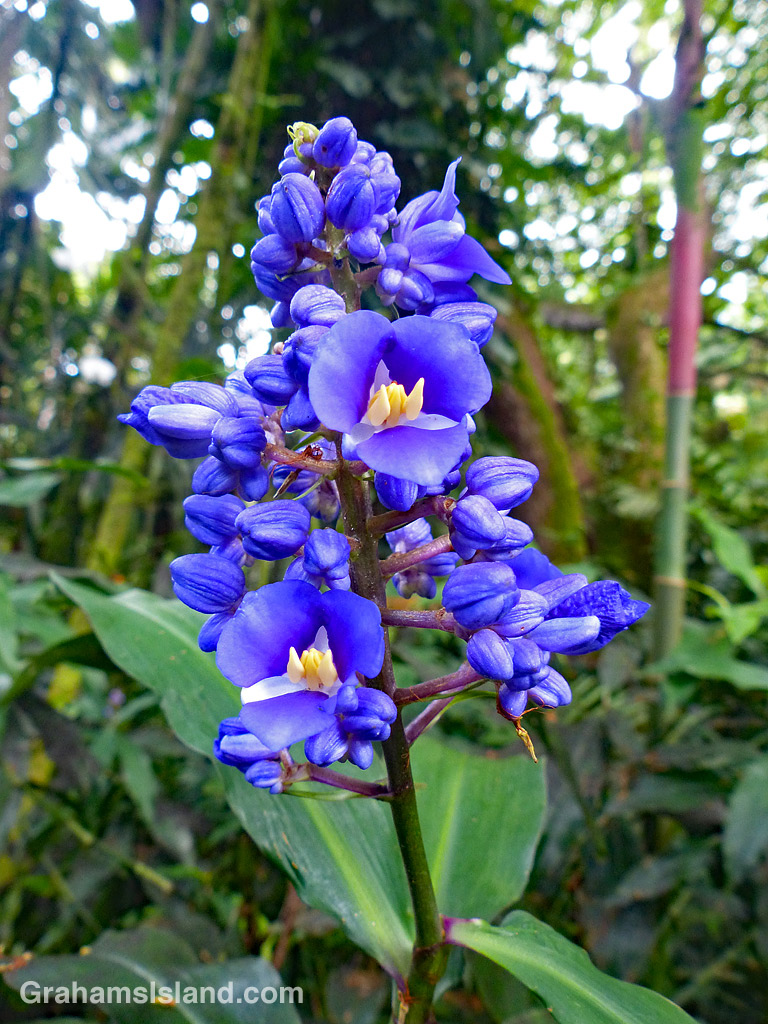
Blue ginger (Dichorisandra thyrsiflora) is not really a ginger but is in the same family as spiderworts (tradescantias). It’s grown primarily for its striking blue flowers.

Blue ginger (Dichorisandra thyrsiflora) is not really a ginger but is in the same family as spiderworts (tradescantias). It’s grown primarily for its striking blue flowers.
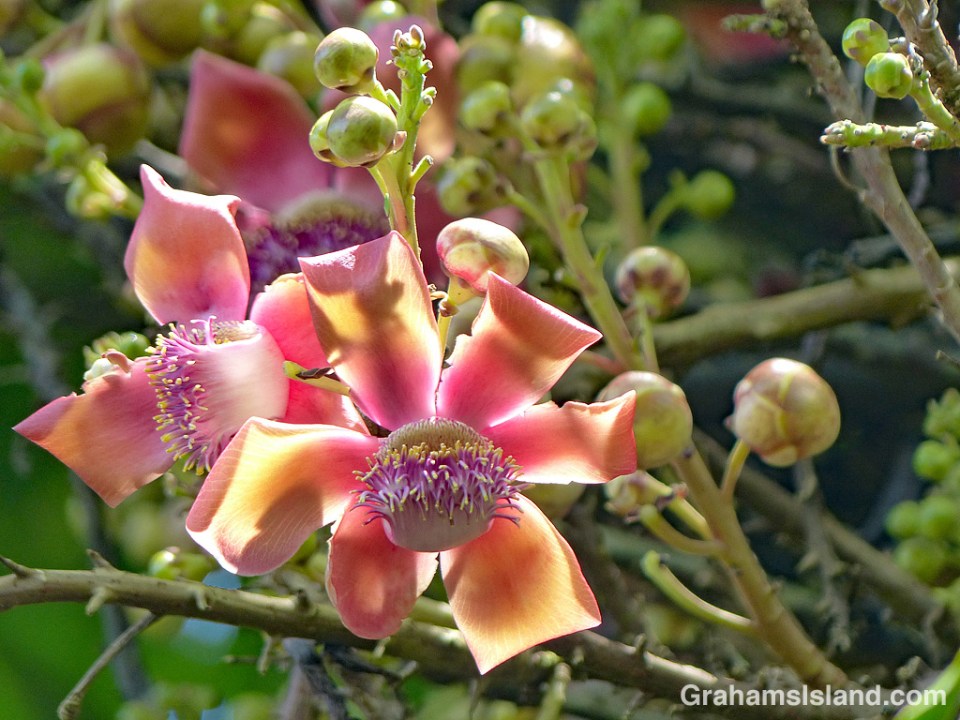
 I’ve posted a photo of a cannonball tree (Couroupita guianensis) before, here. That one focused on the cannonballs that give the tree its name. On this occasion I was taken by the flowers which can vary in color from pink to deep red. These flowers were on the pink end of the scale. The flowers are also fragrant, especially in the early morning and evening.
The flowers grow directly off the tree trunk and all the way up, but it takes a closer look to really appreciate how beautiful they are.

I was very taken by the colors when I saw this gold dust day gecko on a stem of red bamboo at Hawaii Tropical Botanical Garden near Hilo.
For more information about Hawaii Tropical Botanical Garden, go to htbg.com.
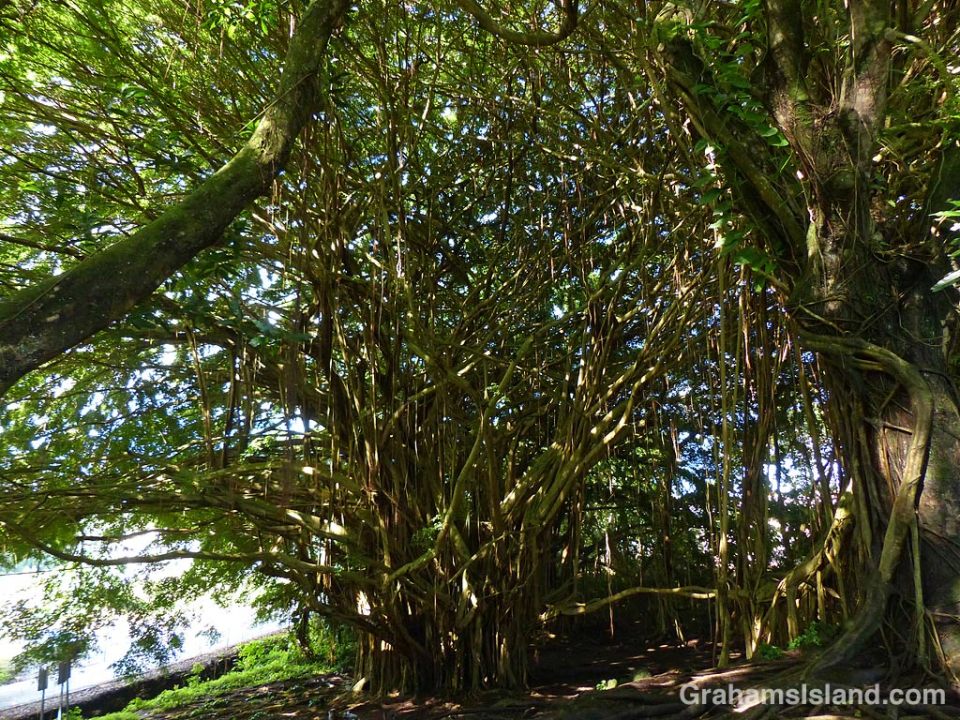
 The main attraction of Wailuku River State Park, in Hilo, is Rainbow Falls. But at the top of the hill are these huge banyan trees.
Banyans are not just a huge sprawl of branches, but a sprawl of roots, too. As epiphytes they begin life growing on other trees, from seeds dispersed there by birds. Over time, they send roots down to the ground, known as prop roots, which help support the mass of branches.
Banyan trees are also known as strangler figs because their roots and branches will ultimately overwhelm the host tree and kill it. Eventually, the dead host will decay and leave a hollow center to the banyan tree that’s left.
By continuing to send down prop roots, banyans grow out as well as up. Very old trees can cover a huge area. For example, the Great Banyan Tree in Kolkata, India is more than 250 years old. Its covers around four acres and has more than 3,500 prop roots. Here in Hawaii, the largest banyan grows in Lahaina on Maui. Planted in 1873, it now has 16 main trunks and covers two thirds of an acre.
The Rainbow Falls trees aren’t that large, but they’re coming along nicely.
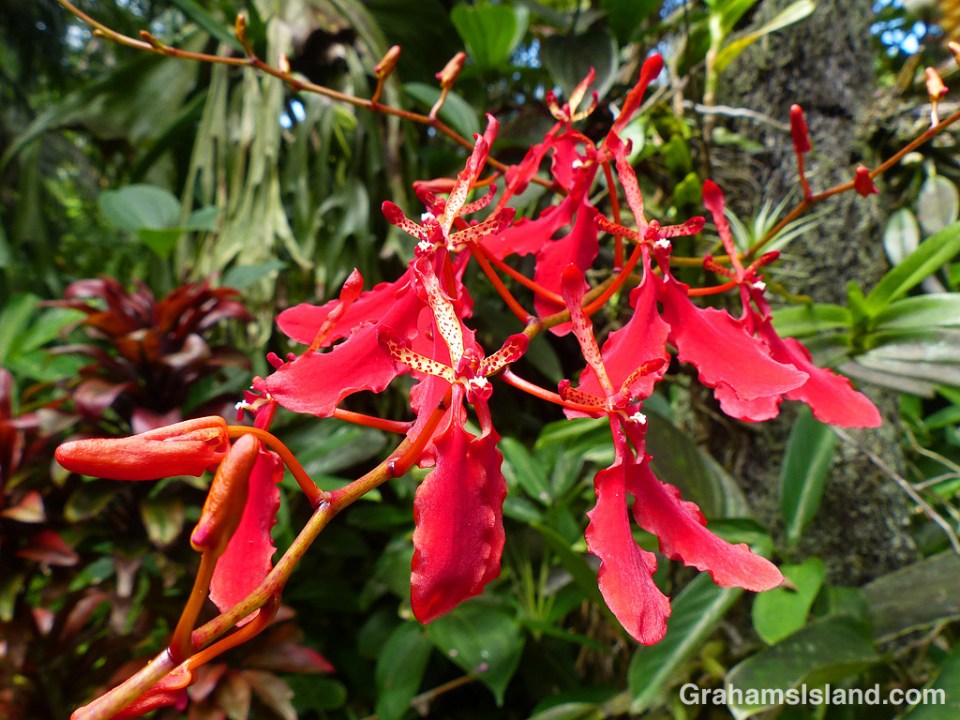
Renanthera imschootiana orchids are from southeast Asia. This one was at Hawaii Tropical Botanical Garden.
For more information about Hawaii Tropical Botanical Garden, go to htbg.com.
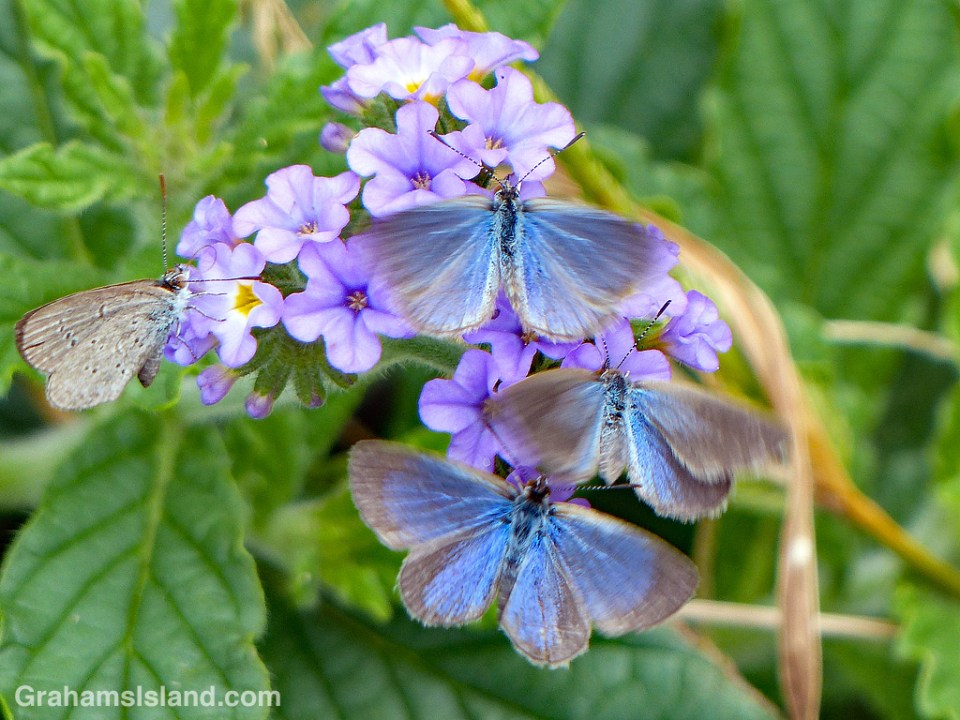
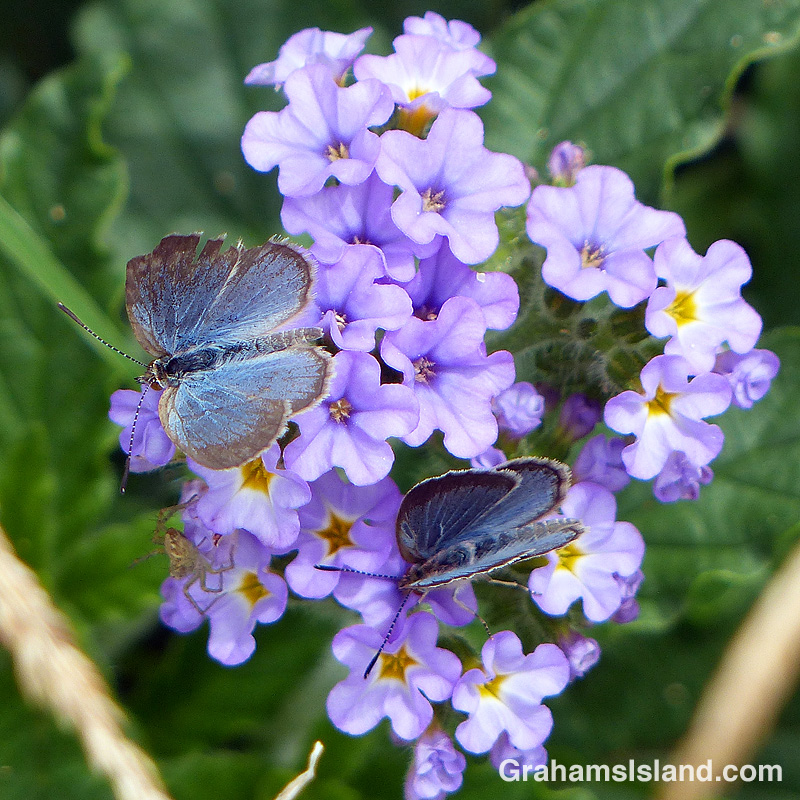 The lesser grass blue butterfly (Zizina otis) was first seen in Hawaii on Oahu in 2008 (for an article, or most of an article, about the find, click here). They’re now well established on the Big Island as well.
Lesser grass blues are very small, with a wingspan no more than ¾-inch. With wings folded up they’re the size of a small fingernail. They also fly close to the ground, within a foot or two.
Lately, I’ve been seeing them in large numbers on these blue heliotrope (Heliotropium amplexicaule) flowers. When I say ‘seeing them,’ what I mean is that when I walk past a patch of these flowers, a host of lesser grass blues will flutter up from the flowers, dance around in a tizzy for a few moments, and then settle back down again. When they do this, it’s like blue confetti being thrown (a few inches) into the air.
I’ve tried to capture this image with my camera, but haven’t been able to (and I’ve taken LOTS of photos). The butterflies are so small, I’m tall, and the effect is fleeting. But the top photo gives an idea of what’s going on, with three lesser grass blues homing in on the small blue heliotrope flowers while a fourth has already found a spot.
It wasn’t until I processed the photos at home that I noticed the spider in the second photo. I don’t know what it made of all the butterfly activity. I hope they weren’t its prey.
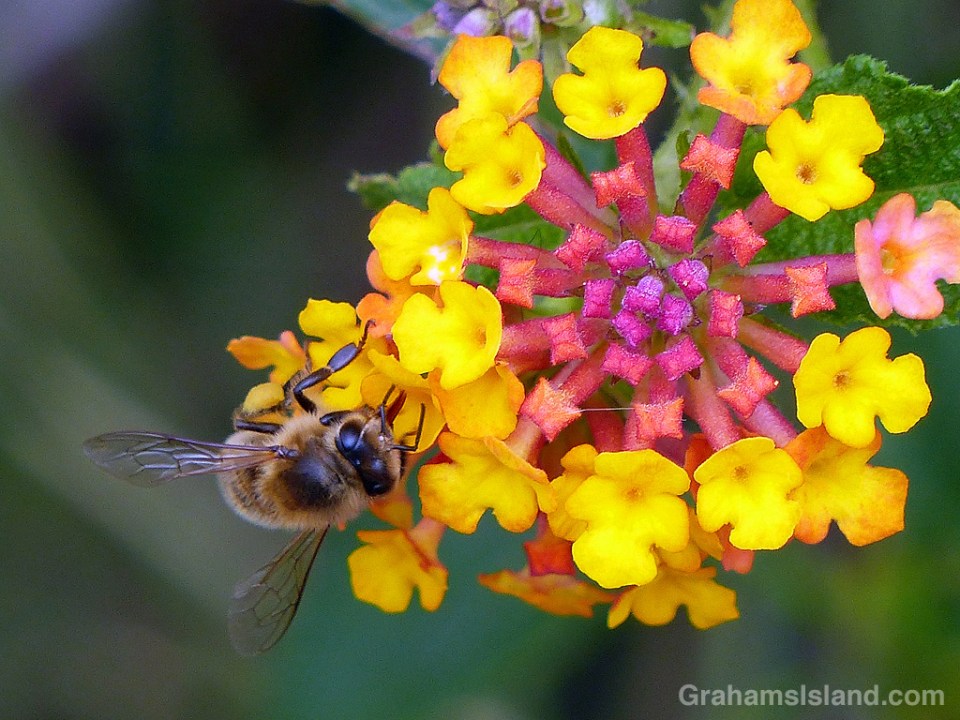
Lantana is such a colorful flower – pink and purple, yellow and orange (and invasive here, but let’s not talk about that). Curiously, it doesn’t seem all that popular with bugs, at least by my observations. But at certain times I see butterflies very interested and on this occasion, several bees were going from bloom to bloom.
Posted in response to this week’s Sunday Stills challenge on the theme of ‘Macro-Photography of Anything.’ See more responses here.
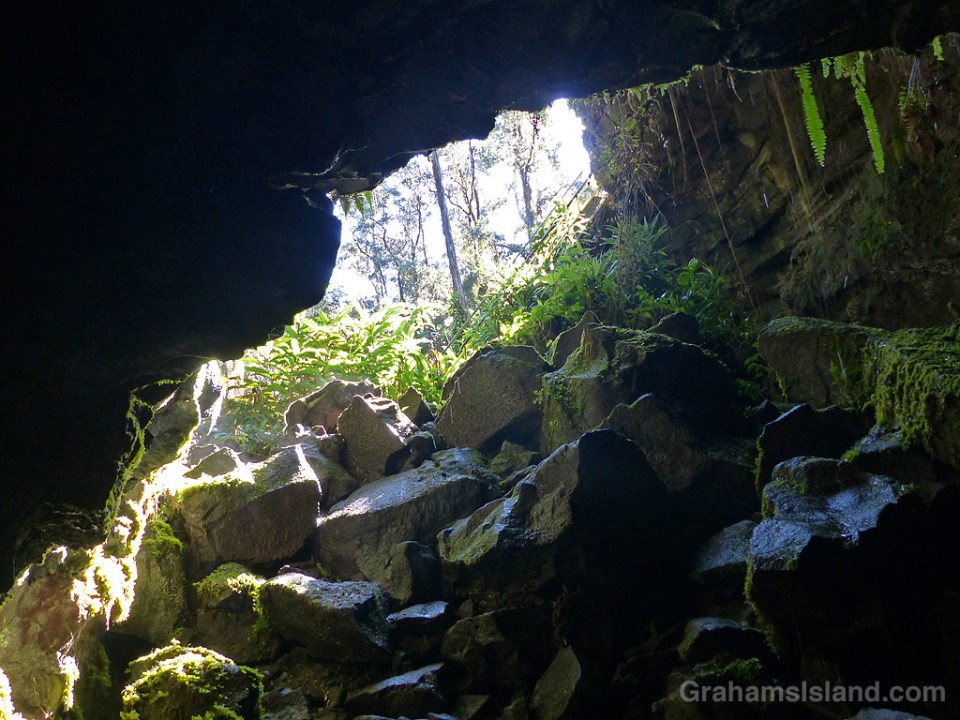
 Kaumana Caves State Park is a small park west of Hilo. Besides the usual park facilities, the main attraction is the caves. The caves are actually a lava tube, created by a flow from Mauna Loa in 1881. They’re accessed through the large opening where a section of the tube collapsed, so the two caves are at opposite ends of this opening.
My understanding is that the caves go on for quite a way, but one is not supposed to go much beyond the entrances because it is, officially, private property after that. It’s also very dark and claustrophobic, so that was enough for me.
The photos show – Above: A view from mouth of the southern cave; Middle: The staircase down to the caves; Below: Foliage that’s grown in the open portion of the tube. The cave entrances are the dark areas at the edge of these photos.