Category Archives: Plants

Growth in the lava

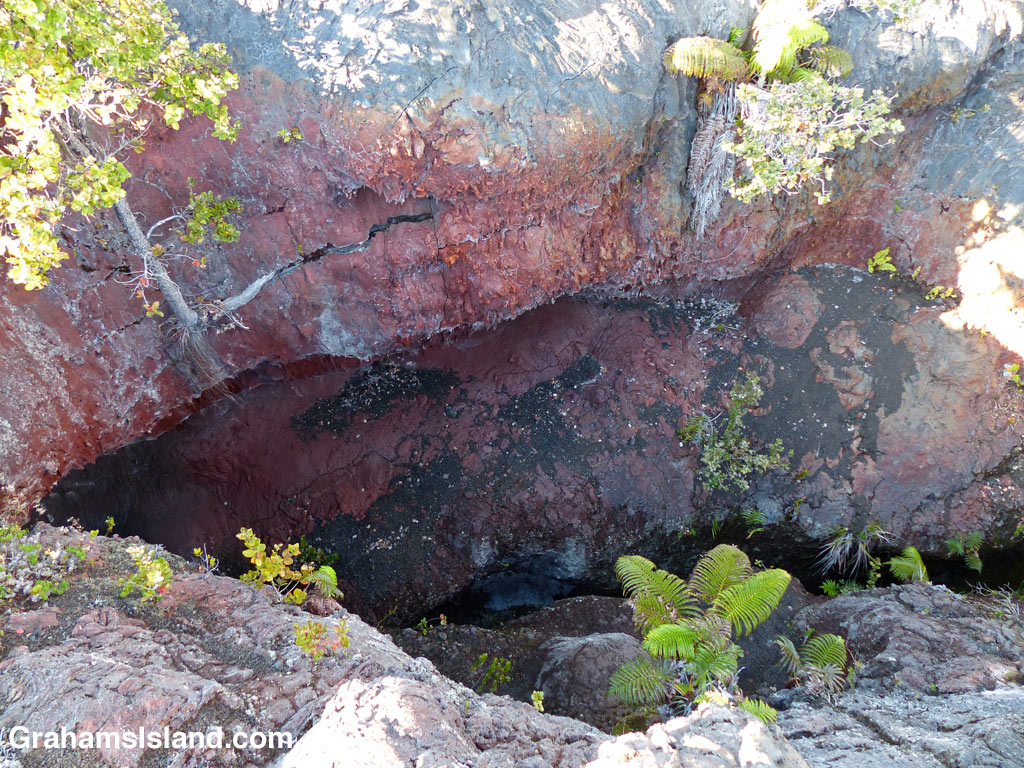
Vegetation has reclaimed a section of the original 1969 fissure of the Mauna Ulu eruption of 1969.
In May of 1969, a series of earthquakes opened a large fissure alongside Chain of Craters Road in Hawaii Volcanoes National Park. This was the beginning of what is known as the Mauna Ulu eruption. For five years, lava poured forth in a series of eruptions. Chain of Craters Road, completed only a few years earlier, was buried for several miles. Landmarks along the road were destroyed or irrevocably altered. A swathe of forest disappeared in flame.

When the eruptions finally ceased, life soon began to reappear on the barren lava landscape. In this photo, vegetation has reclaimed a section of the original 1969 fissure. Roots are anchored in cool, moist cracks in the lava. The tree on the left is particularly striking. Having started out in a crack on a vertical face, it has reached up to the light and is going strong. I like to think it shows how resilient nature can be.

For more information about Hawaii Volcanoes National Park, go to nps.gov/havo/. For more information about Kilauea Volcano and it’s eruptions, go to hvo.wr.usgs.gov/kilauea/history/main.html.
Hibiscus tiliaceus

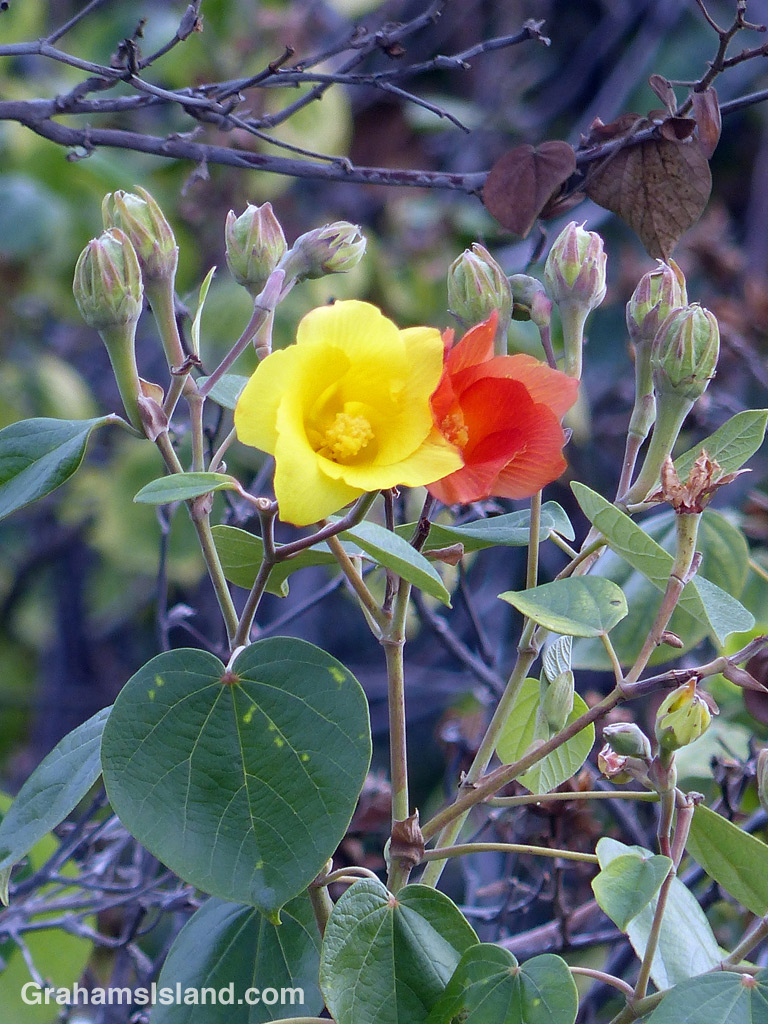
A hibiscus tiliaceus at the Golden Ponds of Keawaiki on The Big Island of Hawaii
Hibiscus tiliaceus is called hau here. This large shrub was growing at the Golden Ponds of Keawaiki, which is a little oasis in a wasteland of lava. The different colored flowers, on the same plant, occur because the flowers only last for a day. They start out yellow and turn to red or orange as the day progresses.

The path to Thurston Lava Tube

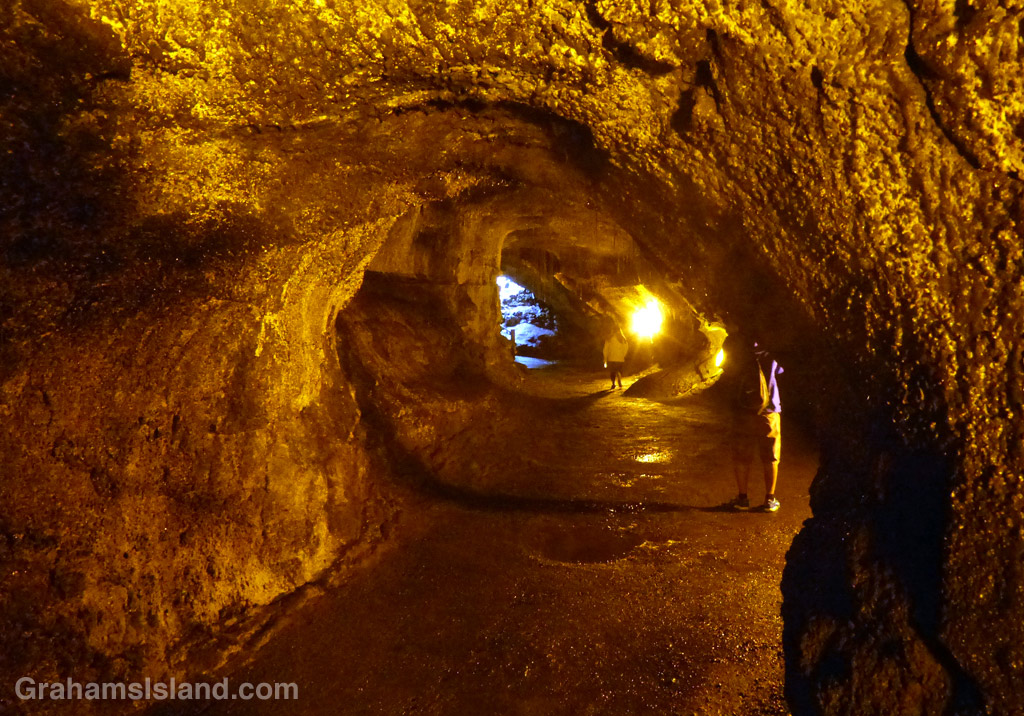
The interior of Thurston Lava Tube at Hawaii Volcanoes National Park.The path to Thurston Lava Tube at Hawaii Volcanoes National Park.
Thurston Lava Tube is one of the more visited spots in Hawaii Volcanoes National Park. It might not be as compelling as Puapoo Lava Tube, but it’s not far from the road and easily accessed. I tend to visit it whenever I’m in the park.

One thing I like about Thurston is the path to and through the tube. It starts with a drop into dense tropical forest, features a bridge leading to the maw of the tube, and then wiggles through the damp and the eerily lit interior until reaching the light at the other end.
The entrance to Thurston Lava Tube at Hawaii Volcanoes National Park.

Jackfruit

Jakfruits
I must have driven by this tree a hundred times, but one day, I was on foot and finally noticed the huge fruits of the jackfruit tree. Jackfruits are relatives of breadfruit and their fruit can grow as large as 3 feet in length and weigh up to 40 pounds. These weren’t that big, but still striking, once I finally noticed them.

Kiawes – a thorn in the foot

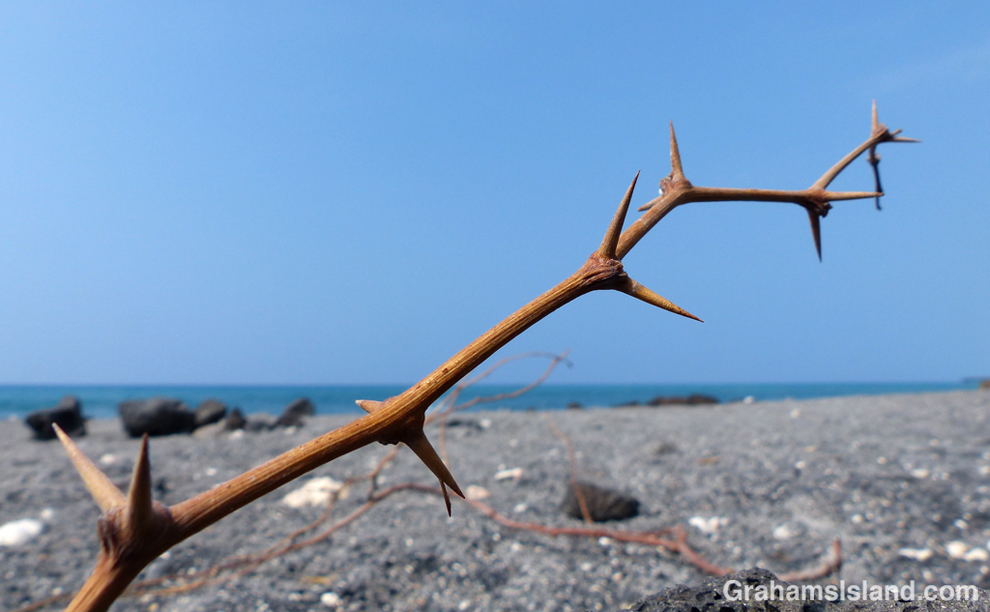
Kiawe thorns on a Big Island beach.

When twigs break off a kiawe, the thorns dry to hard, sharp spikes.

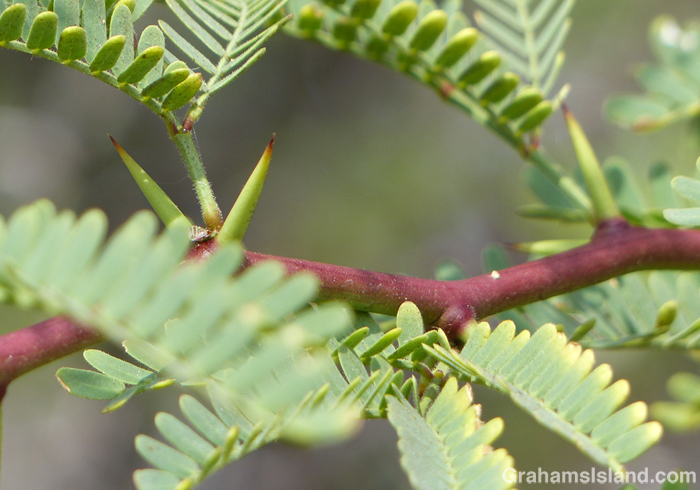
Kiawe thorns growing on a tree on the Big Island.

Kiawe thorns growing on the tree.

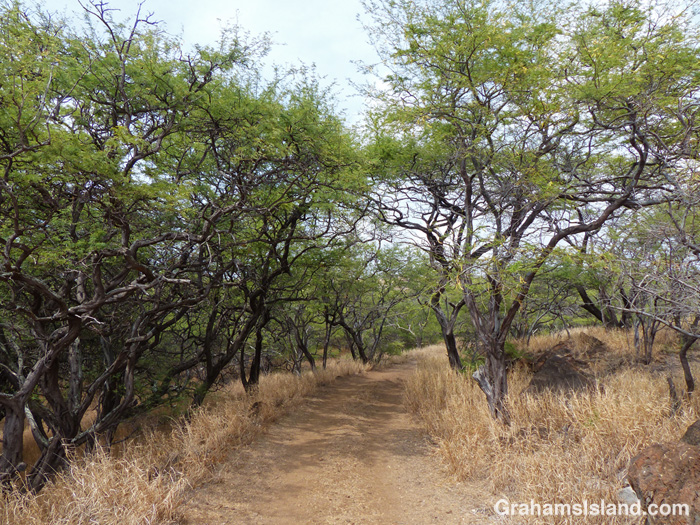
A stand of kiawe trees bordering a trail on the Big Island.

A stand of kiawe trees bordering a trail.

Hiking on the west side of the Big Island can be a hot and arid experience. The landscape is often barren lava or scrubby growth. If it’s scrubby growth, chances are that kiawe trees (Prosopis pallida) are prominent and if they are, it’s wise to tread carefully. That’s because kiawe trees produce long, tough thorns.

Hiking in slippahs (flip flops) is asking for trouble. A kiawe thorn will go through them like a knife through wet tissue. I’ve felt the jab of these thorns through my Tevas, which have robust soles of decent thickness. The first time I wore my new trail shoes, toward the end of the hike, crossing a kiawe-bordered beach, I felt a familiar prick in my foot. A thorn had buried itself in the ¾-inch thick sole and penetrated far enough to make itself felt. One of my routine tasks with my trail shoes, and the Tevas, is to examine the soles and extract any thorns with a pair of pliers. When a hike is over, it doesn’t mean the danger is past. Drive over one of these thorns and it can and does cause punctures.

But if all this makes it seem as if kiawes are reviled, that’s not the case. It’s widely used in smoking meats. The smell of burning kiawe is commonplace.

Kiawe isn’t a native tree; it originated in Peru. In fact, all Hawaii’s kiawes can trace their roots, as it were, back to a single seed planted by a priest in Honolulu in 1828.

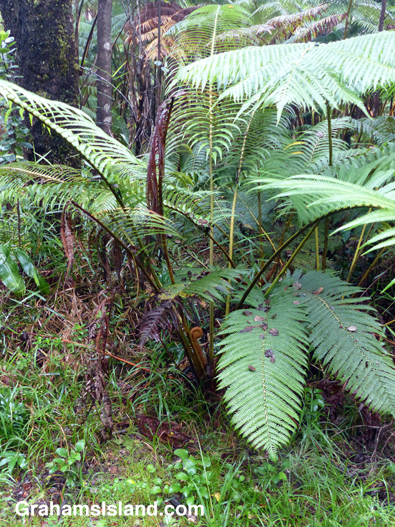
Hapu‘u fern

A hapuu fern on the Big Island
Hapu‘u ferns are endemic to Hawaii and can grow to 25 feet high, depending on the type. I like how the fronds uncurl, gradually revealing more details. The golden brown hair is called pulu. I found these in Hawaii Volcanoes National Park, which is one of the places where the fern grows best.

For more information about hapu‘u ferns, go to instanthawaii.com/cgi-bin/hawaii?Plants.hapuu.

A hapuu fern on the Big Island