Category Archives: Plants

A Bay to Keawaiki hike

The King's trail south of Waikoloa

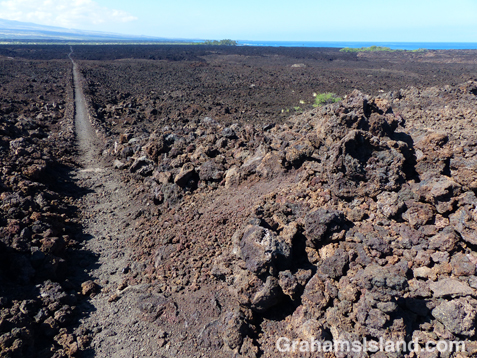
The Ala Loa Trail (King’s Trail) south of Waikoloa.

Keawaiki Beach with its lone palm tree and Hualalai volcano in the background.

Keawaiki Beach with its lone palm tree and Hualalai volcano in the background.

This hike is a 7 mile loop directly north of the Keawaiki to Kiholo loop hike that I posted about here and here. One could combine the two, but it would make for a long, hot walk, though with several opportunities to take a cooling dip. I chose to start the loop at its northern end, heading south on the inland lava field before it got too hot. The return, along the coast, is still over lava, but usually features a cooling sea breeze.

A Bay is officially known as ʻAnaehoʻomalu Bay, but most people find A Bay easier to pronounce. There’s bathrooms and showers at the beach here so I find it a good place to start and finish.

From the parking area, head inland to pick up the old King’s Trail which is marked by a sign, though it’s obvious without it. The King’s Trail heads south in a ramrod straight line. Eventually, this trail intersects with a dirt road headed toward a cluster of palm trees on the coast. Follow this road down to the Brown estate, which is surrounded with barbed-wire. The trail goes down the side of this fence to Keawaiki Bay and its lone palm tree.

The Golden Pools of Keawaiki. The golden color is due to a unique algae.

The Golden Pools of Keawaiki (though they’re actually inland of the next beach down the coast). The golden color is due to a unique algae.

Heading north again, the next bay is Pueo Bay and a small trail inland from this leads to the Golden Pools of Keawaiki. The color of these pools is due to a unique algae that grows here. There’s no swimming in these pools, but further up the coast, after passing Weliweli Point, another lone palm tree marks Akahu Kaimu Bay. Just inland from the palm is a large freshwater pool which is perfect for a cooling dip. When I visited, there was no one else there, or indeed within a mile of the spot.

Heading north along the coast again, the lava transitions to the kind of sandy beaches that Hawaii is renowned for. The southernmost beaches are usually sparsely populated or just plain empty. These beaches lead back to A Bay and its welcome facilities.

For more information about this, and other hikes on the Big Island, go to bigislandhikes.com. (This hike is listed as Keawaiki Bay to ʻAnaehoʻomalu Bay (A Bay), starting from the southern end.)

The freshwater pool behind Akahu Kaimu beach

The freshwater pool behind Akahu Kaimu beach, marked by another lone palm tree. After a hot, dry walk, a dip in the pool was very refreshing.

A sandy beach at the south end of A Bay.

A sandy beach straight out of the brochures at the south end of A Bay.

Zebra doves

A pair of zebra doves perch on a mock orange branch
I’ve been pruning a huge mock orange tree behind the house, a little concerned about how this would impact the birds that use it for food and shelter. However, this pair of zebra doves appeared to enjoy the late afternoon sunshine at a spot opened up by the pruning.

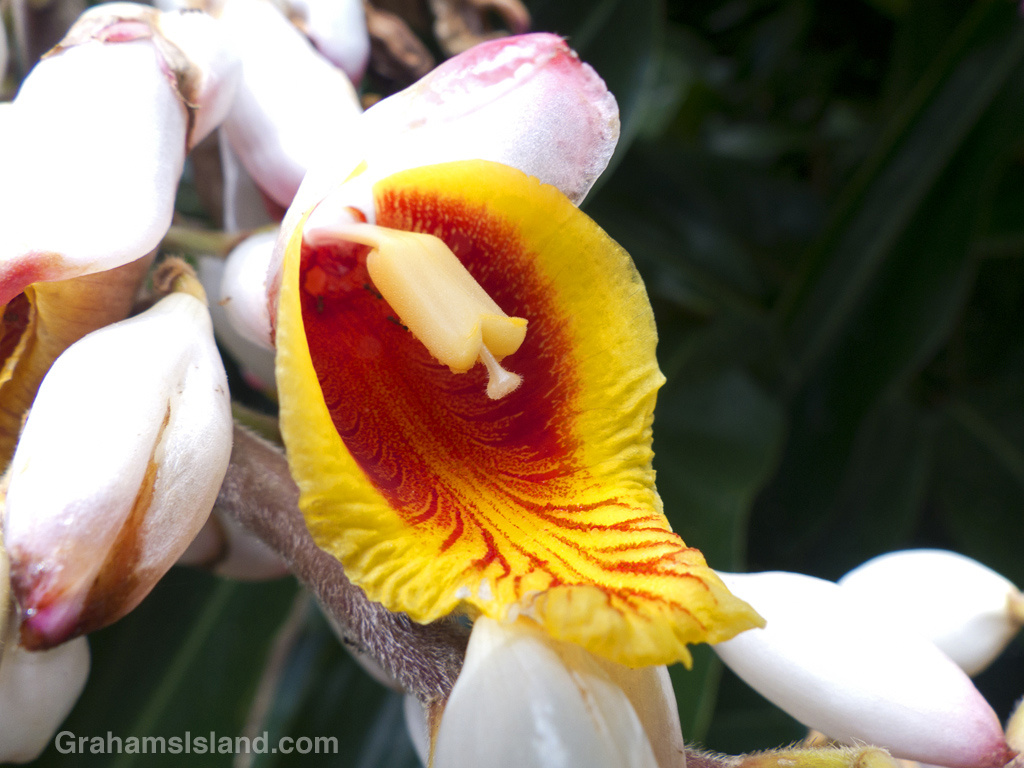
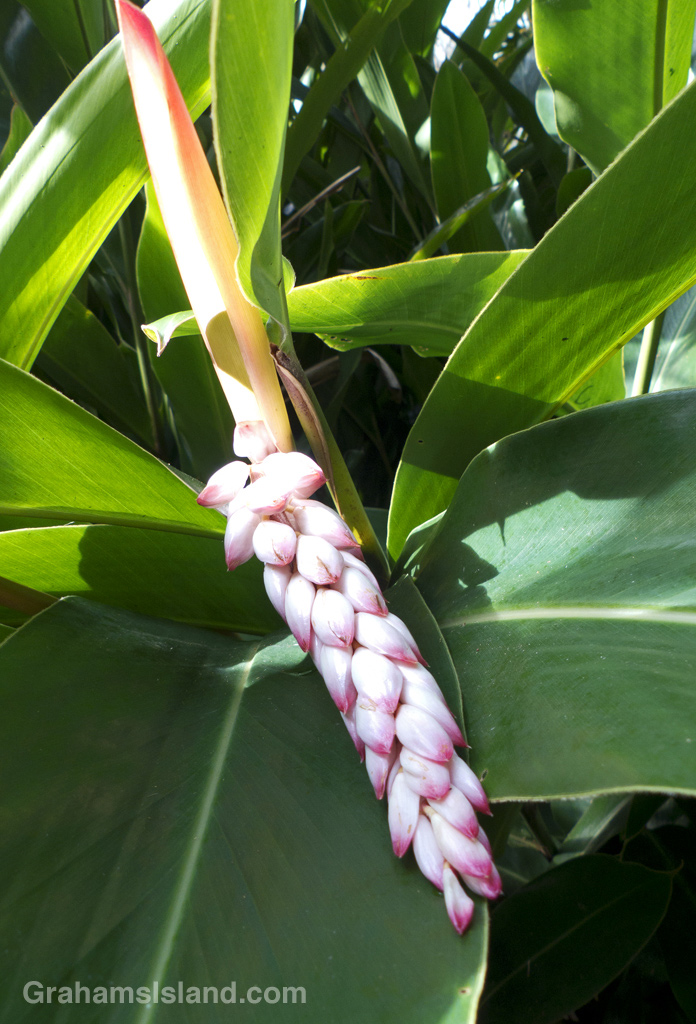
Shell ginger flower

A shell ginger flower opens to reveal a striking red and yellow interior.A shell ginger flower
The shell ginger flower has delicate pink blooms, which give the plant its name. But these pink flowers open to reveal striking red and yellow interiors. This one has attracted a couple of ants.

Bee on fireweed flower

A honey bee on a fireweed flower on the Big Island

Last week I posted here about the fireweed biocontrol moth, secusio extensa, which has been introduced into Hawaii in an attempt to control the spread of invasive fireweed (Senecio madagascariensis). On that same walk I saw lots of fireweed flowers such as this one, busily being helped to propagate by this bee. Such is the battlefield.

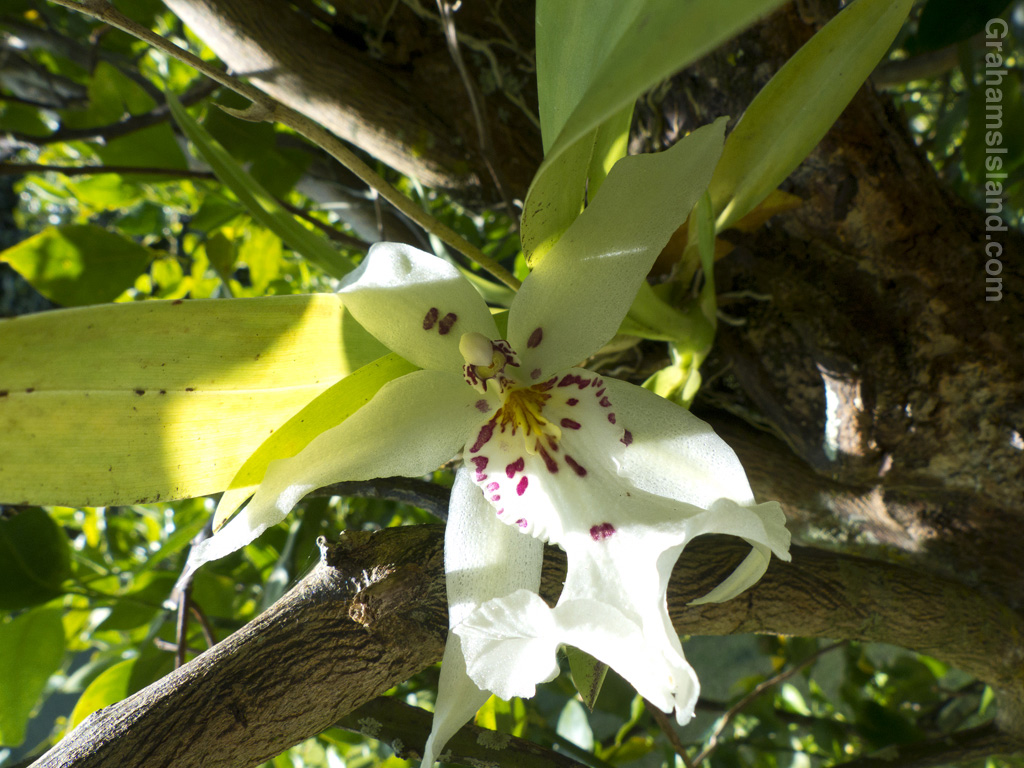
Degarmoara Winter Wonderland ‘White Fairy’

A Degarmoara Winter Wonderland 'White Fairy' orchid grows in the branches of a mandarin orange tree.
Apparently, there are around 8 billion different kinds of orchid. That, of course, doesn’t include hybrids. In my efforts to identify this flower, I tried all kinds of descriptions in my online search engine – ‘white orchid, purple spots,’ ‘epiphyte orchid, white with purple,’ ‘white and purple epiphyte.”

No matter what I tried I didn’t see anything that matched. I rifled through books at the library without success. Finally, I found a book, The Illustrated Encyclopedia of Orchids edited by Alec Pridgeon, that also failed to solve my problem. But the photos in the book did seem to indicate that this flower might be an oncidium orchid.

So I searched for ‘oncidium orchid, white with purple spots’ and voila, there it was. Of course, this being orchids, some photos were identified as ‘White Wonderland.’ Others referred to it as ‘Aliceara Winter Wonderland “White Fairy.”’ I plumped for ‘Degarmoara Winter Wonderland “White Fairy”’ because that appeared to be the more numerous choice. In the world of orchids, there seem to be varying opinions as to which plant fits in which species.

Now the only question is, how did this orchid come to be growing deep in the branches of a tangerine tree?