Category Archives: Hawaiian History

Elephant’s ear

I am particularly fond of any plant that comes with a little tag nearby to identify it. It makes life so much easier.

This is elephant’s ear (Alocasia Macrorrhiza), also known as giant taro. In Hawaii it is known as ‘Ape. I saw this at the Hawaiian Native Plant Garden at Kohanaiki Beach Park, just north of Kailua Kona.

Native to rainforests in Borneo and Australia, elephant’s ear spread to parts of Asia and the South Pacific. It was brought to Hawaii by the Polynesians who first settled the islands, and because of this, it is known here as a canoe plant, a plant brought in the first canoes. The plant is a source of starch from the corms. The leaves and stems of taro plants can also be eaten, but giant taro causes irritation because of calcium oxalate crystals in the sap.

Canoe racers

Canoe racing is part of a resurgence in traditional Hawaiian culture and activities. Before contact with western civilization, canoe racing was widely popular. But missionaries, who were among the early western arrivals on the islands, didn’t like the races and the gambling on them (along with pretty much every other enjoyable activity). Finally, Queen Ka’ahumanu, influenced by the missionaries, banned canoe racing.

In 1875, King David Kalakaua reinstated the sport, leading to renewed participation in the activity. These days, canoe racers come from all walks of life and take part in the sport for the exercise as well as the racing. Many of the boats, based on traditional designs, are made from fiberglass, but most canoe racing clubs have at least one canoe made from koa wood as it would have been in the old days.

In these photos, a group of local women train in a double-hulled canoe, zipping into Kawaihae Harbor ahead of one of the inter-island barges.

Posted in response to this week’s Sunday Stills challenge on the theme of ‘Sports or Hobbies.’ See more offerings here.

Pu’uhonua o Hōnaunau National Historical Park

This week’s Sunday Stills challenge theme is ‘Our National Parks.’ See more responses here. There are two national parks on the island. One is Hawaii Volcanoes National Park which encompasses Kilauea Volcano and Mauna Loa Volcano. The other is the somewhat lesser known Pu’uhonua o Hōnaunau National Historical Park, which is also known as Place of Refuge.

There are two parts to the park, which are separated by an imposing rock wall. On the inland side of the wall are the grounds where Hawaiian royalty made their home. The water side of the wall was the place of refuge. Anyone who had broken the law or kapu faced the death penalty, but if they could reach a place of refuge they would be forgiven by a priest and allowed to return to their normal lives.

At one end of the wall is the Hale o Keawe temple, surrounded by ki’i (wooden statues). This structure houses the bones of many Hawaiian royalty or ali’i, which are believed to give the place great power or mana.

For more photos and information on this site about these parks, click on the tags for Pu’uhonua o Hōnaunau National Historical Park or Hawaii Volcanoes National Park at the bottom of this page.

For more information about Pu’uhonua o Hōnaunau National Historical Park, visit https://www.nps.gov/puho/index.htm. For more information about Hawaii Volcanoes National Park, go to nps.gov/havo/.

Honolulu day trip

This week’s Friendly Friday challenge theme is ‘Day Trip.’ (See more responses here.)

Any trip on the Big Island could qualify as a day trip, as everything can be reached and returned from in a day. But a common day trip in Hawaii is a visit to one of the other islands. This might be for work, for medical reasons, for some other kind of appointment, or simply for pleasure.

These photos are from my last trip to Honolulu. An early flight from Kona Airport and a late afternoon return gave me plenty of time to conduct my business and have a wander around downtown.

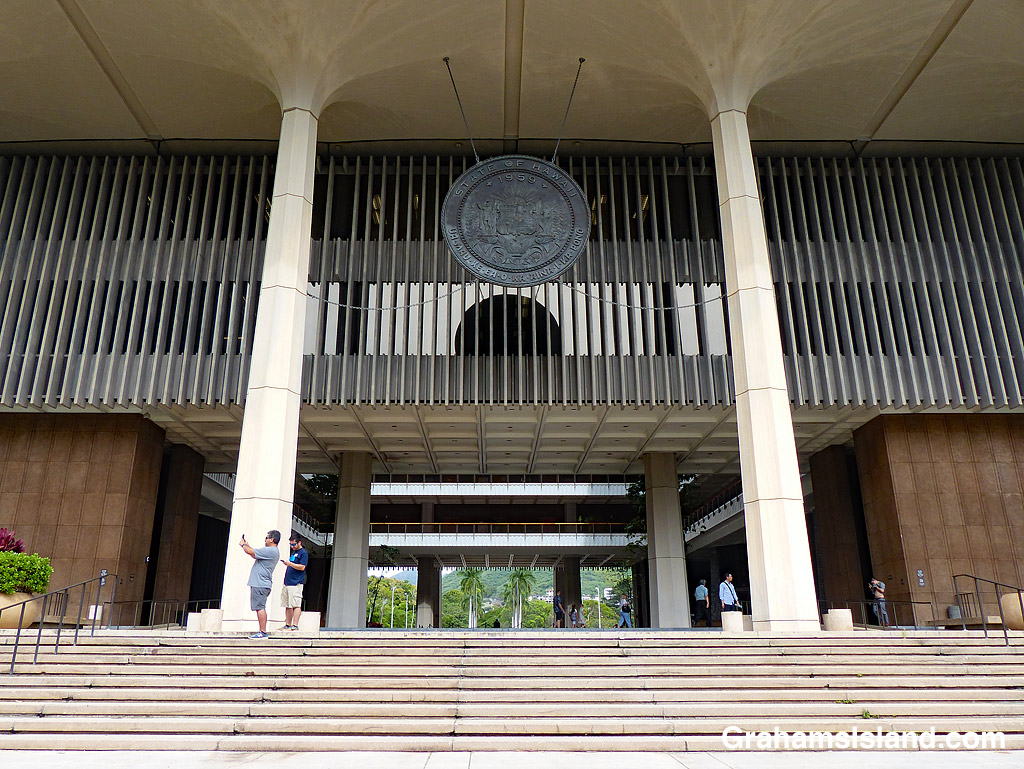
The top photo shows the entrance to the Hawaii State Capitol building. In the middle is Kawaiaha’o Church, constructed between 1836 and 1842, and considered the main Protestant church in Hawaii. Below is one of Honolulu’s large office buildings, somewhat screened by a generous amount of palms and other trees.

Shrapnel

These days, the military conducts exercises at its Pōhakuloa Training Area in the saddle between Mauna Loa, Mauna Kea and Hualālai. At 133,000 acres, it’s the largest such installation in Hawaii or anywhere else in the Pacific.

But during World War II, the military leased 91,000 acres from Parker Ranch, around Waimea and down towards Kawaihae. A temporary base, called Camp Tarawa, was built on this land, and much of the rest of it was called the Waikoloa Maneuver Area. This area was used to train troops for campaigns in the Pacific.

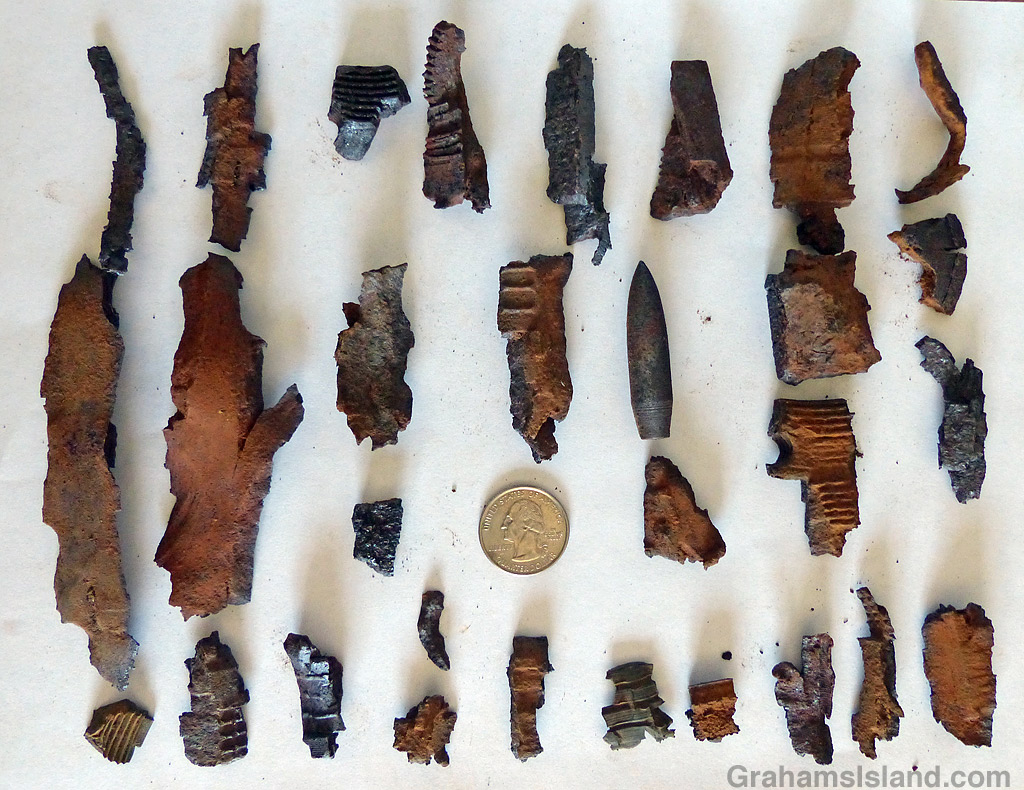
After the war, the land was returned to Parker Ranch. While it was cleared of most munitions, a lot of shrapnel can still be found there today. The top photo shows part of the haul from a half-hour walk through the area. The coin is a U.S. quarter, a little under an inch in diameter. Many of the pieces have lines, grooves, and other marks that might help identify what munitions they were once part of.

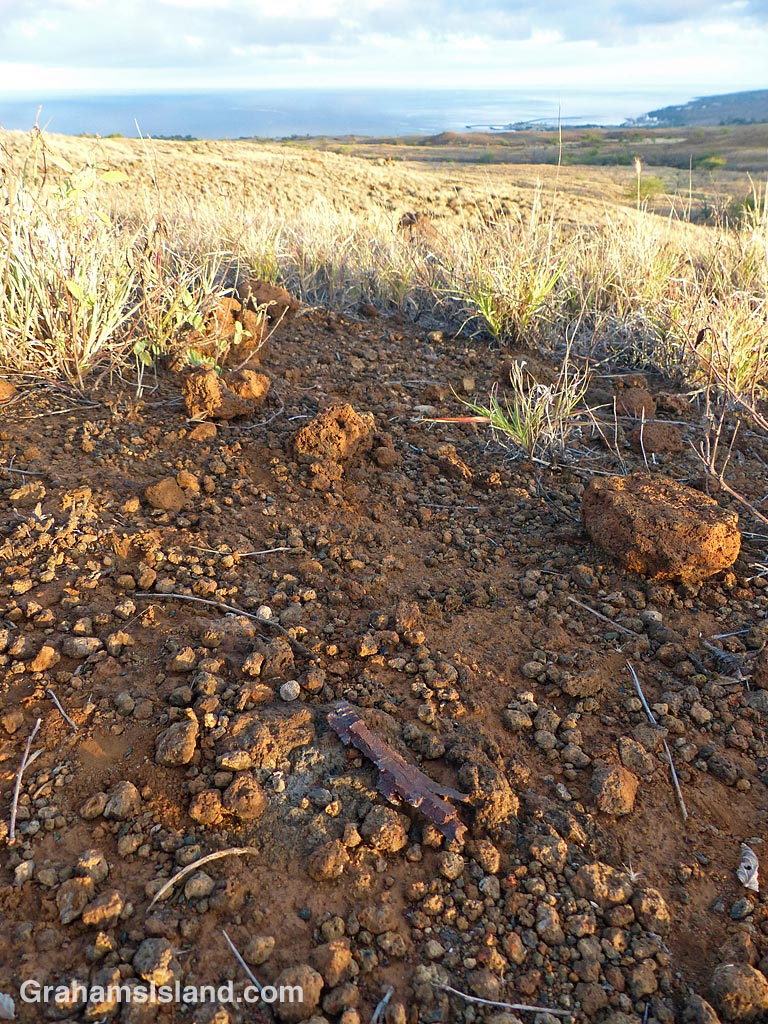
The photo to the right shows a piece of shrapnel lying in the dirt in the scrubby ground that makes up most of this area. Kawaihae Harbor can be seen at the top right. I thought it would be hard to spot shrapnel in this terrain, but it’s surprisingly easy. Shrapnel has a slight, but distinctly different look to the dirt and lava rocks. Pick it up and it’s noticeably heavier than any of the rocks.

Hunting for shrapnel isn’t without risks. Apart from the dangers of wandering around on rough, unstable ground, there’s always a chance of finding something live. Best tread lightly.

Abstracts: State Capitol in Honolulu

This week’s Friendly Friday challenge theme is ‘Design.’ (See more responses here.) For this, I’m posting photos of the Hawaii State Capitol building in Honolulu. Opened in 1969, it’s a relatively recent structure. Some of the design features of the building are striking because they represent elements of the state.

In the middle photo, the reflecting pool, surrounding the building, represents the Pacific Ocean. The columns resemble royal palm trees, and the conical structure, the base of one of the legislative chambers, is the shape of the volcanoes that formed the island chain.

The bottom photo shows how the building is open to the elements, and reflects life in Hawaii where many activities happen outside. On the right is one of four kukui nut trees, the state tree, which represent the four main counties.

The top photo is a view of a segment of the open roof and the walkway that encircles the upper level of the building. I like the strong lines and colors of this view.

Waimea and pu’us

The town of Waimea sits in the saddle between Mauna Kea and Kohala Mountain. The town is also known as Kamuela because several towns on other islands have the name ‘Waimea’ too. The postal service needed something more exclusive so Kamuela, Hawaiian for Samuel, was chosen to honor a local citizen.

This view shows the town nestled among trees and backed by pu’us (hills) on the flank of Kohala Mountain. It could be considered a rather bucolic view, which is something of a private joke in this household. A couple of years ago, a run down and shuttered gas station, at the main intersection in town, was becoming something of an eyesore. A letter to the local paper deplored this situation, saying it was a blight on ‘bucolic Waimea.’

Truth is, Waimea looks a good deal more bucolic from a distance. Close up, it’s a busy small town, with a good deal of traffic and a couple of prominent shopping centers. It’s really a quite nice small town, but I’m not sure ‘bucolic’ is how I’d describe it.

Mahai’ula Beach

This week’s Sunday Stills challenge theme is ‘Warmth.’ (See more offerings here.) Picture yourself stretched out on this beach. Imagine the sun warming the sand, warming you. Perhaps it’s time for a dip in the clear, turquoise waters. After you emerge, the sun quickly dries you. Time to retreat to the shade of the trees lining the beach, a cool beverage at your side, a book in hand (put that phone away). Repeat as necessary.

This is Mahai’ula Beach, one of the beaches at Kekaha Kai Park. The old house, in the top photo, was built in 1880 by John Kaelemakule, a successful fisherman and businessman. After he died in 1936, the property was sold to the Magoon family who owned the land until 1993. It’s now owned by the state of Hawaii.