This week’s Sunday Stills challenge theme is ‘Old.’ See more offerings here.
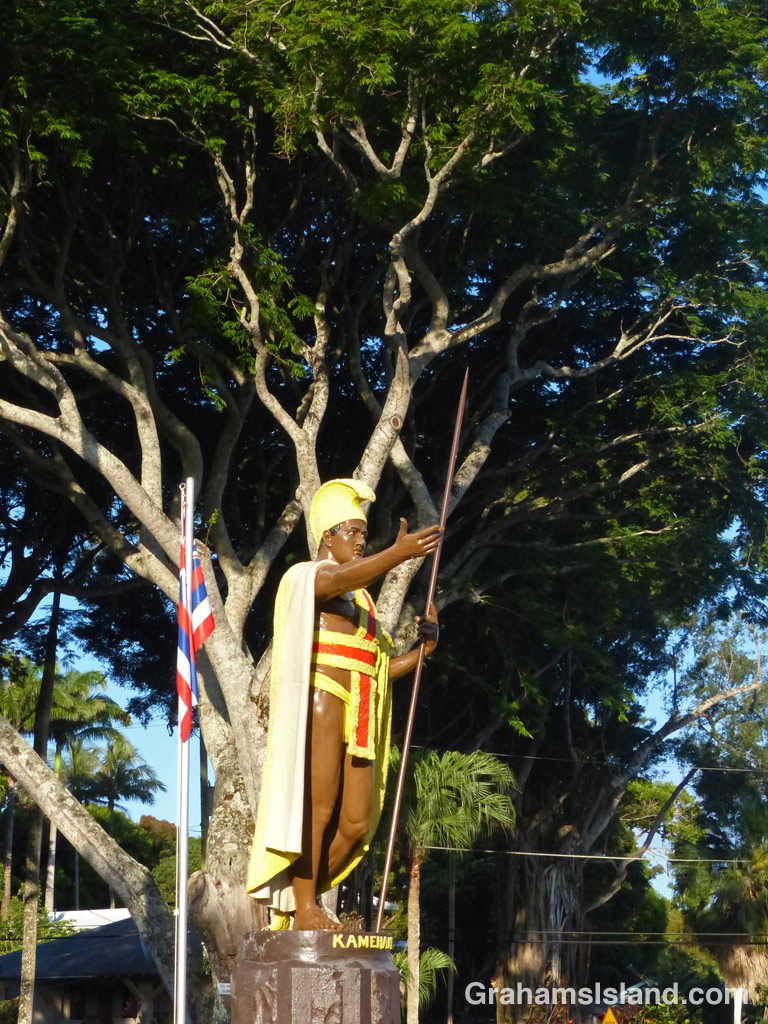
This is the original statue of Kamehameha 1, the king who first united the Hawaiian Islands. The statue was commissioned in 1878, but was lost off the Falkland Islands. A new statue was made, but in the meantime, the original one was salvaged. The new statue was put up in Honolulu and the original shipped to Kapaau.
Not long after I took this photo, the trees in the background were badly damaged during a windstorm and had to be cut down, so this scene looks quite different today.
Kohanaiki Beach Park, north of Kailua Kona, is a favorite spot for surfers. But at the south end of the park, the focus switches to history.
There’s a hālau, Ka Hale Waʽa, which is used for teaching Hawaiian crafts and culture. There’s a garden which grows the same kind of plants brought over by the first Polynesian settlers. And there’s a Hawaiian star compass, a 17-foot diameter recreation showing how the Polynesians used to navigate the vast open spaces of the Pacific Ocean.
The top photo show shows the compass. The middle photo shows a plaque, which explains the basics of how it works, using the points of the compass, the sun, nighttime celestial bodies and the ocean swells. I won’t go into detail here, but more information can be found here, here, and here. Below, the setting of the compass, with a Pacific golden plover walking on it. I like this shot because the plover is said to be the reason Polynesians discovered Hawaii. Each year, plovers summer in Alaska and then fly south as far as New Zealand. It is said that the Polynesians noted this small bird’s annual journey back and forth and figured there must be land somewhere to the north, so they set out in their canoes to find it.
Posted in response to this week’s Sunday Stills challenge on the theme of ‘Round.’ See more offerings here.
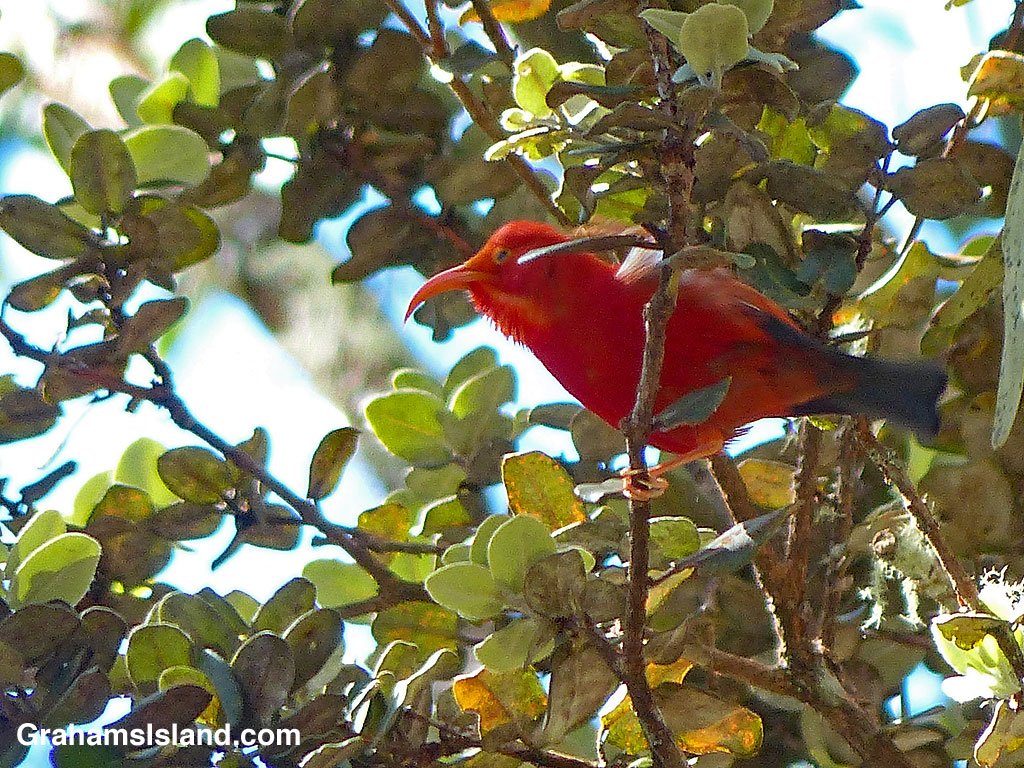
I saw this I’iwi (Drepanis coccinea) on a trail off of Saddle Road, between Mauna Kea and Mauna Loa. These bright red birds are native Hawaiian honeycreepers and in the old days, the feathers of the birds were collected to make cloaks for Hawaiian royalty.
The curved bill is suited for feeding on native lobelias, but a decline in those plants has seen the I’iwi adapt to feeding on other native plants including ʻōhiʻa lehua, māmane, and ohelo.
While the numbers of I’iwi are still fairly good, particularly on the Big Island and Maui, they have suffered, like other birds, from loss of habitat. In addition, They are susceptible to avian malaria, spread by mosquitoes. Consequently, I’iwi are doing better at higher elevations, such as where this photo was taken at around 6,000 feet.
This week’s Friendly Friday challenge theme is ‘Whereabouts.’ See more responses here. ‘Whereabouts’ means ‘the place or general locality where a person or thing is.’
My whereabouts are the Big Island, Hawaii, which is also the place where Captain James Cook, of the British Royal Navy, lost his life on February 14, 1779. He was killed by native Hawaiians with whom he was involved in a dispute over the loss of a cutter from one of his ships. I won’t go into a detailed history here, but more information about Captain Cook can be found at www.captaincooksociety.com/.
Captain Cook’s whereabouts were often uncertain, in that he was an explorer who visited unknown or little known places around the world. Not only did he sail to far flung places, but he made excellent, detailed maps and charts of the places he visited, which made him highly thought of in the British Admiralty, and which made it easier for future travelers to know their whereabouts.
Between 1768 and 1779 Cook made three voyages around the world. The first two focused on the search for the theorized southern super-continent of Terra Australis. The third was intended to find the Northwest Passage across the northern part of North America.
It was on this third voyage that Cook became the first European to officially visit Hawaii (as opposed to other European commercial ships that were believed to have been there before). He sailed on to the north to attempt (unsuccessfully) to fulfill his commission before returning to Hawaii.
This time he anchored in Kealakekua Bay on the Big Island (official name, Hawaii Island). He was well received, in part because his arrival coincided with a Hawaiian festival for the god Lono. After a month, Cook left to resume his voyage, but when one of his ships lost a mast, he returned to Kealakekua Bay.
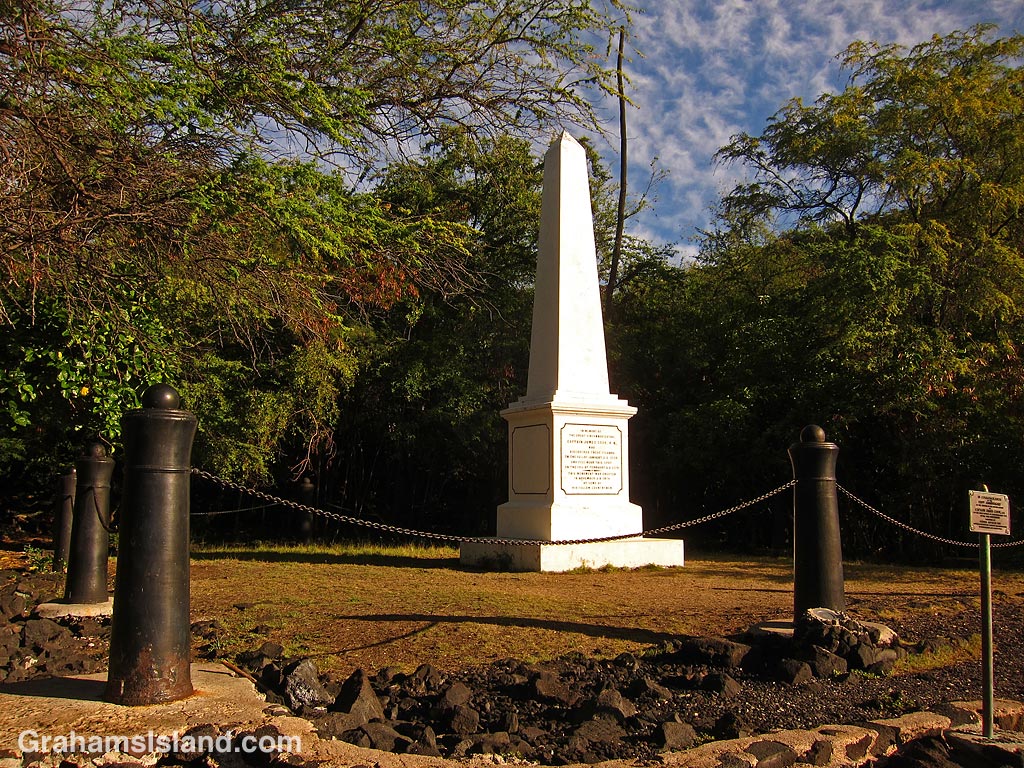
Unfortunately, by then the festival for Lono was over and his return was not greeted with the same enthusiasm. Soured relations led to several incidents culminating the theft of a ship’s cutter and the incident that led to Cook’s death. However, the killing of Cook did not diminish his standing in the eyes of the Hawaiians. In 1874, the Captain Cook monument was put in place and, in 1877, the land on which it stands was deeded to Britain by Princess Likelike as a sign of respect.
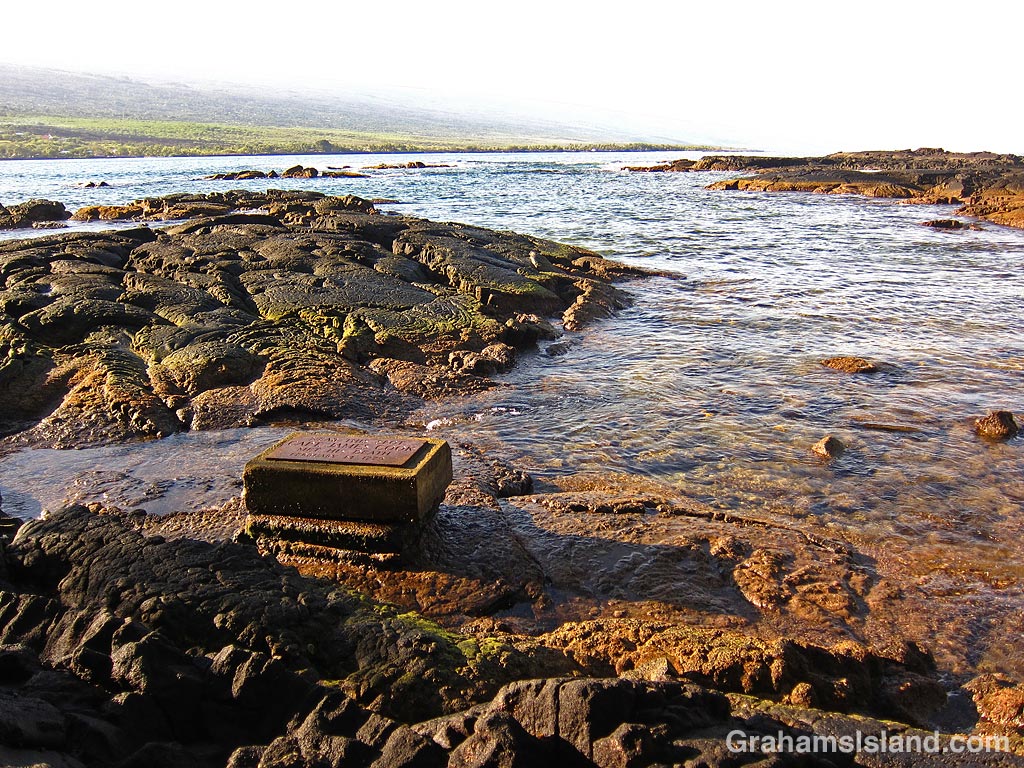
The top photo shows the monument, surrounded by a chain supported by twelve cannons from HMS Fantome. The second photo shows the inscription on the monument. I particularly like the bit about how he discovered these islands, islands which were occupied by a substantial population governed by an established royal line. The third photo is the plaque marking the spot where Captain Cook is believed to have been killed. Below is the location of that plaque in relation to Kealakekua Bay, which is the water beyond the rocks in this photo.
I am particularly fond of any plant that comes with a little tag nearby to identify it. It makes life so much easier.
This is elephant’s ear (Alocasia Macrorrhiza), also known as giant taro. In Hawaii it is known as ‘Ape. I saw this at the Hawaiian Native Plant Garden at Kohanaiki Beach Park, just north of Kailua Kona.
Native to rainforests in Borneo and Australia, elephant’s ear spread to parts of Asia and the South Pacific. It was brought to Hawaii by the Polynesians who first settled the islands, and because of this, it is known here as a canoe plant, a plant brought in the first canoes. The plant is a source of starch from the corms. The leaves and stems of taro plants can also be eaten, but giant taro causes irritation because of calcium oxalate crystals in the sap.
Canoe racing is part of a resurgence in traditional Hawaiian culture and activities. Before contact with western civilization, canoe racing was widely popular. But missionaries, who were among the early western arrivals on the islands, didn’t like the races and the gambling on them (along with pretty much every other enjoyable activity). Finally, Queen Ka’ahumanu, influenced by the missionaries, banned canoe racing.
In 1875, King David Kalakaua reinstated the sport, leading to renewed participation in the activity. These days, canoe racers come from all walks of life and take part in the sport for the exercise as well as the racing. Many of the boats, based on traditional designs, are made from fiberglass, but most canoe racing clubs have at least one canoe made from koa wood as it would have been in the old days.
In these photos, a group of local women train in a double-hulled canoe, zipping into Kawaihae Harbor ahead of one of the inter-island barges.
Posted in response to this week’s Sunday Stills challenge on the theme of ‘Sports or Hobbies.’ See more offerings here.
This week’s Sunday Stills challenge theme is ‘Our National Parks.’ See more responses here. There are two national parks on the island. One is Hawaii Volcanoes National Park which encompasses Kilauea Volcano and Mauna Loa Volcano. The other is the somewhat lesser known Pu’uhonua o Hōnaunau National Historical Park, which is also known as Place of Refuge.
There are two parts to the park, which are separated by an imposing rock wall. On the inland side of the wall are the grounds where Hawaiian royalty made their home. The water side of the wall was the place of refuge. Anyone who had broken the law or kapu faced the death penalty, but if they could reach a place of refuge they would be forgiven by a priest and allowed to return to their normal lives.
At one end of the wall is the Hale o Keawe temple, surrounded by ki’i (wooden statues). This structure houses the bones of many Hawaiian royalty or ali’i, which are believed to give the place great power or mana.
For more photos and information on this site about these parks, click on the tags for Pu’uhonua o Hōnaunau National Historical Park or Hawaii Volcanoes National Park at the bottom of this page.
For more information about Pu’uhonua o Hōnaunau National Historical Park, visit https://www.nps.gov/puho/index.htm. For more information about Hawaii Volcanoes National Park, go to nps.gov/havo/.
This week’s Friendly Friday challenge theme is ‘Day Trip.’ (See more responses here.)
Any trip on the Big Island could qualify as a day trip, as everything can be reached and returned from in a day. But a common day trip in Hawaii is a visit to one of the other islands. This might be for work, for medical reasons, for some other kind of appointment, or simply for pleasure.
These photos are from my last trip to Honolulu. An early flight from Kona Airport and a late afternoon return gave me plenty of time to conduct my business and have a wander around downtown.
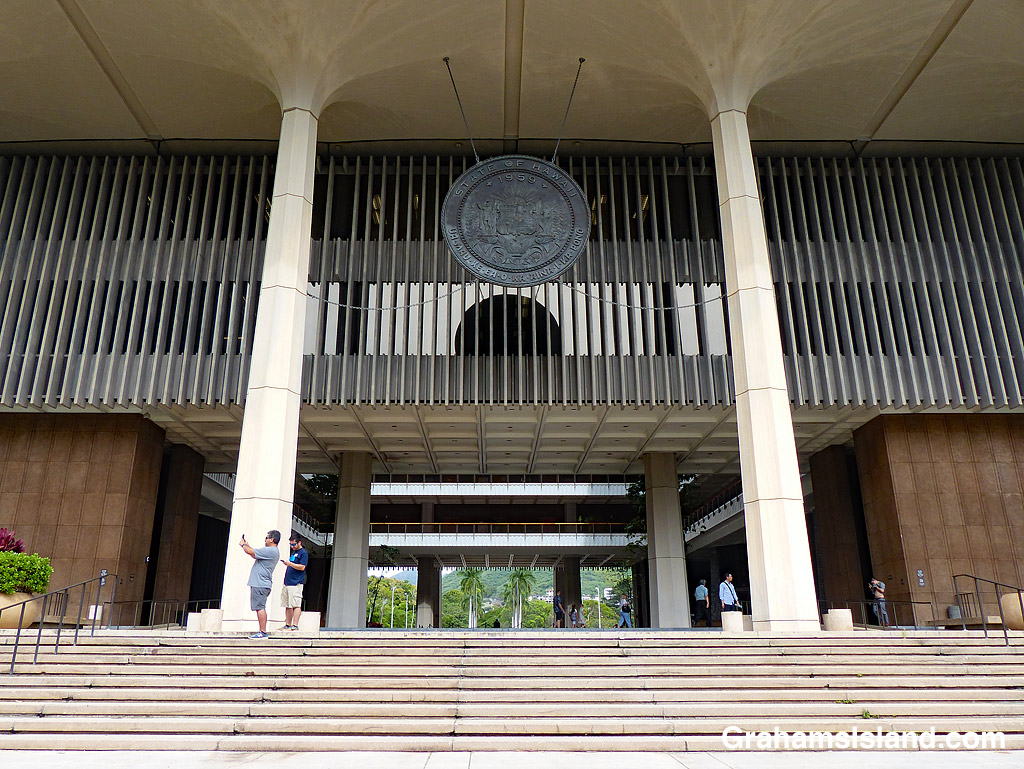
The top photo shows the entrance to the Hawaii State Capitol building. In the middle is Kawaiaha’o Church, constructed between 1836 and 1842, and considered the main Protestant church in Hawaii. Below is one of Honolulu’s large office buildings, somewhat screened by a generous amount of palms and other trees.