Category Archives: Hawaiian History

Kamehameha Day ceremony in Kapaau

A lei is draped over the spear of the statue of King Kamehameha 1 in KapaauA hula group performs on front of the statue of King Kamehameha 1 in KapaauA group pays its respect to the statue of King Kamehameha 1 in Kapaau

Yesterday was Kamehameha Day, celebrating Kamehameha 1, the king who first united the Hawaiian Islands under one leader. There’s a statue of the king at Kapaau in North Kohala, and this was the scene of a ceremony honoring him.

The ceremony began in steady rain, but the weather brightened so that proceedings ended in bright sunshine. After opening blessings, various groups approached the statue and paid their respects to the king. This was followed by the draping of leis on the statue. Finally, a hula performance in front of the statue concluded events – at least as far as this ceremony was concerned. An hour or so later, there was a parade featuring representatives of all the Hawaiian islands, and for the rest of the day, there were events and music in a local park.

The top photo shows a lei being draped over the king’s spear. The lei is made up of plumeria blossoms. The leis draped over his extended arm are mostly made up of ti leaves. In the second photo, members of one of the groups honoring the king performed a hula in front of the statue. Third, I think this is the order of Kamehameha presenting an offering which was carried up and placed at the base of the statue. Below, a red plumeria lei is hoisted over the king’s spear. Bottom, after all the lei were placed on the statue, another hula performance concluded events.

For more information about the Kamehameha Day and the statue, go to kamehamehadaycelebration.org.
For more information about the Kamehameha’s history, go to nps.gov/puhe/learn/historyculture/kamehameha.htm.

A lei is draped on the statue of King Kamehameha 1 in KapaauA hula group performs on front of the statue of King Kamehameha 1 in Kapaau

Kohala Girls School shadows

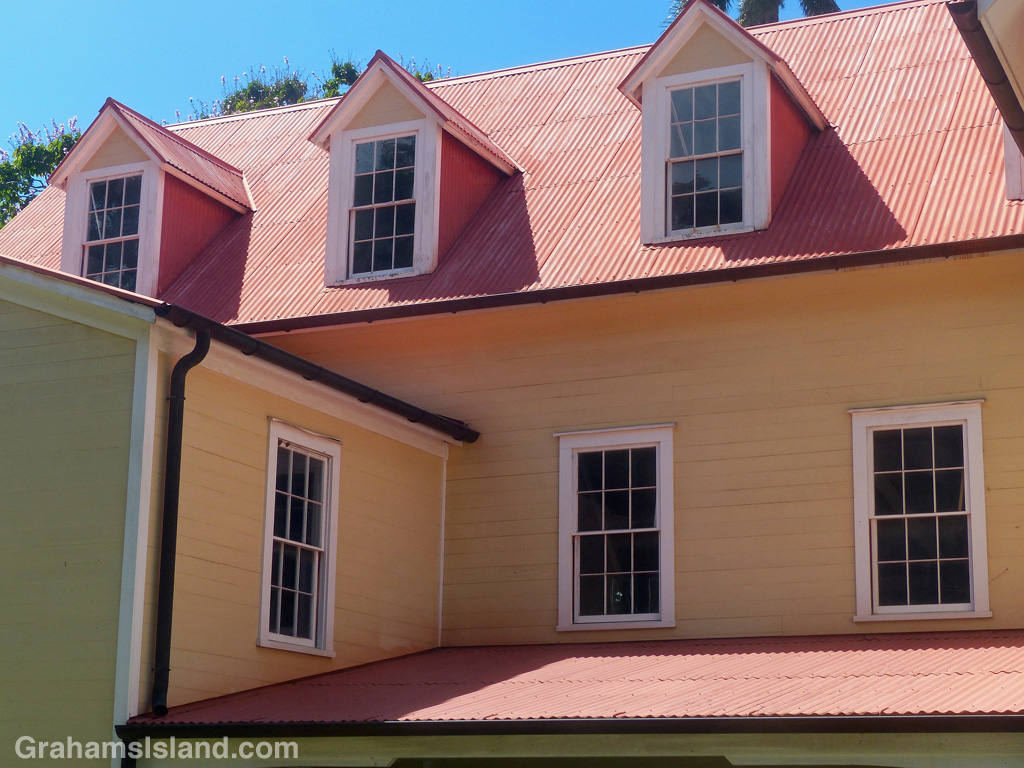
The old Kohala Girls School sits on land at ‘Iole in North Kohala.

The old Kohala Girls School sits on land at ‘Iole in North Kohala. ‘Iole is one of the few remaining ahupua‘a, a pie-shaped division of land stretching from the mountain to the ocean. It’s now managed by Kohala Institute as a retreat center and the recently renovated school is part of that setup.

I like the geometric order of the building – the squares of the windows, the straight lines of the roof and siding – as well as the light and shadows.


Kaloko fishpond

The wall of Kaloko Fishpond, in Kaloko-Honokohau National Historical Park

The wall of Kaloko Fishpond, in Kaloko-Honokohau National Historical Park, is currently under repair. According to the park’s website, work on rebuilding the wall began in 1998. This end looks good, but there’s still work to be done at the far end.

For more information about Kaloko-Honokohau National Historical Park, go to www.nps.gov/kaho/index.htm

For more information about Kaloko Fishpond, go to www.keolamagazine.com/ocean/kaloko-fishpond-a-valuable-cultural-resource/


Truck stuck

A truck stuck in a muddy puddle on the Big Island of Hawaii
While I always prefer to take smaller, winding roads, such roads taken are not without pitfalls.

The last mile of the journey to Mo’okini Heiau in North Kohala is an uneven dirt road studded with rocks. When the road is dry it can be navigated by almost all vehicles (I saw a smart car there once!). However, care is needed, particularly regarding clearance. Almost every time I walk the road, I see fresh scrapes on the rocks. With rainy weather, the road becomes the territory of 4-wheel drives and jacked-up suspensions.

On this day, the puddles that often form on the road had become lakes. This truck had passed me earlier and when I saw it returning I ducked behind a bank to do a little whale watching and avoid the wave of spray that would surely accompany anything driving through the lake. A few minutes passed. I realized I hadn’t registered the truck passing. It had gone very quiet. So I wandered out to the road again and saw the truck marooned. They’d made it through on the way out, but weren’t so lucky on the way back.

The truck was a 4×4 but not with extra clearance. I think their problem was that the lake was deeper at the far end (in the photo). On the way out, they’d no doubt barreled into the water and their momentum had carried them to shallower waters and out. On the way back, the same approach would have propelled them toward the deep end. I suspect a bow wave built up, slowed them, and allowed water to penetrate parts of the truck that responded unfavorably.

The two young local men seemed quite cheerful. They waded through the muddy water, tried to coax life into the truck. One was on the phone (a miracle to have service there). After they insisted they had everything under control, I walked past on the high bank alongside the road, then turned and took this photo. When I returned a half hour or more later, the truck and its occupants were gone.

Better Days: Gravesite

The old gravesite at Hawaii Tropical Botanical Garden on the Big Island.
In Hawaii Tropical Botanical Garden, north of Hilo, this gravesite sits close to the ocean, surrounded by tropical foliage. The wording on the sign reads:

Long ago, Onomea Bay was a fishing village, became a rough-water seaport in the 1800’s, and later was inhabited by Portuguese, Chinese, Japanese and Filipinos who came here to work in the sugar cane fields and to help build the Onomea Sugar Mill. In the early 1900’s, Onomea was deserted and vegetation grew so densely that few signs of habitation could be seen.

When our Founder and his tireless helpers were first clearing this area, they discovered this olden and dignified gravesite. We have never been able to authenticate the origin, although some old-timers believe the gravesite may have belonged to a caretaker’s family, since a cement-made gravesite would not have pre-dated the 1900’s.

Our commitment is to forever preserve this resting place with the utmost care and respect.

Hawaii Tropical Botanical Garden

For more information about Hawaii Tropical Botanical Garden, go to htbg.com.

The Painted Church at Honaunau

The Painted Church at HonaunauBible scenes on the walls of the Painted Church at Honaunau
I’m not a religious person, but I’ve always enjoyed visiting churches. I grew up in England and the stone churches had a calm ambience with cool, quiet interiors. Usually, there was some feature of note, even in the smallest church – carvings on the pew ends, a font dating from Norman times, the tomb of some ancient notable under the floor.

The Painted Church at Honaunau, on the Big Island, is different from those churches, more fitting to its setting. A wooden structure, it dates back to 1899. Father John Velghe moved much of a previous structure to its present site and had it repaired and added to. A self-taught artist, he then painted the interior including several scenes from the bible on the walls.

What I like is how colorful the interior is, with a real tropical feel. But it too has that stillness that I associate with churches and an ambience all its own.

For more information about the Painted Church at Honaunau, go to thepaintedchurch.org.

King Kamehameha’s birthplace

The birthplace of King Kamehameha the Great in North Kohala.
At Kapakai Kokoiki Heiau in North Kohala, not far from Mo’okini Heiau (which can be seen on the hill in the background), stands this sign. Kamehameha Akāhi ‘Āina Hānau loosely translates as the birthplace of Kamehameha I. He was born here around 1736. The exact date isn’t known, with some accounts placing it as late as 1758. Known as Kamehameha the Great, he was the king who fulfilled Hawaiian prophecies and united the Hawaiian islands for the first time in 1810.

He was succeeded by four others in his family who took the name Kamehameha, so the name is in the forefront of Hawaiian history. In present day life it occurs in numerous ways. There’s Kamehameha Day, a state holiday, which celebrates his birth. Kamehameha Schools is an private school system with extensive land holdings on the Big Island and elsewhere. Hotels and other businesses sport the name. A fair number of them will be located on Kamehameha Street, Road, Highway, Avenue, or Boulevard.

In short, the name Kamehameha is still an integral and important part of everyday Hawaiian life.

Growth in the lava

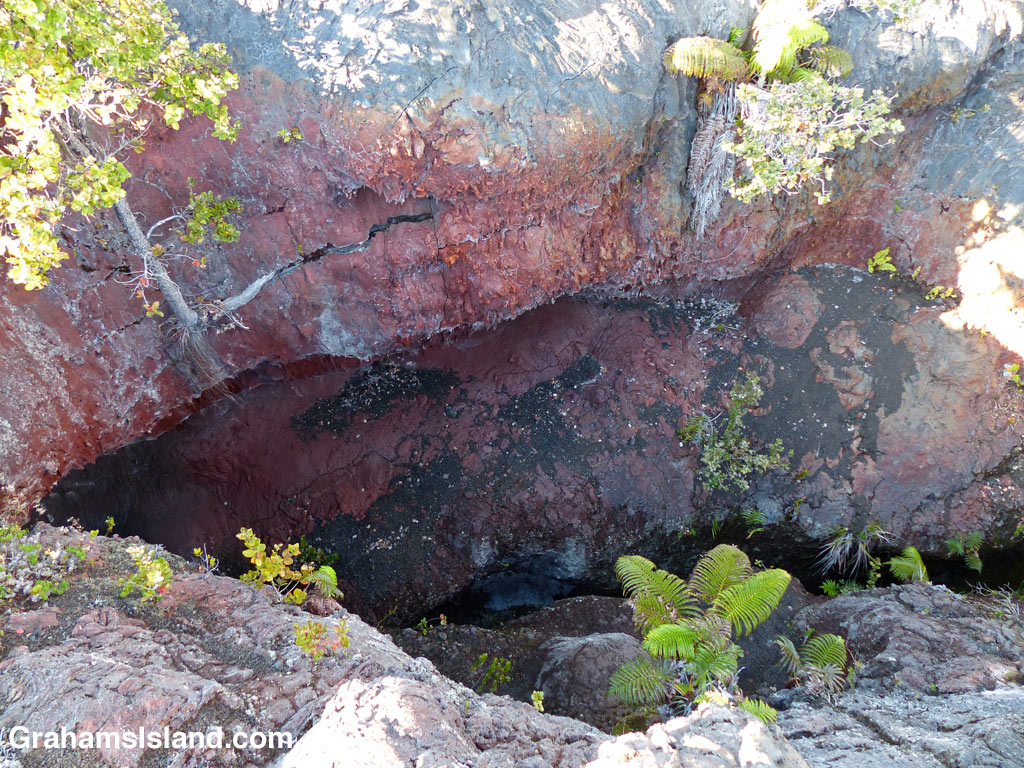
Vegetation has reclaimed a section of the original 1969 fissure of the Mauna Ulu eruption of 1969.
In May of 1969, a series of earthquakes opened a large fissure alongside Chain of Craters Road in Hawaii Volcanoes National Park. This was the beginning of what is known as the Mauna Ulu eruption. For five years, lava poured forth in a series of eruptions. Chain of Craters Road, completed only a few years earlier, was buried for several miles. Landmarks along the road were destroyed or irrevocably altered. A swathe of forest disappeared in flame.

When the eruptions finally ceased, life soon began to reappear on the barren lava landscape. In this photo, vegetation has reclaimed a section of the original 1969 fissure. Roots are anchored in cool, moist cracks in the lava. The tree on the left is particularly striking. Having started out in a crack on a vertical face, it has reached up to the light and is going strong. I like to think it shows how resilient nature can be.

For more information about Hawaii Volcanoes National Park, go to nps.gov/havo/. For more information about Kilauea Volcano and it’s eruptions, go to hvo.wr.usgs.gov/kilauea/history/main.html.