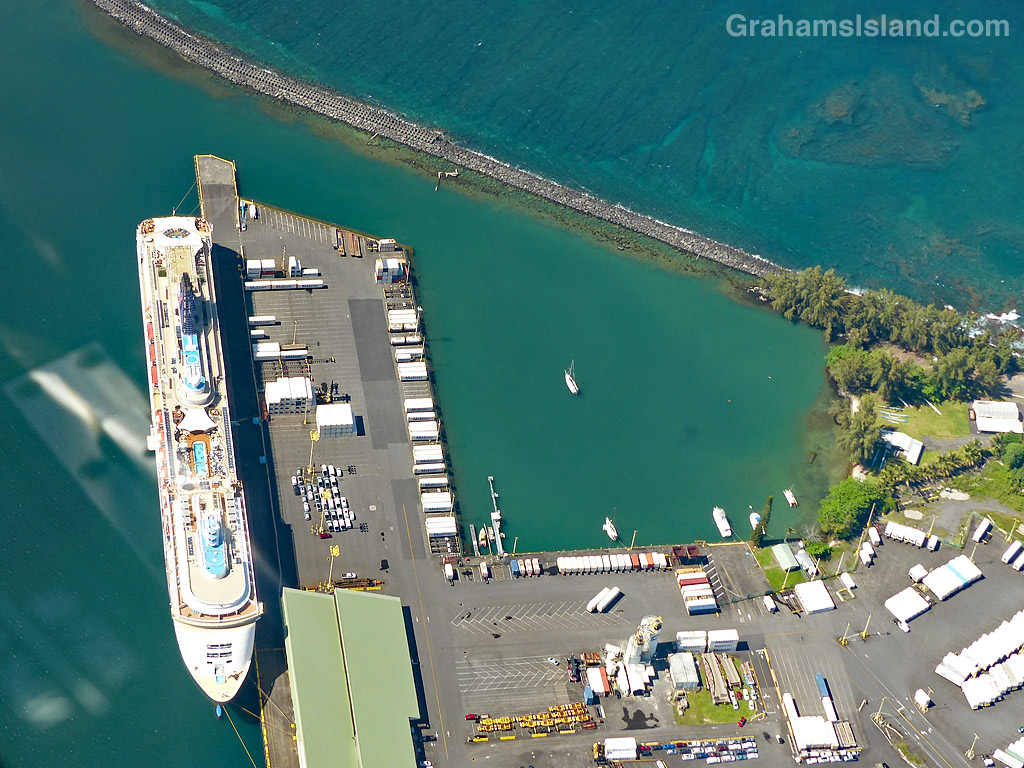
The Kohala Divers boat, Namaka, heads out of Kawaihae harbor for an early morning dive session. The boat is also used for whale watching cruises.
For more information about Kohala Divers, go to kohaladivers.com.

The Kohala Divers boat, Namaka, heads out of Kawaihae harbor for an early morning dive session. The boat is also used for whale watching cruises.
For more information about Kohala Divers, go to kohaladivers.com.

Not far from South Point, the most southerly tip of the Big Island and the United States, is a green sand beach, which I’ve posted about here.
The beach is 2.5 miles from the parking lot and, if you don’t want to walk, locals will drive you there ($20 is the current fee I think) in an assortment of trucks of dubious-looking pedigree. One problem with this practice is that it has generated a warren of deep, rutted routes in the sandy soil. Erosion is a problem. Sand is swept into the ocean when it rains and when the wind blows, both of which happen often and in strength.
The county is looking into ways to mitigate these problems, which could include regulating these unofficial taxis or banning them altogether. However, before anything happens, studies will be needed along with public forums to discuss the issue. These will result in an unacceptable proposal that requires further consideration. It’s entirely possible that, by the time action is taken, South Point will no longer be the most southerly tip of either the Big Island or the United States.

Wilsonara orchids are a kind of hybrid oncidium orchid. This one was at Hawaii Tropical Botanical Garden. For more information about Hawaii Tropical Botanical Garden, go to htbg.com.

I’ve spent a fair amount of time in my life looking up at clouds, often as they poured water in my direction, so it’s nice to look down on them once in a while. Airplanes are probably the most common place to enjoy this view, but here on the Big Island, the upper reaches of Mauna Kea and Mauna Loa also offer this perspective.
In this case, the clouds were low enough that, when I was visiting the Palila Forest Discovery Trail at around 7,000 feet, the clouds blanketed the landscape below. Here, Hualalai pokes through the cloud layer in the late afternoon.
For more information about Palila Forest Discovery Trail, go to dlnr.hawaii.gov/restoremaunakea/palila-forest-discovery-trail/.

One of the vulnerabilities of living in the middle of the Pacific Ocean is that any big disruption of commerce, here or on the mainland, due to natural disaster or otherwise, could result in shortages here. Toilet paper and Spam would likely be the first things to be snapped up, but basic foodstuffs would soon follow. Having a variety of productive farms on the island would be a big help in such a situation.
Sage Farms, an organic farm that’s been in business here for 20 years, is one such enterprise. Their fruits and produce are available in local stores and farmers’ markets. The farm is one of a network of small growers in the area whose goal is to make the Big Island less dependent on imports from the mainland.
It might seem like farming would be easy in Hawaii. Most things grow readily, but that also includes weeds. In addition, pests also thrive and can be voracious. Currently, rat lungworm is a big concern. Recently, students at Kohala Middle School showed that a slug which carries rat lungworm parasites is now established in this area. This slug is just the latest challenge to the farmers of the area and the island in general.
Posted in response to this week’s Sunday Stills challenge on the theme of ‘Fresh.’ See more offerings here.

After something of a dry spell, during which I was able to drive my truck out of the yard without sliding about, there’s been a lot of rain lately. My truck is back to sliding, but that’s a minor issue compared with what happens to all that rainfall.
What happens is that the rain hits the land and runs downhill. It channels into dry gullies. If the rain is heavy enough, flash floods occur and wash all before them – dirt, rocks, trees. But any kind of heavy or prolonged rain will wash earth and debris down the gullies. All those gullies lead to the ocean, channeled under roads by culverts (bottom photo).
When the runoff reaches the ocean, it forms a distinct area of dirty brown water in the blue Pacific Ocean (top photo). The contrast is striking and easily visible from miles away. Over time, the brown and blue water will begin to mix until the delineation is gone, but part of that process is the dirt from the brown water settling to the ocean floor.
This kind of runoff is one of many threats to coral reefs around the Big Island. It’s not just dirt in the runoff, but also pesticides and other chemicals that can be washed down into the reefs, damaging the coral. There are hundreds of gullies and only a few places have erosion prevention measures to help mitigate this pollution.
So while Hawaii may be considered paradise, it has its share of challenges. And the problems associated with runoff and pollution are more visible and obvious than most.
Posted in response to this week’s Friendly Friday challenge on the theme of ‘Contrasts.’ See more responses here.


Once upon a time, I used to know the International Regulations for Preventing Collisions at Sea, also known as the rules of the road for shipping. Like those for automobiles, the rules are designed to keep traffic flowing safely. They govern such things as which vessel has the right of way, what sounds signals they should make, and what lights they should show.
Most of that knowledge has faded from my memory, like a ship into a fog bank, but every so often something brings bits back into view. These photos illustrate one such event.
At night, ships and small boats display lights, the idea being that people on other vessels will be able to identify those lights, interpret what they’re looking at, and avoid running into them. In the top photo, the red lights on the tug and barge indicate that’s the port (left) side of the vessel. In the second photo, the green light indicates that’s the starboard (right) side of the vessel. Seeing these lights and how they move in relation to your own position gives a good indication of how close the other vessel will pass. For example, is you can see both the red and green lights, that means the vessels is coming directly towards you and the likelihood of a collision is high. In this case one or both vessels should change course.
As an aside here, I was on the bridge of an oil tanker in the Strait of Malacca, near Singapore, when a ship traveling in the opposite direction suddenly turned 90°, heading directly across our path. This occurred during the day, so the correct action for our ship was to sound the horn for five short blasts, which is the nautical way of expressing ‘What the *&%# are you doing?’ The officer on the bridge duly pounded the horn button to send this message, except that after three short blasts it wheezed into silence (it was an older ship). Three short blasts mean ‘my engines are going astern,’ which was the exact opposite of what was actually going on. About three seconds later, the captain shot through the door and wanted to know why the hell we were going in reverse. We all lived through the experience, but I’m never surprised when ships collide or run aground; there are a lot of factors involved.
Back to the photos and what prompted this post. On the tug’s mast are three white lights. That means it’s a power-driven vessel engaged in towing – it’s a tug after all – but, and I remembered this, the three lights mean the length of the tow is greater than 200 meters. Granted, in the photo, the length of the tow is less than 200 meters, but that’s because they’re arriving in port and the barge has, deliberately, been allowed to ease up close to the tug, prior to maneuvering it alongside the jetty.
Having unburdened myself, I can now slip the lines on that pearl of nautical wisdom and let it drift back out into the gigantic, floating garbage patch that is my memory.

I’ve made a couple of recent visits to the Palila Forest Discovery Trail, on the slopes of Mauna Kea, in search of palilas, an endangered Hawaiian honeycreeper. On one of those visits I was lucky enough to see this bird.
I wrote here about the first time I saw palilas, in late 2017. Those birds were feeding on immature mamane seed pods, one of their main foods. But the bird in this photo has what I think is a naio flower in its grip. The fruits and flowers of naio, otherwise known as false sandalwood, are the other main foods of the palila.
For more information about palila and the Palila Forest Discovery Trail, go to dlnr.hawaii.gov/restoremaunakea/palila-forest-discovery-trail/.