Category Archives: Volcanoes

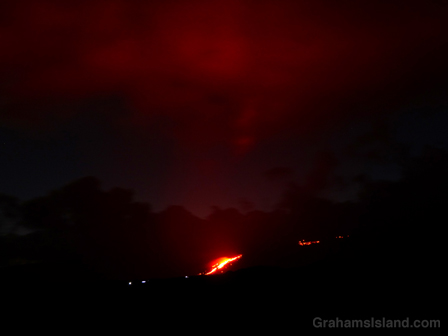
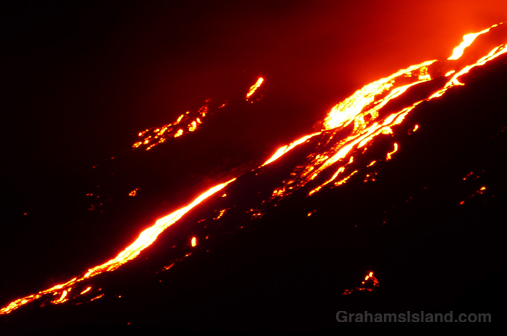
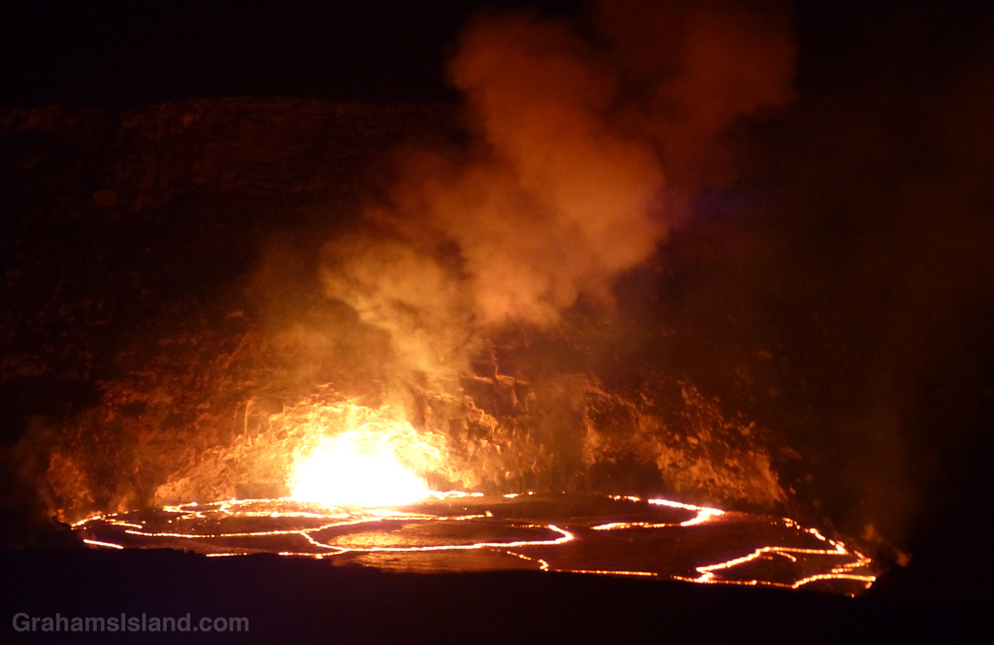
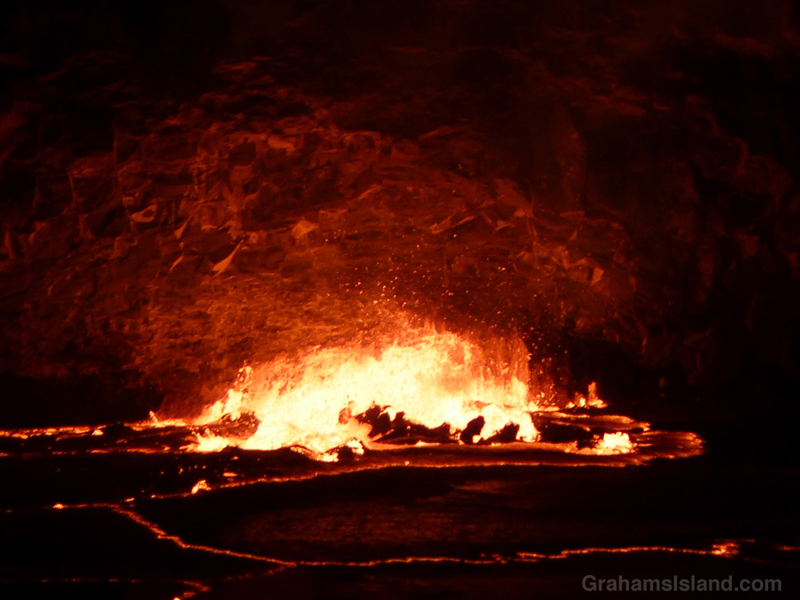
Lava rises at Kilauea volcano

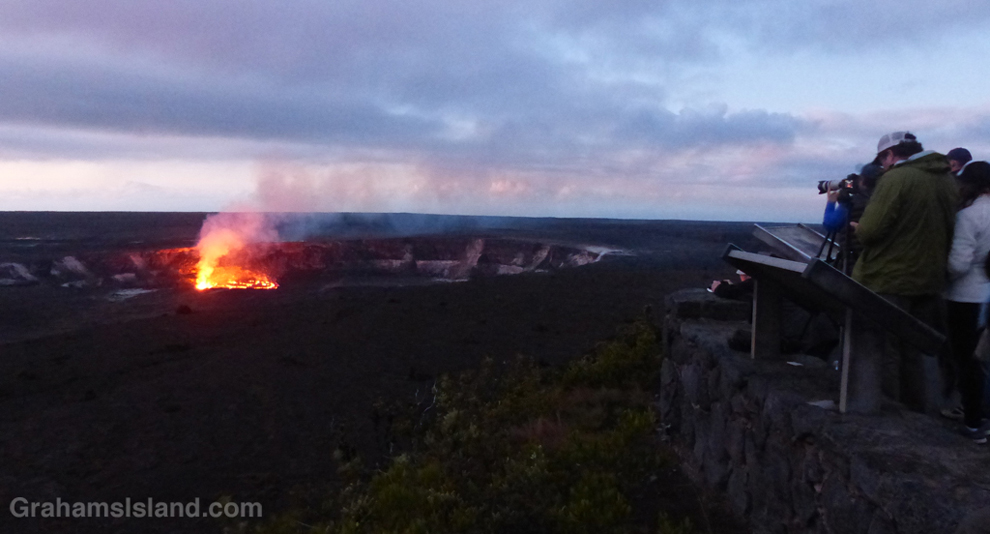
The lava lake in the Overlook vent at Halema’uma’u Crater.
Kilauea lava crust bubbles and cracks
The slightly cooler surface is broken up by bubbling lava.
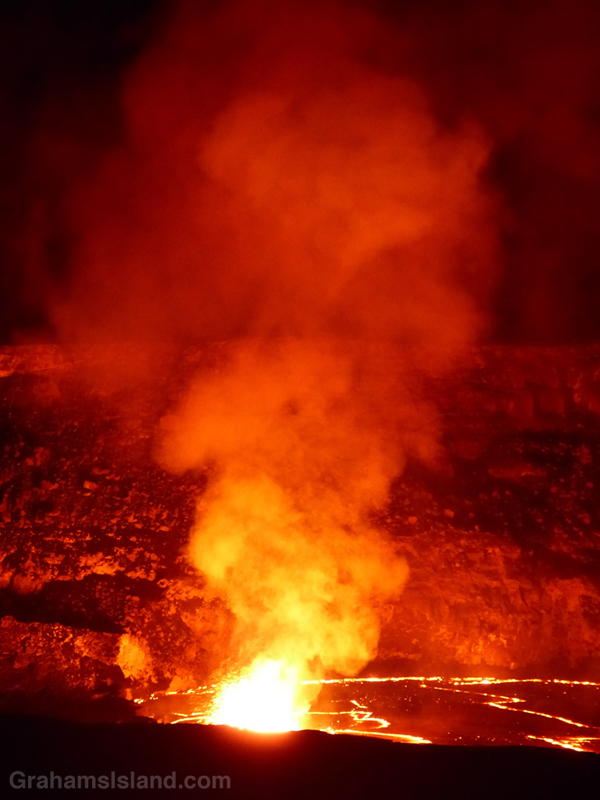
A hotspot illuminates the crater wall at Kilauea
A hotspot illuminates the crater wall.
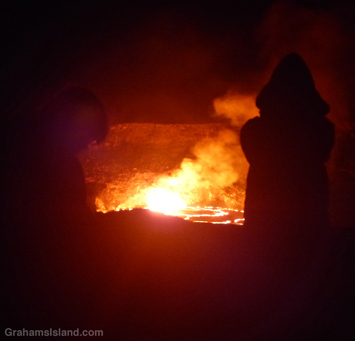
Onlookers at Kilauea
The quiet group reverently looking on had the appearance of a cult at times …
Cult-like gathering at Kilauea volcano.
… Gathered around the mystical ring of fire.

Today marks the anniversary of a trip my wife and I made to Hawaii Volcanoes National Park. That’s where Kilauea Volcano, active since 1983, has two vents spewing lava. Flows from Pu’u O’o vent have, over the last few years, reached to the ocean and threatened to take out the town of Pahoa.

The other vent is in Halema’uma’u Crater. It’s known as the Overlook vent since it’s below an old viewing overlook. Since it became active in 2008, it’s been a bubbling pool of lava, varying from 60 to 400 feet below the floor of the crater. By night the lava glow was visible. By day, mostly what could be seen was steam and smoke.

In early April of last year, the lava lake started rising. It rose so much that the lava became visible from the Jaggar Museum, which gives a good view of the main crater. It was time to check it out. The problem was that the spectacle of active lava visible from an accessible spot led to a crush of visitors. The park warned that large crowds were showing up and advised visiting at off peak times.

Lava viewing is more vivid at night, but the scene in daylight is also interesting, so there were two options. Showing up in the afternoon and staying through sunset would be iffy because it was guaranteed to be crowded. The alternative was to arrive before sunrise and stay until it got light. The only snag? We live 100 miles away.

The day before the trip, we turned in early and I set my alarm for 12:01 a.m. We got up and were on the road by 12:35. Driving in the wee hours was actually pretty nice. The stars were out and the roads mostly empty. In Hilo, we stopped at Ken’s House of Pancakes, the Big Island’s only open-24-hours restaurant, and had breakfast at 2:45 a.m., a slightly surreal experience. Then back on the road before pulling into the viewing area parking lot at the Jaggar Museum a little before 4 a.m.

It was cold with the wind making it feel cooler and we weren’t really dressed for the occasion. But there weren’t too many people there, the night sky was gorgeous, and the lava very visible and active. We watched it bubble and spatter, often vigorously. Daylight crept in. As it did so the scene changed and more people began to show up. By 6 a.m. it was light so we left, getting home just after 8:30. It was strange to think that at that relatively early hour we had driven to the farthest side of the island, watched the volcano for a couple of hours, and driven back. Usually at the time the most I can claim is that I’ve made coffee.

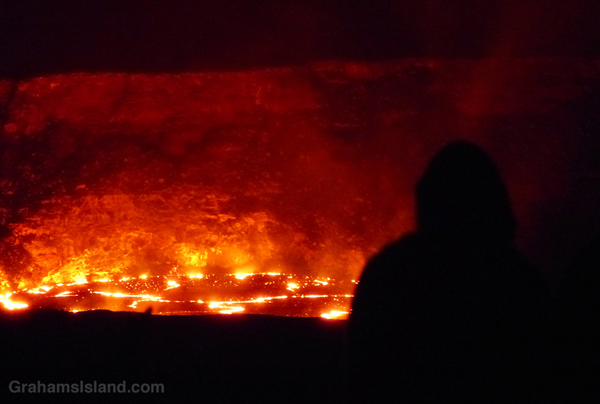
First light silhouettes the onlookers.
As darkness dissipates, lava shoots into the air.
As darkness dissipates, lava bubbles in the crater.

Soon after our visit, part of the crater wall collapsed into the lava causing a big explosion. The lava lake also reached the rim of the Overlook vent and began to spill out onto the main crater floor. We thought these developments were worth making the same trek again. And then the lava went into retreat. It fell back below the rim of the vent. Within days, the lava lake in the vent disappeared from sight and sank back to its former levels, which is where it remains, currently more than 100 feet below the Halema’uma’u Crater floor. (For scale, the active vent opening measures about 500 feet by 700 feet and the distance from the main Halemaumau Crater floor to the rim is about 270 feet.)

For more information about Hawaii Volcanoes National Park, go to nps.gov/havo/. For more information about Kilauea Volcano and it’s eruptions, go to hvo.wr.usgs.gov/kilauea/history/main.html.

Daybreak reveals the onlookers gathered at the Jaggar Museum viewing point.

The planned Thirty Meter Telescope site on Mauna Kea

Thirty Meter Telescope site on Mauna Kea
This is where the planned Thirty Meter Telescope (TMT) is supposed to be built. I say ‘supposed to’ because the project is currently going in reverse. Construction should have started in April of last year, but protests derailed that. Then two court decisions late last year mean the permitting process has to start again. As it stands right now, The TMT people have said they need approved permits by early next year. In the meantime, alternative sites are being checked out, in case things don’t come together.

Personally, I don’t think the telescope will be built here. The protesters aren’t going to go away, I don’t think there’s the will in Hawaii officialdom to get it done, and I don’t think the TMT people want to do what it will take, which would leave them looking like the bad guys running roughshod over Hawaiian cultural practices.

It’s more complicated than this of course, but if I were a betting man, I know where my money would go.

Mauna Loa hike – it’s getting better all the time

The lava comes in many colors, seen here where the trail crosses the road.
Clouds hang over the west side of the saddle between Mauna Loa and Mauna Kea.
These two big cairns mark a collapsed lava tube.
The collapsed lava tube is full of colorful rock.
The observatory comes into view. Note the rough a'a lava on the right and the more rounded pahoehoe on the left nad in the foreground.
The observatory comes into view. Note the rough a’a lava on the right and the more rounded pahoehoe on the left and in the foreground.

This is a continuation of yesterday’s post, the third and final leg of the hike.

I made a rapid descent. Despite not feeling well, I was still able to put one foot in front of the other at a good pace. Unlike the Mauna Kea descent that I did a few weeks previously, this wasn’t as steep so the going really was easier. I made good time back to the trail junction at the edge of North Pit and better time from there on, barreling down the slope.

The weather continued to be perfect – cool, but sunny and clear. And going down, the views are always there. On this trail, unlike the Mauna Kea descent, views open up to both sides of Mauna Kea as well as the mountain itself. There were still clouds over Waimea and the foothills, and some clouds to the Hilo side, but these had been there all day and had not advanced at all up the saddle.

The farther I descended, the better I felt. There was some unnoticed point at which my concern for how I felt was replaced by appreciating what I was seeing, because I wasn’t feeling bad anymore. I wound down through the cinder section, followed the road again and came to the two big cairns marking the broken lava tube. From there it was just a short hike to the rough and ready road and the last string of cairns, with the observatory off to the right and Mauna Kea clear in front.

I ambled along the last section of road back to my car. I hadn’t seen a soul all day, but as I approached the parking area, four vehicles pulled up and disgorged a clump of tourists who sounded like they came from somewhere in Europe. Some wandered off. Others seemed to be going through some sort of personal growth ritual. I got curious looks as I peeled off shoes and socks, giving my battered feet some air. I didn’t much care. I felt pretty good again and very satisfied with the day.

It’s a hike I’d do again. I’d start earlier, have better footwear, take it a mite slower for acclimatization purposes. And I’d hope too make the summit next time, though I’m not too bothered that I didn’t. For me, a day alone on a big mountain is reward enough.

For more information about the Mauna Loa Observatory Trail, go to bigislandhikes.com/mauna-loa or instanthawaii.com (under Things To Do, check Scenic Drives for the road up to the observatory and Hikes & Trails for the trail).

Mauna Loa hike – life at the top

North Pit with the cabin trail heading o;ff to the left. The summit is in the distance.
North Pit with the cabin trail heading off to the left. The summit is in the distance.
This pit toilet is said to have one of the best views, but it really just faces a cinder ridge.
This pit toilet is said to have a great view, but it really just faces a cinder ridge.
Mauna Loa cabin can be seen across the crater.
Mauna Loa cabin can just be seen on the rim, across the crater.
Seismic instruments are scattered around the summit of Mauna Loa.

This is a continuation of yesterday’s post.

Having arrived at the North Pit around 11:00 a.m. I had to decide what to do next. I could explore the North Pit. I could turn around and head down. I could continue on to the summit. The summit is another 2.5 miles or so – I’ve seen different numbers. It’s not steep, but it is relentlessly up, traversing more rough lava and all of it above 13,000 feet.

Still, I was here in better time than I expected, the weather continued to look good, and I continued to feel good. So off I went onto the Summit Trail. Near the start there’s a shelter which is really just a good-sized pit. It’s a good place to shelter from the wind if it’s blowing (and it can really blow), but not so good if it’s raining or snowing.

The trail rumbles uphill. It’s mostly steady going with occasional forays over more challenging a’a lava. The biggest thing, at least as far as I was concerned, is that it just keeps going. There are a succession of crests, not really ridges, just places that look like they’re a ridge. The first one or two didn’t raise any hopes because I knew I hadn’t gone that far. But after that, it’s a series of raised and dashed hopes – ‘maybe that’s the summit, oh no, there’s another one.’

I trudged on, not feeling too bitter about these constant let downs. What did concern me was that I was starting to feel less well. I reached a point where I was sure that the next ridge was the summit and swore that if it wasn’t I was going down because of how I felt. Of course, it wasn’t the summit, but the next ridge really wasn’t far, so I carried on. I repeated this delusion a second time and, when I topped that rise, finally saw the summit. It was a half mile off.

I could probably have slogged that last leg, but I really didn’t feel good and the only cure for altitude sickness is to lose altitude. So I rested a while, had a bite to eat, and enjoyed what was still an awesome view of Moku’āweoweo. I’d been drinking water steadily all the way up and continued to do so. Dehydration sneaks up fast at altitude.

After a short while, I packed up my gear, gave the summit a final rueful glance and headed back the way I’d come.

Tomorrow, I’ll post the hike back down.

For more information about the Mauna Loa Observatory Trail, go to bigislandhikes.com/mauna-loa or instanthawaii.com (under Things To Do, check Scenic Drives for the road up to the observatory and Hikes & Trails for the trail).

Moku’āweoweo, with South Pit in the background.

Mauna Loa hike – going up

Mauna Loa Saddle
Pu’us on the west side of the saddle between Mauna Loa and Mauna Kea, with the Kohala Mountains peeking above the clouds in the background.
Mauna Loa Notice
The trail notice below the observatory.
Mauna Loa Trailhead
The trailhead, a case of spot the cairns.
Mauna Loa 1st Road
The trail, marked by the cairn, crosses the road. The rocks in the foreground are the road!

There are two hiking routes up Mauna Loa. One is the Mauna Loa Trail starting out from Hawaii Volcanoes National Park. This is a 40 miles or so round trip, a multi-day hike requiring a permit. See nps.gov/havo/planyourvisit/hike_maunaloa.htm for information. The other trail is the Observatory Trail, which is reached from Saddle Road. This is the trail I took.

The trail begins at the Mauna Loa Observatory, which monitors atmospheric change. The road up to the observatory begins a hundred yards or so Hilo side of the Mauna Kea Road – Pu’u Huluhulu Native Tree Sanctuary junction. It’s about 17.5 miles and, contrary to some reports, is currently in excellent condition having obviously been repaved in the none too distant past. It’s still single-lane and goes up and down and around many bends, so drive carefully.

Mauna Loa Tube Remnant
This remnant of a lava tube gives some idea of how thin the top can be.

I intended this to be a day trip, which requires an early start. There are two ways to do this. One is to drive up in the evening, sleep in the parking area overnight (all the while acclimating to the altitude), and head out early. The other, which I chose, is to drive up to the observatory early in the morning, spend an hour or so acclimating, and then head out. I left home at 5 a.m. and arrived at the parking area at 7 a.m.. En route I nearly ran over a sheep wandering in the road in the dark and, at the junction, got to see an orange sunrise being welcomed by white-robed followers of what I assumed was some sun-worshipping group.

The trail starts at about 11,000 feet and goes up some 2,700 feet to the summit. It’s a high altitude trail prone to sudden weather changes so the usual cautions apply. There’s a sign at the trailhead that outlines why this hike could be your last. I joke, but the concerns are real. I’d picked a day of fine, settled weather, but packed food, water and clothing for an unscheduled overnight stop.

That said, I headed out on the very rough dirt road that is the start of the trail. This is a road for 4-wheel drive trucks with strong motors and lifted suspensions that make the truck bed seem detached from the wheels. I’ve hiked at altitude a moderate amount and not had any problems, but I know to take my time and be alert to signs of altitude sickness.

After about half a mile the trail proper takes off to the left. There’s a nice, clear sign marking the spot. The trail itself is less obvious. Most of this trail is marked by cairns. Sometimes there’s a splash of white or yellow paint, sometimes a stick or pole, but the cairns are the main guide. The only thing is, the cairns aren’t always obvious as the trailhead photo shows. It’s a good idea to identify the next cairn before leaving the one you’re at.

A lot of this trail passes over rounded pahoehoe lava. I prefer hiking on this to sharp a’a lava. At least with pahoehoe I have a solid surface to place my foot and to push off from. That said, there are times when the surface crackles and I’m keenly aware the area is riddled with lava tubes, some topped with a thin crust that could easily give way. That’s one reason why I try not to stray from the trail.

When I hike, I often have songs running through my head and, on hikes like this, I inevitably end up humming “Put one foot in front of the other” from the 1970 movie Santa Claus is Comin’ to Town (don’t ask). It is, however, a one-foot-in-front-of-the-other kind of hike, a steady climb at a steady pace, watching ones steps.

About 45 minutes in, I crossed the dirt road I’d started on (which zigzags up the mountains most of the way to the summit). I’d walked up the road once before looking for this crossing and hadn’t identified it. Now I recognized that I’d walked past it. A lot of the trail is like this – a mishmash of lava and ups and downs, with a distinctive feature here and there. There’s a broken lava tube marked by two big cairns and another junction with the road. The trail follows the road at this point until it comes to a gate marking the national park boundary. Then it veers off, up the hill, to the right on an easily followed cinder section, crosses the road a third time, and finally winds up another half mile to the edge of North Pit, the northern most feature of Moku’āweoweo, the summit caldera.

Dare I say that this view isn’t the most spectacular? The floor of North Pit is only about 10 feet below the rim and, since it stretches out a good way ahead, that’s really most of what there is to see at this point. It’s still an impressive view. The trail to Mauna Loa cabin angles across the North Pit floor and in the distance are the higher cliffs of the main crater. Best of all, I was feeling pretty good, it was only 11:00 a.m. (three and a quarter hours to this point), and the weather continued to be and look great.

Tomorrow, I’ll post my hike from North Pit up the Summit Trail.

For more information about the Mauna Loa Observatory Trail, go to bigislandhikes.com/mauna-loa or instanthawaii.com (under Things To Do, check Scenic Drives for the road up to the observatory and Hikes & Trails for the trail).

Mauna Loa Gate
The road ends at a locked gate. The trail takes off up to the right.

What goes up Mauna Kea …

The trail starts just below the loop road that links the telescopes.

The trail starts just below the loop road that links the telescopes.

Lake Waiau.

Lake Waiau.

The trail passes through unforgiving landscape. Two hikes are just visible at the top center.

The trail passes through unforgiving landscape. Two hikers are just visible at the top center.

Looking across at Mauna Loa. The trail is visible at bottom left.

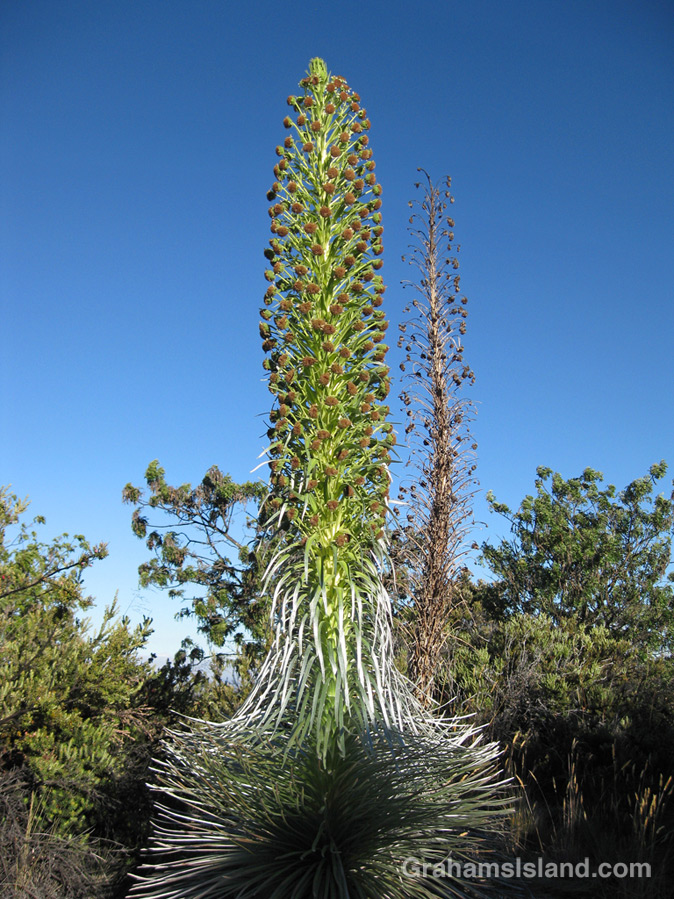
Mauna Kea silverswords grow in the otherwise barren cinder landscape.

Mullein, Verbascum thapsus, grows in the otherwise barren cinder landscape.

I took a hike on Mauna Kea recently. I’ve been up the mountain before in the car and I’ve done a hike or two going around the volcano. This time I thought I’d tackle the Summit Trail. The trail starts at the Mauna Kea Visitor Center at about 9,250 feet and goes 6 miles to the summit at about 13,800 feet. That’s around 4,550 feet of elevation gain. It’s also high altitude, which means it’s not an easy trail.

My plan was to ‘try out’ the trail. I figured if I made a one-way trip it would give me a good insight about whether to try the round trip. My idea was to get a ride from the visitor center to the top, then hike down, because that has to be easier than going up, doesn’t it? Cue ominous music.

I got to the visitor center before opening time and spent an hour acclimating to the altitude. I chatted with one of the volunteers at the desk and she said she preferred the hike UP the mountain. She asked if I had walking sticks, which I didn’t. Tactfully, she didn’t follow up by asking about next of kin. At least the weather was good – sunny and dry, but cool.

By starting early I’d hoped I might snag a ride with a work vehicle heading up to the telescopes that dot the summit. They all passed me by, either fully loaded or, I suspect, forbidden from picking up hitchhikers. That gave me a problem. I’d just left the visitor center and knew there were no 4-wheel-drive vehicles there, which is what visitors going to the summit should be driving. I couldn’t expect a ride until one arrived and the occupants had acclimated as I had. Faced with the prospect of waiting an hour or more I headed off up the trail. I could hike the first ¾ mile, to where it passed close to the road again, and try and get a ride from there.

The trail started off up a rough dirt road that quickly transitioned to a trail. When I say up, I mean up. Mauna Kea is shaped like a classic volcano. It looks, and is, steep.

I huffed and puffed up the slope, feet slipping on the loose cinder underfoot. I began to understand what the woman at the visitor center meant; coming down would be treacherous. Going up was hard work too, but at least I felt I’d earned the frequent stops to recover and appreciate how much elevation had been gained.

I reached the road at around 10,200 feet and soon got a ride to the top. The actual summit of Mauna Kea is along a short trail across from one of the parking areas. I didn’t take it this time having been there before. Instead, I headed off on the road that loops around the top. It’s a surreal place, a barren, windswept, cinder landscape dotted with high-tech telescopes gathering information from the farthest reaches of the universe.

The trail down starts just below where the road begins its loop. It’s easy going at first, through a small valley, over a ridge and down a steeper bit to a saddle. This is where the main trail intersects another one heading to Lake Waiau. Lake Waiau is a small, somewhat perplexing lake. At 13,000 feet it sits on a volcano made up of highly permeable rock at an elevation where it gets very little in the way of rainfall. It’s not entirely clear why the lake exists at all though it undoubtedly does. The day I was there, it appeared quite full and green.

After the side trip to the lake, I started down again. Almost immediately I missed the trail down. I thought it intersected the Lake Waiau trail toward the road, but I soon realized that wasn’t true. So I angled across to the right one over loose lava, slipping often, but finally regaining the proper track.

Soon after, I met two other hikers who I’d seen in the parking lot earlier. They were hiking the round trip, up and down. We chatted a while before they continued. They were younger and fitter than I, though their conversation had left me with the impression that they weren’t looking forward to the return journey.

It’s a steady downhill slog, mostly with a loose surface underfoot (at one point I fell, my feet slipping out from under me, luckily leaving me with nothing worse than a couple of scrapes on one hand). I’d like to say the effort was worth it for the views, but the truth is, I can’t. Across the saddle, is Mauna Loa, which is a bigger volcano than Mauna Kea, but doesn’t look it. Mauna Loa (which means ‘long mountain’) has enormous mass, but not striking, steep sides. Otherwise, I was looking mostly at my feet or the same kind of landscape I was walking on.

This was one of those hikes where I kept thinking that the place where the trail passed close to the road where I’d got my ride, must be just over the next ridge. But one ridge followed another and there were several of them before that observation became true. Then I was back on territory I’d climbed up that morning. The woman at the visitor center was right: it was easier going up.

When I got back to my car, a visitor there asked me about the hike, whether it was worth it. “No,” I said. He was disappointed. He was keen on the hike; his partner, less so. But the truth is, it’s a slog up and down over a barren, cinder landscape. Yes, there are plusses. There’s a stark beauty in the place and the lake is worth it. But, to me, it’s more for the person who likes to be able to say ‘Yeah, I did that hike.’

For more information about the Mauna Kea Summit Trail and Lake Waiau, go to bigislandhikes.com/mauna-kea and ifa.hawaii.edu/info/vis/visiting-mauna-kea/hiking.


Nearly there. The visitor center and road is visible on the left.

Nearly there. The visitor center and road is visible to the left of the red cinder cone.

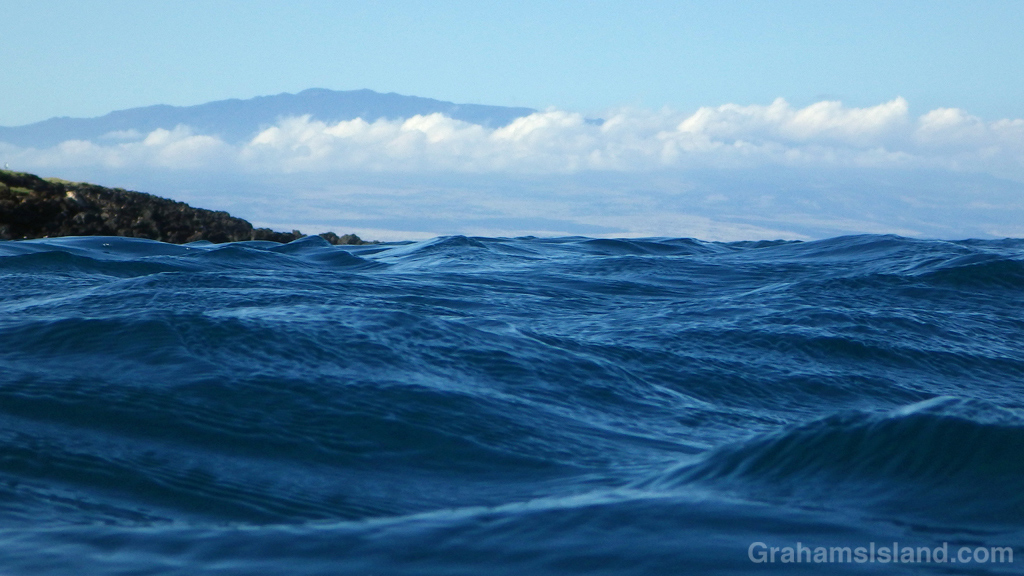
Hualalai from the North Kohala coast

Hualalai

A tranquil view of the volcano, Hualalai. It last erupted in 1801, but is still considered active. If it does go off again, it could be very bad news for the Kohala coast resorts and the airport at Kailua Kona, which is built on the flow from one of the last eruptions.

For more information about Hualalai, go to hvo.wr.usgs.gov/volcanoes/hualalai/.