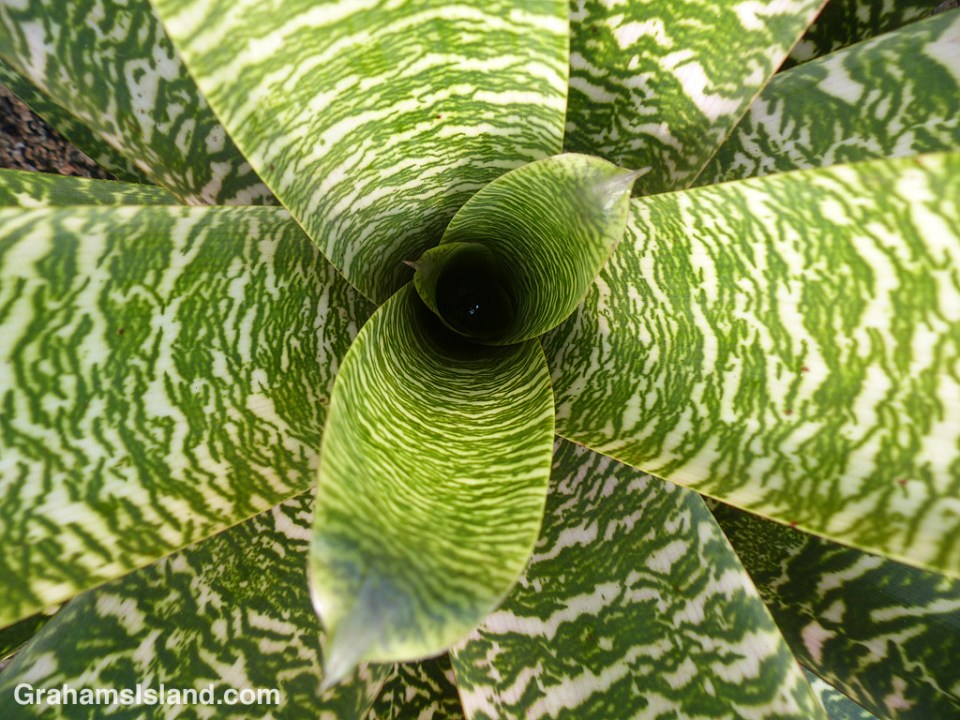
A look into the dark heart of a bromeliad plant. Is that something down there, looking back?

A look into the dark heart of a bromeliad plant. Is that something down there, looking back?
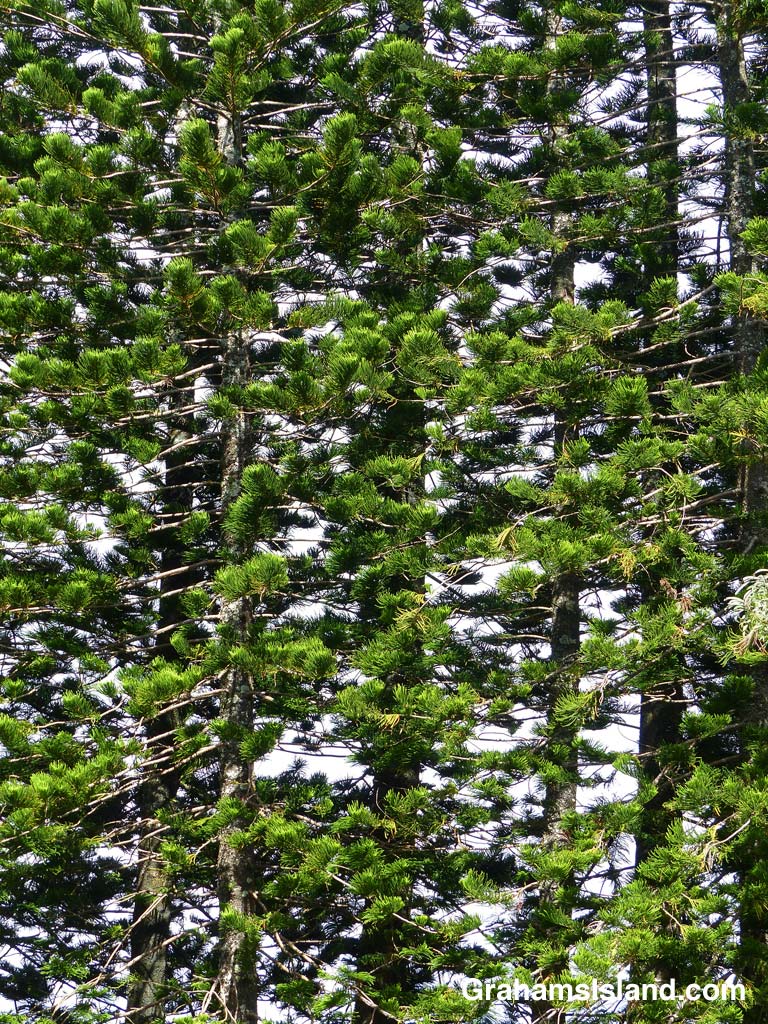
I think these are Cook pines, but what I liked was that there was a long line of extremely tall trees that formed this abstract kind of wall.

Boiling Pots is part of Wailuku River State Park, in Hilo, along with Rainbow Falls. It features a series of small falls and pools. So why the name? When the river runs fast, those pools roil and bubble as if boiling.
The park overlooks these pools and access to the pools is forbidden, hence these signs. However, people go down there all the time and a few die every year. When people do get swept away, rescue divers usually spend 24 to 48 hours searching the river, at some considerable risk to themselves. Sometimes the body turns up several weeks later, swept into some unlikely spot. Sometimes it’s never found.
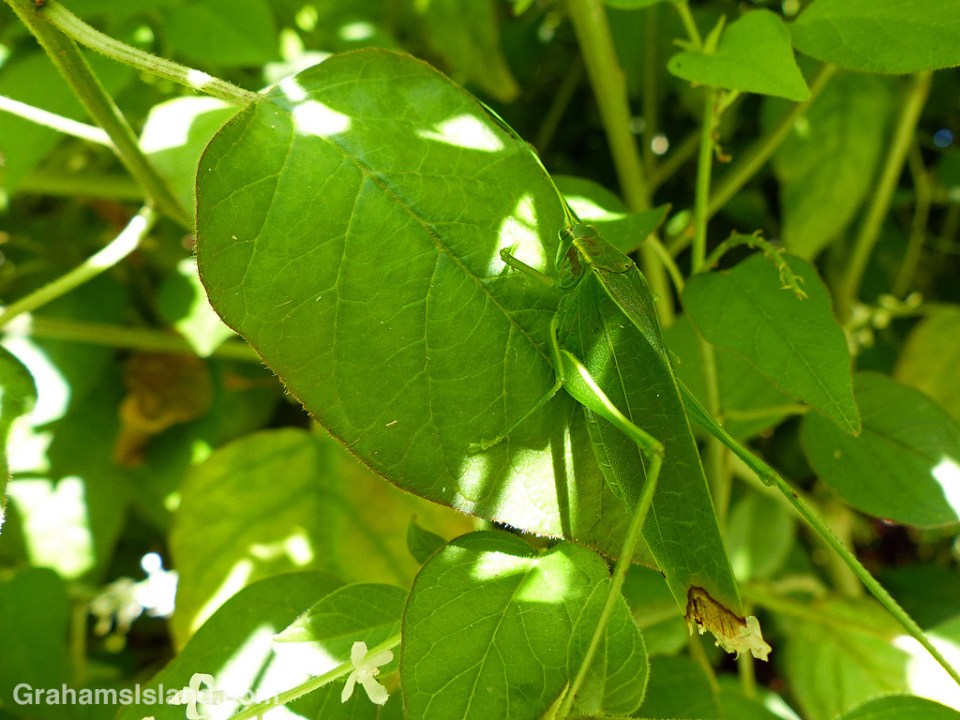
Just a straightforward ‘Spot the katydid’ photo. I was sorting some older photos and I had to look at this one more than once to figure out what was going on.
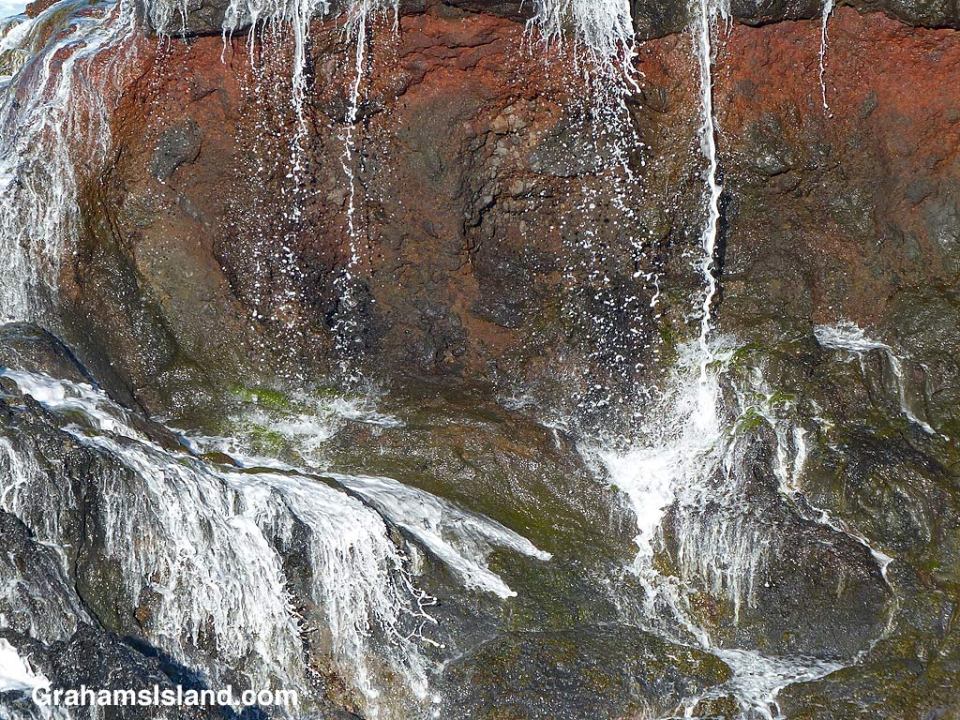
A breaking wave cascades down a colorful rock face on the coast.

Actually, it would take more than a vowel for me to figure out what was writ upon this old blockhouse wall.
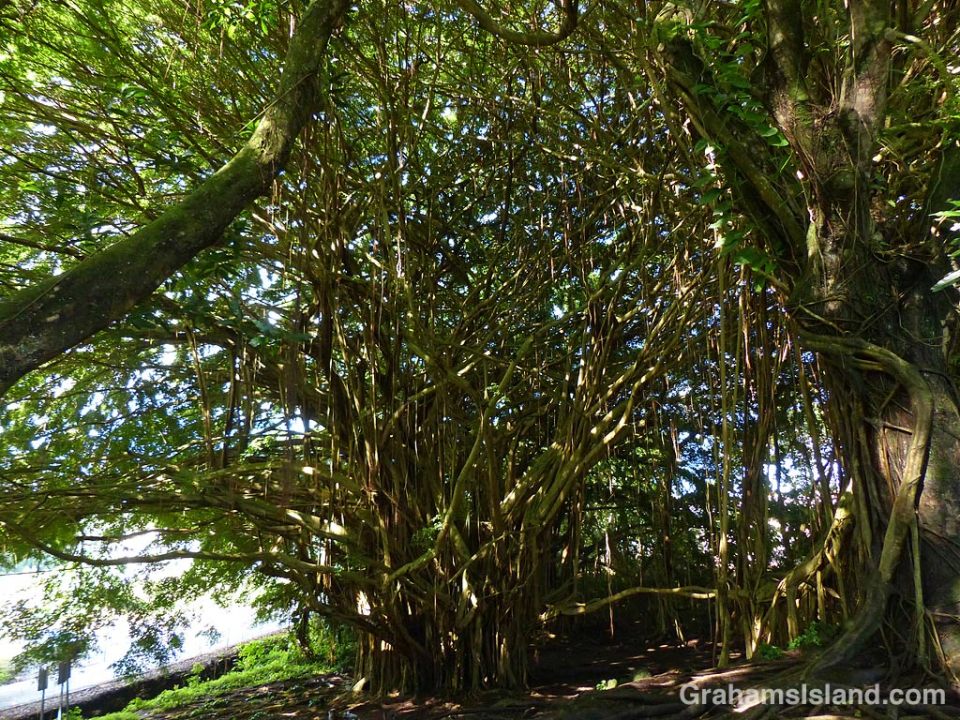
 The main attraction of Wailuku River State Park, in Hilo, is Rainbow Falls. But at the top of the hill are these huge banyan trees.
Banyans are not just a huge sprawl of branches, but a sprawl of roots, too. As epiphytes they begin life growing on other trees, from seeds dispersed there by birds. Over time, they send roots down to the ground, known as prop roots, which help support the mass of branches.
Banyan trees are also known as strangler figs because their roots and branches will ultimately overwhelm the host tree and kill it. Eventually, the dead host will decay and leave a hollow center to the banyan tree that’s left.
By continuing to send down prop roots, banyans grow out as well as up. Very old trees can cover a huge area. For example, the Great Banyan Tree in Kolkata, India is more than 250 years old. Its covers around four acres and has more than 3,500 prop roots. Here in Hawaii, the largest banyan grows in Lahaina on Maui. Planted in 1873, it now has 16 main trunks and covers two thirds of an acre.
The Rainbow Falls trees aren’t that large, but they’re coming along nicely.
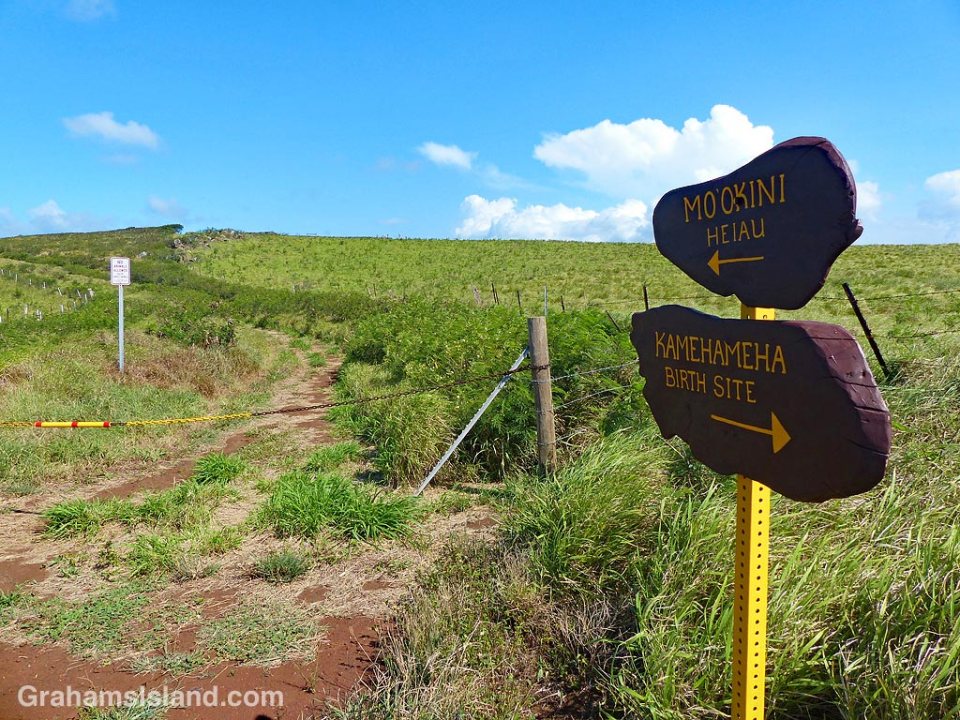
Mo’okini Heiau is located just off one of my regular walks. The old signs for the heiau and the Kamehameha birth site fell from their original spot, tacked on a fence, some years ago. Since then, the signs have been wedged into a barbed wire fence, from which they regularly fell into the grass.
When I noticed this, I’d root the signs out and wedge them back in the fence. I believe other people also did this. At some point, one of the signs split in two, so there were three pieces to try and arrange in some way that they wouldn’t immediately fall down again.
I kept thinking I should bring some wire and a drill and try and put the signs back together again, maybe attach them to a fence post, but I only remembered this good intention when I was picking the signs out of the grass.
The grounds of the heiau are maintained by staff presumably contracted by the county or state. However, the area in the vicinity of the signs never got much attention except when, a couple of years ago, a sign prohibiting animals (on the left of the photo) suddenly appeared. I have a fondness for that sign because the chance of anyone enforcing that regulation is right up there with me winning three different lotteries on the same day (and Hawaii doesn’t have lotteries).
So imagine my surprise the other day when I reached this point in my walk and saw this spiffy new sign. Two new boards attached to a brightly painted pole securely set in a rock. I was giddy with shock and excitement (yes, I don’t get out much). If an alien spaceship had landed I wouldn’t have been more surprised. Note too the red and yellow paint on the chain across the trail to the heiau, and the well-supported post that fell down about a year ago.
Folks, forget the volcano. You want to see something truly amazing on the Big Island, come up to North Kohala and check out these signs while they’re still standing.
 Graham's Island