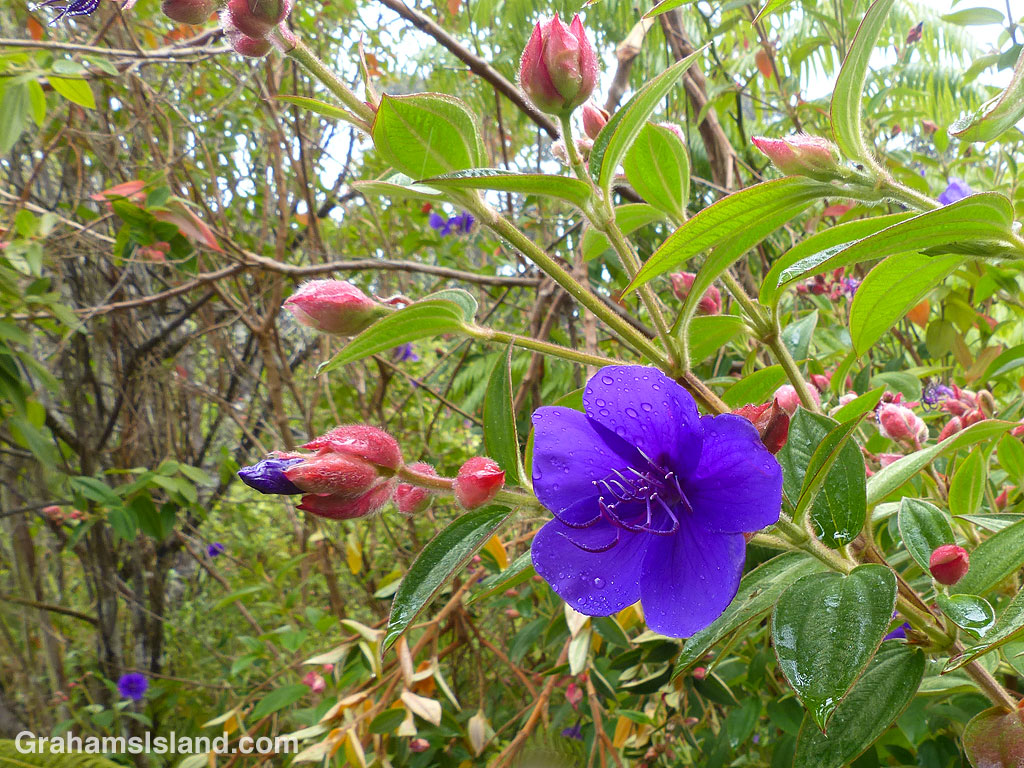
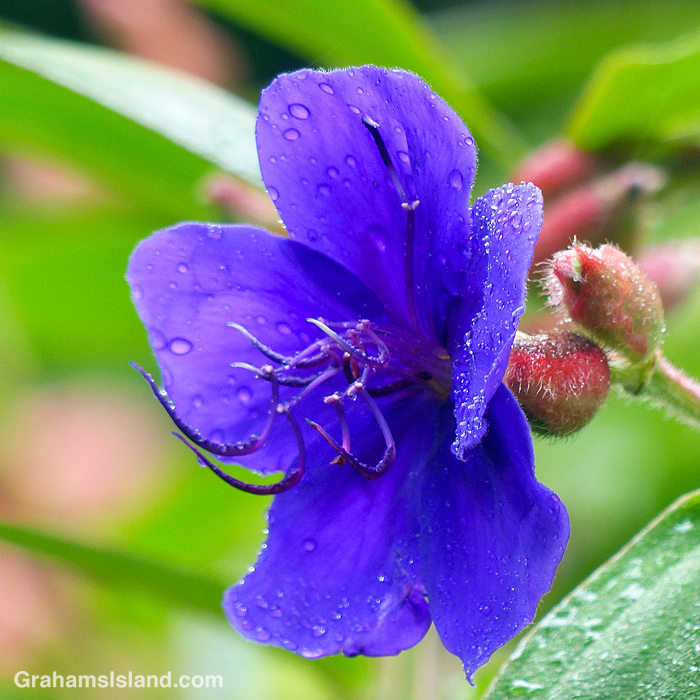
Tibouchina urvilleana hails from Brazil and is also known as purple glory bush and princess flower. Its flowers have striking deep blue to purple petals, which contrast nicely with dark pink sepals. Here on the Big Island, it’s a bit of a problem because of it’s dense growth habit which can crowd out other plants.
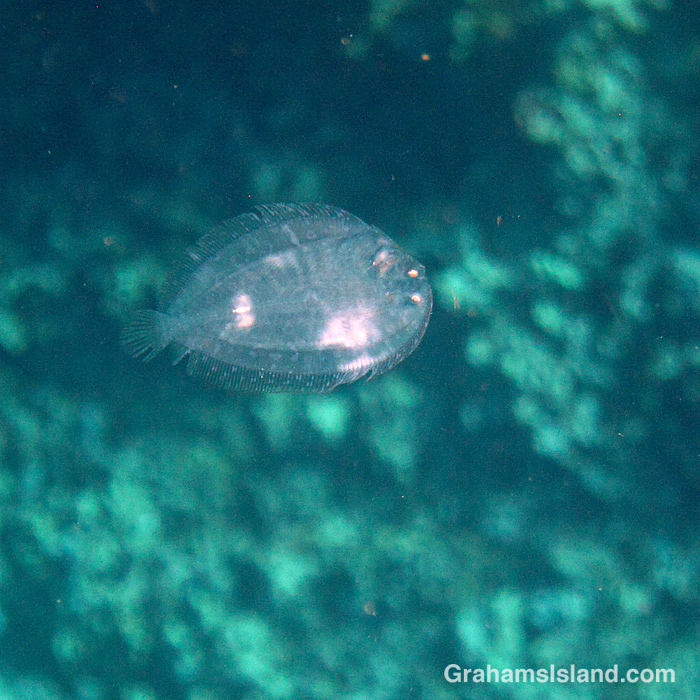
One day, while I was in the water, I ran into a couple of snorkelers who were watching this creature. It was high up in fairly deep water in the middle of the bay. It looked almost translucent and very small, only 2 or 3 inches long. It wasn’t even clear whether this was a live creature or just a bit of floating debris. They took photos, I took photos, but I wasn’t optimistic on how they’d turn out because it’s hard to get the focus right on something like this.
After they left, I hung around and saw the creature swimming, coming up in the water. I took a couple more photos before it descended again. When I got home I was thrilled that, out of the photos I took, this one turned out pretty well. From it, I could see that this was a very small flowery flounder. The general shape and details are a very small version of the adult fish. What’s interesting about this is that flounders start out life looking like regular fish, swimming upright and with an eye on each side of its head. But within a few days, flounders start to lean to one side and one eye begins to migrate to join its partner on the other side.
This tiny, very young flounder has already completed that transition.
This week’s Sunday Stills challenge theme is ‘Inside.’ See more responses here.
I have a ladder I keep in a shed. Lately, I’ve had to access the attic on a regular basis (rat problems!) and have to bring the ladder inside to do so. I’ve learned from experience that, while in the shed, the ladder is home to a variety of creatures, mostly geckos. So before I bring it in the house I do my best to shake out the residents. Almost always, one or two will leap to safety. However, sometimes it’s not until I have the ladder in the house and set up that the more tenacious geckos make a break for it.
I’ve had a spate of this happening, which has resulted in a boost in the numbers of nocturnal house geckos inside. This, in turn, has resulted in territorial clashes between the geckos.
What does this have to do with jars of pasta? Well, at one end of this shelf is a cupboard which is home to one of the resident geckos. The other end of the shelf falls into the realm of a house gecko that lives in a closet in the next room. Into this setup, up above the jars, stumbled one of the new geckos. When it got too close to one end, the cupboard gecko chased it away. It ran to the other end where the closet gecko chased it back. Back and forth it went with the other geckos closing in with each pass. Soon the three of them were very close together.
At this point, the new gecko scurried down the wall in amongst the jars. This left the two resident geckos facing off in close proximity. Cupboard gecko charge the other one, but ran right past while closet gecko just looked bemused. Problem was, now they were both separated from their respective territories by the other gecko. A series of feints and scampers ensued before they regained their own homes.
In the meantime, the new gecko kept a low profile down amongst the pasta jars. That’s when I took this photo, as it was tentatively checking to see if the coast was clear.
There’s a good variety of fish at Two Step including raccoon butterflyfishes, seen here mingling with goatfishes and yellow tangs.
A barred filefish swims by with a startled look on its face, which is just their usual look.
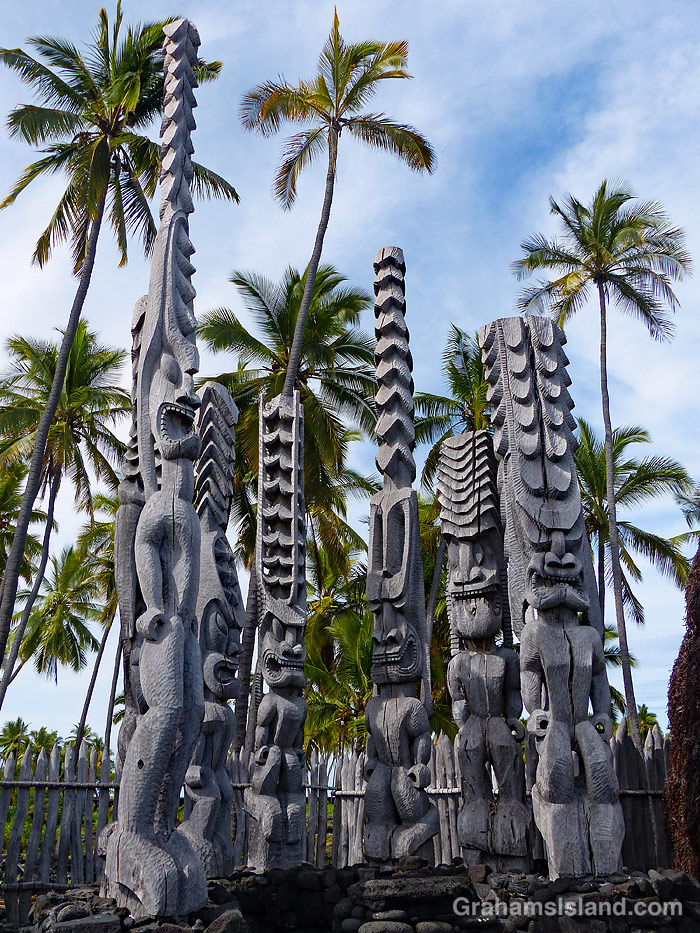
Ki’i at Pu’uhonua o Hōnaunau National Historical Park, better known as Place of Refuge.
This week’s Friendly Friday challenge theme is ‘Anniversaries.’ See more responses here.
Often, on our wedding anniversary, my wife and I go to Hawaii Tropical Bioreserve and Garden (formerly Hawaii Tropical Botanical Garden). This year the garden was shut, and still is, probably until tourists return to the islands. So a different anniversary is my birthday, which is not marked with candles on a cake, since that would be prohibitively expensive, but usually by a trip somewhere and a meal out. This year we went down to snorkel at Two Step and then had a wander around Pu’uhonua o Hōnaunau National Historical Park, otherwise known as Place of Refuge, which is right next door.
Two Step is a very popular snorkeling spot on Honaunau Bay, south of Captain Cook. This is a marine reserve so no fishing is allowed and the fish tend to be more numerous and mellow because of this. It’s a popular spot to see and swim with dolphins, though I haven’t done either of those things there. Currently, it’s not nearly as busy since there are very few tourists on the island and those that are here are diligently following quarantine rules (I’m trying to keep a straight face writing this!).
After our swim we made the short walk to Pu’uhonua o Hōnaunau National Historical Park. The park is on the south side of the bay and, at the moment, is fully open only on Fridays, Saturdays, and Sundays. However, on the other days, pretty much everything else is accessible, it’s just that the parking lot and visitor center are closed. What this means is that there’s basically nobody there so our visit was quiet and uncrowded. The park is an important place in Hawaiian history, and the location is beautiful. What’s not to like?
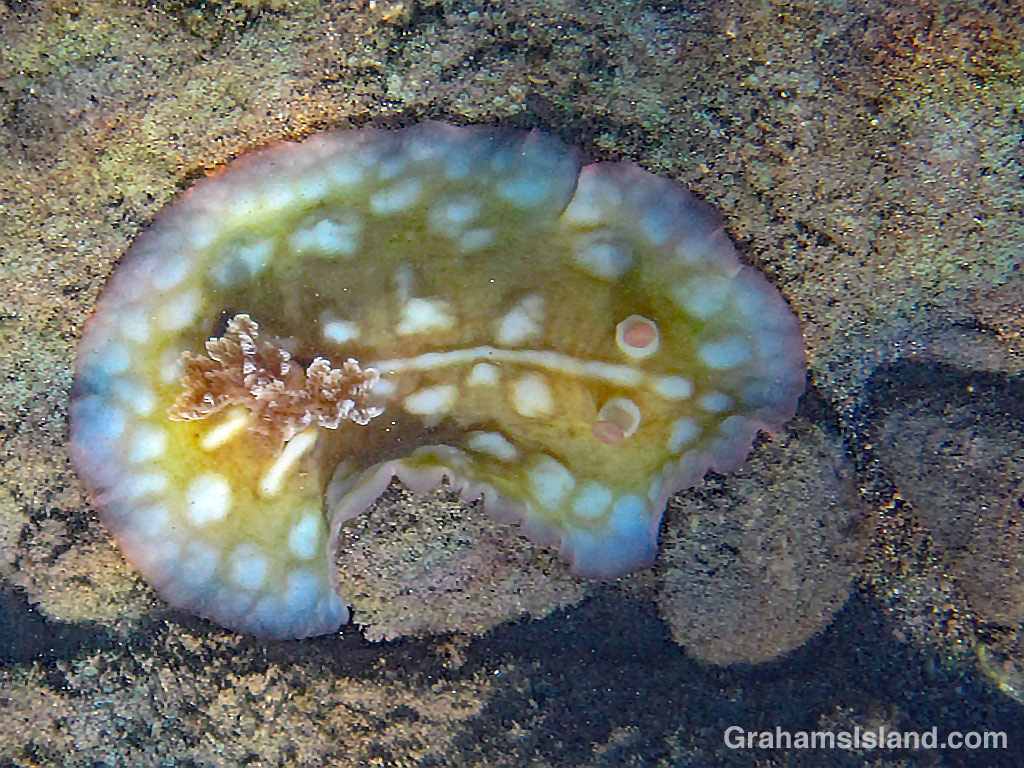
My local snorkeling spot has been roiled with excitement lately over the appearance of a couple of clumpy nudibranchs. Well, it’s exciting for us.
Nudibranchs (pronounced noo-di-branks or noo-da-branks) are members of the sea slug family. Granted this doesn’t sound too exciting, but nudibranchs are strange and exotic and often wildly colorful. The reason I haven’t posted photos of a nudibranch before is that I’ve never seen one before, let alone got a photo of one. That’s the downside of nudibranchs; they tend to be on the small side. One to three inches is typical for most of them. But clumpy nudibranchs are big, up to 10 inches long. In nudibranch world they’re like King Kong, visible from space.
When they were first spotted, I didn’t see them, but I was on high alert. And then, one day, I saw my first nudibranch. I popped up and called to my wife, only to see her waving at me to come see the nudibranch where she was. So this established that nudibranchs are like buses; you wait and wait and wait, then two come along at the same time. Since then, I’ve seen one or both of them most days I get in the water. Each time I’ve seen either of them they’ve been motoring along at speed, at least for a slug.
Clumpy nudibranchs have some color variations which can be seen in these photos. One has more yellow coloring, the other (second photo) being browner. The order’s name, Nudibranchia, means naked gills. These are the feathery clumps to the rear of the nudibranch. The two protuberances at the front are sensory organs. Clumpy nudibranchs feed mainly on sponges (not the cake variety).
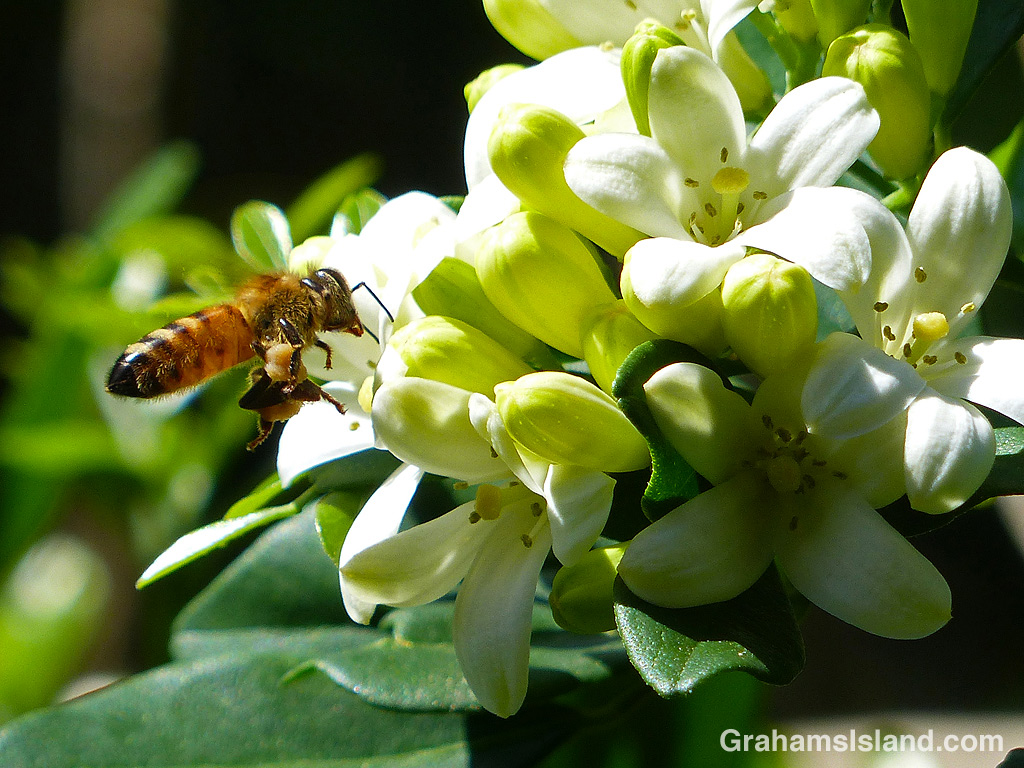
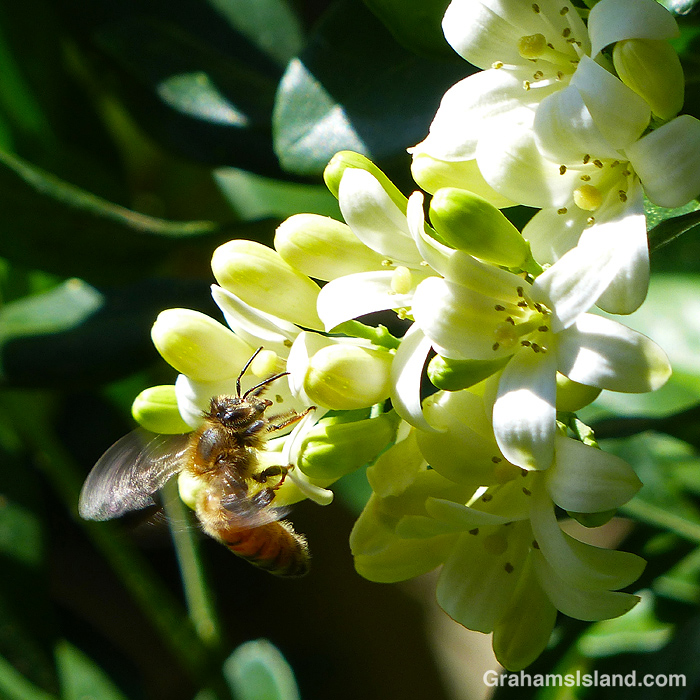
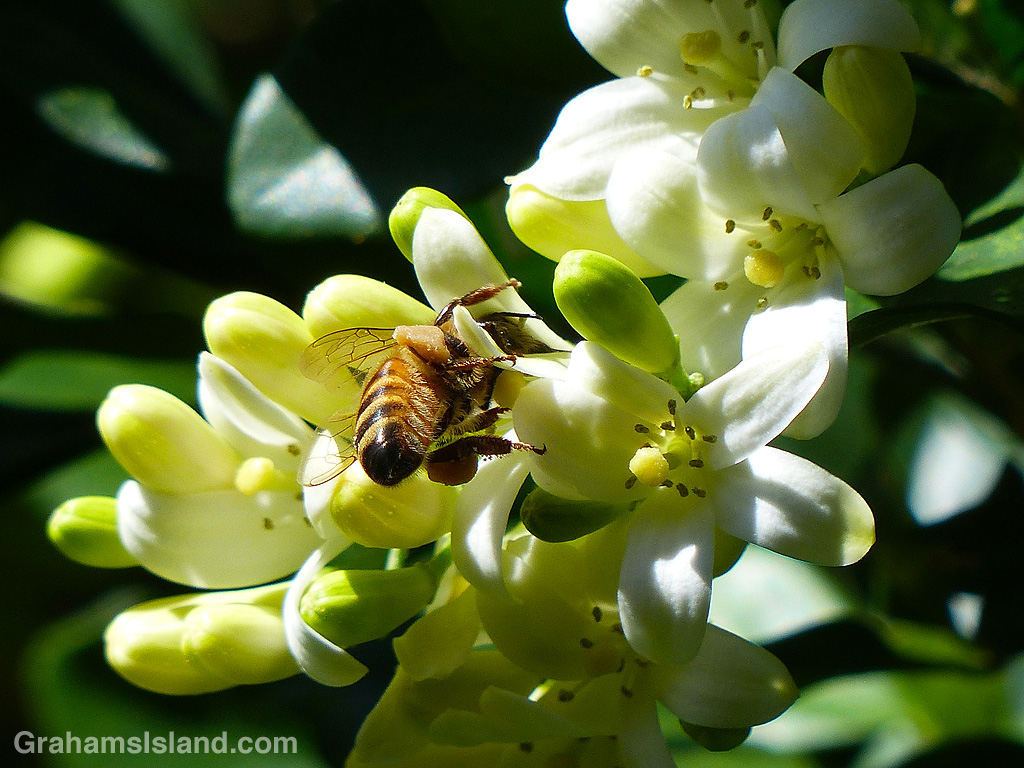
The mock orange next to the house has bloomed again. It does this several times a year, sometimes just parts of it, sometimes all of it. This latest bloom was the whole tree and when that happens the bees come out in force. Step outside, and a low hum fills the air as well as an intense aroma.
I take lots of photos, trying to capture something of interest to me, such as a bee approaching a flower (top), helicoptering in to land (middle), and getting stuck in (bottom). In the bottom photo, I was struck by the flat underside of the bee, not something I’d noticed before.