Long John Mantis

This week’s Friendly Friday challenge theme is ‘Rails.’ See more responses here.

Here’s a praying mantis on a railing. Typically, I line up photos where horizons are horizontal and strong vertical lines are vertical. This photo’s an exception. I think the off-kilter lines complement the off-kilter appearance of the mantis, especially since this mantis had lost an eye and a leg, hence the title of this post.

Goats butting heads

A herd of goats mill about on a trail in South Kona. In any sizable gathering of goats I usually see younger ones butting heads as they tussle with each other. This is practice for when they’re older and the jousts become a more serious contest for position within the group.

Scrawled filefish in the wars

I noticed this scrawled filefish because it was catching the sunlight, as they sometimes do, and the blue scribbles on its side were beautifully illuminated.

The photo on the left is the first sighting I had of the fish, and as it dove I noticed something trailing it. This can just be seen below the tail. It looked like fishing line. So I followed it and got the top photo where I could clearly see that the fish was trying to dislodge a hook and line from its mouth. Not only that, but it had a good-sized slash in its side.

I had visions of trying to grab the line and remove the hook, but the fish kept going down, away from me and out of my reach. It disappeared from view and I was left only with the photos and the rather sad image of the struggling fish.

Unloading a barge

Containers are unloaded from one of the inter-island barges at Kawaihae harbor. It’s not a forklift doing the work, more of a grip-n-raise, though I doubt that’s its official name. No prizes for guessing that the shipping company is Matson, but I like the repetition of their name in the images.

Cattle and turbines

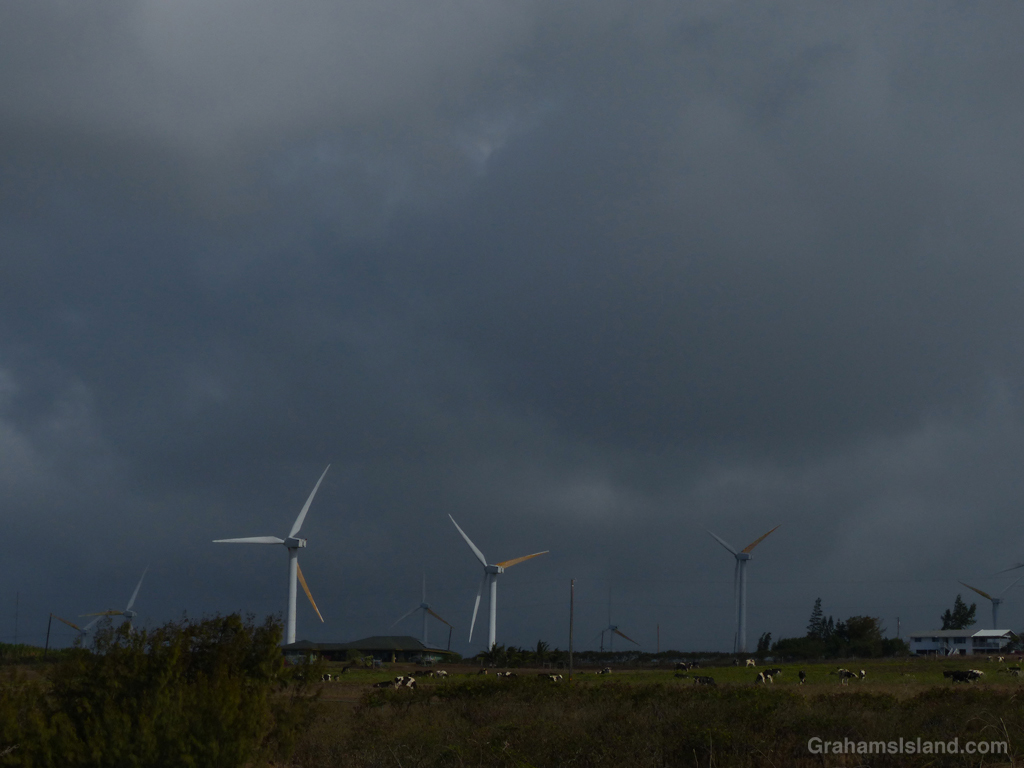
I grew up on a dairy farm so I have a soft spot for cattle (as opposed to some who may have grown up on a dairy farm and have a virulent dislike of cattle).

Sometimes, when I walk by on the dirt road bordering their pasture, the cattle run away. Other times they run towards me. These six lined up and just watched me, which was probably the right response. I’m not that exciting.

Ohia Lehua flower

This week’s Sunday Stills challenge theme is ‘Country or State Flower.’ See more offerings here.

The country flower for the USA is the rose and I don’t have photos of those. The state flower for Hawaii is the hibiscus and, while I have lots of those, they’re all of Chinese hibiscus (Hibiscus rosa-sinensis). The state flower is the native yellow hibiscus (Hibiscus brackenridgei) and I have none of those. The native hibiscus is not often seen in the wild and is currently considered an endangered species, but it is used as an ornamental in domestic gardens.

Having struck out on the two proper responses to this challenge, I’ve chosen to post photos of the official flower of the Big Island, the red ʻōhiʻa lehua (Metrosideros polymorpha). A member of the myrtle family, ʻōhiʻa lehua is endemic to Hawaii. It’s one of the first trees to colonize lava flows. It’s able to survive in such a tough environment because its roots grow down into lava tubes and other voids in the lava and tap into the moisture there.

Recently, ʻōhiʻa trees have been attacked by a fungus which can cause the trees to die within a very short time. This disease, known as Rapid ‘Ohi’a Death, is caused by two new types of Ceratocystis fungus.

Colorful pahoehoe lava

This week’s Friendly Friday challenge theme is ‘Art Unexpected.’ See more responses here.

This was a timely topic since, a couple of days ago, I went for a hike in Hawaii Volcanoes National Park. I headed out on the Puna Coast Trail, one of several longer trails west of Chain of Craters Road, that I haven’t explored before. (I’ll do a post about the trail once I’ve gone through the way-too-many photos I took that day!)

One of the highlights of the trail was the extensive areas of colorful pahoehoe lava. I’ve lived here a while now and I know lava doesn’t just come in basic black. I’ve seen lighter and darker flows; I’ve seen flows with a brown tint; I’ve seen flows with hints of red or green in them. But prior to this hike, I had never seen flows with such a variety of vibrant colors.

Instant Hawaii has a description of different types of lava (here) and they say “All the differences in pahoehoe flows stems completely from the temperature of the lava as well as chemical composition. Since both can change during a flow – it is possible to get all types of pahoehoe flowing from a single flow, over time.” I would also say that, what they call ‘quiet flow’ lava, is an apt description of these areas. When I was walking over them I thought they seemed harder and more metallic than the surrounding black pahoehoe lava, which tends to crunch a bit when walked on.

But the other thing I thought, as I found myself continually stopping, stooping, snapping photos, was that these flows were art, Madame Pele’s art, and that wasn’t something I was expecting when I set out on the hike.

For more information about Hawaii Volcanoes National Park, go to nps.gov/havo/.