
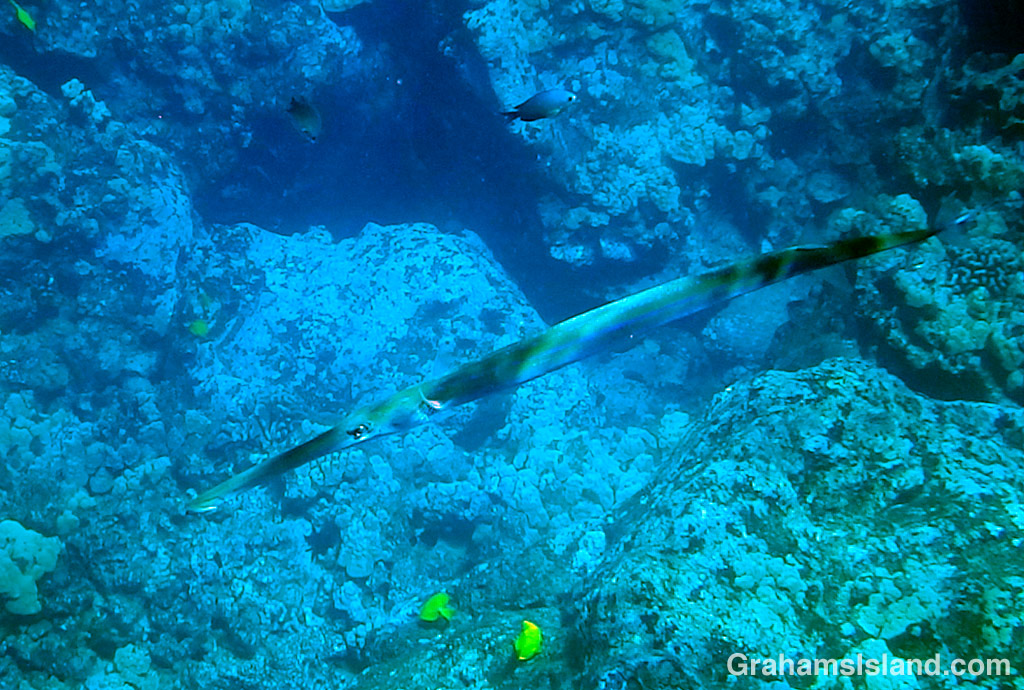
A splash of shadows helps a bluespotted cornetfish blend in with its surroundings.
Green anole approaching

Anoles and geckos are common everywhere around here. Where geckos have a softer, often goofy look to them, the larger anoles seem to me much more ‘reptilian.’ I don’t picture geckos as descendants of dinosaurs, but anoles? Definitely.
This photo is what I mean, both in the anole’s appearance and its pose, echoing a mighty dinosaur clumping through prehistoric forest.
Signs: Kiholo campsite

The campground at Kiholo is located at the end of a gravel road and is only open Friday through Sunday nights. It has eight sites that must be reserved in advance. There are portable toilets, but no other facilities, and no water. So what’s the attraction? Well, let’s see if the photo offers any clues. (Sorry, but the yacht doesn’t come with the reservation.)
For more information about camping at Kiholo, go to camping.ehawaii.gov/camping/all,details,57781.html
For more information about Kiholo Bay, go to bigislandhikes.com/kiholo-bay/
Hawaiian beet webworm moth
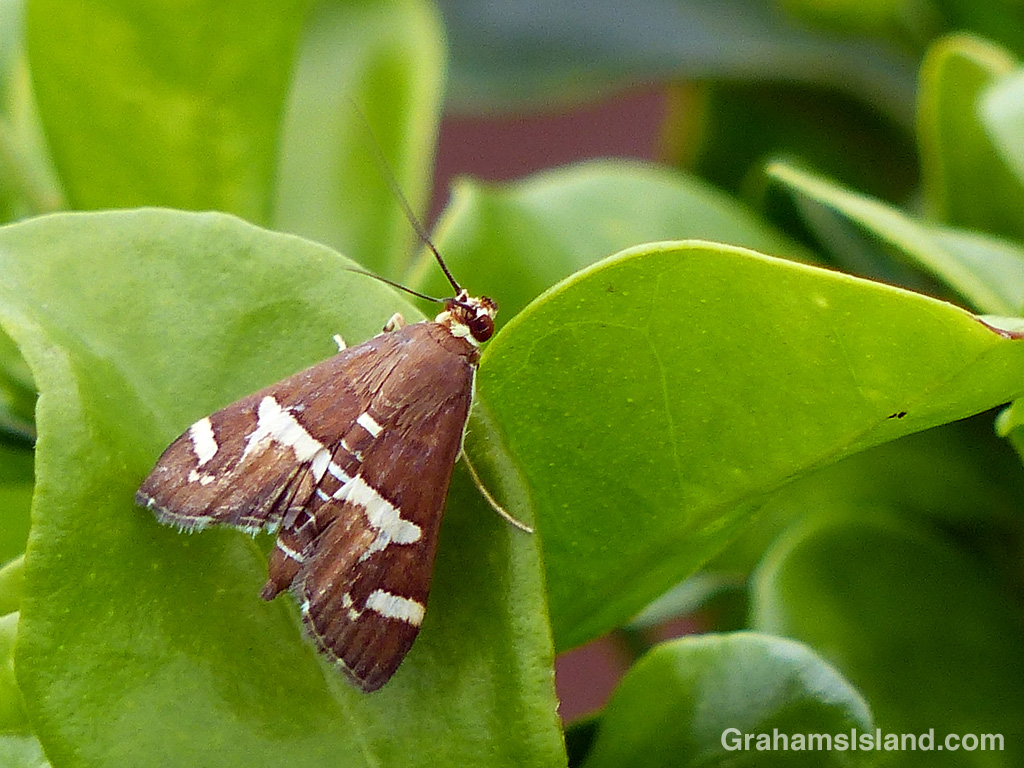
While Hawaiian beet webworm moth (spoladea recurvalis) sounds quite local, this moth is actually widespread in warm regions of the U.S. and other parts of the world. Also widespread is the damage its larvae does to chard, spinach, weeds in genera Chenopodium and Amaranthus, and of course beets.
I’iwi
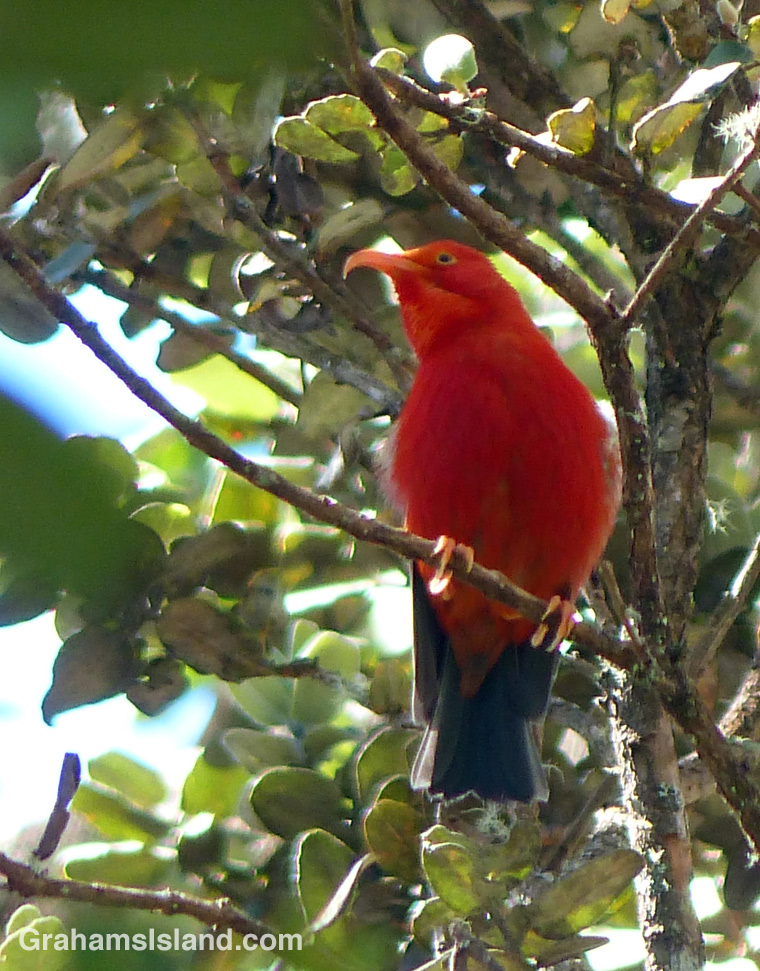
The I’iwi (vestiaria coccinea) is a native Hawaiian honeycreeper, which is still quite common on the Big Island, as well as on Kaua’i and Maui. I saw several while hiking the Pu’u O’o Trail, off of Saddle Road. The fact that they’re bright red and they have a quite distinctive call makes spotting them a bit easier for a non-birder like me.
For more information about the Pu’u O’o Trail, go to bigislandhikes.com/puu-oo-trail/.
Pu’u O’o trail

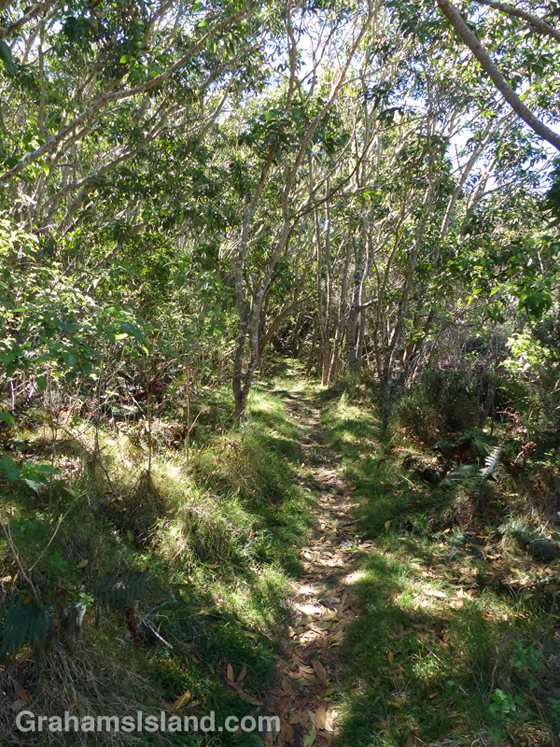

It took me a while to discover the various trails off Saddle Road. That’s because, from the road, they look like they’re mostly lava with some scrubby vegetation, but this is misleading. The kipukas (areas of land where lava has flowed around leaving it relatively untouched) are full of plants and a haven for wildlife including many endemic species. The whole area is an example of the cycle of destruction and regeneration that shapes this island and, indeed, the Earth.
The Pu’u O’o Trail, off of Saddle Road, has nothing to do with Kilauea’s Pu’u O’o vent. It refers to the Pu’u O’o Ranch on Mauna Loa. The trail was used for moving cattle from one grazing area to another.
The trail alternates between crossing lava flows and passing through kipukas. Depending on the age of the flow, it might have a good deal of greenery on it, but more recent flows are stark lava fields. While the open lava flows offer great views of Mauna Loa and Mauna Kea (assuming it’s a clear day), the kipukas offer shade and are alive with bird calls, most of which I don’t recognize.
After about 4 miles the trail intersects with the Powerline trail and a loop can be made back to the start, or simply retrace your steps. Bear in mind that if the clouds roll in, which they do on a regular basis, the trail is a good deal harder to follow.
For more information about this, and other hikes on the Big Island, go to bigislandhikes.com.
Scrawled filefish

When the light catches a scrawled filefish right, its blue scribbles shine in the water.
The view from from Pu’u Ahumoa

Maui and Kohala Mountain as seen from Pu’u Ahumoa on the lower slopes of Mauna Kea. The structure on the left is what remains of an old beacon for low-flying aircraft.

