
Gone fishing

A man fishes on the Big Island coast.
I’m the the world’s worst fisherman with total catches counted on one hand and the price for those fish, in terms of lost tackle, etc., coming in around $100 a pound. However, a lot of people on the Big Island fish, especially when the moon is right, whenever that is.

This man was fishing on a calm, warm early-evening. It’s an idyllic-looking scene, but I wasn’t tempted to join him.

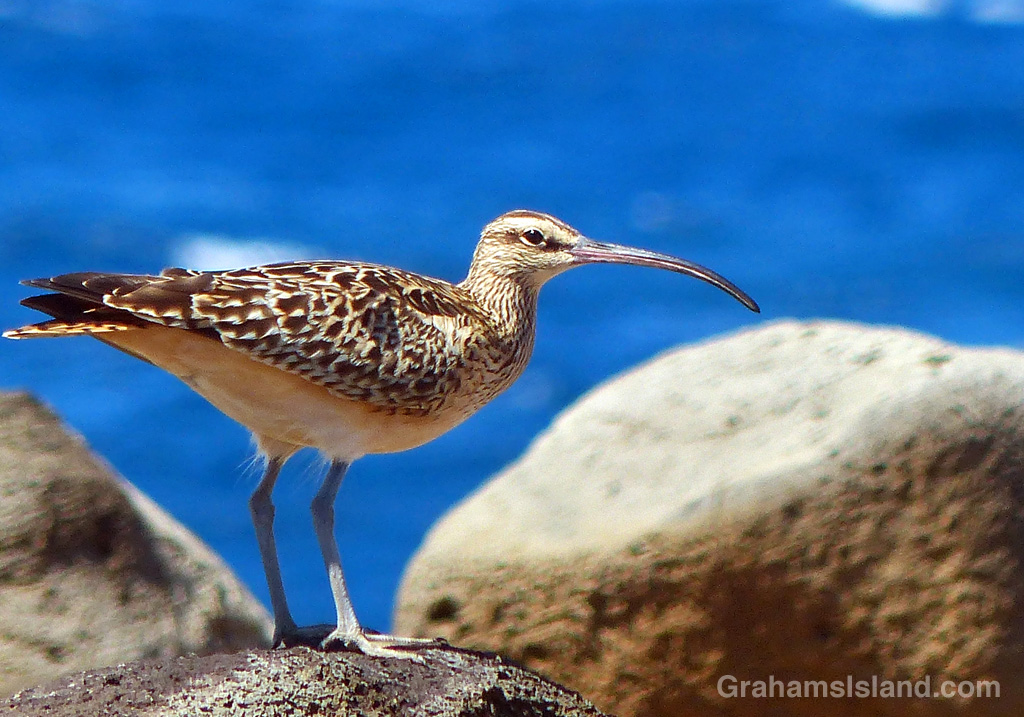
Bristle-thighed curlew

A Bristled-thighed curlew on the Big Island coast
Bristle-thighed curlew (Numenius tahitiensis) isn’t the most flattering bird name I’ve ever heard. In Hawaii it’s called Kioea, which sounds nicer. In May, these curlews migrate to Alaska (a jaunt of 2480 miles) to breed. They return to Hawaii (and other Pacific islands) in July and August. Since this particular bird was still around at the end of May, it may not be making the trip north this year.

For more information about bristle-thighed curlews, go to dlnr.hawaii.gov/wildlife/files/2013/09/Fact-Sheet-Bristle-thighed_Curlew.pdf.

Mars simulation mission site

THe site of the Mars simulation mission site on the Big Island of Hawaii

This little dome is where simulated Mars missions take place. Currently there’s a crew of six living in the dome on a 365-day mission, the longest such experiment to date. The previous crew lived in the dome for eight months.

The dome, at around 8,000 foot on the north side of Mauna Loa, is situated a little way off the Mauna Loa Observatory road. In the photo below it can be seen about ¾ of the way up in the center.

For an interesting article on the Mars simulation mission and its context in history see newyorker.com/magazine/2015/04/20/moving-to-mars. For information about the current, and former, missions, see hi-seas.org.

The road to the Mauna Loa Observatory

Ash grey lady beetle

An ash grey lady beetle in the Big Island of Hawaii.

I’ve always thought of lady beetles as little red creatures with black dots on their backs. So I was enlightened to see this one, also known as the ashy grey lady beetle (Olla v-nigrum). Apparently, this species can also have a completely different coloring. I learn something every day!

For more information about ash grey lady beetles, go to bugguide.net/node/view/8874.