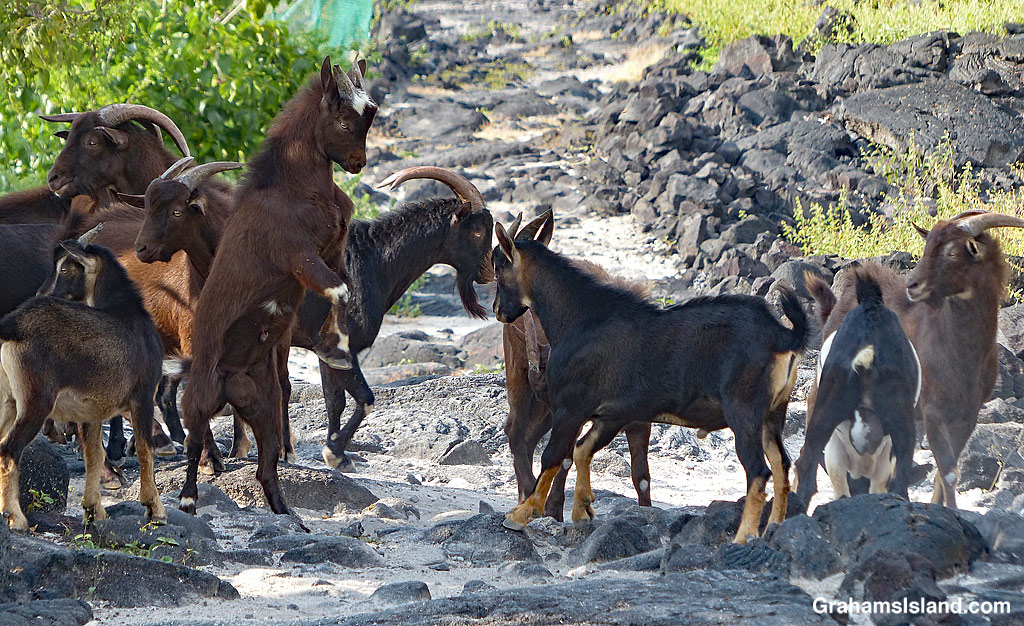
A herd of goats mill about on a trail in South Kona. In any sizable gathering of goats I usually see younger ones butting heads as they tussle with each other. This is practice for when they’re older and the jousts become a more serious contest for position within the group.
This week’s Friendly Friday challenge theme is ‘Art Unexpected.’ See more responses here.
This was a timely topic since, a couple of days ago, I went for a hike in Hawaii Volcanoes National Park. I headed out on the Puna Coast Trail, one of several longer trails west of Chain of Craters Road, that I haven’t explored before. (I’ll do a post about the trail once I’ve gone through the way-too-many photos I took that day!)
One of the highlights of the trail was the extensive areas of colorful pahoehoe lava. I’ve lived here a while now and I know lava doesn’t just come in basic black. I’ve seen lighter and darker flows; I’ve seen flows with a brown tint; I’ve seen flows with hints of red or green in them. But prior to this hike, I had never seen flows with such a variety of vibrant colors.
Instant Hawaii has a description of different types of lava (here) and they say “All the differences in pahoehoe flows stems completely from the temperature of the lava as well as chemical composition. Since both can change during a flow – it is possible to get all types of pahoehoe flowing from a single flow, over time.” I would also say that, what they call ‘quiet flow’ lava, is an apt description of these areas. When I was walking over them I thought they seemed harder and more metallic than the surrounding black pahoehoe lava, which tends to crunch a bit when walked on.
But the other thing I thought, as I found myself continually stopping, stooping, snapping photos, was that these flows were art, Madame Pele’s art, and that wasn’t something I was expecting when I set out on the hike.
For more information about Hawaii Volcanoes National Park, go to nps.gov/havo/.
I was snorkeling recently, when I saw something distinctive on some rocks. At first I thought it was an octopus, but it didn’t look right. A lobster perhaps, but again something was amiss. Then I realized that the fin shapes I was seeing those of a scorpionfish. I focussed in with my camera and the fish scooted forward and disappeared into a crack and beneath a boulder before I could get a shot.
When I got home, I looked at my fish book and figured out that I’d probably seen a titan scorpionfish. The only scorpionfish I’ve seen previously have been devil scorpionfish, which are easily identified by their distinctive and colorful pectoral fins. The titan scorpionfish is more colorful overall but without such a distinctive signature. However, it’s the largest scorpionfish in Hawaii and the one I saw was big.
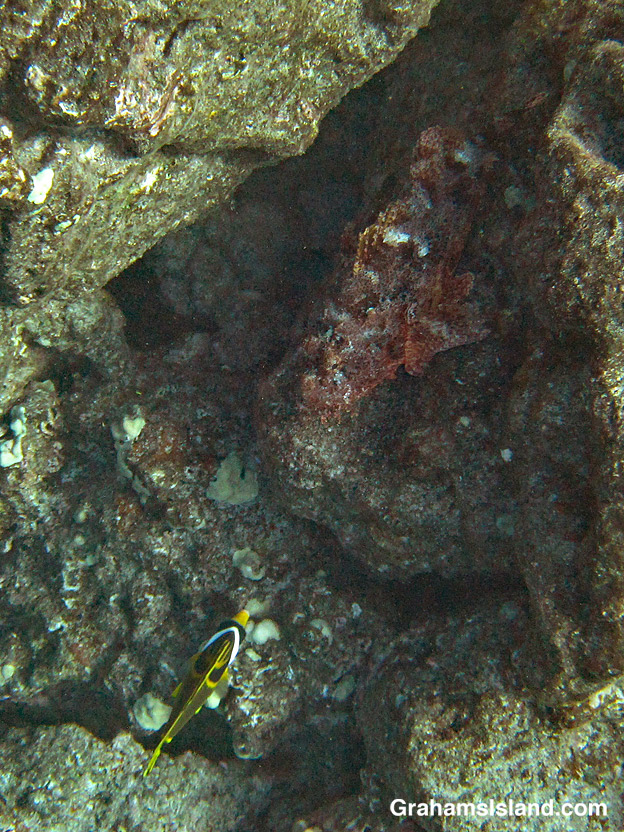
Next day, I was snorkeling in the same general area and I saw a reddish, mottled fish moving. ‘That looks familiar,’ I thought. This time the fish plunked down onto a rocky area and stayed put so I was able to get a good look at it and take some photos, of which this was the best. It was indeed a titan scorpionfish, probably the same one I’d seen the day before. I even saw the loose flaps on its lower jaw which are a prime identifying mark.
Even though I knew where it was, there were times when I looked and thought it had moved on before I could pick it out again, so well does it blend in with its surroundings.
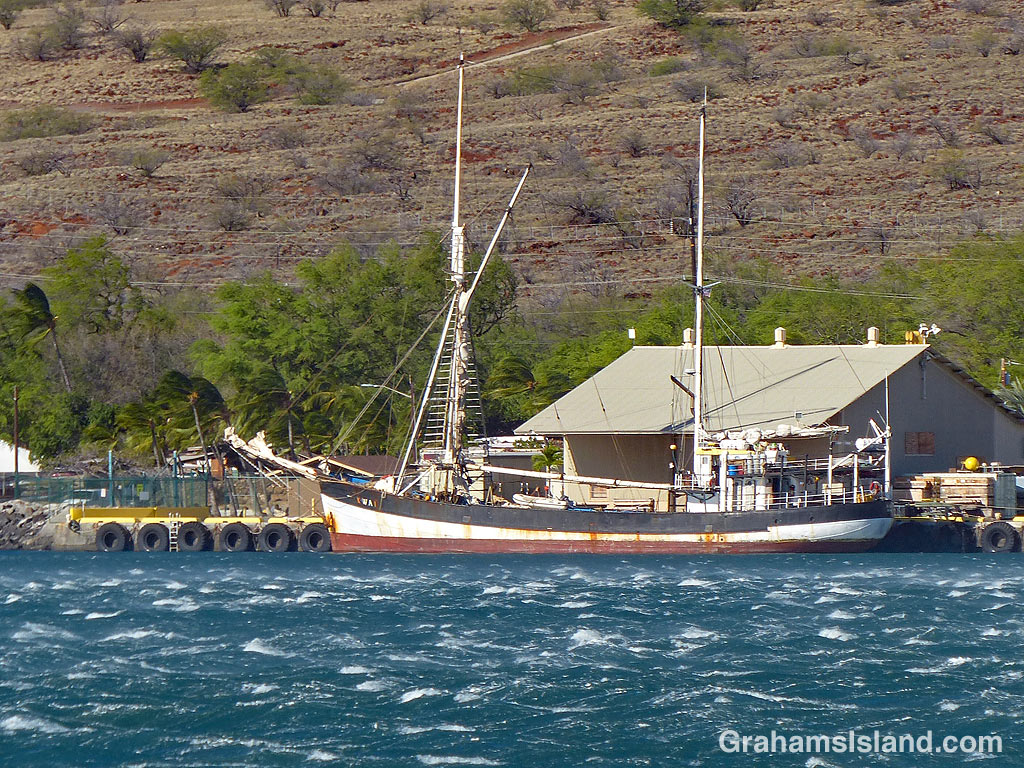
I saw this interesting-looking vessel tied up alongside the wharf at Kawaihae harbor for a week or more in the first half of January. When I searched for information about the boat, I learned that it’s the Sailing Vessel Kwai, a cargo vessel operating between Hawaii and Kiribati and the Cook Islands in the Pacific.
I’m not sure what it was doing in Kawaihae. The boat had been in Honolulu earlier in the month, on completion of its 51st voyage. Their 52nd voyage left Honolulu on January 24. Perhaps they were picking up cargo or doing maintenance in between these dates.
According to the first blog from Voyage 52 (here), the boat returned to the west side of the Big Island to search for a ghost net. A ghost net is a large clump of fishing nets that can be very destructive to ocean life and that will eventually wash up on shore somewhere being equally problematic when it does so. This net was estimated to be 50 feet long and deep by 70 feet wide.
A tracker had been attached to the ghost net so that it could be retrieved by a larger boat but, according to the blog post, when SV Kwai reached the area, only the tracker was found and retrieved. I haven’t heard or seen anything else about the net, so it is either still floating in the ocean or has washed up somewhere.
For more information about Sailing Vessel Kwai, go to svkwai.com. For more information about the ghost net, go here.
This week’s Friendly Friday challenge theme is ‘Simple Joys.’ See more responses here.
This is one of the beaches at Hualalai Resort on the Kona coast. While the resort is private and access is restricted, Hawaii law states stipulates that the public has a right of access along the beaches and shorelines in the state situated below the “upper reaches of the wash of the waves.”
Any developments along the shore are required to provide designated public access points. The catch here is that sometimes parking at these places is limited and if it’s full, getting to the beach involves a much longer walk.
At Hualalai, there’s a good-sized parking lot, an easy walk to the coast, and a paved trail along the waterfront. Some beaches can be quite crowded but, in my experience, it doesn’t take much of a walk to find a stretch of sand that is either sparsely populated or entirely deserted. And in my book, walking along the coast, past palm trees and sandy beaches, is definitely a simple joy.
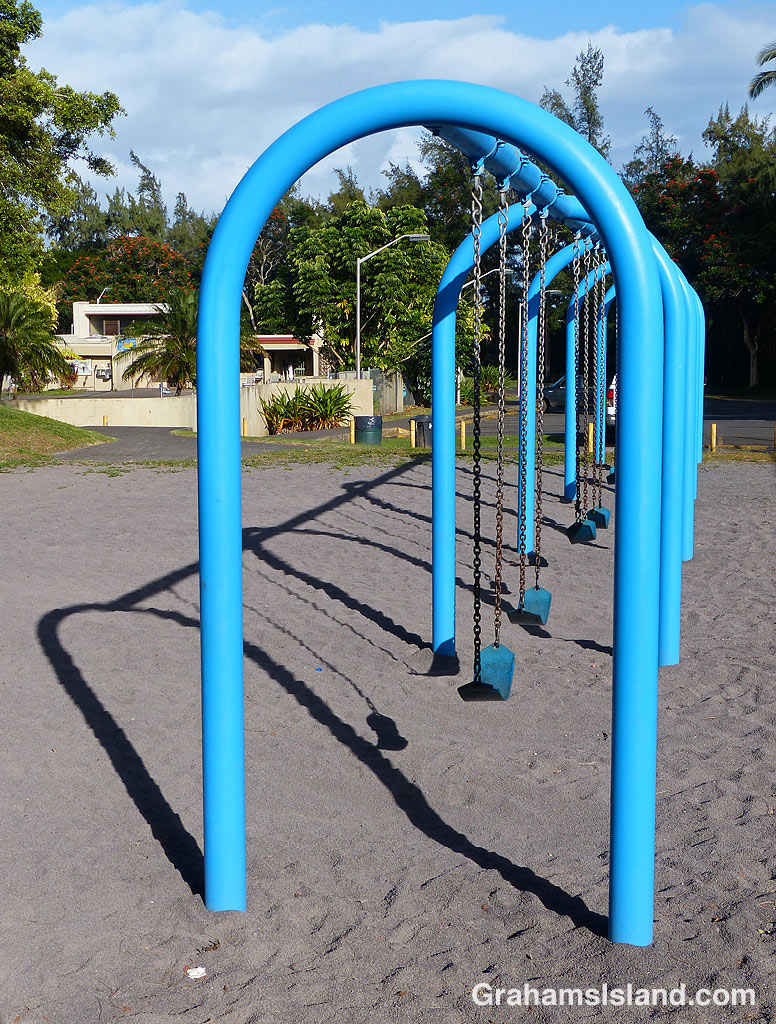
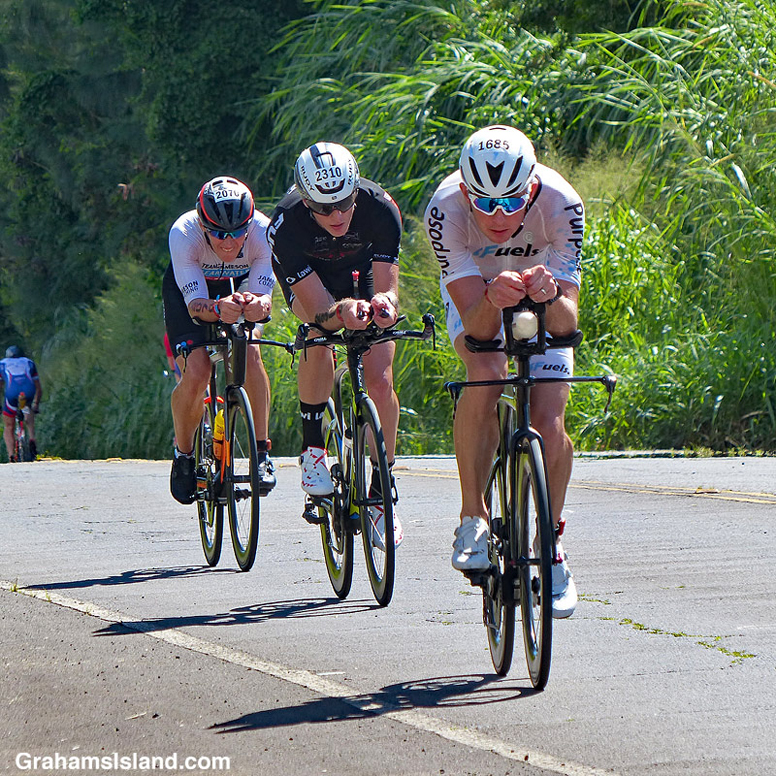
This week’s Sunday Stills challenge theme is ‘Shadows.’ See more offerings here.
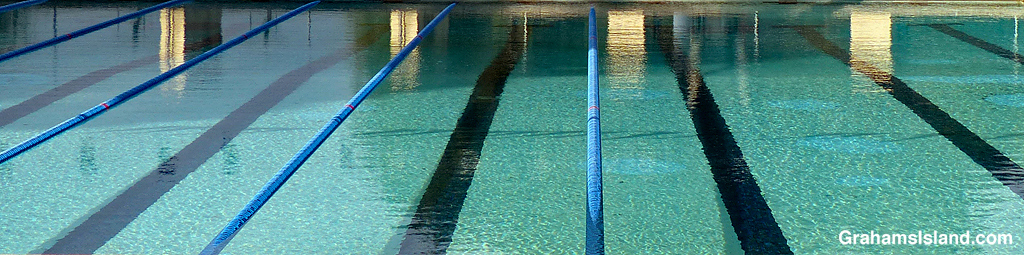
The top photo is a row of colorful playground swings at Kamehameha Park in Kapaau. Below are three cyclists in line, heading out of Hawi during an Ironman World Championship race.
Also posted as a second offering for this week’s Friendly Friday challenge theme of ‘All in a Row.’ (See more responses here.) My first post for this theme is here.
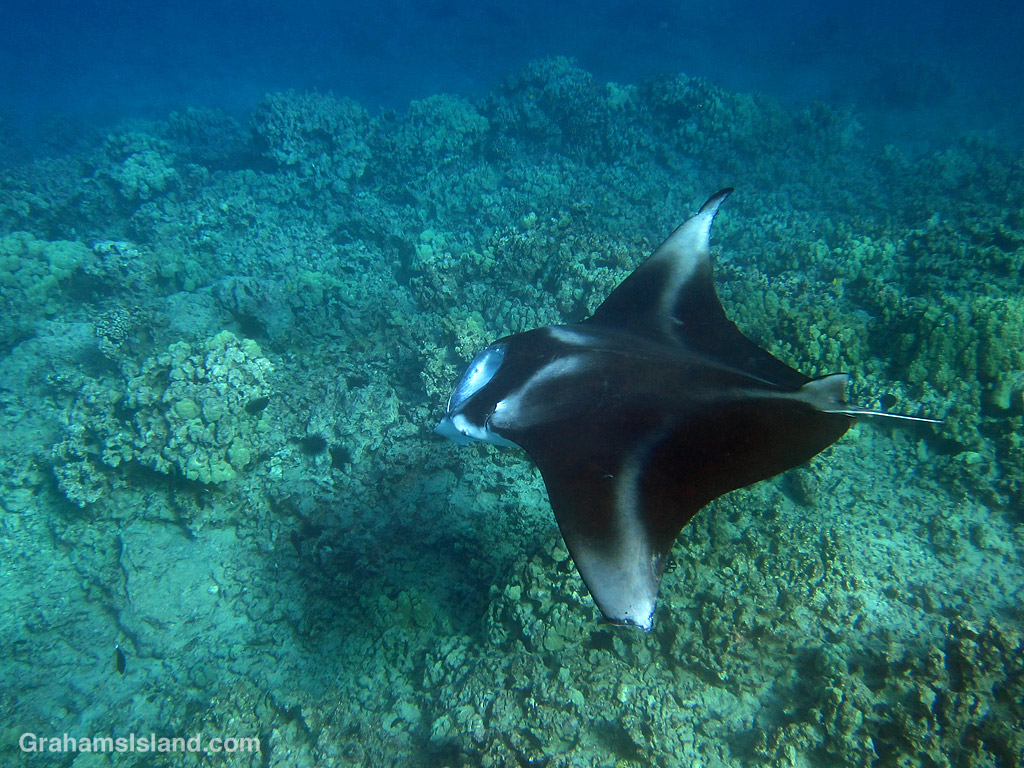
First sight of the manta ray coming toward me.Sliding by to one side, showing an eye and its cephalic fins, while it catches the light.Dipping lower in the water, its upper markings clearly visible.
Heading away over the coral.
My usual posts feature a single photo or perhaps two or three, but today I wanted to give an idea of a recent encounter I had in the water with this manta ray. The photos are a sequence, top to bottom, from the time I first saw it, to it fading from sight into deeper water, about a 10 minute period. The ray swam quite slowly during that time, allowing me to keep up with it.
There are two kinds of manta rays. M. birostris, also known at the ocean manta, is the larger of the two species with a wingspan of 20 feet or more. The manta in these photos is M. alfredi, or reef manta, with a wingspan of 18 feet or less. This one was probably around 12 feet across.
Starting to turn.Crossing below me.Coming back up over some coral.Out of the way, little fish.Heading my way, mouth open, but mantas aren’t menacing.Time to say goodbye.








 Graham's Island