Category Archives: Fish

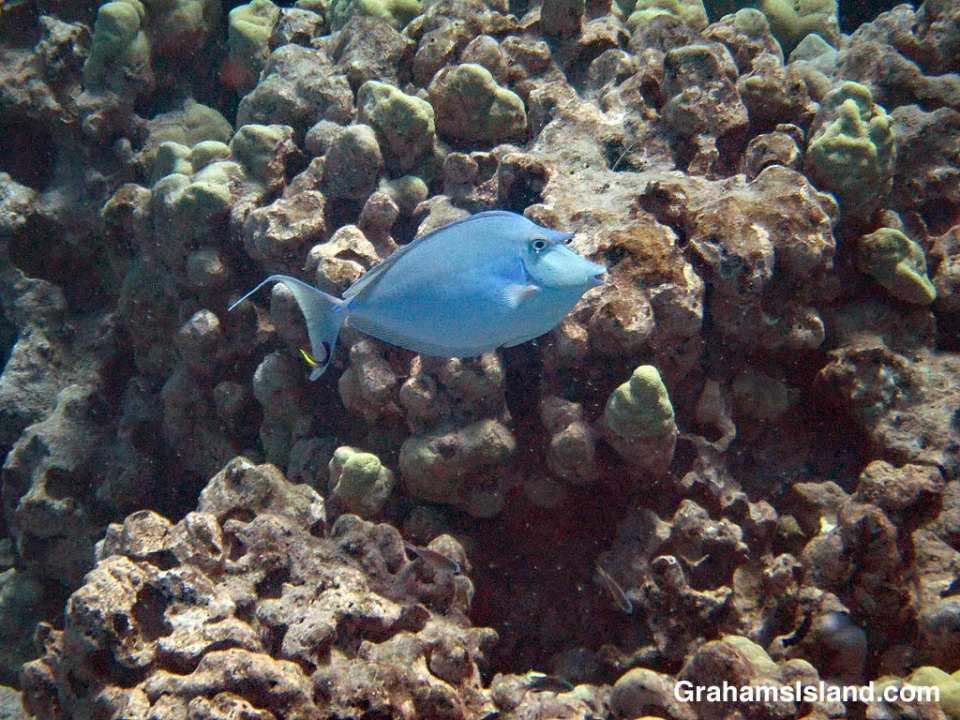
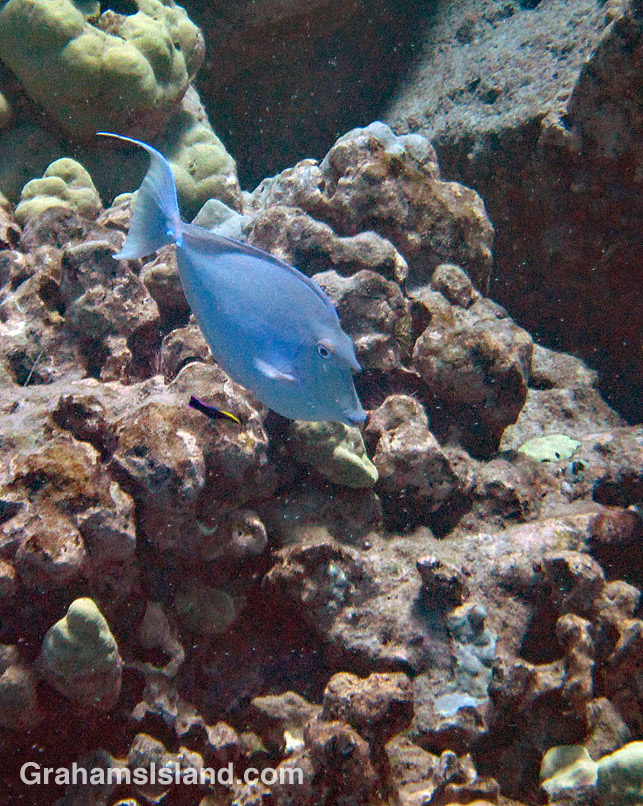
Bluespine unicornfish being cleaned

Bluespine Unicornfish and cleaner wrasse

Bluespine Unicornfish being cleanedThe bluespine unicornfish must be a contender for any ‘Grumpiest Looking Fish’ awards. This one though was enjoying the attention of a small yellow and blue Hawaiian cleaner wrasse.

Cleaner wrasses establish territories where other fish come to be cleaned, removing mucus, dead tissue, and parasites from their customers. This service is obviously valued by other fish. They will line up to be cleaned, waiting their turn. Often times, their expressions are quite blissful during the process. But most significant, cleaner wrasse perform their services on bigger fish, including predators, without becoming prey.
How long is a zebra moray eel?

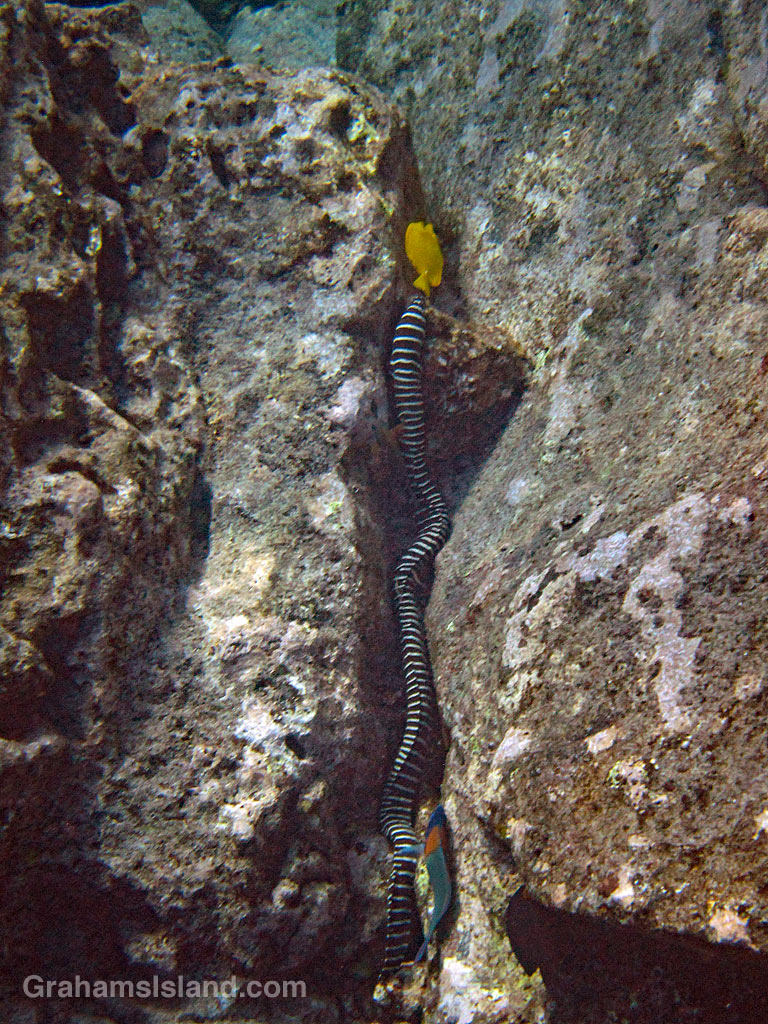
Zebra Moray Eel

Zebra moray eels are one of the easiest eels to identify, their circular stripes differentiating them from any other eel. They feed mostly on crabs, which they crush with their blunt teeth.

These eels can grow to five feet in length, but are usually smaller. This one though is probably about as large as they get. The yellow tang near its head could be as long as six or seven inches, while the saddle wrasse at its tail tops out at ten inches. That would make this eel somewhere between four and five feet long. It’s certainly the biggest zebra moray that I’ve seen.

Gang activity

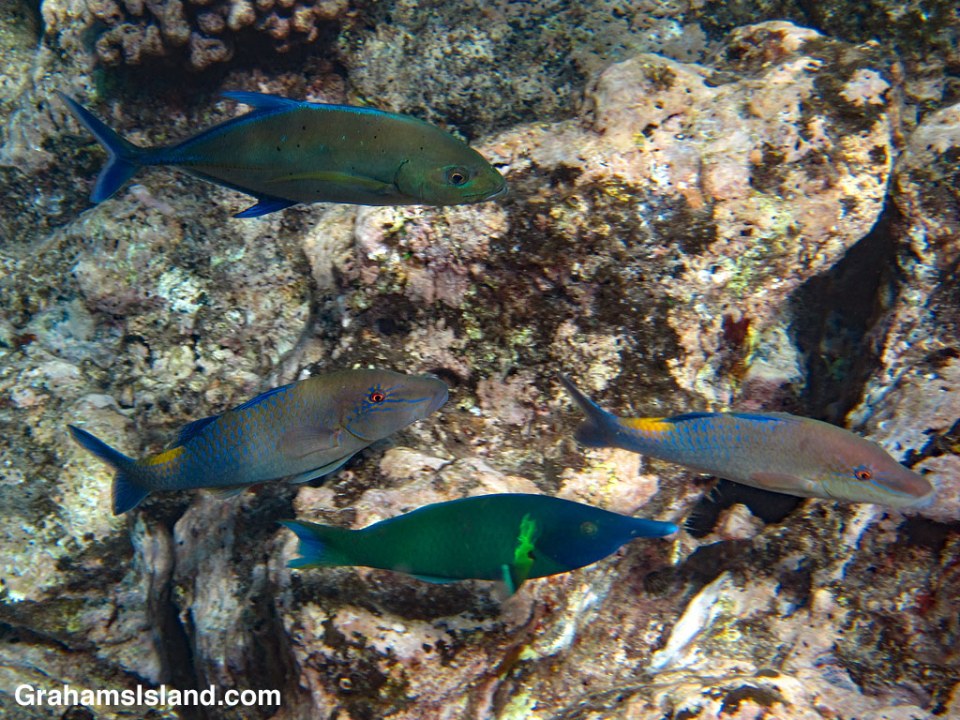
Bird Wrasse, Bluefin Trevally and Blue goatfish

I happened upon this little gang of fish while I was swimming. At the top is a bluefin trevally, in the center a pair of blue goatfish, and at the bottom a male bird wrasse. Trevallies and goatfish regularly hunt together, often in the company of an eel or octopus. They try to flush out or ambush small fish as their prey. The bird wrasse eats mostly marine invertebrates but will also take small fish .

I often see fish like these hunting, but have yet to see any of them snag a meal, though they clearly are reasonably successful hunters.

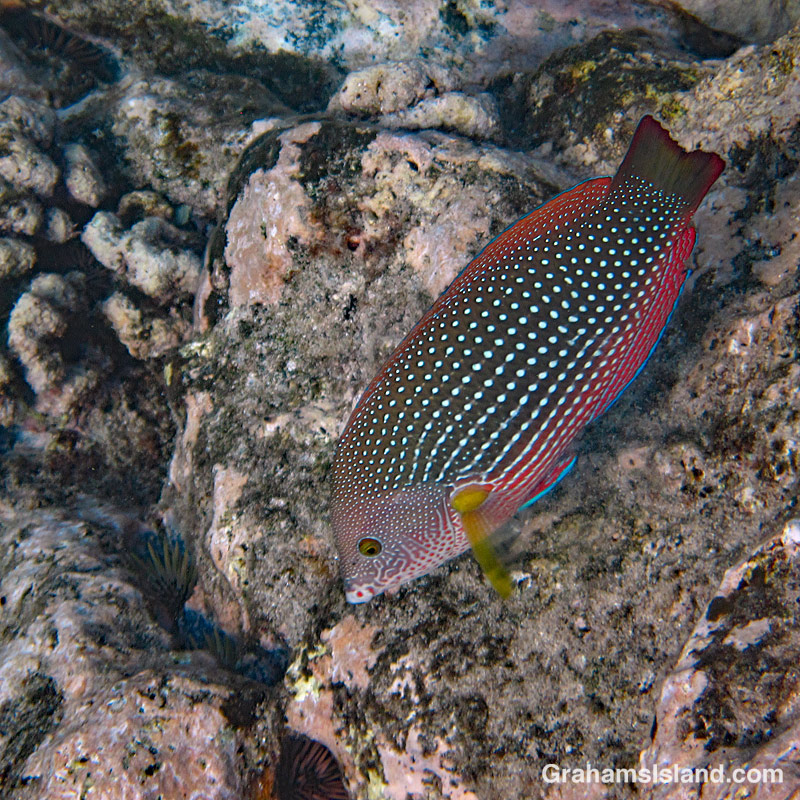
Pearl wrasse

Pearl Wrasse grazing

Pearl WrasseThe pearl wrasse, which is endemic to Hawaii, gets its name from the markings of the female, which look like strings of pearls. The male pearl wrasse is predominantly green with fine blue lines.
I hadn’t seen a pearl wrasse before, or at least not identified one, until this female showed up in a fairly shallow area. She was there for several days before apparently moving on and I haven’t seen her again since.

A striking fish at any time, this one was particularly brilliant when the sun caught her colors.

Whitemouth moray eel

Whitemouth Moray Eel

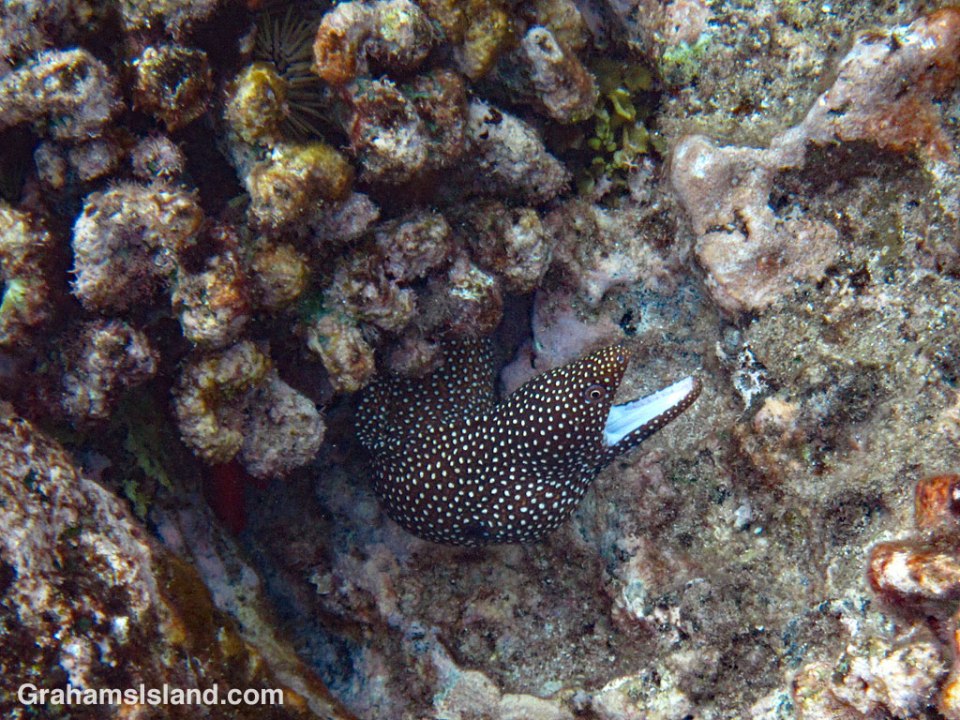
A smaller whitemouth moray eel displays the feature that gives them the name. An eel will typically open and close its mouth in this way, but it’s not an act of aggression. It’s how they breathe, the motion pumping water over the gills.

This pose, with much or most of the eel hidden in a crevasse or coral head, is also typical. It’s how I make most of my sightings. But every so often I’ll see an eel in open water or passing from one hiding spot to the next. It’s usually a fleeting sight as eels can zip along and disappear into the tiniest of cracks.

Dwarf moray eel

Dwarf Moray eel

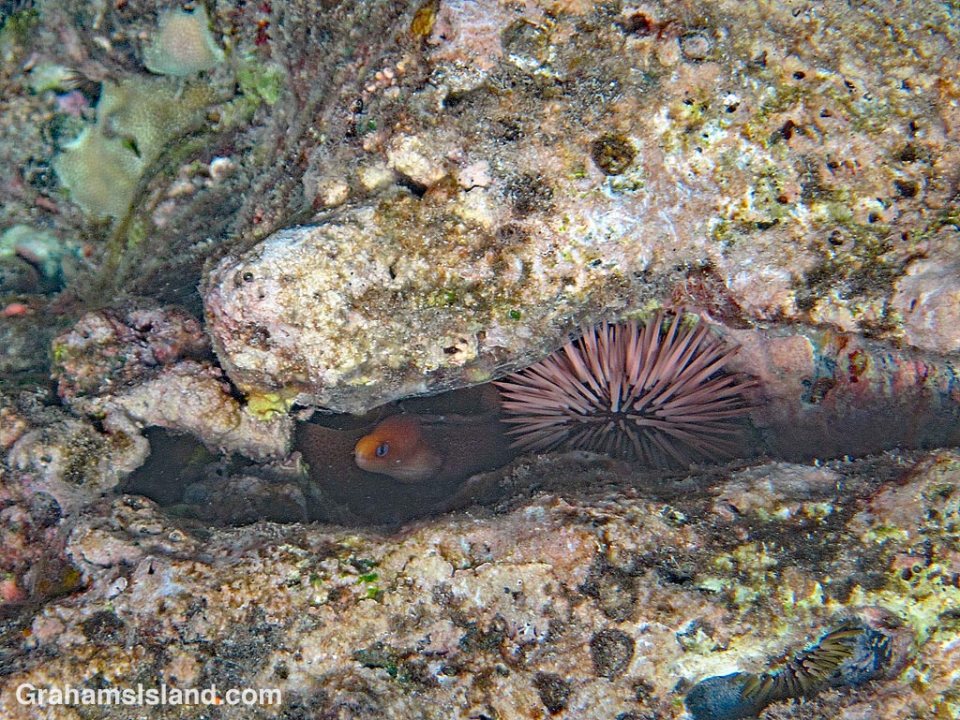
I was watching some fish in fairly shallow water when, below them, I noticed this eel tucked away in a groove in the rock. It looked different to anything I’d seen before, but often the young of a species can look very different to the adults. However, a browse through my fish book showed it’s a dwarf moray eel, which doesn’t grow to more than 12 inches long. The clinching feature, which can be seen in this photo, is the dark bar through its eye.

Dwarf morays are fairly common in Hawaii, but because of their size and their reclusive nature they’re not often seen. This was as far as this eel emerged from of its hiding place so I was happy to get this shot.

I think the pinkish pincushion next to it is a rock-boring urchin, which gets its name from the fact that it can bore into solid rock by scraping with its spines and teeth. A second of these urchins can be seen in the little recess below the main one.

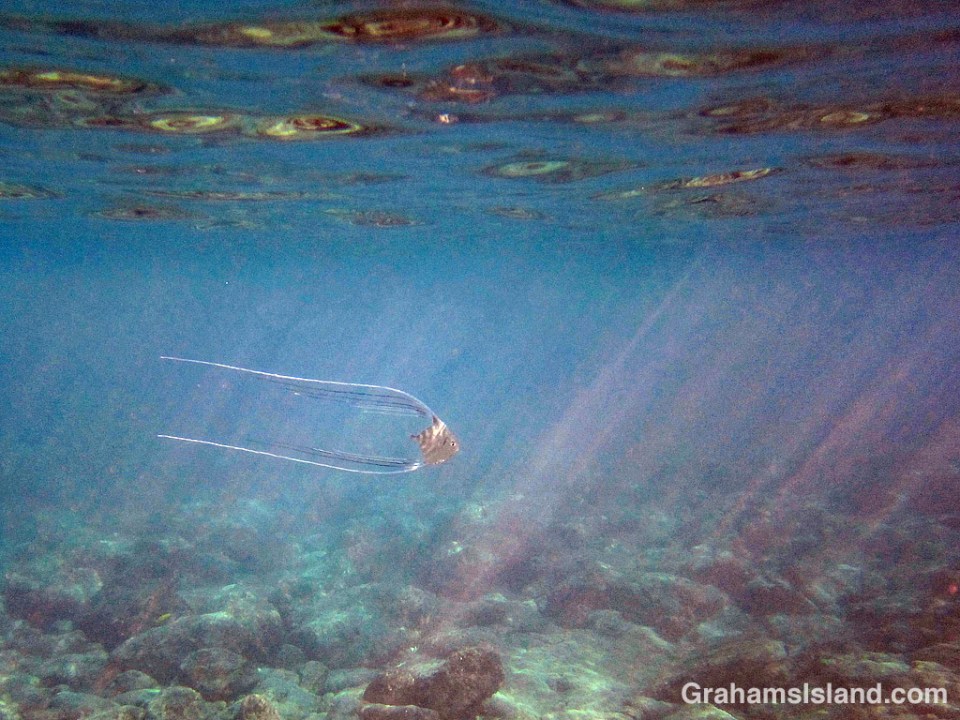
Threadfin jack juvenile

Threadfin Jack juvenile

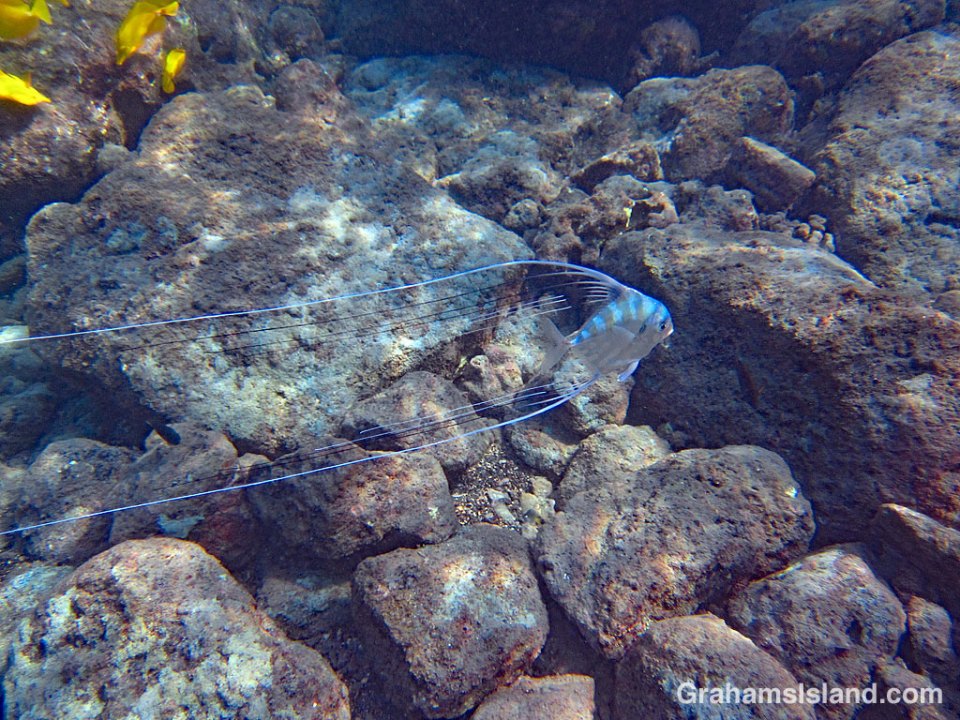
This is the time of year when juvenile threadfin jacks can sometimes be seen in inland waters. I’ve been on the lookout for them since May, but haven’t seen any. This doesn’t mean they’re not there; so small and shimmery, they’re easy to miss in murky shallow water.

Last week, my vigilance was rewarded. While the water wasn’t too clear, the swell was low so I headed among the rocks near the shore and saw my first threadfin of the year. I took the bottom photo which, while not great, does show the shallow area it tends to inhabit and the sun filtering through that water.

Next day, I went back to the same spot but didn’t see the fish. So I turned and headed out toward deeper water and almost bumped into it coming the other way. I quickly snapped the top photo as it went by, not sure if it was even in the frame, before it disappeared into the shallows.

In the past, these juveniles have stuck around for several weeks, so I’ll hopefully get to see this one a few more times. Ultimately, it will head out to deep water and grow up to be a stocky four-footer living up to 200 feet down.

Threadfin Jack Juvenile in sunlight

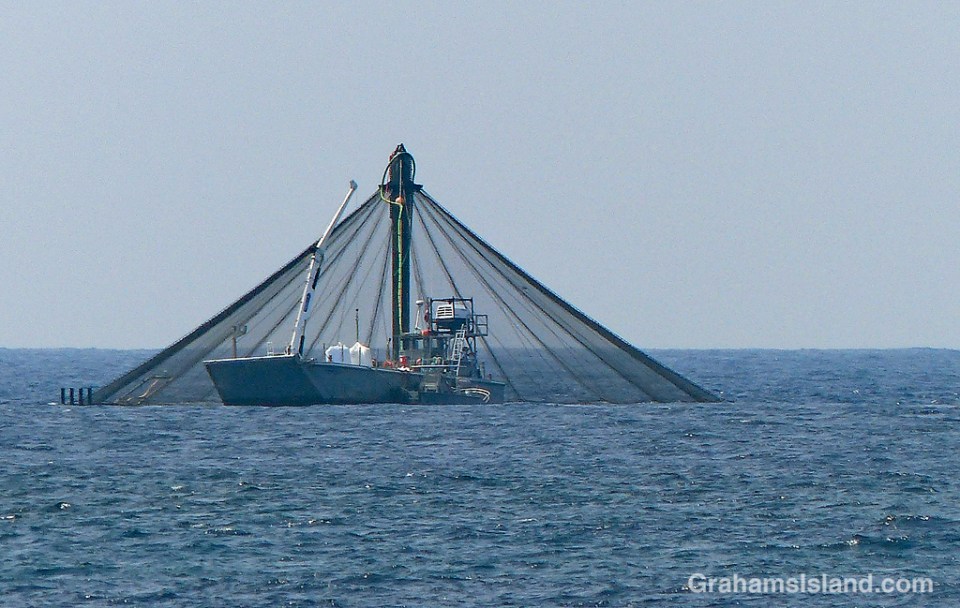
Fish farm

Fish farm net pen and boat

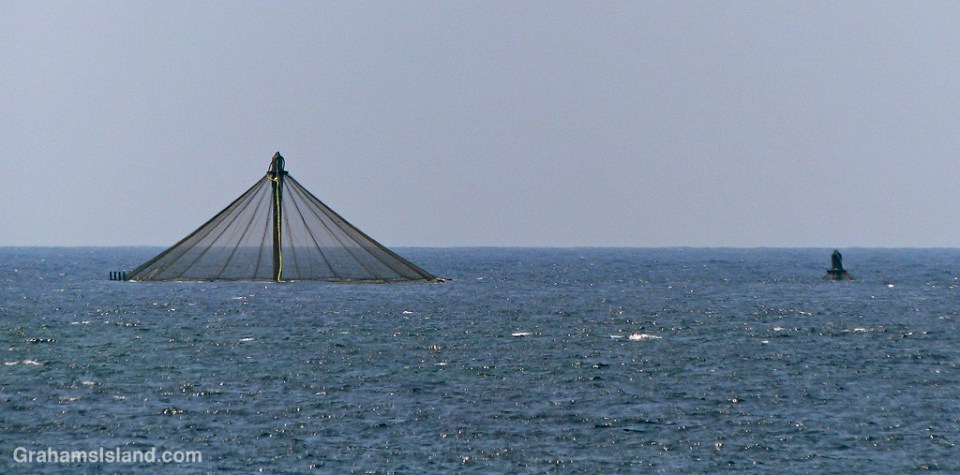
Not far off the Kona coast, near the airport, one or more of these nets can often be seen. They’re the submersible net pens of a fish farm run by Blue Ocean Mariculture. The farm raises Almaco jack which it markets under the name Hawaiian Kanpachi.

In the wild, the fish is prone to ciguatera, a toxin that can cause diarrhea, vomiting, numbness, and other unpleasant symptoms. This is the reason almaco jacks aren’t fished commercially. But the farmed fish are free of this problem. I have mixed feelings about farmed fish, but this farm seems to be well regarded and is approved by Monterey Bay Aquarium’s Seafood Watch.

Part of my ambivalence may be down to the fact that, last year, one of the few resident monk seals living around the island became trapped in a pen and drowned. I’ve since heard that when work is being done on a pen, it should be raised so part is above the surface. That way, if something swims into a pen and can’t get out again, it can at least surface inside the pens to breathe. Whether that happened in this case, I can’t say. The official word is that mariculture projects in Hawaii are under review by the Army Corps of Engineers and NOAA.

Fish farm net pens