Category Archives: Photo Challenges

Abstracts: State Capitol in Honolulu

This week’s Friendly Friday challenge theme is ‘Design.’ (See more responses here.) For this, I’m posting photos of the Hawaii State Capitol building in Honolulu. Opened in 1969, it’s a relatively recent structure. Some of the design features of the building are striking because they represent elements of the state.

In the middle photo, the reflecting pool, surrounding the building, represents the Pacific Ocean. The columns resemble royal palm trees, and the conical structure, the base of one of the legislative chambers, is the shape of the volcanoes that formed the island chain.

The bottom photo shows how the building is open to the elements, and reflects life in Hawaii where many activities happen outside. On the right is one of four kukui nut trees, the state tree, which represent the four main counties.

The top photo is a view of a segment of the open roof and the walkway that encircles the upper level of the building. I like the strong lines and colors of this view.

Halema’uma’u Crater

This week’s Sunday Stills challenge theme is ‘Danger.’ (See more offerings here.) It seemed a suitable opportunity to post some photos reviewing on Kilauea Volcano’s last eruption, which began in May of last year.

The bottom photo, taken from the Jaggar Museum overlook, shows the scene on the morning of April 25, 2018. Lava in the active vent in Halema’uma’u Crater, at Kilauea’s summit, was just below the crater floor and had been overflowing into the crater in previous days. The overflow is the large dark area to the right of the glowing lava.

By early May, the lava level in the vent had dropped around 1,000 feet. This drop occurred at the same time that lava disappeared from Pu’u O’o vent. Not long afterwards, cracks opened in the ground at Leilani Estates, a housing subdivision in the southeastern part of the island. By the end of May, 24 fissures had opened in the area. The most prolific lava flow emanated from Fissure 8, which flowed to the ocean and created more than 800 acres of new land. However, more than 700 homes were destroyed by this eruption.

Meanwhile, back at the summit, the absence of lava in the vent in Halema’uma’u Crater resulted in a series of collapses of the crater floor. Each collapse triggered earthquakes and shot clouds of ash and toxic gas thousands of feet into the air.

The top photo shows Halema’uma’u Crater as it looks today. The crater is twice the size it was the year before and the floor, which was mostly flat, is now a huge cascading pit. In the upper left of the photo, the Jaggar Museum, where I stood to take the bottom photo, can just be seen. It was heavily damaged by the earthquakes, as were the parking lot and access road. It’s also much closer to the crater edge than it was. (Technically the crater edge is closer to it, since the museum hasn’t moved!)

The museum, along with the rest of the park, closed in May 2018, because of the eruption. While much of the rest of the park reopened in September, Jaggar Museum did not. There’s a good possibility it never will and that its fate will be the same as the portion of Crater Rim Drive in the middle photo. A significant length of that road, which used to encircle the whole summit caldera, was destroyed, including the section in the photo which slid, intact, into the crater.

Things have settled down since September 2018 and there has been no volcanic activity anywhere on the island since then. But Kilauea remains an active volcano and will undoubtedly erupt again. It’s just that no one knows exactly when or where that will happen.

Signs: Christa’s swing

I don’t know who Christa is or was, but there were a couple of things that struck me about this image.

The sign and the swing’s rope and seat were in excellent condition in stark contrast to the tree, which was dying and deliberately so. The channel around the trunk, below the sign, is intended to kill the tree, probably a silk oak, which can take over and crowd out native trees.

And then there’s the location, not far from the old quarry near the foot of Pu’u Wa’a Wa’a. It’s more than a mile down the hill to the nearest habitation, a ranch that runs livestock in this area. So, an isolated spot for Christa’s playground, but a wonderful location too, with views to the Pacific and surrounded by birds and animals, both domestic and wild.

Posted in response to this week’s Sunday Stills challenge on the theme of ‘Playground.’ See more responses here.

Chair with an attitude

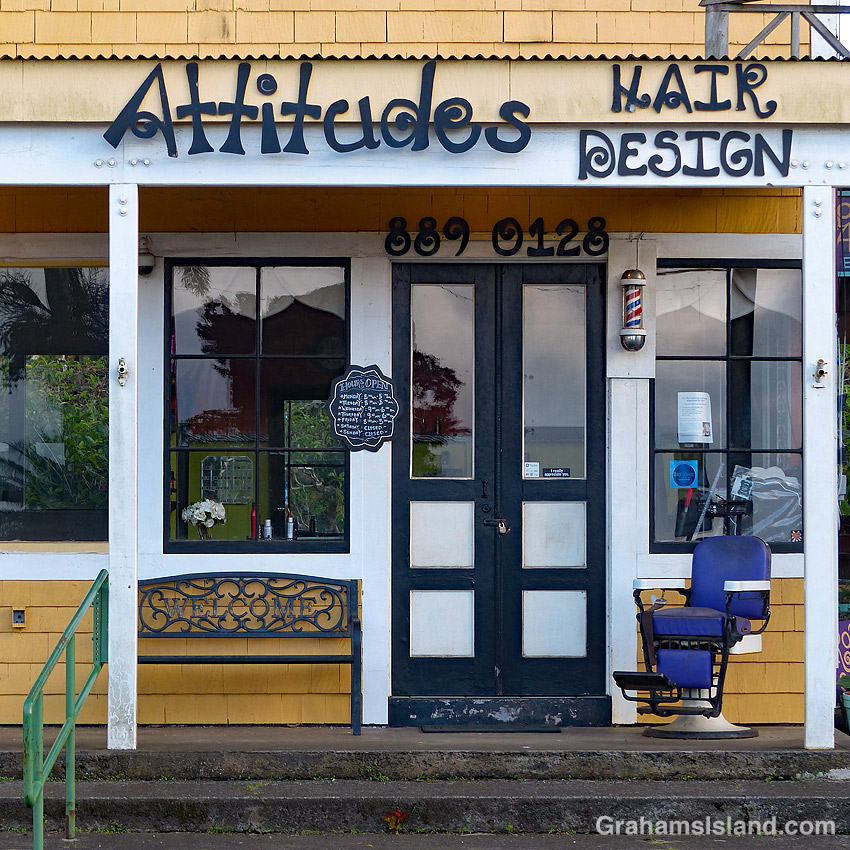
This week’s Friendly Friday challenge theme is ‘Chair.’ (See more responses here.) Usually I dig through my files for something suitable, but I knew I was light on chair photos. Instead, I went out and took a photo specifically for this challenge.

I’ve always liked the front of this hair salon in downtown Hawi and, in particular, the old barber’s chair located out front. This is a spot where customers can hang out prior to an appointment, but it’s also fine for passers-by to take a seat and watch the world go slowly by.

Mahai’ula Beach

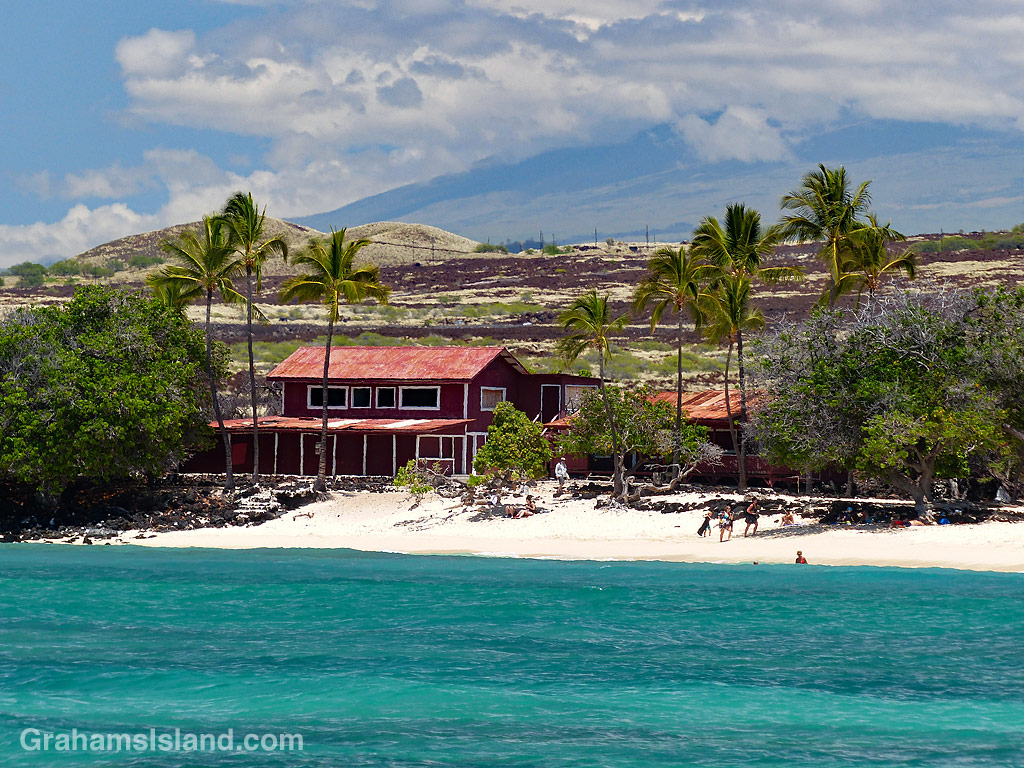
This week’s Sunday Stills challenge theme is ‘Warmth.’ (See more offerings here.) Picture yourself stretched out on this beach. Imagine the sun warming the sand, warming you. Perhaps it’s time for a dip in the clear, turquoise waters. After you emerge, the sun quickly dries you. Time to retreat to the shade of the trees lining the beach, a cool beverage at your side, a book in hand (put that phone away). Repeat as necessary.

This is Mahai’ula Beach, one of the beaches at Kekaha Kai Park. The old house, in the top photo, was built in 1880 by John Kaelemakule, a successful fisherman and businessman. After he died in 1936, the property was sold to the Magoon family who owned the land until 1993. It’s now owned by the state of Hawaii.

Pyrosoma

This week’s Sunday Stills challenge theme is ‘Fifth.’ (See more offerings here.) I was stumped as to what to post until I thought about looking back to see what photos I’d taken on the fifth of a given month. As it happened, these somewhat strange photos were taken just one month ago, on April 5th, and I was now ready to run them.

I was out snorkeling and was drawn to some black triggerfish, which were gathered in a very tight group. I took some photos and as I maneuvered around the group I became aware of something very close by.

The thing was at least two feet long and six inches or so in diameter. It was translucent, but with short lines of purple dots, and a milky central line through the tube. It was floating just below the water, changing shape, though not appearing to propel itself, but more being moved by the water. I thought it was some kind of egg sac, but really had no idea what it might be.

I wasn’t even sure I could get a photo of it, since I thought my camera might not ‘see’ it and instead focus on the fish beyond. I was also leery of getting too close. Perhaps it was some form of jellyfish or some other creature loaded with toxins.

When I got home, I was thrilled to find that some of the photos had turned out and registered what I’d seen, but I had no idea what it was. It didn’t really look like an egg sac, but what were the alternatives?

I had a browse in John Hoover’s Guide to Hawaii’s Marine Invertebrates and the closest thing I found was a prickly pyrosoma (pyrosoma atlanticum), but while the general shape was similar, the surface looked much less smooth than the thing I saw. So I shared the photos with some local snorkelers and divers and asked if they had any idea what it was. A couple of ideas were floated but nothing definitive. No one had seen anything like this before.

I looked online and found a few images that bore some resemblance. One of those links was to John Hoover’s website so I thought, ‘Why not ask someone knows about these things?’ and sent him an email with the photos. He quickly responded that it looked like a pyrosoma, a type of tunicate, and referred me to the listing in his book.

As we exchanged emails about a definitive identification, he noted, ‘Often microscopic examination is required to definitely identify tunicates, so unless you can get a piece of one, preserve it properly, and send it to a specialist we’ll probably never know exactly what it is.’

So what is this pyrosoma in the photos? Well, the name means ‘fire body’ and it can light up at night. It’s a colonial tunicate that can be 30 feet or longer (search online for pyrosoma and diver to see examples). Tunicates are filter-feeding creatures that either attach to hard surfaces or float free in the oceans. The colony is made up of zooids, individuals animals that are embedded in a gelatinous tube, which is open at one end and, apparently, is quite hard to the touch. One end of each zooid opens to the outside of the tube, the other end to the inside. Each zooid filters tiny cells from the water outside and expels filtered water to the inside of the tube.

Now, every time I get in the water, I’m looking around for another one. I probably won’t see one, but if I do get lucky, I just want to poke it, gently of course, to see what it feels like.

The photos show the shape and general composition of the pyrosoma. Some people have said it must have been huge because it dwarfs the fish in the photos, but the pyrosoma was only a couple of feet away. The fish were 20 or more feet beyond.

Monk seal pup update

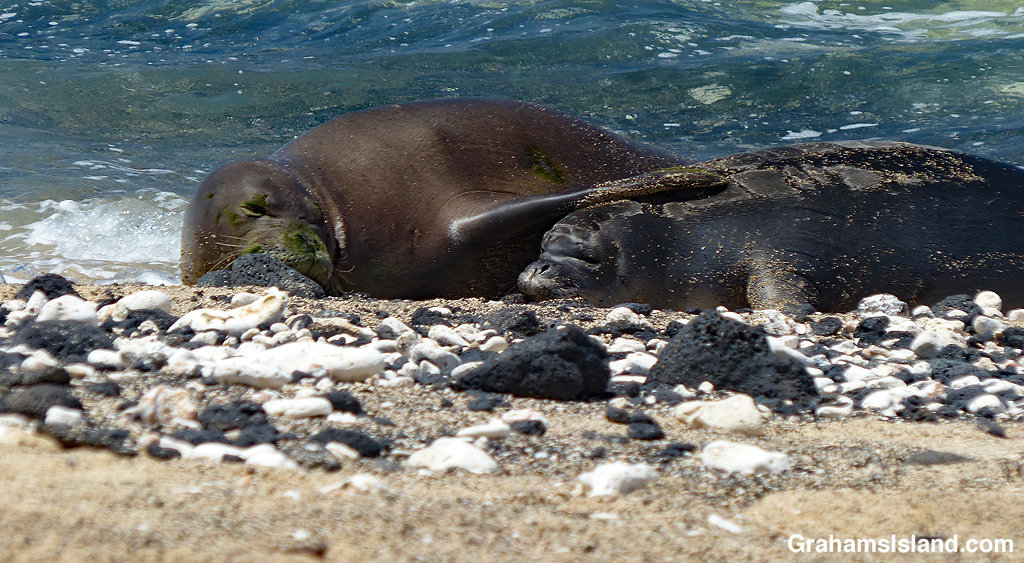
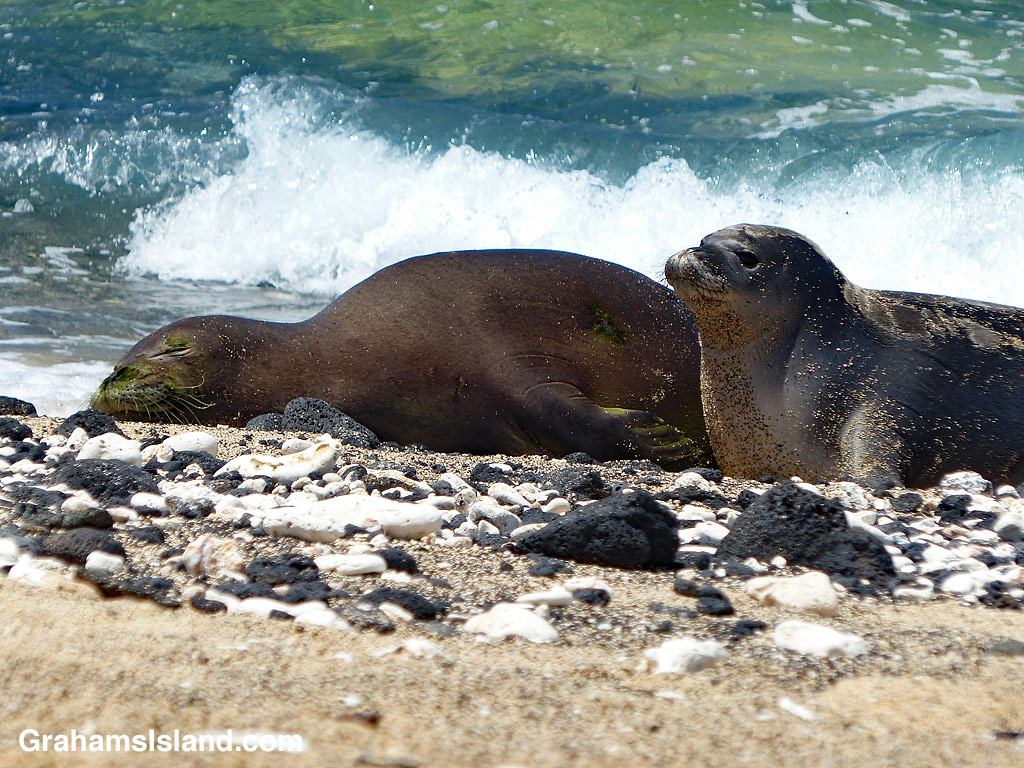
A few weeks back, I posted (here) about a new monk seal pup that had recently been born on the Big Island. I’m happy to report that the mother and pup both continue to do well.

The pup is now about six weeks old and is much closer in size to his mother than he was in the previous post. It’s likely that his mother, RA20, will soon leave him to fend for himself. She has lost a lot of weight and is also looking quite green on her head and flippers, so she will head out to feed and then to molt.

The pup’s sister, Manu’iwa, has been a regular visitor to the area, but the mother is very protective and drives her away. Once the mother leaves, it’s likely that the two siblings will spend some time together in the area. Eventually, the new pup will head out on his own and make his own way.

Manu’iwa has had a very good first year, which is often a very testing time for a new monk seal. Hopefully, the new pup will be equally successful and be another step toward boosting the endangered monk seal population to more sustainable levels.

I’m posting this in response to this week’s Friendly Friday challenge on the theme of ‘Posing.’ (More responses here.) The top photo in particular could easily have the caption, ‘That’s my boy.’