This week’s posts are in response to the WordPress photo challenge on the theme of ‘evanescent.’
A few times a year, I like to visit Hawaii Tropical Botanical Garden, which is just north of Hilo on the east side of the Big Island. It’s a wonderful garden, set in a fairly deep gully, with a wide array of plants.
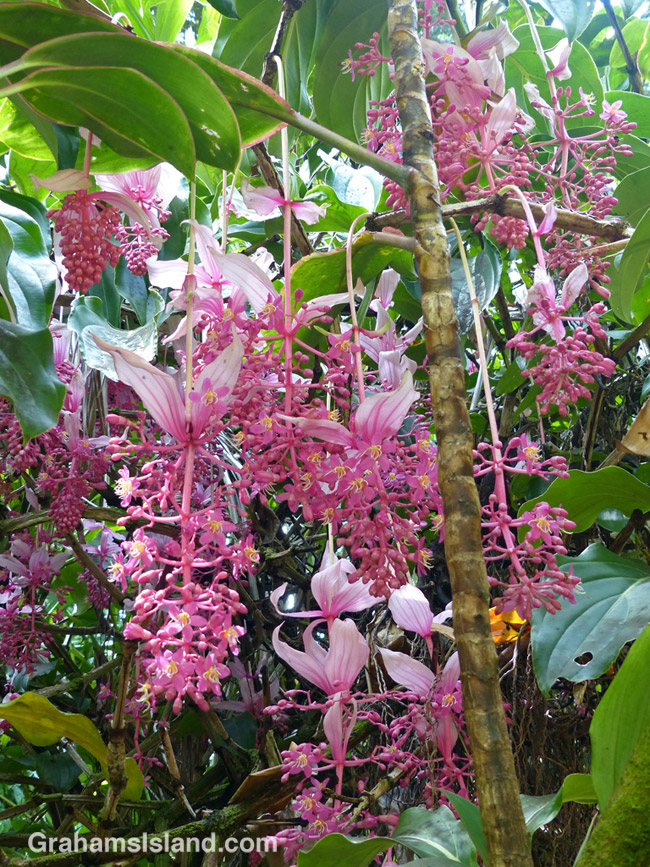
In tropical Hawaii, plants do well year round, but there are still seasons. Different plants flower at different times, so each visit is different. The nice thing about this is there’s always something new to see, such as this rose grape (Medinilla magnifica). The downside is that when I get home and look at my photos, I realize I don’t know what half of the plants are. So I figure I’ll see if I can find a tag next time I visit. But next time, the plant’s not flowering so I have trouble locating exactly what I was looking at.
Ultimately it boils down to me making a mental note to come back, same time next year, when it will be flowering again. Unfortunately, my mental notes have no chance of surviving that long, so the next year I see the flower again, take a new photo, and it’s not until I get home that I realize I already have a photo, still don’t know what it is, and will need to return next year etc., etc., etc.
But the thing is, I don’t really mind this. I just enjoy being at the garden, and appreciating the moments while I’m there.
For more information about Hawaii Tropical Botanical Garden, go to htbg.com.
This week’s posts are in response to the WordPress photo challenge on the theme of ‘evanescent.’
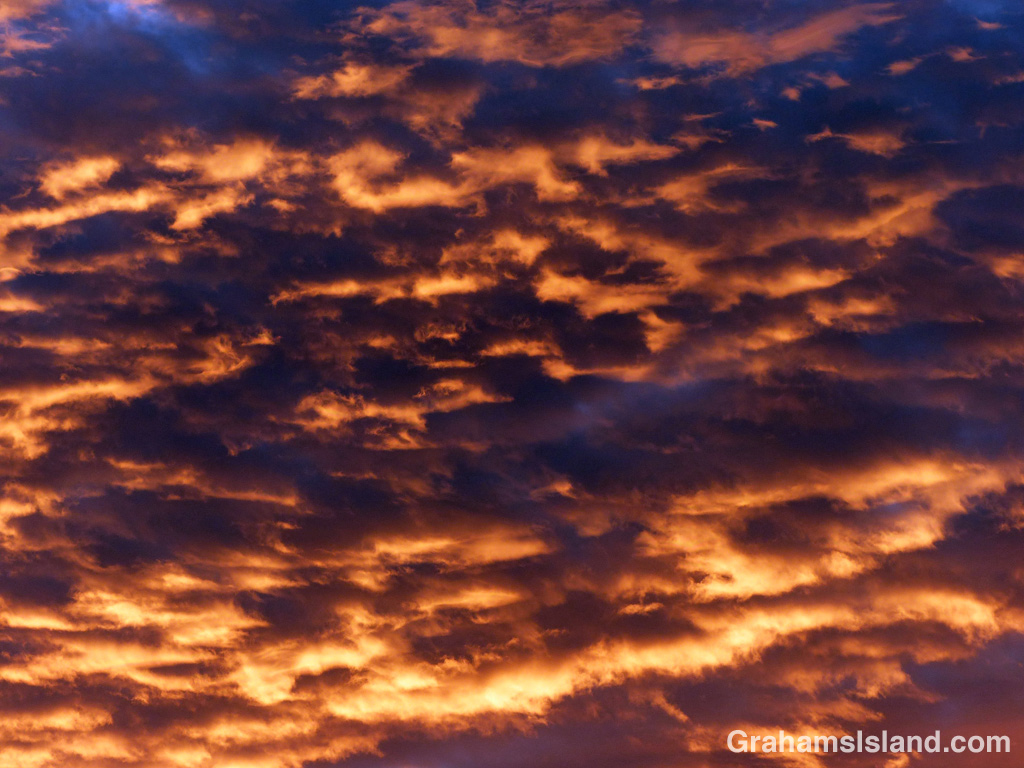
Sunsets are an evanescent event. They’re all different, depending on the clouds and the atmosphere and the weather. And where the sun goes down changes from day to day depending on the time of year. And to top it off, the colors, the composition, change from moment to moment as the sun sinks and the clouds move. There’s no ‘OK, it’ll be like this for the next 15 minutes.’ Instead it might vanish in a moment, diffusing into a previously unnoticed layer of haze on the horizon.
I like that unpredictability. I’ve driven down to a good viewing spot, lured there by promising weather and cloud formations, only to have the sunset be a damp squib. And then there have been other times when I’ve gone with low expectations and been treated to a cascade of color.
This photo was taken from the comfort of my lanai and I like the striking contrast of the bright and the dark at that moment in time. A few minutes later, it was all gone.
This week’s posts are in response to the WordPress photo challenge on the theme of ‘evanescent.’
In a previous photo challenge, I posted a photo of a ‘mountain of water.’ I’d been trying to capture waves breaking toward me and though that one didn’t break, it provided a surprising photo.
I mention this because a couple of days ago I was snorkeling and the surf was higher than I expected with visibility in the water consequently poor. I figured I wasn’t going to get any decent fish photos, but I thought I might get a nice surf shot. So I headed toward a deep spot close to shore where I could see the waves breaking toward me. I got to the spot and popped my head out of the water just in time to see a large breaking wave racing my way. It was probably the perfect shot, but sad to say, I lost my nerve. This was a big wave. I swam away, too late of course, and ended up in a froth of whitewater, pushing into my mask and up my nose. And then it was past.
I had to laugh. Truth is, I was never in danger. There’s enough space where I was that even this bigger wave wasn’t going to trouble me. But for that fleeting moment, I had serious doubts.
And this photo? Well, if the ‘mountain of water’ was too small, and my recent encounter too big, this wave was just right.
This week’s posts are in response to the WordPress photo challenge on the theme of ‘evanescent.’
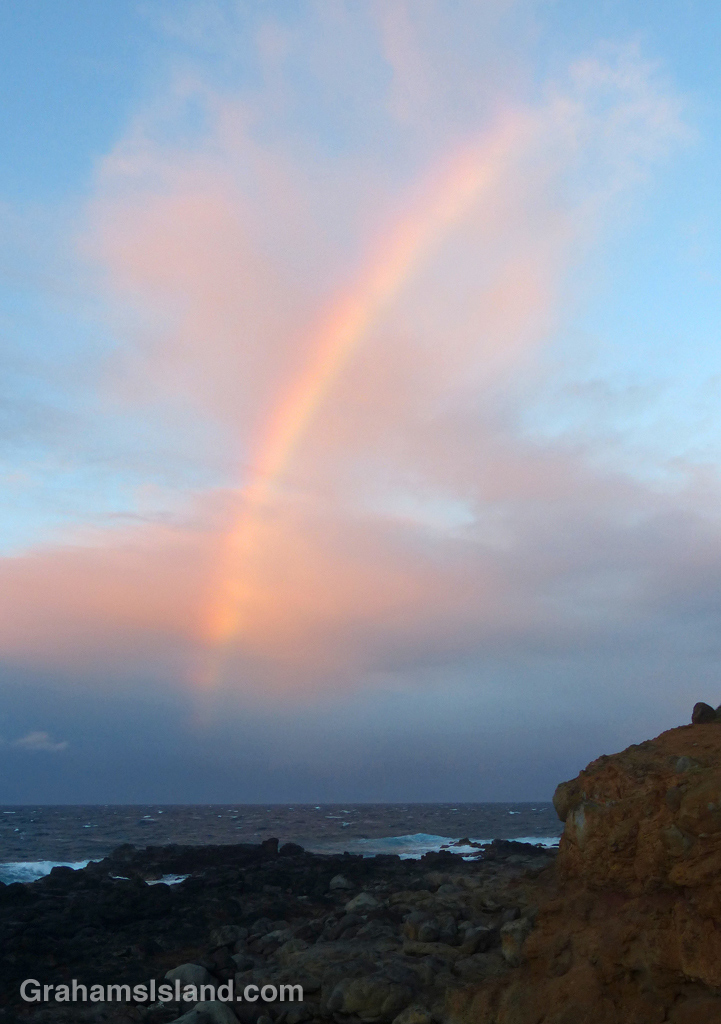
This slice of rainbow, backed by pink clouds, fits the bill, I think. Fueled by an approaching shower of rain, it shone briefly bright, then quickly faded.
Most weeks I post something in response to the WordPress photo challenge. This week’s theme is ‘evanescent,’ a word I wasn’t familiar with. The definition provided is “soon passing out of sight, memory, or existence; quickly fading or disappearing,” or, put simply, ‘a moment in time.’
To me, this is what any photo is, a snapshot of a given moment. Even the look of a fixed object, a landscape, a building, a monument, is always changing. It could be the light, weather, activity around the subject. Everything is in constant flux, sometimes in obvious ways, sometimes only in the detail. With birds, animals, bugs, even plants – blowing in the wind – those changes of passing moments are more obvious.
So I thought I’d take this week’s challenge as my theme for the week (or at least the remaining six days of the challenge). I start off with this photo of a manta ray. One of the great joys of snorkeling is never knowing what I’ll see that day. It could be a common fish engaged in some activity I’ve never seen before. It could be a glimpse of something unexpected. It could be something seen only at a certain time of year. Whatever it is, it almost always gives me a little jolt of ‘wow.’
While out snorkeling, I got a jolt of ‘wow’ when I saw this manta ray gliding along in the opposite direction. I turned and followed its effortless progress for several minutes until it headed into deeper water and disappeared. An evanescent experience? I think so, though it won’t soon disappear from my memory.
The small mirror in the Cassegrain cabin of the James Clerk Maxwell Telescope on Mauna Kea, can be rotated to direct information to a variety of instruments. Here, it reflects about the only empty spot in the crowded space.
I met Yogi on the trail just before entering the forest. Here, he makes his way through the dense growth.
Huge Hapu’u ferns line the forested section of the Nāpau Trail.
The old Pulu factory.
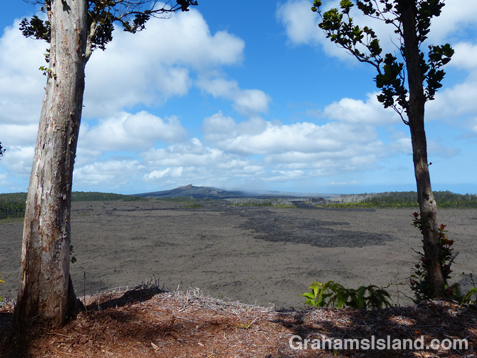
Yesterday, I posted about the first part of the Nāpau Trail in Hawaii Volcanoes National Park, which crosses extensive lava fields. Today’s post picks up from there, on the rim of Makaopuhi Crater, where the trail slips into dense forest on its way to the Nāpau Crater overlook.
Puʻu ʻŌʻō from the Nāpau Crater overlook.
It’s a remarkable contrast between the stark lava and thriving forest. Birdsong is continuous. Ferns of every kind grow in abundance. Bamboo orchids pop out here and there. And above it all, tall Ohia trees provide the backbone of the forest. This forested trail is clear, but somewhat overgrown. I was hiking in shorts and, at the end of the day, my legs were generously scratched.
Early on in this section, it’s possible to get views of Makaopuhi Crater. Also in this area is the junction with the Nāulu Trail, which starts out at the Kealakomo Overlook, farther down Chain of Craters Road.
The forested part of the trail is about 2.5 miles and towards the end of it is an old Pulu factory. The sign there reads: “Between 1851 and 1884 great quantities of pulu, the soft, reddish-brown fiber covering the coiled fronds of the tree fern (hāpuʻu), were harvested on Hawaii. Much of it was processed within these walls, later to be shipped from Keauhou Landing to foreign markets for use as stuffing in pillows and mattresses.” Unfortunately, in drier climates, pulu quickly breaks down so the industry collapsed.
A little farther along is another junction. To the left is the very basic Nāpau campsite, a few open flat areas and an outhouse. To the right, the trail continues to the overlook, where I was lucky enough to have a wonderful, clear view of Puʻu ʻŌʻō, busily pumping out sulphur dioxide and other gases, and of course, million upon millions of gallons of lava, currently entering the ocean on the southeast coast.
Picking the right day for the hike is not always obvious and weather changes quickly around here. At the visitor center, on the way in, it was completely overcast and drizzling, but by the time I got to the trailhead the sun was out and a nice breeze blew. The wind direction is also important. On this day, the northeast trades were blowing and the vog trailed away to the southwest, which is fine for this hike. But if the wind blows more easterly or south of east, then this trail would be downwind of emissions from the volcano, which could potentially be a dangerous situation.






 Graham's Island