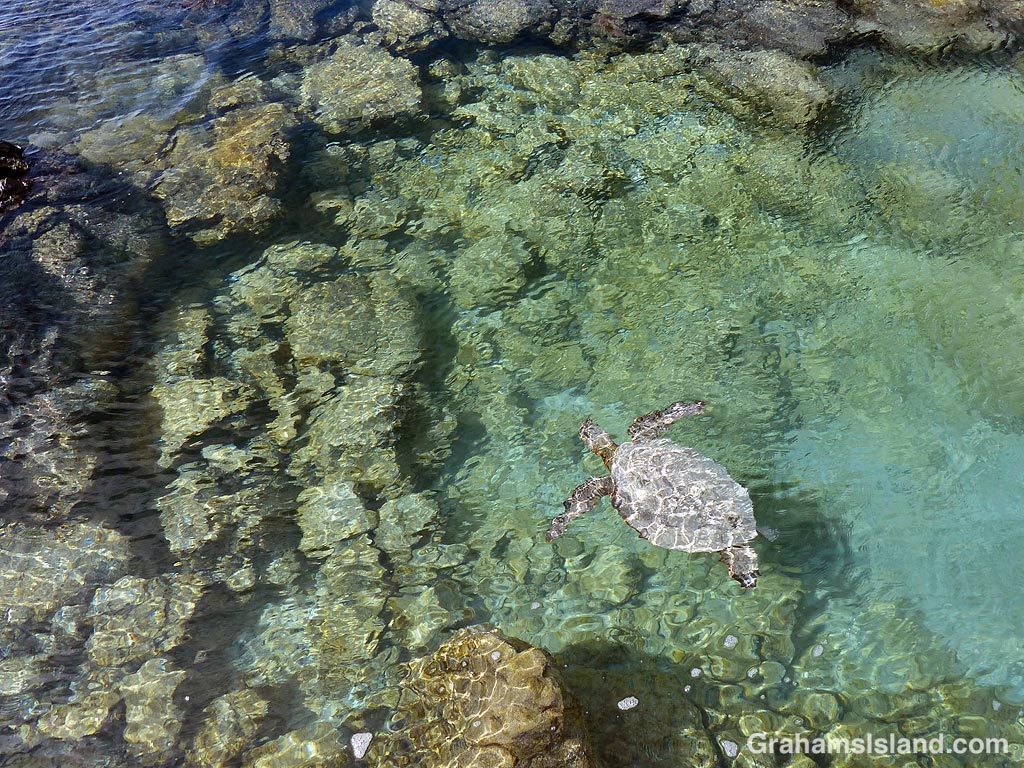
The last time I was down at Kiholo Bay I saw this green turtle in one of the pools around the edge the lagoon. When the turtle saw me, it might have felt a bit vulnerable in such shallow water. It immediately headed for the lagoon proper, at a leisurely pace, before cresting a ridge and easing into deeper water. Once there, it popped up for a breath, then disappeared into the milky waters.
The latest eruption at Kilauea Volcano has recently been declared paused. It was never an especially dramatic eruption, but when I went down a few days after it began (here) the sky was illuminated by the activity. In recent weeks though, the lava lake formed by the eruption crusted over completely and lava from the active vent was also hidden from view.
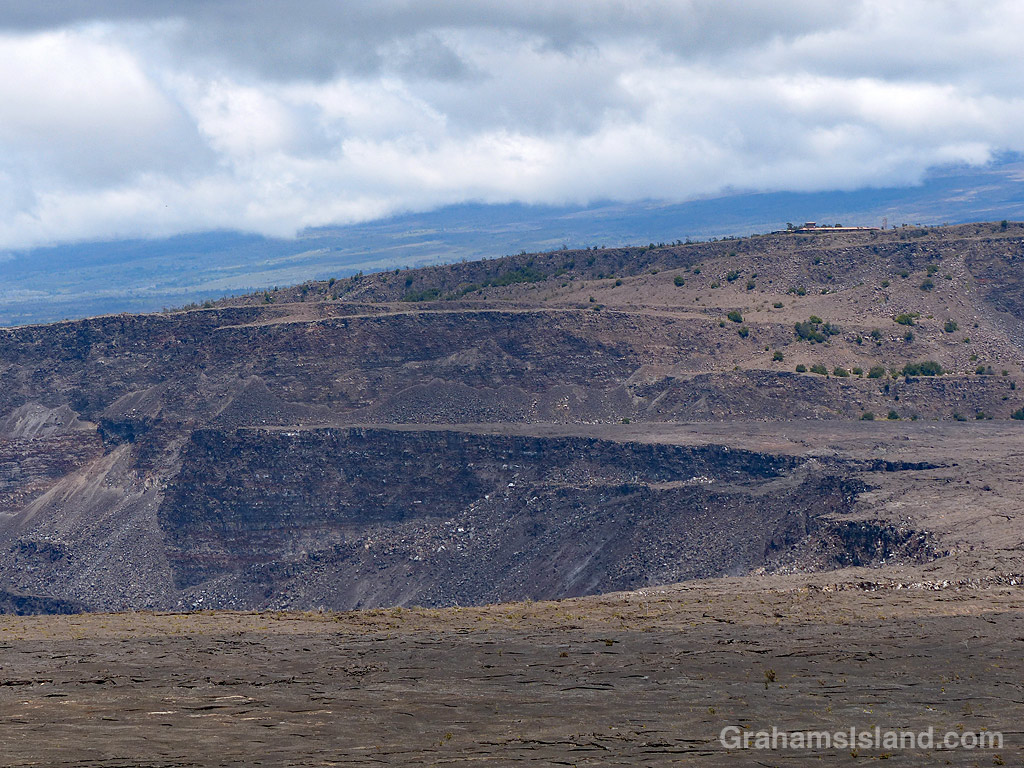
The photos are two views of Halemaumau Crater, taken before this latest eruption. In the top one, the collapsed floor of the crater is on the left. This is what the new lava lake was filling up. On the ridge, to the right side of the photo, is the low profile of the Jaggar Museum, which was closed after the 2018 eruption and likely won’t reopen.
The bottom photo shows the easternmost edge of Halemaumau Crater, which wasn’t greatly impacted by this eruption or the events of 2018. Consequently, the walls of the crater are quite green and the floor is dotted with plants. These plants are mostly ohia trees, which are among the first plants to grow in lava fields, in part because their roots will tap into lava tubes to find moisture and nutrients.
For more information about Hawaii Volcanoes National Park and Kilauea’s eruptions, go to nps.gov/havo/.
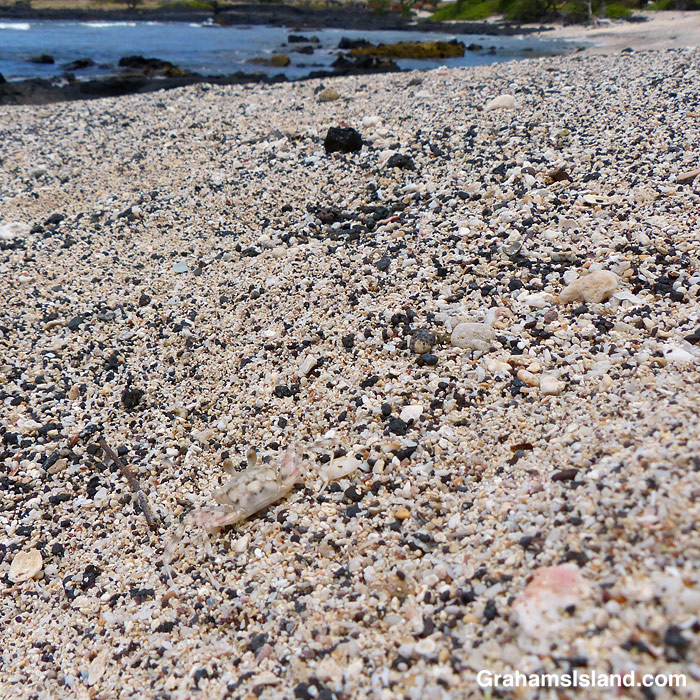
I saw this crab on the beach south of Kohanaiki Park. Pallid ghost crabs are small, with a carapace only an inch or so wide. They’re also speed demons, zipping across the sand, usually to disappear into their holes. That’s how I saw this one, on the move. But instead of diving for cover, it remained above ground.
I took some photos from distance before edging closer to try and capture more detail. The crab didn’t move. My biggest challenge was finding it in the camera’s viewfinder. Even though I knew where it was, half the time I wasn’t sure whether I had it in shot or not, they blend in so well.
The top photo shows the best of the close-ups. The second one gives an idea of the crab’s perfect coloration for its environment.
This was going to be my last response to Becky’s April Squares challenge, but I punted it back a week. These are the beautiful, bright flowers of hibiscus tiliaceus, which is known as hau in Hawaii. It’s a canoe plant, brought to Hawaii by the early Polynesians, who used the wood in their canoes and the bark for cordage and medicinal purposes.
The flowers only last for a day, starting out yellow and becoming orange and then red as the day wears on. As the lower photo shows, different colored blooms can often be seen on the same plant depending on where they are in this progression. These were at Kohanaiki Beach Park.
This is the sixth of my rainbow colors in response to Becky’s April Squares challenge theme of ‘Bright.’ (See more responses here.)
Today’s rainbow arches above Lapakahi State Historical Park in North Kohala. Lapakahi was an old Hawaiian fishing village and the ruins give some insight into the life and culture of those people.
Second is a blue offering hanging outside the predominantly red and green Old Hawaiian Trading Company in Kapaau.
Third is all that’s left of the Bank of Hawaii in Kapaau. The bank used to occupy the whole building, but it’s now used as a senior center.
Kohanaiki, located just north of Kailua Kona, is my new favorite park here on the island. It’s the home of a popular surf break known as Pine Trees. There’s a long, sandy beach backed by trees offering shade (not pine trees though). It’s an historic area, too, and at the south end of the park is a variety of old Hawaiian structures as well as a garden featuring native plants.
Maiapilo (Capparis sandwichiana) is an endemic plant that requires little water once established and is also salt tolerant. This means it grows well on the dry side of the island along the coast. This of course is also an area popular with humans, both for living and recreation. Consequently, maiapilo is considered an at risk plant.
Its standout feature is the beautiful white flowers, but if you want to see them, bring a flashlight or be prepared to get up early. Maiapilo blooms at night and begins to wilt early in the morning, fading to pink as it does so.
These photos were taken around nine in the morning and the bees were busy exploring and pollinating the flowers. At night though, native moths are the main pollinators, attracted by the white flowers and pleasant lemon scent. A cucumber-like fruit follows the flowers but, unlike them, it is said to have a very pungent smell.
The plant can be low-growing and sprawling, or a more upright shrub reaching 10 feet.