Category Archives: Parks

Abstracts: A softer, gentler firehose of lava

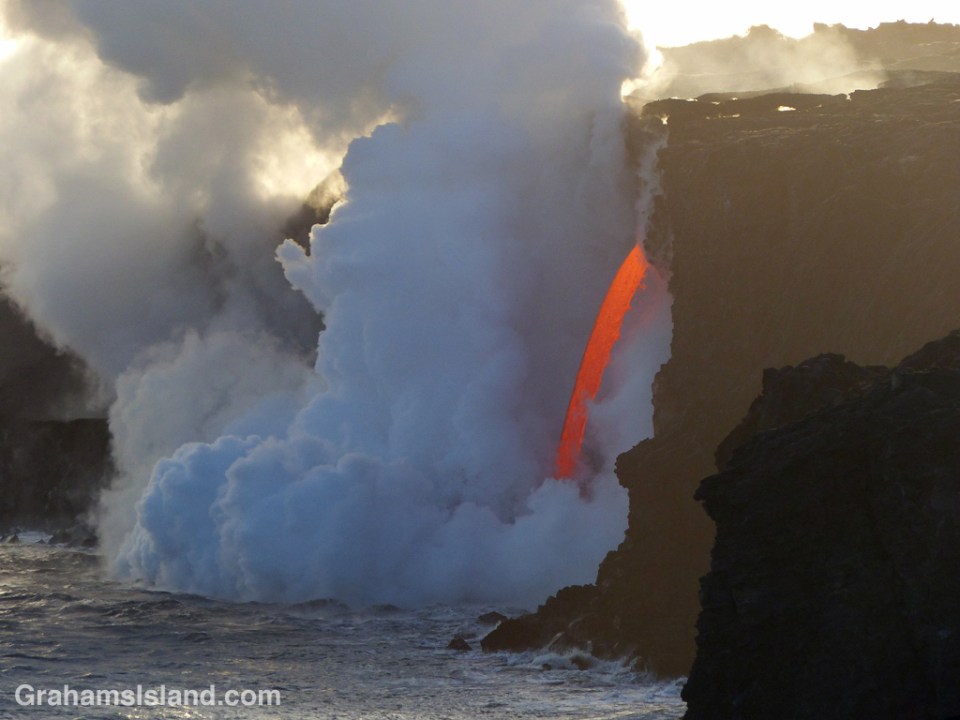
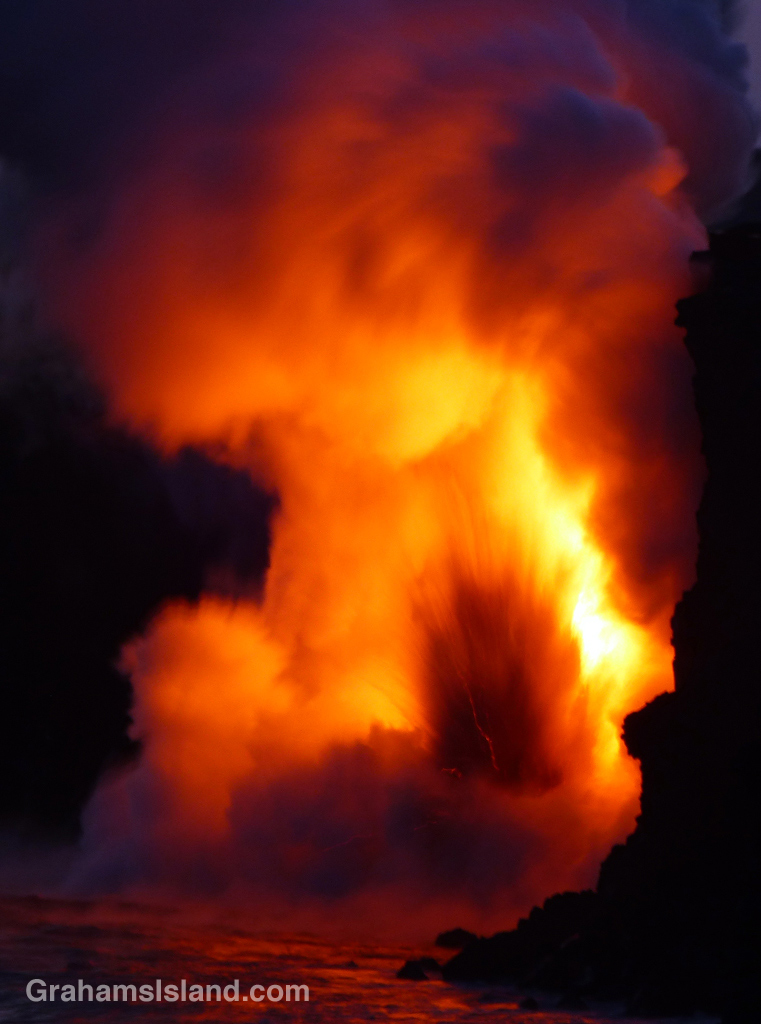
The firehose of lava entering the sea from Kilauea Volcano
One last photo from my trip to see the firehose of lava from Kilauea Volcano gushing into the sea. I tried a few longer exposures and I particularly like the effect of this one. More lava photos here.

For more information about Kilauea Volcano and it current eruption, go to hvo.wr.usgs.gov/activity/kilaueastatus.php.


Brant goose

A brant goose at Kaloko-Honokohau National Historical Park, north of KonaA brant goose and green turtle at Kaloko-Honokohau National Historical Park, north of Kona
Brant geese are rare visitors to Hawaii so it was nice to see this one puttering in the shallows at Kaloko-Honokohau National Historical Park, north of Kona. The rock it’s about to bump into is a Hawaiian green sea turtle. There were probably about a dozen of them there, either resting on the sand or bumping along the reef close to shore.

Firehose of lava at sunset

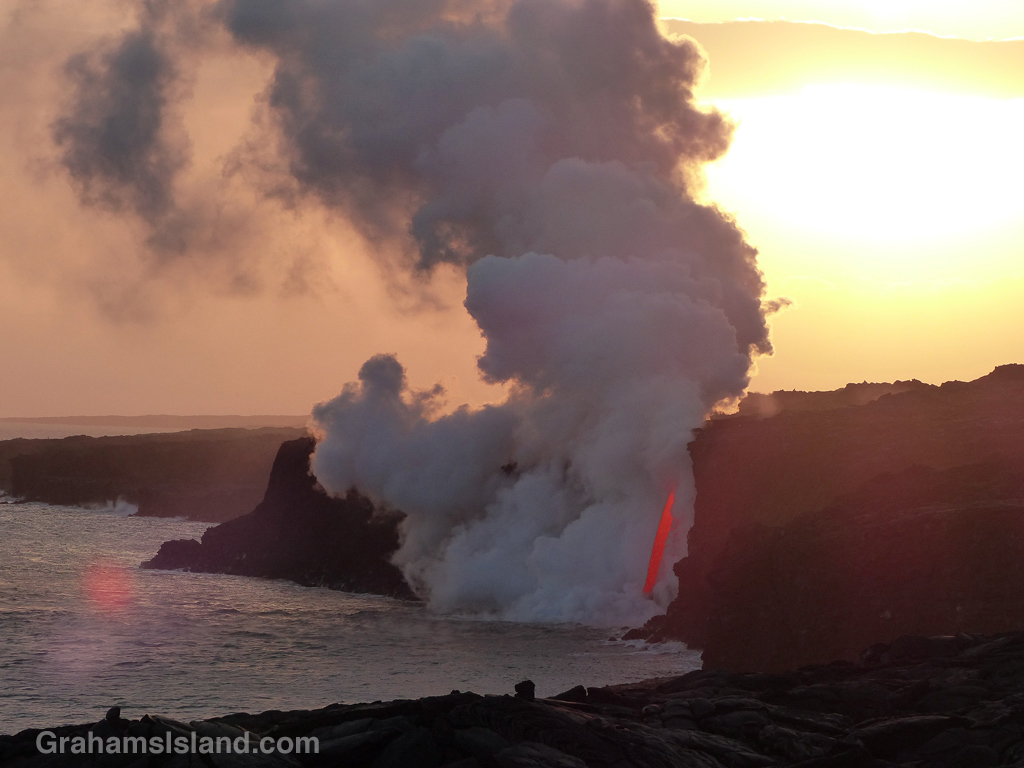
As the sun sinks slowly in the west, a firehose of lava from Kilauea Volcano gushes into the sea.
As the sun sinks slowly in the west, a firehose of lava from Kilauea Volcano gushes into the sea. More photos here. A good video of the firehose, since the cliff collapse, can be found here.

For more information about Kilauea Volcano and it current eruption, go to hvo.wr.usgs.gov/activity/kilaueastatus.php.
Going to the flow

Cyclists head to the Kilauea lava flow where it enters the sea.
I posted here about the current flow from Kilauea Volcano entering the sea, in a dramatic, firehose-like outpouring. In that post, I mentioned that the day after my visit, a cliff collapse caused the firehose to disappear from view. Things have settled down again and the firehose is once more visible, though another large crack not far back from the cliff is expected to cause another collapse soon.

From the Kalapana side, it’s about four miles to the viewing area and a thriving trade in bike rentals has sprung up. When I was down that way last July there were a few bikes available for rent. Now there are maybe 200 or 300 available from a large number of vendors in the parking lot. At the viewing area, bikes were piled alongside the road, and locked in clumps.

I preferred to walk, seeing the towering column of smoke and steam getting gradually larger on the way out, and enjoying a star-studded night sky on my return.

For more information about Kilauea Volcano and it current eruption, go to hvo.wr.usgs.gov/activity/kilaueastatus.php.

Kilauea Volcano’s firehose of lava

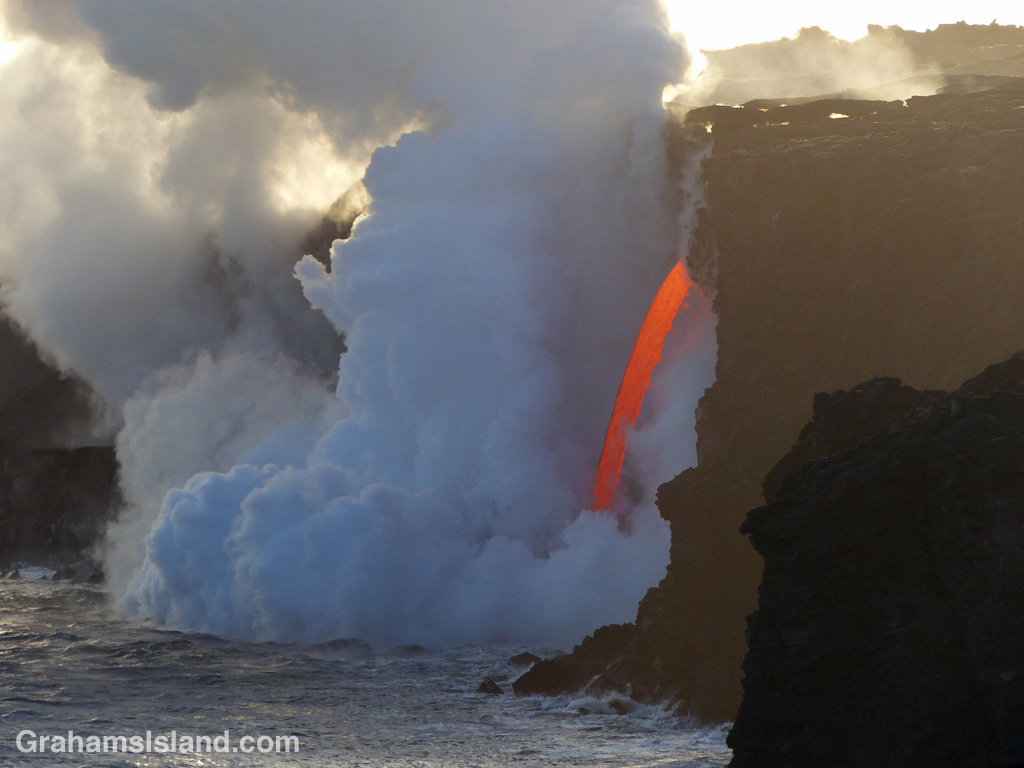
Lava from Kilauea Volcano’s Pu’u O’o vent enters the ocean as if from a firehose.Lava from Kilauea Volcano’s Pu’u O’o vent enters the ocean as if from a firehose.
I’ve posted before (here, here, here and here) about trips I’ve made to see the current lava flow from Kilauea Volcano’s Pu’u O’o vent. Lava first reached the coast on July 26, 2016 and has been pouring into the ocean ever since. However, on New Year’s Eve, much of the newly formed delta collapsed into the ocean taking with it a chunk of the older cliff. As a result, the lava tube carrying the active flow was suddenly left exposed and lava gushed out into the ocean as if from a firehose.

I was aware this was going on, but hadn’t really appreciated what it meant until this past Wednesday. Then, I read a report about the phenomenon, saw some photos, and realized this was something I had to see. Since the weather was favorable and it was early enough, I set out the same day.

After a three-hour drive and brisk hike I got to the viewing area, from the Kalapana side, around 5 p.m. These photos are from that trip. The top photo shows the firehose, lava gushing into the ocean in a constant, unwavering stream. When it hit the water, it generated a series of explosive reactions. The second photo shows the Lava Ocean tour boat nudging in toward the action as one of these explosions occurred. Below is a closer look at the stream with chunks of hot lava being hurled out into the water.

I stuck around until it got dark and then headed home – another hour-long hike and long drive – but it was so worth the effort. This was emphasized when, the next day, another cliff collapse caused the firehose to disappear from view. It might return, since the whole area is unstable, but it might also be gone for good.

I guess timing really is everything and I feel very fortunate that I was able to experience this phenomenon before it was gone.

For more information about Kilauea Volcano and it current eruption, go to hvo.wr.usgs.gov/activity/kilaueastatus.php.
Lava from Kilauea Volcano’s Pu’u O’o vent enters the ocean as if from a firehose.

Growth in the lava

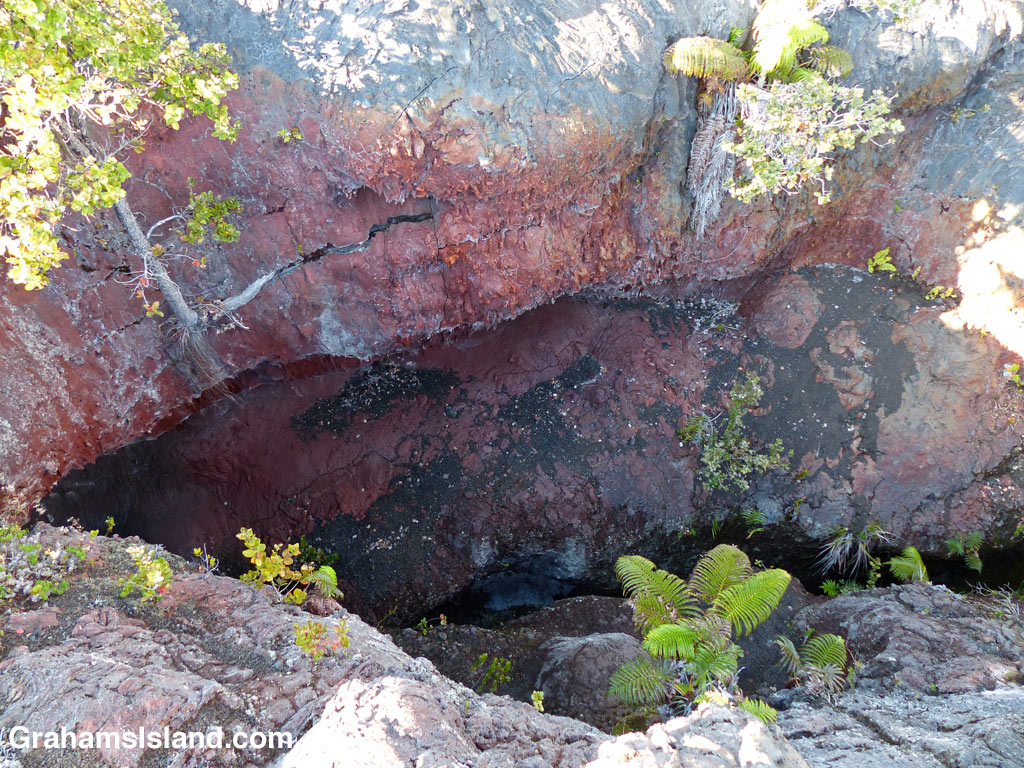
Vegetation has reclaimed a section of the original 1969 fissure of the Mauna Ulu eruption of 1969.
In May of 1969, a series of earthquakes opened a large fissure alongside Chain of Craters Road in Hawaii Volcanoes National Park. This was the beginning of what is known as the Mauna Ulu eruption. For five years, lava poured forth in a series of eruptions. Chain of Craters Road, completed only a few years earlier, was buried for several miles. Landmarks along the road were destroyed or irrevocably altered. A swathe of forest disappeared in flame.

When the eruptions finally ceased, life soon began to reappear on the barren lava landscape. In this photo, vegetation has reclaimed a section of the original 1969 fissure. Roots are anchored in cool, moist cracks in the lava. The tree on the left is particularly striking. Having started out in a crack on a vertical face, it has reached up to the light and is going strong. I like to think it shows how resilient nature can be.

For more information about Hawaii Volcanoes National Park, go to nps.gov/havo/. For more information about Kilauea Volcano and it’s eruptions, go to hvo.wr.usgs.gov/kilauea/history/main.html.