Category Archives: Places

Bryophyllum

Bryophyllum and Pu'u Wa'awa'a

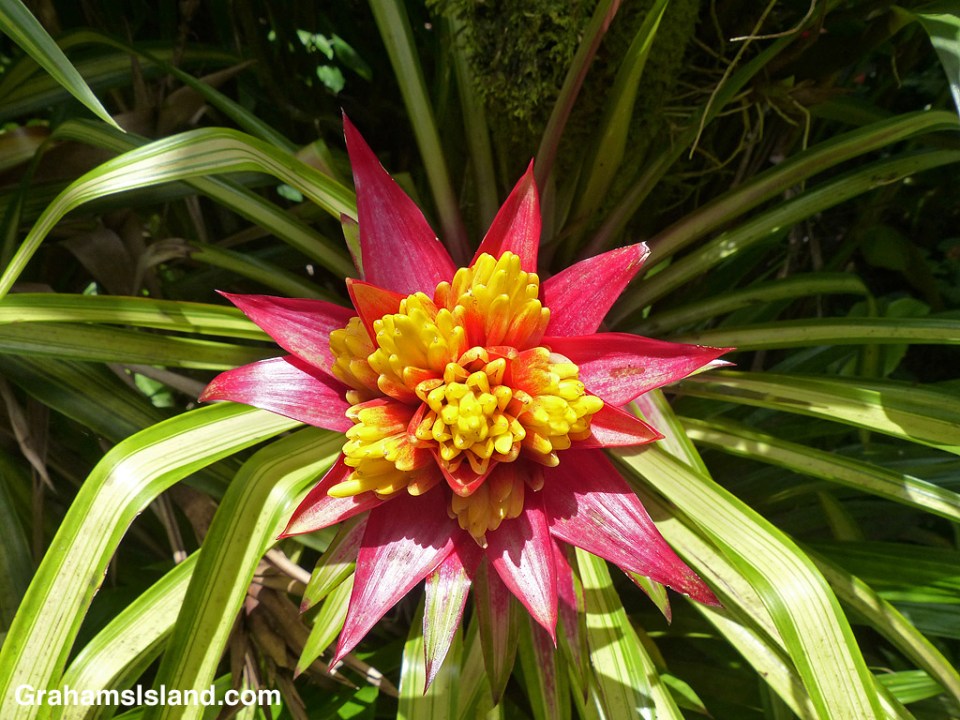
Bryophyllum and beeThis bryophyllum is probably bryophyllum x houghtonii, but there are several similar looking varieties of bryophyllum. Their common names are telling, however. Bryophyllum x houghtonii is known as ‘hybrid mother-of-millions.’ Common names for other bryophyllums include ‘mother-of-millions,’ ‘prolific mother-of-millions,’ and ‘mother-of-thousands.’

Such names make it no surprise that bryophyllums are invasive. They’re also poisonous to both livestock and humans, which is problematic since these photos were taken at Pu’u Wa’awa’a, in an area occupied by sheep and cattle.

For more information about Pu’u Wa’awa’a and its trails, go to puuwaawaa.org.

Pig dig

Pig Digging

Pig DiggingsOn an early morning hike at Pu’u Wa’awa’a, I saw this wild pig on the hillside above me. It was busy rooting around in the dirt, hence the brown snout. Wild pigs can do an enormous amount of damage in their foraging. The photo at right shows one of many areas alongside the trail that has been dug up by pigs. These areas are susceptible to erosion when it rains.

I was glad the pig was a ways up the hill as the other damage they can do is to people who get too close. Given the size of this one, I suspect I’d have come off second best.

Monk seal scars

Monk seal scars

Monk seal with scarsThese are older photos, but still interesting to me. I spotted this monk seal one day, not too far from a second seal that is a regular around the Big Island.

The top photo shows some lighter marking on the side of the seal, below and behind the two dark marks. This lighter marking is bleaching, which is applied to seals when possible, to help researchers monitor the population and keep track of their travels. The bleaching only lasts a year as seals molt annually. In addition to the bleaching, most seals have red tags placed in their rear flippers, to help identify them. It can be a hit and miss method as these photos show. This seal has tags in both flippers, but they were never visible to me.

The other interesting thing is those two dark circles on the seal’s back. They’re made by cookiecutter sharks. Cookiecutter sharks are small dogfish sharks, less than two feet in length. They feed by gouging round plugs, hence the name, out of larger creatures such as monk seals.

Cookiecutter sharks live in the deep ocean during the day, sometimes at depths over two miles. At dusk they rise up toward the surface, before descending to the depths again around daybreak. Another reason not to go swimming at night.

Better Days: Abandoned car

Better Days-Abandoned car on coast

Better Days-Abandoned carOne of the Big Island’s scenic attractions is its sprinkling of abandoned vehicles. One doesn’t have to drive too far to spot a car being swallowed by weeds or a wreck languishing just off the highway. Usually the person dumping the vehicle has stripped it of all the identifying information or never registered it and so can’t be traced.

I did a double take when I saw this car on one of my regular walks. Was this something new or something I’d simply failed to register for days/weeks/months? The latter is entirely possible, but I think this was a recent arrival that someone was not content to just abandon, but also felt it necessary to push it into the ocean. Perhaps it was stolen, perhaps used in a crime. Either way, it didn’t make it to its planned watery grave, at least not yet. Next winter’s storms might yet snatch it away. I doubt it will be retrieved before then.

Two Step

Two Step

There are seasons in Hawaii. Summer is hotter, and wetter on the dry side of the Big Island. But let’s be honest, there are many people who live through freezing winters and boiling summers, sun-free winters and sun-seared summers. They believe Hawaii has summer year-round, and not just any summer, but a pleasant summer where it’s warm and sunny but not inhospitably so.

For those people, and in response to this week’s Sunday Stills challenge on the theme of ‘Summer,’ I give you a typical summer shot of people getting ready to go snorkeling, or just exiting the water. The photo was taken at Two Step, next door to Pu’uhonua o Hōnaunau National Historical Park — in February. Bwahahahahahaha.

For more information about Pu’uhonua o Hōnaunau National Historical Park, visit https://www.nps.gov/puho/index.htm.

See more Sunday Stills responses here.

Spathoglottis orchid

Spathoglottis orchid

Spathoglottis orchid flowersThis spathoglottis orchid is probably spathoglottis picata, though it could be spathoglottis kimballiana. This one was at Hawaii Tropical Botanical Garden, which lists the kimballiana but not the picata in their plant database. However, that database doesn’t list all their plants, so it’s not conclusive. The closest images I found online looked more like the spathoglottis picata.

Bottom line is that it’s a beautiful flower whatever its exact name (but I’m always open to help in getting the correct identification for plants or anything else on the blog).

For more information about Hawaii Tropical Botanical Garden, go to htbg.com.

Your tax dollars at rest

Sikorsky CH 53E Super Stallion helicopter at Upolu Airport

I was out on one of my usual coast walks when I heard the thrumming of engines. I looked up to see a pair of military helicopters heading west. I see a lot of helicopters on my walks, sometimes military ones, but more often those on tours.

I kept walking but, as they sometimes do, the helicopters turned and came in to land at Upolu Airport. This wasn’t unusual. Military aircraft often land at the lightly used airstrip. I’d have carried on, but the two aircraft had come to rest a little way above where I was walking. All I could see of them was their rotors turning, though I could hear plenty; helicopters are loud.

Anyway, I thought the situation had some photographic potential so I edged toward the airport fence and took some shots – not too interesting as it turned out. Still, I knew that when military craft touch down here, they only tend to stick around for a few minutes before taking off again. I thought these large helicopters rising above the vegetation might be interesting, so I waited, punishing my ears in the process.

Five minutes passed, then 10. I started to get antsy. What were they up to? I waited another five minutes or so and then I saw one of the crewmen through a gap in the vegetation, walking on the runway from the second helicopter to the first. Now it was possible he was returning to his aircraft prior to takeoff and I just hadn’t noticed him going the other way, but I figured if the crew were wandering around on foot, chances were that nothing was going to happen any time soon. I put away my camera and started walking again.

At this point in the story, one might expect that both helicopters to take of and collide in a flash of flame, or a UFO comes down and lands between them, but no. I walked a bit and turned around in time to see the rotors on the second helicopter turning slower and slower on their way to stopping. Something was wrong.

I kept going and several minutes later there was a surge in noise and the first helicopter rose up, made a sharp curve through the air, and headed off toward Oahu. I didn’t get a photo of this in part because I was looking directly into the sun and in part because it was halfway to Honolulu before I reacted.

Instead, I finished my walk and saw that the second helicopter was still sitting forlornly at the far end of the runway (something of a hazard for anyone else wanting to land there). So I drove my truck down the road and parked opposite the helicopter. I didn’t see anyone in it, but the doors were open and I didn’t think it had been abandoned. I was tempted to yell across asking if they needed a gallon of gas, but restrained myself, aware that such a craft was probably bristling with machine guns. Instead, I took these photos and left.

Later that evening, not long after dark, I heard that thrumming again and next day the runway was empty so I assume that whatever had gone wrong had been fixed.

The helicopter is a Sikorsky CH-53E Super Stallion operated by the U.S. Marine Corps who have a base at Kaneohe Bay on Oahu. It’s used for heavy-lift transport and I think it was a couple of these craft that were stationed in Hilo recently in case people needed to be evacuated from the region threatened by the current lava flow in Puna.

Sikorsky CH 53E Super Stallion helicopter