
The rising sun begins to illuminate scrubby terrain on the dry side of the Kohala Mountains.

The rising sun begins to illuminate scrubby terrain on the dry side of the Kohala Mountains.
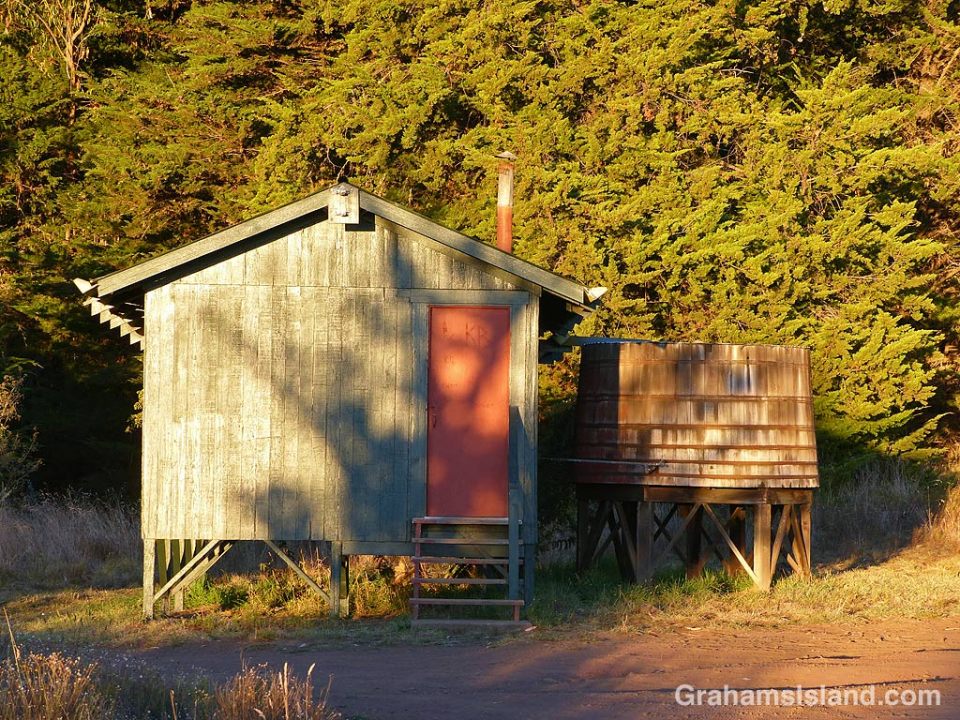
This Civilian Conservation Corps (CCC) Cabin is one of seven that were built around Mauna Kea in the 1930s. The CCC was a public work relief program to create jobs during the Great Depression. It focused on the conservation of resources on government-owned lands.
The seven cabins on Mauna Kea were used by crews working on the construction of sheep-proof fencing. The goal was to remove sheep from parts of Mauna Kea in order to protect the high-elevation dry forest which was rapidly being destroyed.
This cabin is just above the Palila Forest Discovery Trail on the southwest slopes of Mauna Kea.
Posted in response to this week’s Sunday Stills challenge on the theme of ‘Work.’ See more responses here.


 The top of Mauna Kea is dotted with telescopes, but Mauna Loa’s summit is bare save for some small pieces of equipment monitoring the volcano’s seismic activity and small changes in inflation and deflation.
However, just above the 11,000 foot level on Mauna Loa’s northern slope is the Mauna Loa Observatory. The observatory is operated by the National Oceanic and Atmospheric Administration – Earth System Research Laboratory – Global Monitoring Division.
Since 1958, the observatory has been monitoring changes in the atmosphere and in particular, levels of carbon dioxide, one of the leading contributors to global warming. It’s the world’s oldest continuous carbon dioxide monitoring station, which is ironic given that it’s situated in one of the few countries on Earth not subject to global warming (and if you’re wondering how that works, all you have to do is go to the beach, stick your head in the sand and, voila, no more global warming.).
In the top photo, the two domes on the left house solar sensors operated by the Mauna Loa Solar Observatory which shares the site. The bottom photo shows the observatory under a near full moon. And in the middle is a view back down the road to the observatory, an up and down, winding one-lane road, which is one of my favorite drives on the island.
For more information on the Mauna Loa Observatory, go to https://www.esrl.noaa.gov/gmd/obop/mlo/.

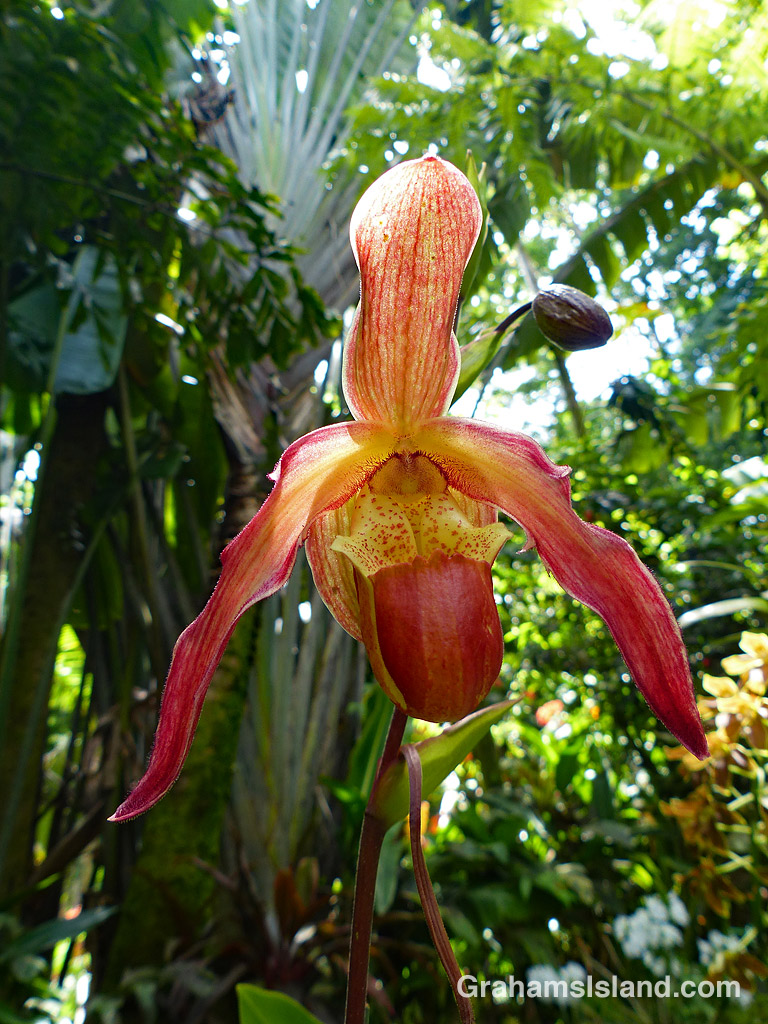
This phragmipedium orchid is Eric Young 4N, a hybrid of Mont Millars and Sorcerer’s Apprentice. It belongs to the family of slipper orchids and was at Hawaii Tropical Botanical Garden near Hilo.
For more information about Hawaii Tropical Botanical Garden, go to htbg.com.

 In response to this week’s Sunday Stills challenge on the theme of ‘Water’ (more responses here) I thought I’d post something very Hawaiian. Most widely-seen surfing images feature a surfer cruising through a barrel of blue water or sliding down the face of a terrifyingly steep wave. But many people enjoy getting out on the water and having fun on whatever waves are available.
The Big Island isn’t known for its surfing spots in the same way as Maui and Oahu, but there are still plenty of surfing enthusiasts. Good, rideable surf often leads to an increase in people calling in sick to work.
These photos were taken at Honolii Beach Park north of Hilo, a popular surfing spot on the east side of the island and a good spot for kids to get to grips with the sport.

Here’s a view of part of the golf course at the Westin Hapuna Beach Resort on the Kohala coast. Besides the usual trees and bunkers to challenge golfers, there’s a generous sprinkling of goats. I liked the pastoral feel of this photo, but if I were a golfer and my ball came to rest within a club’s length of some of these goats, I’d be inclined to drop a new ball a safe distance away.

Boiling Pots is part of Wailuku River State Park, in Hilo, along with Rainbow Falls. It features a series of small falls and pools. So why the name? When the river runs fast, those pools roil and bubble as if boiling.
The park overlooks these pools and access to the pools is forbidden, hence these signs. However, people go down there all the time and a few die every year. When people do get swept away, rescue divers usually spend 24 to 48 hours searching the river, at some considerable risk to themselves. Sometimes the body turns up several weeks later, swept into some unlikely spot. Sometimes it’s never found.

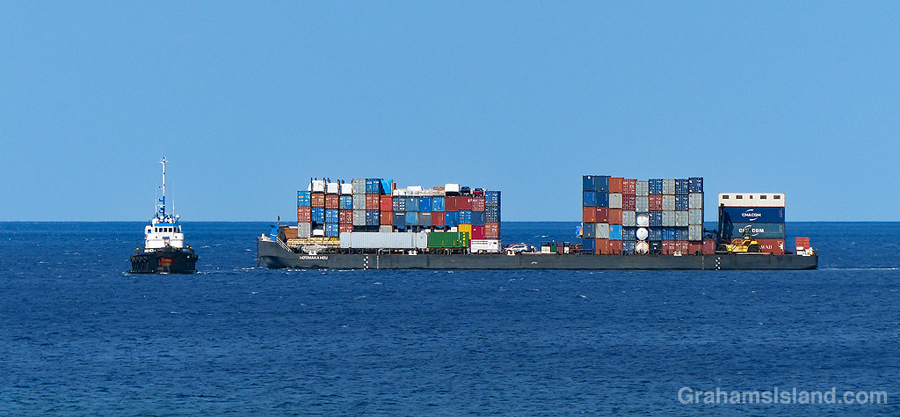
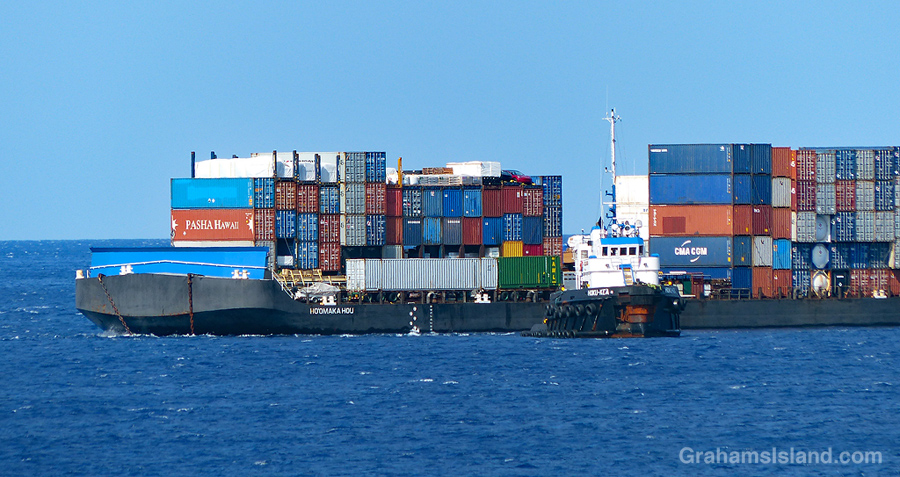

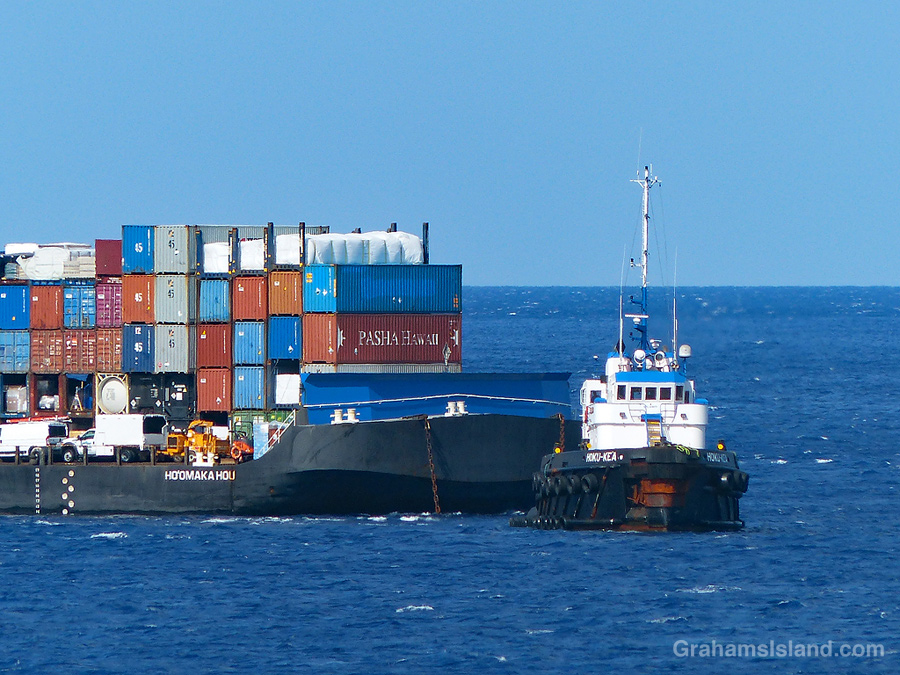
Driving towards Kawaihae, I noticed the inter-island barge a mile or two short of the harbor entrance. But instead of heading in, it was stooging around, going in circles or possibly figure eights. Clearly the harbor wasn’t ready to receive it. Still, there are many worse things that can happen than being obliged to make gentle loops off the coast of the Big Island on a beautiful sunny morning.
 Graham's Island